Tag: Basics of small business

  • The Four Stages Of Wealth Creation; From Clueless To Capitalist.

    The Four Stages Of Wealth Creation; From Clueless To Capitalist.

    Over the years of my practice and subsequent success/failures I have grown to appreciate the multifaceted reality associated with conducting business well. I have found that everyone puts their own spin on creating wealth or has a bias that bleeds through their approach to business. This isn’t bad it simply illustrates that there are many ways to think about and build enterprises. In some ways this is exciting and shouldn’t be a surprise. If business is fundamentally relational why wouldn’t personality weave its way through all aspects of it?

    So, here is our perspective of the stages one goes though as they break out of their business shell and begin their journey. Some people don’t mature very far or fast while others likely have matured well beyond what we propose.  

    Maturing is not a scholastic or purely cerebral occurrence. One matures as they put the reps in and flexes the related muscles/mind sets to grow past their comfort levels. You can’t learn to swim by reading a blog and you won’t master business without practice.

    This site exists to help anyone on their entrepreneurial journey no matter where they are. To do that we have put together a four-piece framework to outlines what you can expect. These stages embody the natural progression towards financial freedom. This isn’t to say that all people “aught” to mature further down the path but for those that want to here is what you can expect.

    The four stages are:

    1. Earn to spend
    2. Earn to save
    3. Earn to invest
    4. Invest to earn

    Earn to Spend (Awareness)
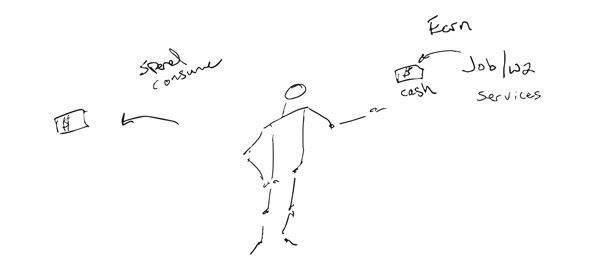
    When we get started in our free market journey, we are clueless but quickly realize that nothing is free. This little thing called money is needed to exchange for products and services. If you want a roof over your head, you will need to pay rent. For food on your plate, you will need to buy groceries. If you want warm food, you will need to procure fuel or electricity for the needed energy. In this consuming culture people earn to spend. Want more? Then you need to spend more. In order to spend more, you need to earn more.

    This seems straight forward but many people fall victim to the idea that if they don’t have the money, they can simply borrow from tomorrow to pay for something today. This idea has been written about a ton, so I won’t belabor it her. What I will say is that not only is this model a bad one to follow but the opposite of it is a great model to follow.

    Borrow from today to spend on something tomorrow.

    Wait,… what? In its essence the first step to wealth is simply putting off an expense now for the purpose of covering an expense latter. In a word: save.

    Earn to Save (Intention)
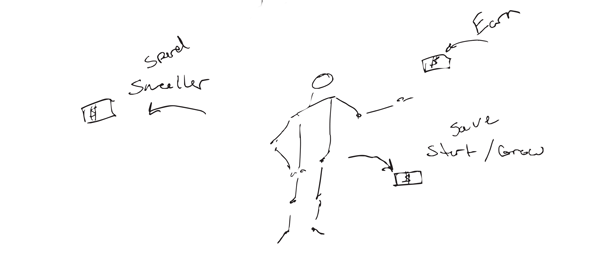
    When a person realizes that they either don’t earn enough to buy the things they want or that their earning ability may not always exist they begin to establish an earning buffer in the form of savings. Dave Ramsey’s popular first step in his plan is to save one thousand dollars. If you listen to him long, you will find that he is preaching to the idea that an emotional switch needs to be flipped and a self-control muscle needs to be flexed. It’s not fun, it’s not easy, but it is essential to move on down the path of wealth creation.

    As one’s savings grows so does their financial reach and ability to weather life’s storms. The monetary pressures of life don’t carry the weight they once did. Proverbs 13:11, and Proverbs 28:20 speak to this. Proverbs 21:20 illustrate the folly of the foolish and consequence of consumption. Saving is essential. Not spending is essential. 

    Earn to Invest (Strategy) 
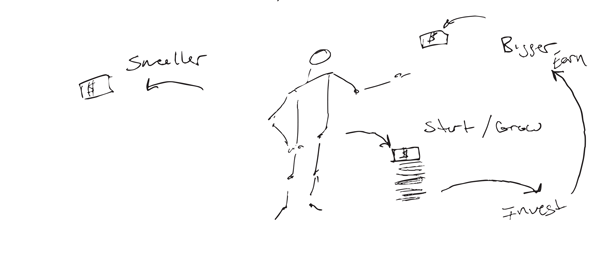
    Once you have mastered the ability to not spend and are sitting on a pile of cash you will find yourself with the burden of stewarding your accumulated resources well. Extra money is an extra recourse that can be poorly managed. What do I mean by this? On the assumption that you started saving for the end goal of wealth creation what you do with the money you earn is key.
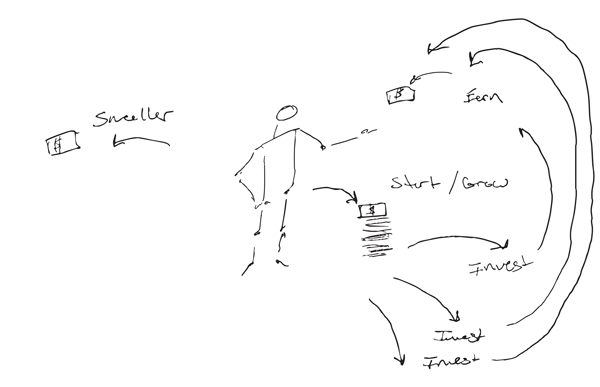
    What you do with your money will depend on many factors. Often spoken of in terms of risk and reward you will find there are many investment opportunities on a spectrum between putting your money under your mattress and heading down to your local casino. To be clear we don’t view gambling as investing, these are examples given in a spirit of levity. The point is you don’t want to sit on your finds and have them do nothing, and you don’t want to piss them away playing against bad odds.

    Invest to Earn (Wealth Building)
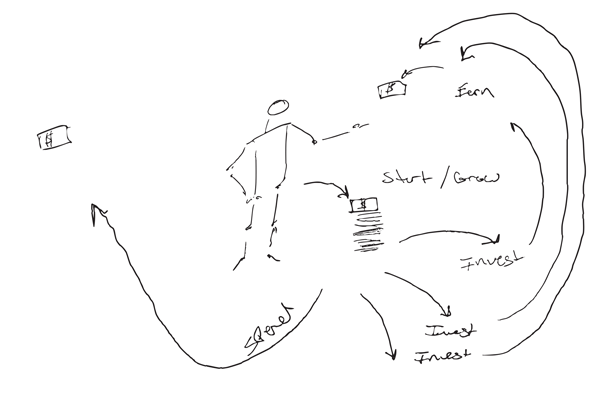
    At some point in your journey, you will find that your investments create taxable income and as such increase your tax burden. When this happens, you will begin to think differently about income, expenses, and taxes. Where money comes from, how it is accounted for, and what it is spent on all have financial consequences.

    The goal becomes controlling assets not merely owning assets. Your vehicles, phones, and other necessities will become the property of business entities which you establish. How you route business will be an art that you can spend the rest of your days leaning. Expenses that once were simply dollars out the window take a new light and become legitimate write offs or depreciable events. This is the land in which you will learn the secrets of building your net worth and refining your skills as a capitalist.  

    Each of these stages offers many rabbit holes to go down and gobs of information to get caught up in. we will unfold these niches through the site from different angles. Some of it you may already know and other bits of it will be new. The beauty of it all is that no matter where you are you will be able to find something that will help you take your next step. You won’t find a golden ticket or get rich quick solution, but you will find tried and true principles, examples, and illustrations.

    1. Earn to spend (awareness)
    2. Earn to save (intention)
    3. Earn to invest (Strategy)
    4. Invest to earn (Wealth building)
      • Starting a business in 2023
      • Purchasing through your entities.
      • Never ending journey of finding wealth channels
      • Business/Real-estate/Paper/commodities
  • Is Starting A Business In 2023 Going To Be A Good Idea?

    Is Starting A Business In 2023 Going To Be A Good Idea?

    No one knows the future so its tough to give a solid answer to this but what I can say is that starting any business at any time is a great idea if you do it the correct way.

    If you read through this site you will find many articles on all facets of business creation but the main idea we want to drive home is that much of what you need to know about business can be found by looking in the mirror. You are your fist business.

    People seem to think that starting and running a business is some sort of special action. Its not, at its core it is no different that much of what you already know. Now, there are a lot of facets to business and scaling an organization, hiring help, competing, and much more are all things you will hopefully deal with later but for now don’t make it out to be more than it is.

    So Why Do So Many Small Businesses Fail?

    In short, they are easy to start and hard to keep alive.

     Many businesses are established on the wrong premise or without proper forethought. I have met many people that say they want to start a business, but I have met very few successful business owners who said that it was easy. Every business owner I know that has done well has an ethic of hard work, stubborn persistence, and a knack for the market space they are in. In other words, if you want to do well in business you will need to find the right market to get into, the right value to provide, and strong desire to work through the tough times ahead. If you enjoy what you do, who you do it for, and like a bit of a challenge you have the makings of a successful entrepreneur.

    The Importance of Human Capital And Alignment

    A fundamental truth is that successful companies focus on their core competencies and work to meet the need of many markets. They don’t go outside of what they are good at. They compete on very few things, but they are best at those very few things. If this is true for the business, its true for you and I.

    What Are Your Core Competencies?

    By this we are asking what are you good at? What are the things you excel in? How are you geared as a person? What do people ask you to help them with?

    This may seem like a simple thing to answer but it is much more involved than you may realize. Even if you are good in some area we want to know if this area would be one in which you can compete in the free market.

    I’ll give you an example. When I started college, I thought that when you graduated you got some sort of golden ticket that guaranteed you a job so I may as well choose something I enjoy. I chose music. Over the course of two classes I realized that the people sitting next to me were cut from a different cloth. I may have been a decent musician, but I was a far cry from my classmates. In other words, if I was to go head-to-head against these people in the free market, they would have stomped me. I had a skill, I had a desire, but I didn’t have great enough of either to compete.

    I later found out that the primary career path for a degree in music is to be a music teacher. That was not something I cared to do.        

    How Will You Reach Your Target Market?

    If you are able to find a competence, where will you take that competence to solve other people’s problems?

    If you can’t answer this, I would suggest you have more planning to do. Its great to have an ability and desire for a business but if you don’t have access to a market, you won’t make it. In manufacturing for example someone can set up a machine shop but if they don’t have a market to serve, they will be hurting for customers. If on the other hand someone is the president of their local car club and active in classic car communities then they will only be a discussion away from their next project.    

    What Are The Financial Considerations Of A New Small Business?

    Out of the gate you will want to earn a profit as quickly as possible. If you borrow a bunch of money and have interest payments each month it could make this difficult. We are a proponent of a lean service-based business so that the initial capital requirements are kept to a minimum. We want the success of the business to fund its growth. We don’t want to presuppose any income will exist until it does.

    Service-based businesses will require very little overhead to start. You could get started as a virtual assistant with as little as a laptop and a few monthly subscriptions (internet/QuickBooks/etc.). Janitorial and window cleaning? A computer, a few subscriptions and a bucket of supplies. You see where I am going with this.

    What If I Don’t Want to Be the Person to do the Work?

    Um…I think you are reading the wrong blog.

    Your first business may not be your forever business, but you will learn a lot by getting out there, dealing with people, and adding value others are willing to pay for.

    Wherever you are on your income journey be sure to check out The Four Stages Of Wealth Creation; From Clueless To Capitalist. We put this together as a guide for those looking to grow their financial acumen and take their next step towards financial independence.

  • Earn To Save, Budgeting Personal Finances For Freedom, Flexibility, and Peace of Mind

    Earn To Save, Budgeting Personal Finances For Freedom, Flexibility, and Peace of Mind

    In the previous section we discussed How Saving Money Works and What it Will Afford You. If you have done this and have established a habit of saving you have begun the process of creating a personal budget that will give you freedom, flexibility, and peace of mind.

    Having a plan is essential and establishing/sticking to a budget is nothing more than following your plan. This becomes much easier when you know why you are going through the trouble.

    What Is the End Goal of Following a Budget?

    A budget does nothing more than allocate funds for specific purposes. They can be granular and strict, or they can be vague and loose. Circumstance and your end goal will determine how deep you need to define your spending. Someone in retirement is dealing with a much different reality than a student that just started college. Here we have someone with likely a fixed income and a short time horizon vs. someone with no income and an entire career ahead of them. Both can benefit greatly from a budget.

    Many government agencies in the US operate off of a budget and work to spend every last cent so they don’t lose funding whereas a bootstrapping startup works from a position of stretching every single penny they can drum up.

    The tool of a budget communicates the paths that the moneys will go in order to achieve your financial end goal.

    Curiously enough the less money you have the more likely you are to achieve your goal. This is because your “why” and desire is much more focused than someone who doesn’t have to worry about where their next dollar is coming from. In our piece Key Small Business Success Factors we explore this a bit further.

    Goal setting for your budget can consist of short-term and long-term Goals. In the case of a startup the goal is to make money, in the case of an individual it could be retirement. It could be as simple as a goal to pay for a family vacation, braces, or a new vehicle. You will likely have a large overarching end game goal and then many subsequent milestone goals along the way.

    Why Many People Don’t Follow a Budget

    Many people don’t establish or follow a budget for the following reasons:

    1. They don’t know how to write a budget.
    2. They don’t see a benefit in a budget.
    3.  A budget feels like a restraint.

    For those that don’t know where to start with a budget I can sympathize. It can be daunting to lay out all the transactions and decisions that need to be made around setting up a budget. The front-end effort of this can seem laborious and overwhelming. I have a harder time however with the people that don’t see the benefits of budgeting or who feel like a budget will hurt them. These people simply have not lived on a budget and are allowing fear of an unknown hold them back.

    How Do You Write a Personal Budget?

    As mentioned earlier, if you have put the effort in establishing a savings you have already taken the first step. Next, we want to outline the other main elements of common personal financial situations. A great place to start is with the 50/30/20 rule.

    The 50/30/20 rule simply allocates funds to three main areas. 50 is for 50% or half of your income to go towards your needs. 30 is for 30% of roughly one third of your income to go towards your wants. 20 is for 20% or just under a quarter of your income to go towards savings. Needs would be shelter, food, transportation. Wants would be entertainment. Savings we discussed previously.

    So, with a $1,000.00 dollar income we would see the following:

    • $500.00 for Needs
    • $300.00 for Wants
    • $200.00 for Savings

    This spread won’t work for every situation but is a great place to start. It allows for a person to take care of their fundamental needs, have some fun, and put money aside for the future.

    Benefits Of a Budget

    Getting a budget set up will allow you to know in advance if you have the money you need or not. How much can you spend on rent? Well, what do you have available in your budget? Can you afford that nice car? Well, do you have room in your budget? Is the trip you want to take a need or a want? Do you have room in your budget?

    A budget will change your spending behavior to align with your end goal. It will bring to light where you historically have been spending money that you didn’t need to spend. It can be quite liberating to find these areas and adjust them to see your financial situation improve. This will have its own effect of encouraging you to stick with your budget further.

    How a Budget Frees You

    Any time you address change one must address the risk associated with that change. It’s on this principle that I believe people allow their fear to keep them from budgeting. They falsely believe that introducing a budget will hold them back or make them feel stuck. This risk of being held back or feeling stuck is a false assumption.

    The truth is failing to plan is planning to fail. Cliché I know but it’s true.    

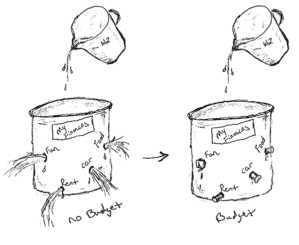
    When you start dialing in your spending you begin to find more and more ways to save. By virtue of this you plug the holes in your bucket creating more available funding for any purpose.

    A purpose such as that trip you wanted to take but just didn’t have the money for. Or, that purse that was so cute you almost couldn’t say no to. You now have a road map to get to these things without compromising your financial situation. You can make those previously “emotional” buys and feel good about it.  

    There is much more out there on the theories and practices of budgets, and I would hope you get those questions answered but, in the meantime, do yourself a favor and get a budget started.

    Wherever you are on your income journey be sure to check out The Four Stages Of Wealth Creation; From Clueless To Capitalist. We put this together as a guide for those looking to grow their financial acumen and take their next step towards financial independence.

  • Earning To Spend, How To Increase Your Income

    Earning To Spend, How To Increase Your Income

    The first piece of the financial equation that people often address is; how to make more money? Naturally this is where people start when making career choices and planning their futures. So, lets take a look at how we can influence the “money in” side of things. How can we bring more money into your situation?

    There are two main approaches to this question.

    1. Increase the amount of your income source.
    2. Increase the number of income sources.

    It really is that simple. Any organization that wants to increase its sales numbers will either increase their sales price or find more customers. Your situation is much the same. The one caveat that I will mention is that you likely will not be able to increase your earnings without adding additional value. What I mean by this is don’t expect to make more money by doing nothing. According to the interweb many seek to make more money without doing work and I can tell you that is simply lazy and stupid. Ask yourself: who do you want to give money to, the person that did something for you or the person that does nothing for you? Now, there are ways to achieve passive income but that is for a later discussion.    

    Increasing The Amount Of Your Current Income Source.

    For many that work full time they have a single income source in the form of a job. Many working professionals in this situation put in a lot of hours with a single employer and live off of those earnings. These W2-preneurs show up, add value, and help their employer build their bottom-line profits. If an employee doesn’t allow an employer to make more money, or possibly minimize the loss of money than they are not a good hire and won’t be working for very long. Each employee in an organization must contribute to the end goal of the company making more money now and in the future.

    Understanding this reality can position you as an employee to negotiate a better income. I have seen firsthand individuals critical to a company coast along and make at or below market average pay. This happens because some people are either happy with what they are earning or don’t realize they should be getting paid more.

    My first salary negotiation was much the same.

    When I started as an engineer I began as a part time intern, then moved to full time hourly, and finally to a full-time salary position. This process was not one that the company initiated however. I had to push this along. How did I do it? In short, I simply added value and demanded commensurate pay. As promotions occurred, I likewise negotiated offers and counteroffers. What I didn’t do is simply say: “Hey Mr. boss, I want more money!”.

    Get An Offer From Industry Competitors.

    If you want to find out how much you are worth, get a few offers from others in your industry. This is similar to finding comps in real-estate. How much am I worth? Well, how much is company A willing to pay? What about company B? You will find out quickly what others are paying for you position. I found myself asking this same question. Here I was with two undergraduate degrees, two minors, and sneaking feeling that I was worth a bit more than what I was being paid. So, I interviewed with another establishment and was provided a very generous offer. I didn’t take the offer however as I wanted to stay with my current employer. What I did do is inform my current employer what others said I was worth. Guess what, I got the raise. It also boosted my confidence. Having others say they will pay more for you is a good feeling.

    Quantify your value.

    If perhaps you don’t have the above option, go the route of quantifying your value to your organization. This can be a bit tricky as people seem to think they are worth more than they truly are. Remain objective when assessing your worth. Asking hard questions like: if I leave tomorrow what will it cost for them to not have me? How quickly will they find my replacement? How long will it take for someone to get up to my level of training? Hopefully you can nail down some hard numbers and put your value in black and white.

    If you can objectively communicate the additional value that you bring above your current job duties it makes it a lot easier for your manager to grant you a raise. Remember, who the decision maker is and make it easy on them. Do not use “I think I should get a raise” or “I feel I deserve more” this fluff will not work to your benefit. What does work to your benefit is: “My efforts in project X netted the company an additional $2,000.00” or “When I instituted and enforced policy Y the fall out has dropped 10% which conservatively saved the company $3,000.00 this year”. Hard facts and hard numbers will make it much easier for your employer to justify paying you more.   

    Increase The Number Of Income Sources.

    If you have already maxed out your current income source the next option to increase your income is to find other sources of revenue. Your additional income sources will likely be service based and not capital intensive. By this I mean you will be working, not renting out assets. As your asset base grows you will get to that point but in the beginning the hard truth is that you don’t have much more than your skills and time to offer.   

     You need more people willing to pay you for the value you offer. Assuming that you are working full time this will mean you have to find other part time jobs or alternative side gigs. These nighttime or weekend gigs can be a very quick and effective way to earn more money. I would put overtime into this same bucket.  

    If you can offer what you are currently offering your full-time employer to others part time this will likely be your greatest return on your time. After all you spend the majority of your time doing what you do, you better be good at it.

    If perhaps you are limited by non-compete or conflicts of interest, then take your skill set to another industry. Someone that makes cabinets for example may not be able to work for a competing cabinet company, but they could use their wood working skills to make other furniture. The point here is don’t limit yourself to only the domain of your nine to five job.

    Finding Your Work Life Balance, Why You Work

    All of this extra income is great but at some point, you have to ask what it is all fore. Unless you simply love to work all of this extra time sold to others will begin to wear on you.  You will need to find the balance that works for you. For some this will mean a comfortable 9-5 position and having their nights and weekends free. For others it could mean a period of time focused on earning so as to afford additional expenses or to eliminate debt. Having the reason for your money known and establishing your financial goals will help make these decisions. In subsequent articles we will discus this balance and ways in which you can work to the appropriate end.   

    Wherever you are on your income journey be sure to check out The Four Stages Of Wealth Creation; From Clueless To Capitalist. We put this together as a guide for those looking to grow their financial acumen and take their next step towards financial independence.

  • Top 5 Considerations for Small Business Success

    1. Business is simple; don’t make it more difficult than it needs to be. Having spent a lot of time studying organizations and business theory I am so surprised at how little of it makes its way into successful companies. This is especially true for smaller organizations. In the end a business fails because it can’t make money and a business succeeds because it can make money. To say it another way; Do the things that make money and quite doing the things that don’t make money. Simple enough?

    The idea of making money is an odd subject and one that seems people either understand or see as smoke and mirrors. For some people making money is something that happens after a slew of things fall into place and “magically” money finds its way into their account. For others there is a linear correlation; provide value and collect money. I have to admit I began as the former with the idea that making money was much more complicated than it really is. Even after being on the receiving end of transactions that were lucrative I questioned “can it really be this easy?”…Yes it can!!!

    The business theory side of me would communicate this as defining a value chain and operating lean. All that means is cut out the fat of your operation. Certain things you provide are needed and others are not. I would especially challenge you to question the things you see as adding indirect value. These would be the things that don’t make you any money but you feel are necessary because they are expected.

    2.  Effectiveness is more important than efficiency. This would be another area in which a small business can shine over a larger competitor. Often times larger organizations are so caught up in doing things perfectly that they lose sight of doing the right things. I have had the opportunity to work with a lot of big organizations and it would surprise you at how often they will forfeit their competitive advantage in the market place for the sake of their financial reports. In the article The Upside to Inefficiency I cover in a bit more detail where and when effectiveness should take precedence and when efficiency is needed. It may surprise you to learn that efficiency can at times do more damage than good.

    As an engineer I ran into this with quality groups that would hold up production because something wasn’t perfect. They identified a measurement or characteristic that was out of line and as they were instructed rejected the part. The problem was the measurement or characteristic that they identified had nothing to do with the form, fit, or function of the product. So they were putting the brakes on production for something that had no tie to the value the product provided. Don’t get me wrong I am all for constant improvement but when a quality group is given full authority over the big picture they will find the perfect way to run a company into the ground.

    As a small business one of your greatest assets will be the attitude to get things done. You may have to do things more than once or come back to the job site for a later fix. The sooner you can see it as an opportunity to strengthen your relationship with your customer the better. Being perfect is much too expensive for a small business. Your customers may not realize this but perfection was not what they were looking for when they called you up. They had a need and they simply want you to take care of that need.

    3. Keep an eye on your expenditures. Have you ever known someone to start a business and turn around the next day and buy a new car? There can exist a mindset that owning a business automatically means you have money. Sadly this is often not the case. Starting a business and running a successful business are two completely different things. Out of the starting gate you need to keep an eye on every penny and ensuring that you are not spending more money than you are making. If you can do this it won’t take long for your organization to grow to the point you dream.

    Don’t justify purchases because you can get a tax write off. We all want a nice work environment but buying a walnut executive desk would not be the best use of funds in your early stages. “ I can write it off” you say, well I don’t know what good a write off is to a company that doesn’t exist.

    If you don’t own a business or are just getting started take a look at your checking account. How have you managed it? The answer to this is exactly how you will manage your business. You are your fist business and I hope you have taken the time to budget accordingly and don’t find yourself at the end of the month wondering where all of your money went. If you don’t control your money it will control you. Keep an eye on where you spend and eliminate any of the spending that is not adding value to your company.

    4. Know your numbers. This may seem obvious but a lot of people don’t know if their product or service is making money. They are so caught up in putting out fires don’t realize they are the reason they can’t get ahead. When you do a quote or cost out your product you must know how much it cost and how long it will take to deliver. If you simply copied a number from the market or adopted what the other guy was doing you could be setting yourself up for failure.

    Additionally the more intimately you know your numbers the more likely you will be able to improve your company. There is a great example of Henry Ford utilizing the boxes that were used to ship him supplies in his automobiles. This is a great example of recognizing value in what others likely perceived as garbage. If you are in lawn care, how long does each lane take to maintain? How many guys are needed to do a lawn? How much gas is used? How many times a month does that lawn need attention? In one day how many laws can be cared for? How much weed eater line is consumed in a week/month/year? These are all things I would expect someone in lawn care to know and I don’t know much about lawn care.

    Knowing your numbers also allows you to make better judgments on the fly. In conversations with your customers you will be able to parse information very quickly and accurately to know when a job would be a winner or a looser. You will know when you are being competitive or when you are being conservative. If you have acquired a small business you will be able to identify the projects and customers that are loss leaders. One of the best business men I know could tell you more than anyone would care to know about his business because he minds the numbers.

    5. Buffer everything. In the end you cannot account for everything. Human behavior has a funny way of inviting murphy to every party. Buffers are very important when managing your customers’ expectations. Being strategic with your buffers will allow you to remain competitive and allow room for variability. In every case you want to be able to under promise and over deliver while remaining competitive. In the world of project management buffers are key to successful execution. An aggressive schedule with strategic buffers will outperform a loose schedule with no buffers every day of the week.

    Buffers can also help speed things up. If you know the amortized daily expense of an asset is say $98.60 you will be well served to quote at a cost of $100.00. This will speed up your quoting process and will give you a slight buffer on your expense estimate. This along with the prior point of knowing your numbers will equip you to cost things out quickly and effectively and in the world of small business this speed is key.

    These 5 principles are invaluable to the small business owner. Learn them, test them, and lean on them. I can assure you everyone reading this will benefit greatly by exercising these. If you have an example or a principle you have found helpful send us a comment and let us know your thoughts.

  • Key Small Business Success Factors

    Many factors play a role in the success or failure of a small business, but how can these factors be assessed across business types and how do we identify which ones are key? In previous articles we have addressed how businesses can compete relative to one another but here we will dig into the key factors that permit start-up and long-term success.

    Through the 80s, as the study of entrepreneurs and small businesses became more prevalent, it was recognized that a formal structure to describe venture creation would be helpful. William B. Gartner in his 1985 work ‘A Conceptual Framework for Describing the Phenomenon of New Venture Creation’ set out to establish such a structure.

    The goal is to identify the specific variables that describe how each new venture was created, in order that meaningful contrasts and comparisons among new ventures can be made.” (Gartner 1985, 701)

    As Gartner puts it

    The framework integrates four major perspectives in entrepreneurship: characteristics of the individual(s) who start the venture, the organization which they create, the environment surrounding the new venture, and the process by which the new venture is started.” (Gartner 1985, 696)

    Gartner’s first category the “individual” includes characteristics such as the need for achievement, locus or control, risk taking propensity, work experience, age, and education.

    The “organization” is the entity that is created and consists of the product or service, the customer contracts, licensing, focus, and resource usage.

    The “environment” is the external conditions outside the ventures scope of influence. Environmental factors include the available capital, skilled labor force, market accessibility, living conditions, and availability of supplies.

    Lastly the “process” is the behavior and activities of the individual. Examples of process would be finding a business opportunity, gathering resources, making the product, or marketing.

    This framework provides a common ground to compare the primary factors at a venture’s creation to the factors that play a role in the overall success. You will be suprised to find they are quite different.

    Key Start-up Success Factors

    The application of Gartner’s framework upon business startup was conducted by Marco Van Gelderen when he used the framework to assess the relative importance of factors in successfully getting a venture started. (Van Gelderen 2006). The empirical study followed 512 entrepreneurs over the course of three years and determined that there were three primary contributing variables in the startup phase.

    The first factor he found to be associated with startup success was the perceived risk of the market. In other words Individuals may or may not start a business given their perception of the risk associate with the venture. Van Gelderen points out that the actual risk may not be the same as the perceived risk but argues that a lower perceived risk will result in an earlier start to a venture.  Risk or perceived risk of the market would be considered by Gartner to be an environmental condition.

    The second factor associated with success at startup was found to be starting full time verses starting part time. Van Gelderen noted that starting part time is less risky but is also a sign of lower commitment. Starting full time assumes more risk but is also a sign of greater commitment. Individuals who started full time with a greater commitment are more likely to get their venture off the ground. Within the scope of Gartner’s frame work this would fall under the banner of an organizational factor.

    The last factor Van Gelderen cites is the early capital requirements. Van Gelderen noted that those who lower their capital requirements increase their chances of getting started while those who intend to use more startup capital have a lower probability of getting their business running. Capital requirements would be considered by Gartner to be an environmental factor.

    To summarize Van Gelderen’s findings in terms of Gartner’s framework, the primary success factors associated with getting a business started are (1) the perceived risk of the market, an environmental factor (2)starting full time verses starting part time, an organizational factor (3) the initial capital requirements, an environmental factor.

    Key Long-term Success Factors

    Once a venture has started the dynamics change and the factors that played a role at startup are no longer the primary concern. The study entitled ‘Why do Most Firms Die Young?’ by Robert Cressy develops a model to address the factors that contribute to success and failure in the first few years of operation and illustrates the exposure to risk through the life of a business. (Cressy 2006,111)

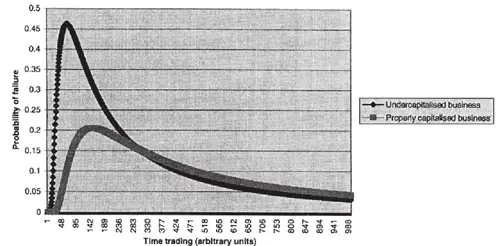
    Cressy defined the primary variables associated with life time failure probability to be managerial capital(Human Capital), financial capital, entrepreneurial risk aversion, and the decision on market positioning. Using these factors Cressy created a theoretical model to illustrate the risk distribution over the lifetime of a venture. His resulting distribution indicated that the peak of risk exposure exists within the first 18-24 months and then tapers off through the remaining life of the venture. The study also suggested that the appropriate initial startup capital, both financial and managerial, will delay and minimize the overall exposure a venture will face. Cressy’s distribution is illustrated in figure 5.

    Cressy, R., 2006, ‘Why do Most Firms Die Young?’
    Small Business Economics 26, 103-116.
    Figure 5

    Applying Gartner’s framework to Cressy’s findings the primary factors can be categorized as follows (1) managerial capital, an individual factor (2) financial capital, and environmental factor(3) risk aversion, an individual factor (4) market positioning, a process factor.

    Startup Vs. Long-term Success Factors

    Comparing the results of Cressy’s study to the results of Van Gelderen’s shows the difference between the key factors in startup and long-term success. Table 1 illustrates the comparison.

    Gartner’s Framework

    Pre Startup Success

    Long-term Success

    Individual

    II

    Organization

    I

    Environment

    II

    I

    Process

    I

    Table 1. Success factors and Gartner’s Framework

    From the studies we can make the following observations.

    • Long-term success is a function of four primary factors whereas startup success is a function of three.
    • The environment is the only factor that is considered in both startup and long-term success.
    • The specific environmental condition that existed in both cases was financial capital requirements.
    • The environment is the single biggest contributing factor associated with starting a venture.
    • The individual is the single biggest contributing factor associated with long-term success.

    This paints quite a picture, not only do the factors change from the startup to the long-term but long-term success is dependent on one more factor than startup. Additionally the individual is considered to be a large part of what makes a venture succeed but is not a primary factor at startup. This discontinuity between primary startup factors and long-term factors along with the high failure rate together imply that it may be easier to get a business started than it is to make a business successful.

    Could such a high small business mortality rate be due to the ease of getting a business started vs. the ease of making a business successful? What we do know is that the largest factor involved in long-term success is not required at startup and that the individual and financial capital requirements will always be a concern.

  • The Up Side to Inefficiency

    The Up Side to Inefficiency

    For the past year I have been trying to wrap my brain around the paradoxical relationship between effectiveness and efficiency in small businesses. I have understood that one can be effective without being efficient but I could not reason why. I kept thinking this was a reality that persisted in spite of itself and ultimately was not an appropriate one to accept. I was wrong.
    If you have been a part of a small business for any amount of time you know that disorder and inefficiencies are constant. Rework and second tries eat up potential profits all day long and yet the mode of operation continues. How can this be? Why can’t organizations get their act together and address the core issue leading to this waste? The answer may surprise you.
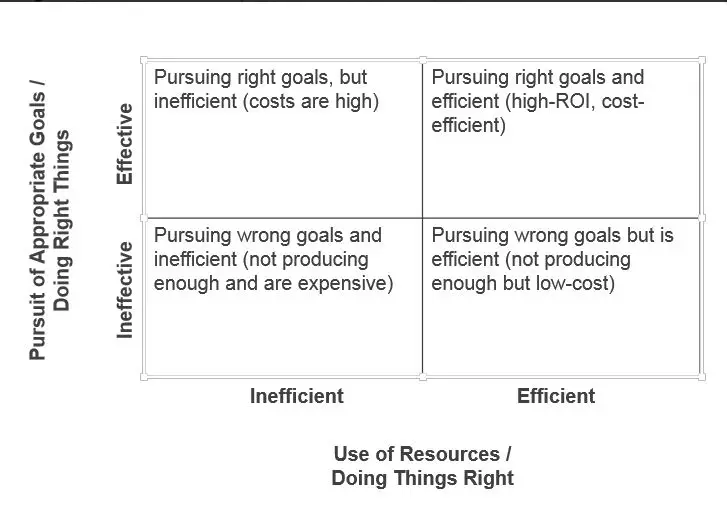
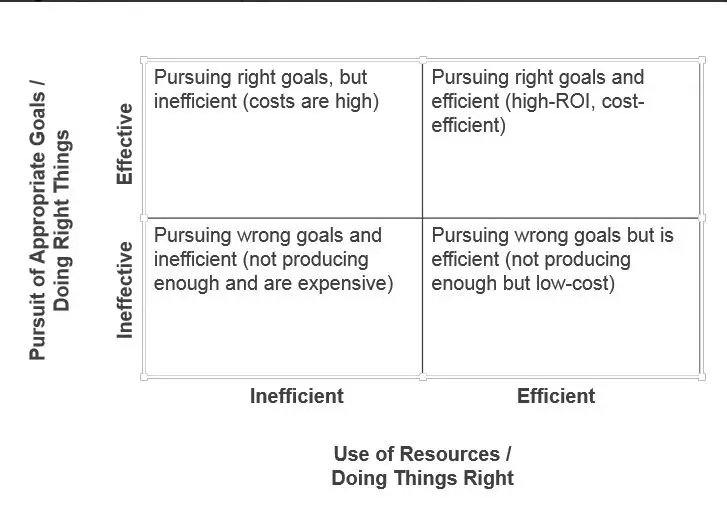
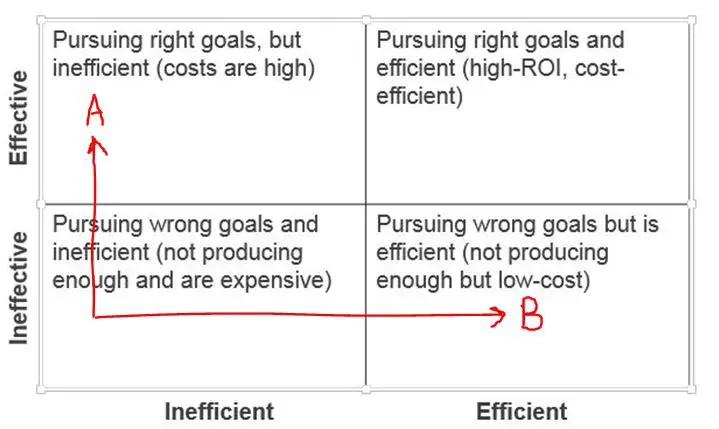
    While digging for answers I came across the following matrix which expresses the relationship nicely;

    I don’t know if http://www.insightsquared.com/2013/08/effectiveness-vs-efficiency-whats-the-difference/ was the original author of the image but that is where I found it. In the article they go on to explain the effectiveness is doing the right thing and efficiency is doing things right. This is rather straight forward and sounds very similar to the maxim: “Leaders figure out the right things to do while managers figure out how to do things right.”  I stewed on this for a bit to see if there was anything I could garnish to aid in reconciling the dichotomy. At first I saw nothing but it soon dawned on me that the conflict was less a conflict and more a rite of passage.
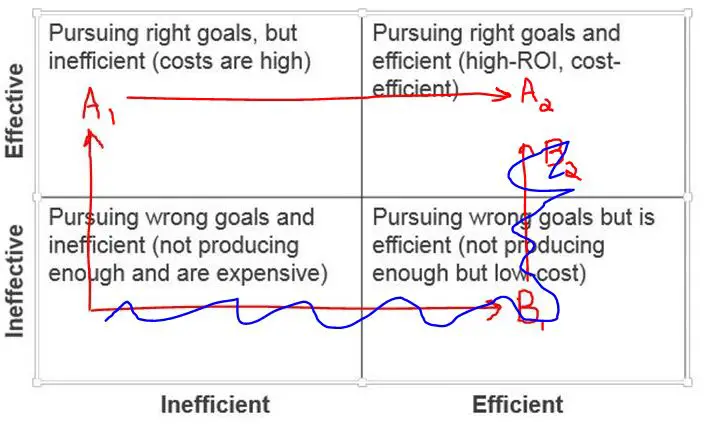
    Let us pretend that we are stating an organization and we begin at the corner of ineffective and inefficient. We have two paths to choose from; Path “A” leads us to the world of the inefficient and effective. Path “B” leads us to the land of efficient and ineffective.

    As far as this matrix is concerned companies must begin in the lower left and work towards the upper right. The question is how. To stay viable smaller organizations would be wise to first do the right things (effectiveness) before focusing on doing things the right way (efficiency). Large companies can focus on process improvement (efficiencies) because they have already established that they are doing the right things. Smaller companies on the other hand can’t compete on those fronts and by virtue of that have to focus on doing the right things (effectiveness). As a company grows the challenge becomes improving how one can be effective. Systemizing and standardizing while great for a large company can fundamentally undermine the agility that has provided competitive advantage to the smaller organization. There isn’t enough of anything when starting a business to justify spending time and resources on efficiency matters.

    In an earlier work: How To Measure Business Performance. Effectiveness Vs. Efficiency  I touched on this reality but I did not extrapolate the reasoning behind it. I have known that effectiveness took priority over efficiency but until recently I couldn’t articulate why without a long explanation. The premise of a small company fundamentally requires effectiveness to take the front seat. I don’t know for certain but I suspect if you did some digging you would find that the small business mortality rate could be tied to misdirected efforts to improve efficiency at the expense of effectiveness. People that decide to take path “B” end up doing an amazing job but their efforts are in vein.
    Another thing to keep in mind is that this process does not have an end. As a company matures the point of addressing efficiency will be different for each aspect of the organization. The need will trickle through as growth occurs. One year you may need to streamline your quoting procedures while the next you will need to focus on customer support. Don’t think this is a one and done arrangement. You will be following the A1 to A2 path time and time again. With each growth new issues will arise the will require another assessment.

    All of this is not to say practical efficiencies should be ignored. In everything you do you want to optimize your ROI but you don’t want to do so if it compromises your fundamental competitive advantage. I see a lot of people come out of college with a portfolio of process improvement training but don’t understand this reality. They are eager to prove their worth by squeezing the rag dry and completely miss the fact that most of the “process improvement” solutions they learned were only appropriate after the effectiveness of those processes was established.
    If you find this helpful at all leave us a note and continue the discussion. The comments that come from real world situations help everyone.

  • Island Economics

    Have you ever wondered why one company thrives while another fizzles? It is a question that I come back to on a continual basis. The more I process the factors associated with success and failure of businesses the more I realize the answers for both are numerous. I don’t like this. I have to believe there is an inherent simplicity underlining it all.

    How is it that a once successful business that was a world leader can crumble while a college kid and his roommate can create a huge venture out of lines of code? What are the sands that seem to shift under our feet, constantly changing the game that create an opportunity for one and mean doom to anther? This dynamic is constant and while I can’t quite put my finger on it I think I can demonstrate it through the following.

    I will do my best to illustrate where I am coming form with an example of a fake isolated economy consisting of two men on an island. I realize that in my example I may give into some traditional ways of thinking but for right now it is how I see it so bear with me.

    In an economy where currency does not exist value is present when one man has something another man needs. One could assimilate it to the potential difference with in an electrical circuit. In an electrical circuit electrons don’t flow until a potential difference exists. So long as both men on the island have everything the other has, there is equilibrium of value. It isn’t until there is an imbalance that value can exist.

    So, to create an imbalance let’s make one man big and tall and the other small and short.

    Now, in the day to day life of our two islanders both will encounter situations which the other is inherently better suited to handle. When this happens each man is in need of the other. For a moment each man is valued by the other. Equilibrium of value is once again established once each man assists the other equal number of times. If more is required of one man than of the other indefinitely we would consider that to be unjust if there wasn’t a correlative shift of debt. In other words one man would be habitually indebted to the other.

    In our fake economy business is simply the concert of maintaining the equilibrium. The imbalance is what many would refer to as a competitive advantage.

    Our real economy of course is not this straight forward. We have men and woman of all shapes and sizes, each with their own set of needs. This reality makes it possible for us to facilitate the needs of more than one person and consequently establish wealth. To think of it without currency; if we were to provide a service to 100 people we would have 100 people whom “owed” us their services in return, we would be wealthy. If no one needed the service that we had to provide we would be poor.

    I know this is a crude example but I hope it helps you understand where you can add value in your own situations. I see a lot of young zealous entrepreneurs who don’t seem to understand that value doesn’t simply fall from the sky; it is established by virtue of a potential difference. No venture is going to be successful until it can find a way to offer a product or service that isn’t already available.

    A great way to insure you are headed the right direction is to follow a pull strategy. Facilitate an unmet need that already exists. Rather than trying to force what you want to offer upon others, why not take some time to meet a need that no one else has met. This is one of my biggest concerns regarding many MLM businesses. People sign up thinking they have the world at their fingertips and don’t understand they are simply a marketing company competing with a bunch of other marketers to ultimately sell dreams. Without a potential difference or a fundamental value to bring to the table it becomes the job of the marketer to skillfully craft a sales pitch containing perceived value in order to expand their network.

    This idea of course is not new and years ago people began facilitating common needs. Companies that matured with their markets and made the appropriate changes over time are now leaders within their respective industry. However, if they don’t continue to adapt and change as the needs do they will lose their competitive advantage and an aspiring young company will rise up to take their place. This can happen more than you realize as companies become overly bureaucratic and lose the ability to compete with smaller businesses.  I hope you are that aspiring young company I read about next!

  • Reader’s Questions on Contemporary Business Issues.

    The following list was posed to me by a reader so I thought if this person had these questions others may also. Each refers to small business and the issue of growth. I left the questions as they were asked

    1. Are small to medium sized companies innovative needs, more crucial to their success than large companies?

    The level to which innovation plays a role in any business can be huge so it is hard to say under which paradigm it is more important. Innovation allows for greater competitive advantage regardless of one’s size, industry, or market. That said I would say it plays a larger role in the larger business environment for a few reasons.

    The first is that a small business by definition operates more on a service level. It is the speed and agility of a small business that give it an advantage. This service is generally not a cutting edge thing it is simply meeting the customers where they are to fulfill their specific needs. This means one does not have to be as innovative to bring customers in the door.

    The second reason I would say larger companies rely on innovation a bit more than the smaller business is the nature of the large business environment. The large business environment by definition is mature and does not allow much room for profitability (per unit). The products or services have been ringed down to their bare bones so every last cent is off the table. It is here that innovation can truly shine. Taking the old model and throwing a new spine or innovating can produce huge returns.

    2. Can you increase market share while staying small?

    The short answer is yes but this question suggests that the ability to step into a larger space exists. If you have a niche carved out and want to grow within this niche then increasing market share and remaining small can be a reality. If on the other hand one would like to step outside of their niche and grow their business through other avenues additional investments and external help may be required. It boils down to how quickly one wants to grow.

    Any business could grow to any level to serve any number of markets but how it does so depends on the paradigm it operates under. A small business has more of a flat organizational structure and generally has slower growth rate. A large business will likely have layers to their organizational structure, external investors and can grow quickly.
    One’s growth is subject to the resources available. Small businesses generally don’t have a ton of money behind them and can’t make huge moves in a short amount of time. A small business would also lack the network and infrastructure to attack a world market whereas a larger business may have these things in place.

    So, to answer the question; it depends on how you want to grow.

    3. What are some advantages and disadvantages to having stayed small?

    I have written two articles that I believe will answer this question.

    Advantages; The Advantages of a Small Business

    Disadvantages (realities); Small Business Volatility

    4. Is the product/service of a small company more prone to imitability?

    Everything can be copied, the value a business brings to the table is not simply the “What” but the “How”. A perfect example is McDonald’s. Most would say they could make a better burger than McDonald’s but very few can deliver their burgers around the world in less time than McDonald. By the time you drive up to the window your food is waiting for you.

    Think of the best burger you have ever had from a restaurant… now, which company do you think makes more money, the one in your head or McDonald’s?

    5. What is the ideal size of your company and do you believe that growth is inevitable?

    You need to be big enough to serve your customers yet small enough to keep your overhead low. Size is dependent on so many things that I believe it would be worthless to try and nail a head count or square footage down.  That said I think most would be surprised at how small a business can be and still compete on a big level.

    Growth is inevitable if you want the business to outlast you. In the short run any business can tread water without growth. Think of anyone you know that is self-employed. They are their business and as long as they continue to offer their product or service the business will exist. The second they stop offering their services the business halts. I maintain that growth is required if you want to see prolonged monetary success.

    I hope everyone got something out of the above and by all means if you have any questions let us know.
    TJ

  • Chaos Vs. Bureaucracy

    You may not realize this but as an entrepreneur one of your main functions is finding the balance between chaos and bureaucracy. If you take a look at successful organizations you will see they have somehow found a happy medium between these two extremes. It is this balance that allows organizations to flourish and will be required if you want to take your company to the next level.

    My first exposure to this dynamic came as I was trying to push a product line in an organization didn’t share my same directive.  The problem was that the product line required formal processes in order to continue to scale up but the organization as a whole operated on the “get-er-done” approach. Talk about frustrating, how is one supposed to facilitate the exponential growth of variability through putting out perpetual fires?

    This lead me to a book that gave me a new perspective on managing growth. The book was

    No Man’s Land: Where Growing Companies Fail.

    I enjoyed the book in that it helped me communicate my dilemma but a few assertions it made could be discounted by the now non-existent financial organizations it referenced to.  One exert that I especially appreciate was;

    “The resources and approaches that allowed for growth in the first place can be insufficient or an obstacle for growth in the future.”

    This is so vital to long-term success. Understanding organizational needs change with growth is huge. This begins right after startup and continues through each stage your company passes through. The book focuses on one significant stage referred to as “No Mans Land”. This is the point at which a company is too big to be small and too small to be big.

    So how does the size of an organization tie to the balance between chaos and bureaucracy? Generally speaking smaller organizations have fewer formal processes and operate under a flat management infrastructure. Larger organizations have more formal processes and operate under a hierarchical infrastructure. A deeper discussion on this and the small business advantage is discussed in the article The Advantages of Small Business. The balance however is not an easy one to find.

    Small businesses on the “Chaos” side of the spectrum have a great flexibility and agility to fulfill the customer’s changing needs in a moment’s notice but don’t have the ability to handle large volumes. Larger businesses on the “Bureaucratic” side have the ability to facilitate a common need over and over again at a high volume but lack the ability to change to accommodate a custom need. Too much towards Chaos and you will find yourself with a lot of waist, rework, and similar inefficiencies; too much toward Bureaucracy and you will find yourself buried in formalities, paperwork, and pointless meetings.

    So what is the answer? In short it is finding the right people. The intricacies of your business are known only to you and your people and they are the ones that will make the day to day decisions that will allow you to not weigh your organization down with bureaucracy while simultaneously avoiding excess chaos. To be honest with you this can be a hard answer to swallow, it means we need to trust and invest in people. If you are able to do this however you will find your life and business begin to operate at a higher standard.

    So, you have the right people and your company begins to grow so much so you now find yourself approaching “No Man’s Land”. This means you are faced with the challenge of making a leap forward from a small business paradigm to a large business paradigm. You have hundreds of customers, thousands of products and simply can’t keep up given your current infrastructure. What do you do? If you are a restaurant perhaps you head towards franchising, if you are a designer perhaps you create a proprietary line or product, and if you are a manufacturer perhaps you simply gear up to handle a worldwide market place. That is if you are willing to make the leap. As Doug Tatum mentions in his book making the leap may not be the best choice for you and your organization.

    What should you take away from all of this? Most of all understand that you won’t have all of the answers. Building a business is iterative and each step changes the game. You begin the learning cycle, build upon your intuition, keep the things that work, and get rid of the things that don’t. I would advise younger organization and entrepreneurs to simply dig in and work hard. A sole proprietor needs simply to push and push out of the gate and refine his or her game plane as the knowledgebase grows. Good business is meeting your customers’ needs it is not having immaculate paper work or flawless products. You will mess up but everyone does. Cater to your customer (within reason) and you and your company will have a bright future.