Tag: Basics of small business

  • How to Finance a Small Business

    When starting and running a small business the question of how to finance will come up multiple times. There is often an initial startup cost for assets, materials, and initial operations. As the business grows the demands on your company will change and you will again need to look at acquiring more resources. Depending on your industry the financial barriers will differ but there are some fundamental truths you should adhere to as a small operation.

    Importance of Cash Flow

    I can’t stress enough the importance of cash flow for your biz. It is the life blood of your organization and without it you won’t last long. You can have all the net worth in the world but if you don’t have positive cash flow your company is worthless. Think of your business like a bucket that has holes in the bottom of it. Your cash flow would be the water pouring in the top while your expenses would be the water pouring out the bottom. Without cash flow your bucket will run dry.

    This is a simplistic analogy because in reality you will find that both the flow of water into your bucket and the flow out of the bucket are in constant flux. So much so that your “flow” in will sometimes be more like a drip at the same time your bucket loses its bottom entirely. The ideal circumstance is to have an organization that maintains a constraint positive cash flow and empties its reserves into savings for future market fluctuations.

    Little Money in a Dynamic Market

    As a small business you fundamentally have to deal with having little money in a market that is constantly changing. Understanding this you would be wise to play into the strengths of small business while at the same time staying conservative with your spending. Small business market places don’t see large sums of constant income; they see peaks and valleys. This comes from seasonality and the inconsistent demand inherent to the market.

    To combat this reality it is advisable to find ways to diversify your services and build your customer base. This can be a fine line because you can’t be all things to all people. A landscaping company could do snow removal in the winter, a painter could do both residential and commercial work, or the machinist could create a proprietary product to sell online. The trick it to focus on the company’s core competencies and serve the markets they benefit.

    What to Expect the “J” Curve

    If you take a step back and look at the gross financial positioning of a successful organization you would see a curve that resembles a J. The J curve implies an initial expense and a gradual return on investment. The rental house I just completed for example required initial finances to purchase and fix. Once rented however the home will produce an income and begin to offset those initial expenses. The point at which you have earned the amount you have invested is your breakeven point. In the case of the rental house it will take many years for the income to offset the expense.

    Ideally you will want as quick of a turn as possible but it can take as much as two years or more to recoup your initial investment. As you plan you financing keep this in mind so you have an idea as to when you can expect the initial expenses to stop and when you can expect to see a trend begin in the other direction. Generally all companies get two years. If you are fortunate enough to have made it past two years you will have experienced the majority of the threats your business will ever see.

    More isn’t Always Better

    There have been studies that suggest that surplus financial capital can be a detriment to startup performance. The reason for this is that the more money one has the less intentional they are with it. Another illustration of Parkinson’s law – expenses expand to fill the budget allocated. This is also one of the reasons venture capitalists assume so much risk when throwing money at a venture. It is also the part of the reason they have “rounds” of funding.

    A perfect example of this dynamic is again our rental. I had originally planned on throwing 20 to 30 thousand at the property for the fix ups that were required but found a 6 moth zero % interest credit card with a limit of 8k. I though ok let’s start there and see what happens.  Having free money for 6 months is a pretty good deal; if it could cover everything then I could pull a loan out against the house (in its remodeled state) at a great rate and pay the card off. So that is what we did and the 8k limit made us much more intentional with each dollar. We actually ended up just over 7k for all the materials leaving 1k as a buffer for unforeseen expenses.

    We could have easily spent 20 or 30k on the project but because we only allocated 8k we made it work. I can think of many instances in which we hunted for a deal rather than purchasing something new at the local hardware store. In fact I think I could write an entire post on “how much we are willing to spend for conveyance”. Shopping at the local habitat for humanity saved us thousands but cost us a little time. We had the time to spend so it was no big deal.

    Sources, Where to Find Funding

    Now that you have chewed on a few considerations regarding how much funding you may need where should you go to find it? There are a ton of options so I will only touch on my favorite few.

    Personal Saving.
    If you can save what you need for your business I would suggest you do so. Operating off your own hard earned cash will yield the best return for each dollar spent. It also means that you will have no debt. Having not debt gives you a huge upper hand for obvious reasons.

    Family and Friends
    Personally I don’t like to mix family and friends with business but this can often be a great way to get started. This is especially true for younger entrepreneurs who don’t have the credit history or income to merit larger formal loans.

    SBA
    The U.S. Small Business Administration has a few loan programs that may be what you need. You will need to read up on them to see but the idea is they will operate as your advocate to help you receive adequate funding.

    Be Self-Reliant

    The most successful business men I know will leverage other people’s money but could pay off 100% of their debt if they needed to. If you can get into this position you will be sitting pretty. Banks tend to only lend to those who can prove they don’t need the money  so when figuring out how to finance your small business try to be the one that doesn’t need the money.

    The borrower is slave to the lender (Proverbs 22:7)
  • The Goal by Eli Goldratt

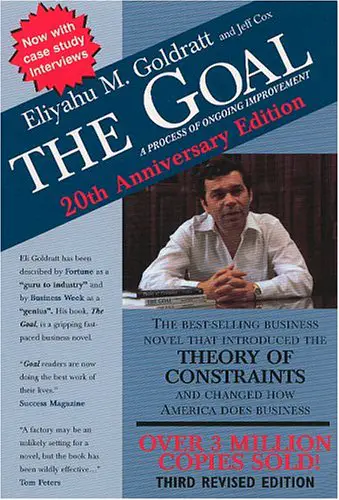
    Every practitioner of the Theory of Constraints (TOC) is familiar with “The Goal: A Process of Ongoing Improvement – 30th Anniversary Edition” by Eli Goldratt. The book is an oldie but a goodie with the first edition published in 1984. I don’t know that it was Eli’s first book but it is most certainly his most recognized work. In it he illustrates many fundamental concepts of TOC through the story of Mr. Rogo, a plant manager, who is fighting to keep his plant from going under. The nice thing about the book and the reason I think it has been around for so long is that the principles are presented in a non-esoteric manner. You follow Mr. Rogo as he works through his day to day challenges of optimizing his organization.

    I really appreciated the book because it applies a scientific bent to operational management. As a physicists, Dr. Goldratt was quite capable of applying the scientific method to the phenomenon’s found within organizations. It gained popularity because he was able to do this without losing the dynamic of entertainment.

    If you have ever experienced the strain of bottle necks in your organization this would be a good book for you. Pay close attention to Herbie…

  • How To Measure Business Performance. Effectiveness Vs. Efficiency

    I found myself in yet another interesting conversation with a successful entrepreneur on the topic of successful business practices. We were discussing what is needed within an organization as it grows from a mom and pop shop to a mature corporation. It is obvious that the demands of the company will change as it matures but how do we measure business performance? Other than the bottom line, what can we look at to know if we are on the right track?

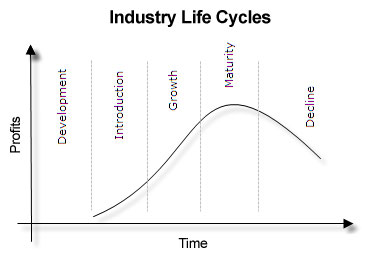
    Industry Life Cycle

    The answer to these questions will differ depending on your industry and where the industry is in its life cycle. There are many good articles out there discussing the industry life cycle so I won’t explore that here other than to say if you are in a more mature industry you will have your work cut out for you. Here is a quick look at the life cycle.

    (PHOTO)

    A small business generally competes in non-mature industries. The reason for this is that a mature industry has been around long enough to attract the attention of big players who will have deep roots. It is not impossible to compete in a mature market but keep in mind you will need offer more than you would if you were in a new or growing industry. In a mature market purchase decisions are generally made on preference rather than on need.  Think of Coke and Pepsi or MacDonald’s and Burger King. Arguably the products don’t offer a different value, they are simply preferred. Hint: when dealing with preference you start to walk down the road of brand recognition and huge ad spend. This is where big marketing companies can come into play.

    I explained the above to give you an idea of where you may be in order that you may know where you are headed.

    Decisions Decisions

    Back to measuring business performance. The core conflict that can arise in any stage of the cycle is pursuing efficiency vs. pursuing effectiveness. As an engineer I must admit my bent is to go after efficiency with everything from the start but that is not always the best course of action. The entrepreneur I mentioned earlier shared a story from early in his career.

    When he was younger and working for a successful business owner he found himself struggling with some hard decisions that would affect the company. The owner noticed him in his dilemma and said “Just make a decision. Do what you can and get things done. If you make the right decision 50% of the time you will move forward, if you agonize about each decision the world will pass you by. Now I’m guessing you will do better than 50%” From that point on my friend has been much more of a “get er done” type of guy and has built a multimillion dollar business.

    Fear of Mistakes

    It is my belief that our fear of failure pushes us not to feel ok about making mistakes. It is this fear that leads to the all too common “Paralysis by Analysis”. We may argue that it is for the sake of efficiency that we weigh and reweigh our options but I would suspect fear is the main driver.

    That’s not to say we should never concern ourselves with efficiency because it is quite vital for continued success. I would argue however that in a small business, initial efforts should be concerned with effectiveness while later efforts, once you are established, can address efficiency. Remember the life cycle above? The efficiencies and the cutting of the fat are not introduced until more players enter the market and the need to be efficient is required for survival. So, said another way;

    Initially a business or organization does not need to be efficient they need to be effective. Efficiency comes into play later when market demand requires you to sharpen your pencil or resource availability becomes limited.

    So, don’t worry as much about how a job is done as long as it gets done and doesn’t put you in the red. This takes a bit of intuition but a mistake can often teach you more than success on the first try which in turn build your human capital.

  • Part Time Money Making Ideas

    It seems most people could use additional money on the side so I wanted to share with you a few things I have done to give you some part time money making ideas. What are the two things we never to seem to have enough of? Money and time. I believe this is why many people look for ways to make as much money on the side as they can.
    If you are a stay at home mom, college student, or the bread winner of the family there always seems to be a need for more time to do the things you want to do and more money to afford to do them. I am no different which is why I have a few irons in the fire that I want to share with you.

    Making Products To Sell Online

    My first experience making money part time came in high school when I made products and sold them on Ebay. At the time I was into paintballing and had purchased a paintball gun that came with a silencer. I decided I wanted to know how the silencer worked so I ripped it apart and figured out how to make them for my friends and I. That lead to selling them online and equated to a $240/h rate. Now, I only sold a few silencers but the money to time ratio was great. Little did I know selling such items is frowned upon so the experience was short lived. If you have the talent and tools to produce a simple product you can probably make a few bucks selling them online.

    Making products is one of my favorite methods for making money. It is what lead me into engineering and offers a very tangible means to provide value. This is by no means passive but if you can find a good niche and provide a decent product I guarantee you can make some good money.

    Buying Domains

    I began buying domains in 2008 as I could see that the finite availability of Dot Coms implied value. I currently have 98 under my belt and have developed a handful of them. Each runs $7 to $12 dollars a year to hold onto so you can see how that can get expensive quick but once liquidated that $7 or $12  dollars a year can turn into thousands. I purchased one domain for $7.95 and was offered 12,000.00 for it the following week. Talk about a good return. Now, this is the exception not the rule. If you want to invest into domains understand it will take a good deal of time and effort to land a decent one. It cost me a lot of money to find out most domains have a gestation period. Additionally the changing landscape of the internet could have adverse effects. The “semantic” web could discount a domain portfolio. If you do decide to go forward with domains understand the return will be slow. My preferred registrar is GoDaddy.com only because it was where I started. There are many other great options out there.


    Rental Property

    While another long term investment, rental properties can offer great part time revenue. This of course requires a good deal of cash up front and usually a good deal of work but it can be worth it. Real-estate is one of the few things you can purchase that generally increases in value. This is because of the finite availability of homes and lots. That said real-estate also demands a long term strategy. It is possible to flip properties but you need to be on your toes if you are going to go that route. Additionally rentals require to deal with renters. For me this is no big deal as I grew up working on rentals with my parents but for other it could be a game changer.

    Developing Online Properties

    The most notable effort is the site you are reading. ShyEntrepreneur.com came out of the efforts in my master’s program to provide small, young, and home based businesses owners/ entrepreneurs with exposure to the formal ideas I have picked up along the way. The site is young yet (a little over a year old) and is positioned for growth. With the help of a small part time team I have compiled some resources that were designed to edify the reader base. To date the site is still in the red but our breakeven is just around the corner.

    Total time invested: not sure, a lot at first to get it up and going then roughly an hour or two per article. With 64 posts that is roughly at least 120 hours. This doesn’t include the 7+ years of school or personal experiences that preceded the site just the time put into making it happen.

    The Common Thread

    I don’t know if you have picked up on it yet but in short there is not easy get rich quick program or model that works. Everything that has ever brought in money for me has required hard work and time. Even so called “passive” investments require a good deal of attention to perform well. Don’t get stuck in believing you don’t need to work, you do and you should. The neat thing is a little bit of hard work can go a long way. All businesses require someone behind them strategically directing the organization and pushing the people to make each day a success. If you are your first business you need to accept that you will need to put in hard work to make any king of money either part or fulltime. I believe it is David Ramsey who said “to get to where few are tomorrow you must do what few do today. ”

  • Entrepreneurs, Take Advantage of the Business Cycle Phases

    Entrepreneurs, Take Advantage of the Business Cycle Phases

    I recently met with my financial advisor and our discussion sparked an idea for this post. I am going to discuss the business cycle and how as entrepreneurs we can better position ourselves to take advantage of the phase changes.
    The Business Cycle

    As you know there is an ebb and flow to our economy with times of prosperity and times of poverty. If you are not aware of this you need to open your eyes. The big thing to note however is that the cycle is just that, a cycle. No time of prosperity or poverty ever lasts forever. What does this mean for you and I? It means there are continual opportunities to position yourself and your business to make a profit. This is the strategy my advisor and I are following with my portfolio.  The cycle can be thought of as the following a Sine wave;

    This isn’t entirely true of course but it does illustrate the general rise and fall. The common approach is to break the cycle into four parts: Recovery, Prosperity, Recession, and Depression but, for the sake of this article I have broken the cycle into 6 parts. The image below breaks the cycle into 6 parts each found between inflection points. The idea here is that the inflection point denotes the beginning of a change.  “A” represents the recovery phase, “B” is growth, “C” indicates maturity, “D” can be considered to be a correction, “E” is decline, and “F” the beginning of the next recovery. This cycle as I said is not perfect but has roughly a 2-3 period.

    Why should you care? Just as an investor will change his portfolio for the coming economic land scape you can position yourself accordingly. For example companies that do well in recovery are generally smaller firms that assist in efficiencies. Doing more with less is the name of the game in recovery. IT businesses can find themselves in this group as IT products often allow for higher internal efficiencies.

    In the maturity phase (C) the companies that do well are the larger institutions that are less effected by the market landscape. These companies are often so big and so diversified that they never see large spikes in any regard. The law of averages keeps them on a steady path. For the entrepreneur this could mean moving away from the “want” areas of your industry and into the “need” areas. What is it that your customers absolutely cannot live without? How can you offer solutions that don’t focus on options but feed into the core need of a person or business.

    The time to position yourself or your company for each change is in the preceding phase. This will often be in the growth (B) and decline (E) periods. Some of you run businesses that can be easily tailored to these changes while others of you do not. Service based organizations can alter their packages to offer a better angle on the market whereas product oriented businesses may need to diversify their product line. Again, your specific industry and circumstance will need to be taken into consideration.

    Other Cycles

    Cycles are everywhere and if you are aware of them you can often profit greatly. Annual cycles that affect many industries are often tied to the weather. Construction for example often slows in the winter because of the snow fall in cooler climates. The warmth of summer is also a catalyst for the soft serve beverage establishments. In fact, because I live in a 4 season area I decided against opening a self-serve yogurt shop in 2008. I watched a few similar establishments go under because they couldn’t carry an overhead through the winter months. If I were to have moved forward I would have had to offer more than frozen yogurt and I didn’t want to go down that path.

    It would also be advisable to change your buying habits such that you purchase items in their off season. I haven’t tried the following but I have often wondered how much money one could make if they simply purchased lawnmowers in the winter from Craig’s list and sold them in the summer. The same could be done for snow blowers, picking them up in the summer and liquidating them in the winter. Doing this would exploit the cyclical nature of the demand that follows the weather. Of course this would require you to hold the items for half a year or so but I think it could pay off.

    Out of Phase

    As Warren puts it; “you should be fearful when others are greedy and be greedy when others are fearful.”  This phrase speaks to the idea of setting yourself apart from the rest and positioning yourself for the effects of group think. You want to stay out of phase with what the majority of people are doing. Staying ahead  of the curve often means not adopting what everyone else has adopted. Find a unique angle and go with it, don’t model your approach after the market you will be lost in the masses. To read up a bit more on how to set yourself apart check out The Competitive Advantage Spectrum.

    The dynamics we are talking about also hold true on the business to business level. Companies that sell out to other companies often do so because they plaid into the masses. By playing into what everyone wants you will water your business down until you find yourself in a financial crisis and in need of someone to bail you out. Pricing wars can quickly lead to this. If a competitor is selling a product for less than what you can make it for you are either in the wrong industry or your competitor won’t be in business long. Dropping your price to meet theirs will only lead them to do the same and ultimately lower the expectation in the customer’s mind of the price for your product or service. This is one of the reasons why I tell all small business owners never to compete on price.

    Conclusion

    Play your own game. Take the cycles of your industry into account but don’t allow them to shape your business. Just because your customers want to pay less doesn’t mean you need to lower your price. There are many creative ways to meet the coming changes but you will need to step outside of what everyone is telling you and find a unique position that has not yet been exploited.

  • What is The Importance of Human Capital in Small Business?

    A series of conversations has prompted me to address the importance of the human element as it pertains to small business. It seems as though most understand the importance of financial capital and overlook the role human capital plays in successful companies. I find this interesting especially because the significance of human capital can arguably be greater the smaller the company.

    Why you ask? In short, as companies grow their paradigm changes such that they have many people who know a lot about a few things (the specialists) whereas a smaller company requires fewer people to know a little about everything (the generalists). Ideally an organization wants to find employees that fit both profiles. People that know enough about the big picture to better preform at their specialty and people that know enough about the specifics to better manage the big picture. Owners of small business don’t have much say in the matter, they are forced to know both by virtue of the fact that they cannot afford to bring on much help.

    What about creating specialized generalists? Training the few employees you can afford to excel in all areas resulting in a smaller skilled labor pool rather than having a bloated workforce of general laborers? This approach would be quite contrary to what is commonly practiced. Putting much stock into employees is often viewed as a good way to corner a business if anything happened to them or to the relationship. This is unfortunate. I maintain leveraging ones human capital can prove to be more profitable than discounting it to the point of making employees easily replicable. Now, I’m sure there are instances where easily replicable labor is desirable but as a small company the more you can lean on your workers the faster you will find business success.

    By having a well trained workforce you will also allow be positioning yourself for a stronger competitive advantage. As we mentioned in The Competitive Advantage Spectrum a small business should be set up to provide a quality solution in a short amount of time. This is because a company’s ability to respond to its customer’s is directly tied to the human capital at all levels of the organization. Think of the last time you called a tech support line and were redirected to an overseas call center. How quickly was your problem resolved? Was it resolved? It is not that the call centers can’t point you to a solution but if you could talk directly to someone intimately familiar with the product you are calling about you would have a much faster and more pleasant experience.

    Human Capital Needs to Add Value

    You will be doing yourself and your customers a disservice if you subscribe to the idea that some roles in your organization don’t require trained employees. All employees need to add value to your organization beyond their daily tasks. The more everyone in your company knows the better. An example of where this isn’t true can be found in procurement departments all over the place. You would be surprised at how often purchasers buy the wrong items simply because they don’t have a grasp of the big picture. Often times finding the lowest price takes priority over buying the right items. This dynamic will play out anytime you thrust an untrained individual into a role that requires preexisting understanding.

    A good progression begins by starting someone out on the basics and moving them up as their understanding grows. This even holds true at the professional level. Green college graduates can’t hold a light to a non-formally educated employee with years of experiences. As a business owner you need to recognize that if you are not an expert there is a good chance your company could be in trouble.

    Design Vs. Quality

    To illustrate the point further think of a master craftsman who has been making wood odds and ends all his life. Now, someone comes to him and asks “hey mister, would you build me a guitar?” to which he replies “no problem”. Some time passes and our master craftsman finishes his work and presents it to the customer. What would you expect the end result to be? Well, unless our master craftsman had a preexisting understanding of how to build guitars the final product would probably not be what the customer had in mind. It could have the highest level of “quality” and be a beautiful product but it could also lack greatly in the area of Design. Positioning of the frets, the shape of the neck, and the acoustics of the body are all design considerations that require a deeper level of understanding than simply wood working. If this same request was given to a trained luthier not only would he know the correct shapes and positioning he would also probably know which woods would work best given the time of year and geographic location. The point is the intent or purpose of a product needs to be fully understood.

    Managing Human Capital in Growth

    There is no cut and dry answer to managing human behavior but much of the issues you will come across can be circumvented by simply hiring the right people. By that I mean find people who are characterized by their hard work and integrity. In his book Good to Great: Why Some Companies Make the Leap… and Others Don’t , Jim Collins refers to this dynamic as getting the right people on the bus. He says it doesn’t matter if you don’t have a job for them, if you come across a quality individual get them on your team and figure out the rest from there. The right people will bring your business to new heights, the wrong people will hold you down.

    Conclusion

    Small businesses must leverage the human element, not discount it. There is a lot to gain from the skills of your workers if you are willing to put the ball in their court. That said you must also be willing to compensate them accordingly. A justifiable wage should accompany quality talent.

  • 5 Steps to Start a Small Business

    Steps-to-start-a-small-business

    With everyone talking about the economy I decided it would be a good idea to discuss an approach to small business that if followed would minimize the number of failures. These 5 steps to start a small business provide a solid foundation to any venture and should not be ignored. It is in the success of small business that the economy finds its strength so, take notes.

    1. Take a Look in the Mirror

    When thinking about starting a small business the first thing one should examine is their personal financial situation. You are your first business and the way you manage your personal finances is a reflection of how you will manage the finances of your business. If your personal finances are in order and you make more than you spend, you are probably ready to begin thinking about other business ventures. If on the other hand your situation is the other way around and you spend more than you make, I would suggest that you get your situation turned around before venturing into the world of small business.

    The management principles that lead to financial success on the personal level are the same principles in the business world. If you are employed you are providing a service to your employer and in exchange they are compensating you with a salary or an hourly wage. Think about this for a bit, you are already playing the small business game. Where are your week spots? Are there spending issues? Why are you looking to start yet another business? Examining your current situation with this perspective will give you an idea of what to expect if you were to get another business off the ground.

    2. Understand the Small Business Marketplace

    Before getting started make sure you understand Small Business Volatility. The most notable characteristic of the small business marketplace is its resistance to success.  The fact is the majority of small business startups will close their doors after two years of operation. If you don’t take note of this reality you are positioning yourself for failure. One of the biggest contributors to this reality is the fact that small businesses generally don’t have much money behind them and businesses fail because they don’t make enough money to cover their expenses.  In other words the small business marketplace is a marketplace averse to error. One must know where each penny is going and how each penny will help the bottom line.

    That said, there are advantages to small business. Being small means you are flexible and fast. You won’t have the layers of bureaucracy to slow you down when you need to make a decision or change something up. Leveraging this reality can afford you opportunities that your larger counterparts cannot act upon.  Commonalities exist among the small business and large business paradigms but keep in mind a small business approach will not work in a large business environment, and a large business approach will not work in a small business environment. Most consumer based organizations that we are accustom to follow the large business paradigm so keep yourself in check because a Wal-Mart approach to a custom boutique is a recipe for failure.

    3. Begin with Service

    Outside of yourself your first small business should be service oriented. There is a smaller financial barrier of entry for service based businesses than there is for product based models. This means you will reach a break even faster than you would if you decided to go with a product based model. Think about a janitorial agency. The startup costs would be rather small, especially if you had supplies you could use around the house.

    Additionally many service based business are better suited to handle fluctuations in demand. Market fluctuation can be killer for smaller organization. A service based model can have its expenses tied closely to the actual delivery of the service. This means unless you are providing the service, you are not incurring costs. There will be some overhead but not as much as there would be in a product oriented environment.

    4. Be Willing to Change Direction

    I have heard it said that companies change their focus an average of 5 times before they find success. As you begin to fulfill a need your intuition on that need will grow, as it does allow it to direct your company. Microsoft for example began in traffic analysis hardware, not software. There is freedom to try multiple directions (one at a time) to figure out how your company can best add value. Eric Ries in his book The Lean Startup: How Today’s Entrepreneurs Use Continuous Innovation to Create Radically Successful Businesses calls this “the pivot”.

    5. Dig In and Get to Work

    These precautions will safe guard you tremendously as you pursue each business venture but they are worthless if you don’t act. In order to make you business work you will have to work… a lot. A common trait I have witnessed among successful business men is their drive to get things done. They don’t sit around and wait for this or that, they figure out what needs to be taken care of and take care of it. The journey doesn’t have an end, being a business owner is a continuous effort to perpetuate your organization. If you don’t eat and breathe your business chances are you will play second fiddle to someone who’s passion is the business you claim to love.

    I hope you find this helpful. I know may people want to know How To Make Easy Money Fast, which can be done, but not continually and not with a small business. Business is hard work that will take time to produce fruits but trust me when I say diligent effort invested into a focused business will pay off handsomely in the time. Remember, the small business is the heart of our economy and anything that can be done for the sake of small business is a cause worth pursuing.

  • How to Increase Profits in Business

    In discussing profitability we are effectively discussing the efficiency of a business to make money. In other words, how can we squeeze a little more money out of the existing establishment? This topic is well worth discussing as most people find themselves in need of small business financial help. There are many effective ways in which this can be done but before doing so you want to make sure your efforts won’t be in vain.  The following considerations will help you to identify root issues that may be leading to your initial question of how to increase profits in business.

    When to address profitability?

    Addressing profitability should be addressed at startup and again after you have passed the survival phase.  I discuss the phases of business development in the article; Small Business Volatility. The short of it is there is no point working on your profitability if you are not sitting on a proven business model. If you find that your model is not one that will fly in a small business environment than profitability is not your problem, your premise is. Upon such a discovery you should immediately pivot your focus to an approach that works with small business. If you are sitting on a proven business model than your next concern will be market positioning.

    Adjust Your Market Positioning

    First things first, be sure you are playing into The Advantages of a Small Business. Small business should already have a fairly healthy profit margin. If this is not the case you may want to look at your market positioning. Make sure you are not using a large business approach in your small business environment. This adjustment alone can turn your company around in record time. Profit per order will see a huge increase, your customers will love you, and you will no longer be pulling out your hair trying to figure out how to pay the bills while pushing tones of product out the door.
    As a small business you should not compete on price. Small businesses should be competing on quality and lead time. If you are already positioned to compete on quality and lead time than the hurdle simply becomes acquiring more orders. This is accomplished by letting the market know you exist through various marketing efforts.

    Up Your Marketing Efforts

    You don’t want to spend much if anything on this so you will need to team up with local organizations and co-sponsor events. In many cases a donated widget or two will buy you a booth for an event that draws in hundreds to thousands of people.
    If you are having trouble finding events figure out how to hold one yourself. If you go this direction I strongly suggest you approach a local TV or radio station and ask if they would like to co-sponsor the event with you. If you can get them to bite they will run adds in their dead time promoting themselves and your event at the same time. Once you are able to increase your exposure what you will find is many people already know you exist, they simply were not aware of your current products or promotions. This leads us into one of your greatest pools of potential customers.

    Approach Existing Customers

    One of the largest pools of untapped income is consistently your existing customer base. Think about it, if they purchased from you once they are highly likely to do so again. Take your customer list, which I know you have, and shoot out a promotional email and see if you get any response. It would be prudent to record which customers purchase, these are your gold mines and will probably continue to buy in the future.
    If you don’t have a customer list start putting one together. Most database applications can output this information if you have been using something like QuickBooks. For those of you who may have customer lists but they are small, start gathering potential customer information through free giveaways or on your website. The one that always makes me laugh is the fitness club giveaway that says “Sign up to win a free week at our gym!” you know that they call each and every name entered into the drawing. On top of that they probably already offer a free week to every person who signs up.

    Ask For Referrals

    Many of your existing customers may not be willing to make another purchase right away but they probably know someone else who will. Ask them if they know someone that could benefit from what you have to offer. Personally I would have no reservation pointing a supplier in someone else’s direction. It gives the supplier another potential lead and allows me to feel like good about myself even though I decided not to purchase anything that day.

    Increase Your Baseline

    Finally, if you have tried all of the above, the last thing to do is raise your price. I will assume that you price was already acceptable to your market so you will need to justify this increase. The two big areas that will without question justify a price increase are your quality and lead time. Higher quality and faster turnaround times inherently demand higher price tags. An example would be a custom wood worker guaranteeing a finished product in one month at an additional cost. Or, a seamstress could double stich an entire article of clothing for 20 additional dollars. These small incentives will obviously be specific to your situation but you get the idea, added value at a slightly higher price.

    Wrap up

    I hope that gives you a few ideas on how you can squeeze a little more out of your organization. The hunt for further profitability is one you should never stop pursuing. You will find some products or customer’s seem to be more trouble than they are worth while others are simply a dream. As you identify your cash cows you want to focus your efforts in their direction. You can’t please everyone so you may as well work hard pleasing those that can be pleased.

  • Maslow’s Hierarchy of Needs for a Small Scale Business

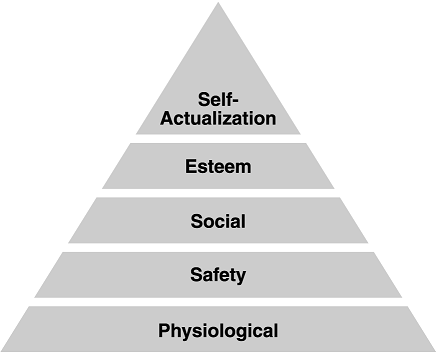
    For those of you who don’t know, Abraham Maslow published a paper in 1943 titled “A Theory of Human Motivation.” In this work he established a hierarchy of needs that he argued was fundamental to all humans.  The structure of his hierarchy is often portrayed as a pyramid with the more basic needs making up the base and the less essential needs towards the top. The needs in order are:

    1. Physiological
    2. Safety
    3. Love/belonging (social)
    4. Esteem
    5. Self-actualization

    Personification of Business

    You may be asking yourself how in the world a personal hierarchy can apply to a business. Businesses are an outpouring of their founder and as such carry many traits found in the individual. If you look at any company, large or small, you can trace its origin back to a person or a small group of people.  Additionally, the company was built to fulfill a need that others have, making it very much a relational entity. In short, you are your first business. I may explore this truth a bit more in future articles, but for now the above correlation is sufficient.

    Physiological Needs of a Business

    For the individual these are the literal requirements for survival; for the business this would consist of an audience, a need to fulfill, and a value proposition. If any one of these is removed a business will wither and die. The business is sustained through fulfilling the need of a group of people by posing its value proposition. Growth will come in the form of compensation.

    Safety Needs of a Business

    The safety needs of a business tie into how far away a company is from going bankrupt. This displacement is a function of how competitive the company’s value proposition is, how diversified its portfolio may be, and how much cash it has to weather unforeseen storms. The only threat to a business is its inability to turn a profit. So, anything that jeopardizes this would be in conflict with the safety needs.

    Social Needs of a Business

    Individuals realize love and belonging needs through friendship, intimacy, and family. A business is no different. Once a customer-supplier relationship is established through customer acquisition, the business must continue to invest into each customer in order to grow the relationship. A competitive advantage can bring new people to a business, but the relationship that is established is what will keep those people coming back and referring others. Said another way, the love and belonging needs would be the market’s acceptance and perception of the business as a member of their respective community.

    Esteem Needs of a Business

    For the individual, esteem needs speak to the desire to feel respected and to have a good self-image. For the business, the fulfillment of this need is made evident by expressed industry standing or awards. Awards and being number one in an industry may win over a few customers, but they are not required to turn a profit. This is why the esteem needs are further down the hierarchy. Having these fulfilled will help the business as an entity feel good about itself but are not required for survival. A company with a high collective self-esteem will cultivate a positive culture among its employees, which in turn will bring about more successful ventures.

    Self-actualization Needs of a Business

    Self-actualization is the fulfillment of one’s own potential. Companies that seek this fulfillment are the ones who so exceedingly meet a demand that they create new markets and innovations. Apple would be a prime example of self-actualization being fulfilled. In everything Apple has done, they have pushed the limits of how people create with technology. Steve Jobs directed the company towards excellence by helping people create in ways they could never achieve before.  Consequently, the iMac, the iPod, the iPhone, and the iPad all played a big role in the introduction of new markets. The self-actualization need of a business is tied tightly to the man steering the ship. The CEO of a business will dictate a company’s direction, which may or may not be towards self-actualization. CEO Steve Jobs led Macintosh through each of its largest innovations, but when he left, it began to lose its way and market share. Upon his return, Macintosh quickly returned to its initial direction and to profitability.

    Conclusion

    As an entrepreneur or small business owner you would be wise to realize the organic nature of the business you conduct. Businesses are living entities with needs that, if not met, will perish. If nurtured, however, they can grow to unprecedented levels, reaching and affecting the lives of many. As an entrepreneur, I know that there are many things on your plate, but I would challenge you to filter through the noise and find the one thing that you know you can do exceedingly well. It will be in that focus that you find your true genius.
    I have discussed another benefit to focusing your efforts in the article titled Successful Habits. In it I explore the ramifications of spreading yourself thin and the inefficiency of multitasking. When I learned this principle, my world changed, and everyone I have shared it with has also found it extremely helpful.

  • What Is In A Name? What You Need To Know When You Name Your Company

    One of the hurdles you will undoubtedly run into when starting up a small business is choosing your company name. The quick and easy advice is to find something catchy, relevant, memorable, short, and unique, but I don’t want to leave it at that. What you call your company is very important and there are many reasons why. Follow me as I address considerations that may not have crossed your mind.

    Just as with you product or service, the first thing you want to think about is your target market. Your customers will care more than anyone about your company name. Your target demographic and market positioning should be well-defined; if they are, you may be able to fit your primary competitive advantage into your name. This will help your customers visualize the benefit of your business.

    Think about the idea you want to give people: You want to sound like you know what you’re doing right? A funny name may be fitting for a dog kennel but would be less fitting for a law office.

    For ideas, you can start by looking at your competition. Each industry may have a common convention or approach to company names. As an example, it is often easy to tell when a company is related to computers and technology–they often incorporate things like “Sys” or “Tech.” Ohh… SysTech… I wonder if that name has been taken?

    Appropriate Scope

    Don’t’ be too narrow or too broad in scope. If you are starting up a landscaping business, you may want to focus on just lawns. If that is the case, a name like “Lil’ Jimmies Lawn Care” may be appropriate. If, however, you are into moving dirt and want to focus on commercial accounts, a name like “Rocky’s Landscapes” may be a bit more fitting.

    Keep in mind where you will fall in directories or the phone book. Names starting with numbers or letters at the beginning of the alphabet may be desirable. AAA services vs. ZZZ Services. This concern is becoming less and less of an issue as we move towards a semantic web, in which case descriptive words will carry more weight.

    Keeping It Local

    It is advisable for local businesses to adopt a title associated with their town or city.  Doing this builds instant rapport and credibility as well as a sense of community. Google has been very intentional to list local companies when searches are made regarding local services. New York Window Cleaners may rank well for a search such as “window cleaning services” made in the New York area.

    Can it be abbreviated? People will naturally shorten the name. Pink Puddles Dog Care becomes the Pink Puddle.

    To Build or Not to Build a Brand

    Building a brand name = money, money, money. Regardless of what name you choose, building you brand will take a good deal of time and money. Most small businesses won’t need to worry about brand recognition, at least initially. Brand recognition holds more weight in highly saturated markets. Smaller firms by nature won’t be competing in highly saturated markets.

    When everything is said and done and the dust settles, the name means nothing if you don’t have a good product or service. Your product is your greatest advocate, so be sure to push a product or service that you believe in. Success will be knocking at your door if you have a business that exists to fulfill a true need.

    Lastly, before you decide, get a list of many possibilities and compare them to each other. Have anyone you know that is familiar with the industry give their opinion. Seeking the thoughts of others is always a prudent move.

    If after everything above you are still stuck, you can try the method used to come up with domain name variants. I did not come up with this complete process on my own; it is a compilation of my own method and ones adopted from others.

    The Matrix Method

    Set up a matrix in Excel, on a sheet of paper, or a whiteboard. Start with 5 columns and 5 rows. Grab a dictionary, thesaurus, and Google.

    In the first column write down all the words associated with your business. When you think of your business, what are the main things you thing about? Include products, services, names, and any other iconic embodiments of your business.

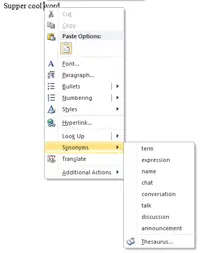
    In the second column write down words associated with the first column. Synonyms can be quickly generated by typing the word in Microsoft Word, right clicking, and hovering over “Synonyms.”


    In the third column write down verbs associated with your company, products or services. These would be action terms. It is ok if a term is a stretch–this is simply a brainstorming session.

    In the fourth column write down any words that have a double meaning. Draw upon words in other columns and find double meanings, insinuations, and variations. Alternative spellings or clever phrasings can be used to create a witty name that people will remember.

    In column five you will write down external references. You are looking for any phrases, quotes, or book titles associated with your industry. Identify existing manners of speech that are common knowledge and well-known. This will be especially helpful for businesses that are competing in a more ambiguous market.

    Once you have a good chunk of words and phrases, get rid of anything that is obvious garbage. Pair up words from each column, and mix and match to see if you can come up with a keeper.

    If this has been of any help let us know, and it would also be cool to see what names you came up with.