Tag: Competitive Advantage

  • The Secret Mind Of An Entrepreneur Is Not What You Think

    The Secret Mind Of An Entrepreneur Is Not What You Think

    When I started my business journey, I initially sought to find the secret to business success. I suspected there was a secret because only a handful of people experienced success while the majority of people found failure. Additionally of those that found success there were always those serial entrepreneurs that seemed to find one success after another. There was also a ton of examples of people failing at business. Why such a disparity?

    The nature of the secret I assumed was a tactical or methodical difference. If I could figure that out I could adopt the methods into my own businesses and live happily ever after. Sorry to say it is not that simple. The difference is more in line with how entrepreneurs think about and address their problems and relationships with people. I hate that this is true. I hate it because it means the answer I was looking for is not something that can be easily defined or discussed.

    Take a hall of fame sports star for example. One can’t pin point the things they do habitually that allowed them to make it to the hall of fame. They made it to the hall of fame because of who they are and how they approached their game. The unique reality and un-assessable truth is that they brought a piece of humanity to the table that few others have. Fundamentally they thought about their craft in a unique way.   

    The reason there are few successful serial entrepreneurs is because there are few people that focus on business and life in the way these people do.

    The Dark Side Of The Focused Individual.

    Before going into all the “amazing” things these business superheroes can do I would like to discuss the dark side. I have come to believe that how some entrepreneurs approach life and business is something I never want to recreate in my own life. For some serial entrepreneurs their identity is 100% tied to their commercial success. They are one dimensional with their only dimension being business success. That is great if the only thing in life is business but for most of us this will not be the case. For me a well-balanced life is much more important than a having only a commercially successful life.

    I discussed how entrepreneurs think in my piece: How to Become an Entrepreneur but I didn’t extrapolate my thoughts to their full conclusions. When entrepreneurs are young they are often misled by the pursuit of profit. While it is true that the goal of a business is to make money now and in the future (thank you Eli Goldratt) the goal of life is not. If the goal of a business is to make money perhaps we should ask; what is the purpose of a money making business? The answer to this will be different for everyone.

    I have been really challenged lately with how my time is spent. In his book Hero on a Mission: A Path to a Meaningful Life Donald Miller discusses a technique in which you write your own eulogy. Wow, what a mind bender. The idea isn’t his, Stephen Covey the author of The 7 Habits of Highly Effective People also suggests the exercise. In doing so you begin to see how finite the time we have is and what really matters. Children have forever, teenagers have forever, but a young aspiring entrepreneur may only have a decade or two. What is it you want to do with the handful of years you have left?

    How Buying A Machine Shop Changed My Perspective

    When I bought a machine shop, I achieved something I thought would never happen in my life time. All the equipment anyone could ask for and the ability to make anything was at my fingertips yet it didn’t take long for my “why” to change. I love manufacturing and making physical goods, solving interesting problems, and establishing sustainable solutions. I very much dislike exchanging time for money. A one to one exchange of time for money is no different than what occurs with a W2 income. It took a handful of breakeven projects for me to refine our approach to the market space. The funny thing was I was the reason we weren’t making money. I was so excited to land jobs that I landed jobs I should have passed on.  

    What you will find is; generating revenue is easy with a smallish business. Generating revenue that exceeded expenses is more complicated problem. Many of the projects that people want you to quote are projects that don’t have money in them. Buyers put projects out to bid in search of the lowest bidder. A starving shop bites and begins spinning their wheels. Sad really. A budding entrepreneur won’t necessarily be able to see these projects for what they are until they have committed. The silver lining to this is that these experiences are the building blocks to the entrepreneurial mindset.       

    I still love the machine shop but I love it in a different way today. Had I had the opportunity out of college to run the shop I don’t know if I would have had the maturity to make it work. I was young and ignorant to so many business truths and human conditions. It took spinning our wheels a few times to show us there is work out there that is better left to our competition.

    Accept That You Will Fail, Just Don’t Fail To Learn

    The one trait I have seen ring louder than almost any other with successful businesspersons is their ability to see through all the fluff. They don’t lean on forecasts, hope on promises, or blame things they can’t control. They are pragmatic to the core. They work off of hard figures, test their own assumptions, and distil all the noise around them down to fundamental truths. I wouldn’t say they are cynical, but they are certainly not going to bank on what other people tell them. Why do you think they are this way? The answer is because they have felt the pain and subsequent benefits of failure.

    Having the humility and wisdom to understand when you screwed up is essential to conducting business well. I personally like the motto of; fail fast. There is more out there that you don’t know that what you do know. Accept this and don’t pretend to have all the answers. This advice is nothing new. Proverbs 16:16 ; How much better to get wisdom than gold, to get insight rather than silver. The value of knowledge and wisdom cannot be understated.

    Entrepreneurs By Definition Don’t Follow The Crowd

    To be an entrepreneur one must fundamentally be able to see opportunity and add value where others do not. This means the way you think aught not be consistent with the masses. You have an obligation to solve problems and provide solutions that others need. Others need you because they can’t take care of their pain the way you can. I find this rather exciting.

    How cool is it that people need you? In what way is the world a better place because of what you do and how you do it? Your service to others will garner financial rewards but beyond the money I hope you can see the changes you are making!

  • Making money is simple but not easy

    Why making money is simple. Have you ever wondered why some people seem to make money hand over fist while others just seem to spin their wheels? Making money is nothing more than a result of adding value. Anyone can do that. Adding or providing value to someone happens every time you spend a dime. Next time you pull out your wallet ask yourself what it was exactly that you needed and could not facilitate on your own. If you bought a gallon of milk, did you actually need the milk or perhaps you were more concerned about a crying baby. I recently had to go to a close gas station and paid too much for a gallon of milk but was 100% ok with that because I had a baby at home and time was of the essence.

    In a free market things are sold on three predominant basis; cost, quality, and lead time. You buy on a cost basis when you are shopping for a value at the lowest price. This is often commoditized items that are available everywhere and don’t differ from one another. You buy on a quality basis when you purchase an item that “must be” a certain way. An example of this could be custom furniture or premium gasoline. You forgo other options when buying on a quality basis because your ultimate need stemming from the product or service is specific and recognized. Finally you buy on a lead time basis when time is more important than any other metric. This was the case when I purchased the milk for my crying baby.

    Can you see the value? Value is the thing that meets the need and this can be provided by a product or a service. An interesting thing to note is that the product or the service itself is not the value. The value comes from what the product or service provides. You don’t pay for window washing because you want to watch people wash windows, you pay to have clean windows when the washing is complete. The same holds true for all services. The service itself is of zero value if in the end the customer’s expectation is not met.

    This holds true for products as well. Any widget you buy from the hardware store is only of value because of what it will allow you to do. A hammer is worthless unless you have to drive some nails. You don’t need a wrench if you don’t have any bolts to tighten or loosen. A tape measure is a paper weight if you don’t need to know the dimension of something. Your vehicle exists to get you from point A to point B. To some this may seem obvious to others it may provide a new angle to think about the products or services you provide.

    Why making money is not always easy. While making money can be simple it is often times not always easy. There are a number of reasons for this but I believe the largest one is the competitive nature of free markets. In free markets everyone has the option to compete in a market space. This means there are a number of other players out to offer the same value that you want to offer. Because of this you won’t have an advantage as you enter a market simply because you are in the market. This can seem frustrating on the surface but it is also one of the things I find most intriguing about business. Those who do well in their business are part of a continuous dance of trying to figure out how they can stand out from the crowd.

    People are inherently selfish and as a result the free market is rife with stiff competition. The lively hood of people and their families is pushing many people to figure out how to find a way to the top and additionally how to stay there. What better motivation is there to compete? I believe this is one of the underlining realities that feed into the small business failure rate. People have a novel idea to start a business and think there isn’t much too it only to find that absolutely nothing will be handed to them if they don’t compete. All of the low hanging fruit was snatched up a long time ago by someone else who was already treading down that path.

     Adding value is hard work. Ask anyone who has had many years of success in business and I bet they will tell you it was hard work. Making money can be simple and chalk full of hard work at the same time. This is not a bad thing all it means is that you will need to dig in if you want your company to succeed. In fact, the sooner you realize that simply working harder you have an advantage the sooner you will find yourself as the market leader. Hard work is one of the single biggest differentiators in small business markets.

    The market will change.  Another dynamic that makes business challenging is that the market place is constantly changing. Driven in part by the competition stated earlier the marketplace is anything but stagnant. Business is a bunch of people interacting and if there is anything we know about people it is that they are not robots. Companies that get comfortable with their market position won’t enjoy their position for very long. This is one of the biggest reasons small business can have an advantage over large business. Large businesses can’t move at the speed of a smaller organization and as a result is at a fundamental disadvantage in many respects.

    Other factors that play into the flux of the market are technology and rising costs. As a market matures and spreads its tentacles out disruptive technologies will sprout up to change the game. Technology is simply a force multiplier and as a market grows it will gain more recognition from others. As this happens more and more people will be looking for ways to do what is being done in a more efficient manner. Many times this can be driven by rising costs. Rising costs are constant over the long run. This means that in 10 years your product or service will cost more than it does today if nothing is done to improve how it is delivered.

    What we know. In the end we know the secret to making money is focused persistent hard work. Once you have your niche defined and you are digging in keep this in mind. “Success” won’t happen overnight and it won’t hit you like a ton of bricks. It is a slow process that will require hard work and strategic thinking. It is not rocket science and if made more complicated than it needs to be will be much harder to attaint than simply getting out there and getting something done.

  • The Competitive Advantage Spectrum

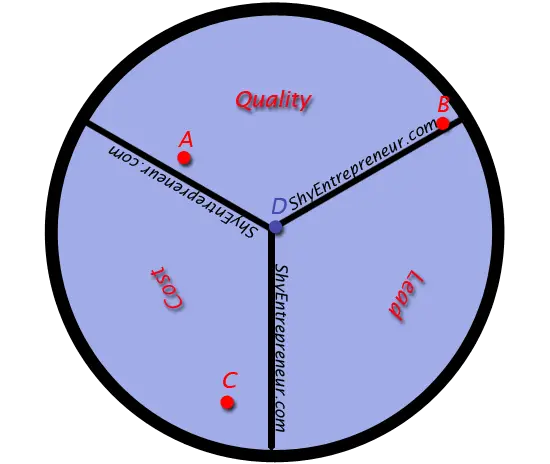
    In a previous article entitles “Factors of a Competitive Advantage” I covered the three main areas a company can compete without an existing relationship. The three areas again are Cost, Quality, and Lead Time. Each of these factors is present in the market place and is taken into account whenever someone is making a buying decision. In other words the reason people make a purchase decision between two products is because one of them is cheaper, of better quality, or is readily available. Understanding this dynamic can help you better serve your target market and allow you and your business to provide the greatest value possible.

    The Competitive Advantage Spectrum

    When thinking about how you can compete in your market it may be helpful to think in terms of the following spectrum.

    Shy Entrepreneur Competitive Advantage
    ShyEntrepreneur.com Competitive Advantage

    Cost, Quality, and Lead all exist as areas in which you can compete but unless you are the only player in an emerging market (Company “D”) you will not have an advantage in all three areas. Most companies start off having an advantage in one area and work to compete in two. If you are just starting your business think long and hard about this because your pursuit to compete on too many factors could lead to your ultimate demise. It is better to excel in one area than it is to compete moderately in two. Many small businesses don’t understand this and try to be all things to all people.

    Relative Positioning

    While it is true that any business in any industry can position itself wherever it pleases on the competitive advantage spectrum, industries themselves often demand relative positioning. Web based companies often have real time products that are available at the click of the mouse. This means lead time is of little concern throughout the market segment and businesses will compete on Cost and Quality. An example of this could be Microsoft Operating systems and Macintosh Operating Systems. Both are readily available so competing on lead time is not of concern. Both Microsoft and Macintosh positioned themselves to offer solutions to different target markets. In terms of the spectrum Microsoft offers a better quality solution for the price for business oriented customers. Macintosh on the other hand offers a better quality solution for the price for graphic processing and artistic consumers.

    Much of the retail industry has also found its corner on the spectrum. If you think of Wal-Mart, where would they be positioned? They would be somewhere close to Company “C”. They seek to have a large inventory of low cost products available to the general consumer. This in turn means they inherently have the super high quality merchandise that may be found in a boutique store specializing in a focused product group.

    What about Company “A”? One business type that would be in this neck of the woods would be custom furniture companies. Competing on cost and quality they often provide a long lead time. An order could be placed and it may take a few months for the product to be delivered. The products will be of higher quality than what you could pick up today but you will have to wait for them to be put together.

    Small Business Vs. Large Business

    Understanding how small and large business relate to the spectrum and how they compete can further equip you for success. Large businesses often cater to the general needs of many whereas a small business is positioned to provide specific needs to few. So, where does this put them in the spectrum? A small business should almost always be positioned in the neighborhood of Company “B”. They should never be positioned to compete on Cost, small businesses need to be as far away from that position as possible. As a small business there is inherently little money behind the organization so competing on cost can be futile. A small business should provide the highest quality solution in the shortest amount of time as possible and charge a premium.

    Large businesses on the other hand are geared to provide boxed solutions at as competitive of a price as possible. Large businesses often must compete on price because they are taking part in very mature markets. As stated earlier Wall-Mart leverages the economy of scale to bring a lot of inventory in that is of little cost but often doesn’t have the greatest quality (Company “C”). It is hard for a larger organization to compete against custom solutions so often times they don’t. Larger establishments want to partake in a market segment that has a high volume of similar needs.

    Emerging Market

    An example of an emerging market would be Microsoft in the early years as they pioneered consumer oriented operating systems. Apple was right behind them but for a time the Microsoft OS was the only thing people were using on PCs. Finding a new market with no competition is quite difficult and is often found on accident. Many Startup companies operate on this premise of discovery working to find or create a new market in which they are the first competitor. If this works out the monetary reward can be huge but as you may have guessed the failure rate is much higher than the success rate.

    Even if you are fortunate enough to be the first competitor in a market it would behoove you to determine how you will maintain your advantage in the future. The triple advantage will be lost the second another competitor shows up on the scene. Chances are they will enter your newly formed market asking where they can provide value where your company falls short.

      Why You Care About Competitive Positioning

    If you have not started your business yet consider yourself lucky, now you can do so knowing the best way to position your company on the competitive advantage spectrum. Use this spectrum when assessing your competition; it may give insight on where they can be out performed. This will also help you to not give away your competitive advantage. In the Theory of Constraints the Viable Vision is often achieved by providing quality products quickly at a premium. This means you are getting much more out of your efforts than you would be trying to compete on every factor. I have seen this work first hand and it is amazing. The value in providing a part or service quickly can easily outweigh the value inherent to the part itself. So, take some time today and figure out where you are located on the spectrum, then figure out where your competitors are positioned.

  • Factors of Competitive Advantage

    Does your company have a competitive advantage? A competitive advantage is the edge one company has over another. It is the reason someone will purchase what you have to offer even if they have no idea who you are. This is important for small businesses because many only offer the same value as the next guy or gal in line.

    Let’s take a look at the factors that allow a competitive advantage to exist prior to an established relationship. No matter what you are selling, defining your target market and maintaining a strong position to attack that market is vital for success. How is this achieved, you ask? Within any given market there are three areas in which a company can strive to gain an edge and consequently more sales. These areas are:

    • Cost
    • Quality
    • Lead

    Cost

    Cost is simple—it’s the price you are charging for your product or service. What will your product or service cost? All too often people are under the impression that the cheaper the product is, the more likely it is to sell. While that is partially true, companies that only compete on cost generally don’t offer a quality product. Who competes on cost: Dollar stores, distributors, larger companies pursuing higher volume and lower profit margins.

    Quality

    The general public does know what to think in terms of quality. The common viewpoint is that the higher the quality the better. The quality that is generally assessed is in relation to the standard of excellence. From an engineering standpoint, the quality of a product relates to the elimination of variability. If a product goes out the door the same way every time it is a “quality” product. If each time a part is ordered it has a high degree of variation, it is be considered a low-quality product. This extends also to the customer service you provide. Who competes on quality: McDonalds (that’s right, their cheese burgers taste the same all over the world).

    Lead

    The lead refers to the turnaround time required from the moment the order is received to the moment the item is in the mail. The fastest turnaround time exists when items are in stock. Who competes on lead time: Made-to-order manufacturers.

    How They Relate

    You can think of these three factors as three vertices of a cube, or the X, Y, and Z axes. While there are three axes, companies usually only compete in one or two of the three areas. Wal-Mart focuses on lead by keeping inventory in stock and maintains lower costs, but it does not always have the highest quality components.

    If a company is known as a high-quality, low-cost company, they will probably have a longer lead time. Conversely, if they are known as a high-quality, short-lead company, they will generally demand a higher price for their goods. The nature of a free market regulates this “give and take.”

    A company can have the advantage in all three areas only at the point of a paradigm shift, when a company breaks into a new unsaturated market. Once a competitor is on the scene, the ability to maintain a 100% advantage is lost.

    A fourth factor that fits in with a long-term competitive advantage is relationship. The three factors above will help you win someone over in order to build a relationship with them; however, the relationship itself will give you an edge once it is established.

    This is a very important business truth that will be extremely helpful in assessing your market. Understanding the competitive advantage your company strives to maintain will allow you to focus your efforts on those areas that support your overall vision. It will also help you to understand where your competition is coming from and what market segments they are likely to facilitate.

    Related Articles;Key Small Business Success Factors,
    The Competitive Advantage Spectrum

  • The Up Side to Inefficiency

    The Up Side to Inefficiency

    For the past year I have been trying to wrap my brain around the paradoxical relationship between effectiveness and efficiency in small businesses. I have understood that one can be effective without being efficient but I could not reason why. I kept thinking this was a reality that persisted in spite of itself and ultimately was not an appropriate one to accept. I was wrong.
    If you have been a part of a small business for any amount of time you know that disorder and inefficiencies are constant. Rework and second tries eat up potential profits all day long and yet the mode of operation continues. How can this be? Why can’t organizations get their act together and address the core issue leading to this waste? The answer may surprise you.
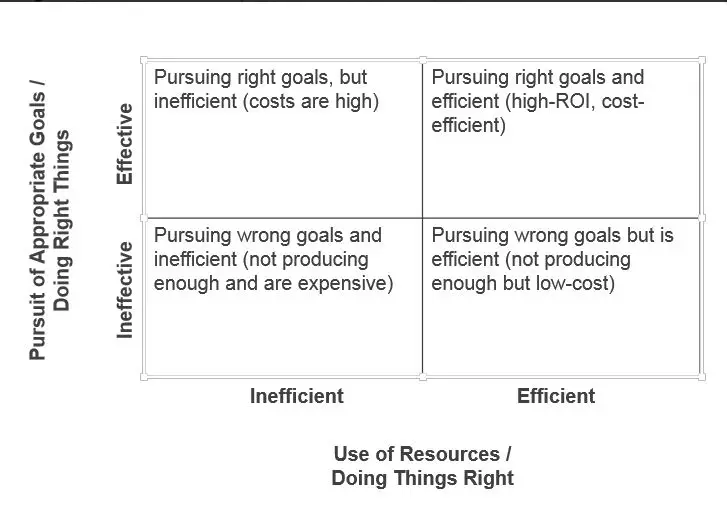
    While digging for answers I came across the following matrix which expresses the relationship nicely;

    I don’t know if http://www.insightsquared.com/2013/08/effectiveness-vs-efficiency-whats-the-difference/ was the original author of the image but that is where I found it. In the article they go on to explain the effectiveness is doing the right thing and efficiency is doing things right. This is rather straight forward and sounds very similar to the maxim: “Leaders figure out the right things to do while managers figure out how to do things right.”  I stewed on this for a bit to see if there was anything I could garnish to aid in reconciling the dichotomy. At first I saw nothing but it soon dawned on me that the conflict was less a conflict and more a rite of passage.
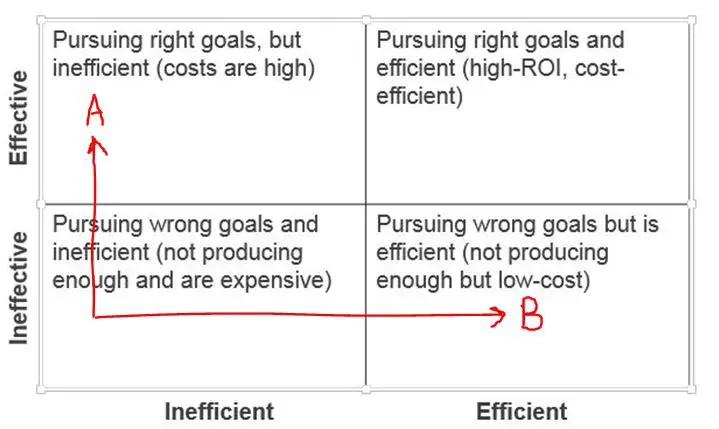
    Let us pretend that we are stating an organization and we begin at the corner of ineffective and inefficient. We have two paths to choose from; Path “A” leads us to the world of the inefficient and effective. Path “B” leads us to the land of efficient and ineffective.

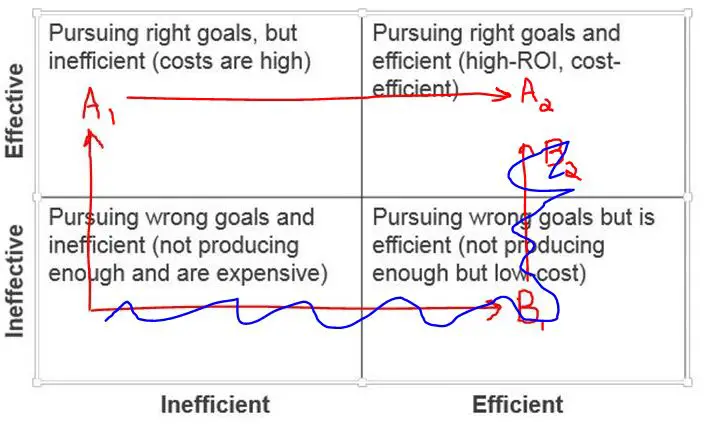
    As far as this matrix is concerned companies must begin in the lower left and work towards the upper right. The question is how. To stay viable smaller organizations would be wise to first do the right things (effectiveness) before focusing on doing things the right way (efficiency). Large companies can focus on process improvement (efficiencies) because they have already established that they are doing the right things. Smaller companies on the other hand can’t compete on those fronts and by virtue of that have to focus on doing the right things (effectiveness). As a company grows the challenge becomes improving how one can be effective. Systemizing and standardizing while great for a large company can fundamentally undermine the agility that has provided competitive advantage to the smaller organization. There isn’t enough of anything when starting a business to justify spending time and resources on efficiency matters.

    In an earlier work: How To Measure Business Performance. Effectiveness Vs. Efficiency  I touched on this reality but I did not extrapolate the reasoning behind it. I have known that effectiveness took priority over efficiency but until recently I couldn’t articulate why without a long explanation. The premise of a small company fundamentally requires effectiveness to take the front seat. I don’t know for certain but I suspect if you did some digging you would find that the small business mortality rate could be tied to misdirected efforts to improve efficiency at the expense of effectiveness. People that decide to take path “B” end up doing an amazing job but their efforts are in vein.
    Another thing to keep in mind is that this process does not have an end. As a company matures the point of addressing efficiency will be different for each aspect of the organization. The need will trickle through as growth occurs. One year you may need to streamline your quoting procedures while the next you will need to focus on customer support. Don’t think this is a one and done arrangement. You will be following the A1 to A2 path time and time again. With each growth new issues will arise the will require another assessment.

    All of this is not to say practical efficiencies should be ignored. In everything you do you want to optimize your ROI but you don’t want to do so if it compromises your fundamental competitive advantage. I see a lot of people come out of college with a portfolio of process improvement training but don’t understand this reality. They are eager to prove their worth by squeezing the rag dry and completely miss the fact that most of the “process improvement” solutions they learned were only appropriate after the effectiveness of those processes was established.
    If you find this helpful at all leave us a note and continue the discussion. The comments that come from real world situations help everyone.

  • Island Economics

    Have you ever wondered why one company thrives while another fizzles? It is a question that I come back to on a continual basis. The more I process the factors associated with success and failure of businesses the more I realize the answers for both are numerous. I don’t like this. I have to believe there is an inherent simplicity underlining it all.

    How is it that a once successful business that was a world leader can crumble while a college kid and his roommate can create a huge venture out of lines of code? What are the sands that seem to shift under our feet, constantly changing the game that create an opportunity for one and mean doom to anther? This dynamic is constant and while I can’t quite put my finger on it I think I can demonstrate it through the following.

    I will do my best to illustrate where I am coming form with an example of a fake isolated economy consisting of two men on an island. I realize that in my example I may give into some traditional ways of thinking but for right now it is how I see it so bear with me.

    In an economy where currency does not exist value is present when one man has something another man needs. One could assimilate it to the potential difference with in an electrical circuit. In an electrical circuit electrons don’t flow until a potential difference exists. So long as both men on the island have everything the other has, there is equilibrium of value. It isn’t until there is an imbalance that value can exist.

    So, to create an imbalance let’s make one man big and tall and the other small and short.

    Now, in the day to day life of our two islanders both will encounter situations which the other is inherently better suited to handle. When this happens each man is in need of the other. For a moment each man is valued by the other. Equilibrium of value is once again established once each man assists the other equal number of times. If more is required of one man than of the other indefinitely we would consider that to be unjust if there wasn’t a correlative shift of debt. In other words one man would be habitually indebted to the other.

    In our fake economy business is simply the concert of maintaining the equilibrium. The imbalance is what many would refer to as a competitive advantage.

    Our real economy of course is not this straight forward. We have men and woman of all shapes and sizes, each with their own set of needs. This reality makes it possible for us to facilitate the needs of more than one person and consequently establish wealth. To think of it without currency; if we were to provide a service to 100 people we would have 100 people whom “owed” us their services in return, we would be wealthy. If no one needed the service that we had to provide we would be poor.

    I know this is a crude example but I hope it helps you understand where you can add value in your own situations. I see a lot of young zealous entrepreneurs who don’t seem to understand that value doesn’t simply fall from the sky; it is established by virtue of a potential difference. No venture is going to be successful until it can find a way to offer a product or service that isn’t already available.

    A great way to insure you are headed the right direction is to follow a pull strategy. Facilitate an unmet need that already exists. Rather than trying to force what you want to offer upon others, why not take some time to meet a need that no one else has met. This is one of my biggest concerns regarding many MLM businesses. People sign up thinking they have the world at their fingertips and don’t understand they are simply a marketing company competing with a bunch of other marketers to ultimately sell dreams. Without a potential difference or a fundamental value to bring to the table it becomes the job of the marketer to skillfully craft a sales pitch containing perceived value in order to expand their network.

    This idea of course is not new and years ago people began facilitating common needs. Companies that matured with their markets and made the appropriate changes over time are now leaders within their respective industry. However, if they don’t continue to adapt and change as the needs do they will lose their competitive advantage and an aspiring young company will rise up to take their place. This can happen more than you realize as companies become overly bureaucratic and lose the ability to compete with smaller businesses.  I hope you are that aspiring young company I read about next!