Tag: Conflict Resolution

  • Conflict Management Strategies Used In The Workplace

    Whether you own your own business or simply work in an environment with other people you will run into situations that require you to manage conflict. Conflicts can be interpersonal, profession, or simply strategic in any case having the ability to work through conflict is a vital skill. You may not realize how much conflicts play a role in your day to day life so follow along as we explore conflict management strategies used in the workplace.

    “Why Won’t You Listen?”

    Even if you are one of the parties in conflict take note that people need to be heard. In the amazing book How To Win Friends and Influence People Dale Carnegie discusses how people will not listen to you if you don’t first listen to them. After all, how in the world could you possibly offer a solution if you didn’t listen well enough to understand the problem in the first place?. This is huge. Listening to a frustrated employee or someone advocating for something other than what you want will open the door for reciprocal communication. Cut them off mid-sentence and you may as well slam a door in their face.

    “I Have My Reasons!”

    If you don’t agree with someone’s stance step back and see if you can at least appreciate why they have the stance they have. No mature adult wants to disagree for the sake of disagreeing, there is a reason someone may not agree with you. This technique can be executed with the help of a conflict cloud if it isn’t initially obvious where someone is coming from. If you are working to mitigate two conflicting party’s a solution may arise simply by having each person state why they have taken their stance. Often times the reasons exist for a common goal. Even if two people are working towards different ends they may back off once they realize the reason why an action was taken.

    I can’t tell you how many times I have been able to untangle a conflict by simply walking through each position. Stepping through the conflict slowly to uncover the main point of contention and bring to light a possible solution.

    “Why Don’t You Care?”

    As a manager, owner, or fellow employee it is important to let your colleagues know that you care about them and their situation. If you don’t care you have no place “managing conflict”. If you do care make an effort to let the people involved know. People need the reassurance that you are on their side and empathize with the situation.

    “Don’t Assume!”

    Assumptions are often the underlining cause of your conflict. These assumptions are usually not obvious. A Socratic approach to why the conflict exists may help uncover some of these assumptions but if the conflict is big enough and you want to put in some effort the Theory of Constraints Thinking process can help immensely. The Thinking Process uses conflict clouds but takes everything a step further by outlining the situation as it exists, how you want it to exist, and ultimately how to get there.

    Complete books have been written on this method so it isn’t something you can do in 20 minutes. It is however an amazingly powerful tool that leaves me impressed every time I use is. The heart of it like I said earlier is to uncover assumptions so if this can be done without all the overhead of the Thinking Process I suggest going that route.

    Conflict Management Strategies Work

    Methods to manage conflict abound but the few mentioned above have proven very effective for me. Be careful not to make a mountain out of a mole hill. People often clash and conflict is not always a bad thing. In fact it can be quite constructive and necessary in some situations so long as one can communicate their position and listen to what others have to say. I hope this was helpful and by all means please let us know if there are specific issues you would like us to tough upon.

  • Steps to Saving a Company, Triage in Business

    If your business is seeing trouble times and needs some crisis management here are the steps that will turn things around. In a crisis situation every decision can mean the difference between saving or killing the company. Your job as a business owner is to manage the situation in a way that provides the best possibility for success. This process is straight forward and contains many parallels found in managing medical situations when there are limited resources.

    1. Triage.  Determine the priority of your issues. What do I address first?
    2. Crisis management. Stop negative cash flow. Increase margins lower overhead. Short term action plan
    3. Stabilize. Build a management team. Move to long term action plan
    4. Plan for the future.

    What does Triage mean in business

    Triage is a means to prioritize. So, what does triage mean in business? In business time is of the essence in a crisis situation and how you prioritize your time is critical to turning the business around. Triage is a suitable word as its medical origin paint a great picture for its use in the business world. The business is a wounded patient and you want to address the problems in the order of their severity. Don’t mess with the broken leg if the patient has a severed artery. You will also need to take into account the limited resources you have to do what you can do. If you lack the means to solve your largest problem perhaps you have what is needed to address your second largest problem. In the battle field the three categories that patients find themselves in are;

    • Those who are likely to live, regardless of what care they receive;
    • Those who are likely to die, regardless of what care they receive;
    • Those for whom immediate care might make a positive difference in outcome.

    Similar categories can be drawn for the problem areas of your company;

    • Issues that are likely not to cause further problems, regardless of what actions are taken;
    • Issues that are likely to cause further problems, regardless of what actions are taken;
    • Issues in which immediate action might make a positive difference in outcome.

    The first two categories are highlight time bandit issues that will only bring you closer to bankruptcy if you attend to them. The last category will contain the issues which if addressed could turn your situation around. Keep in mind however there may be times when an issue can be solved but the return on investment to make the change may not be justifiable. An example could be fixing an old piece of equipment for twice the cost of a new replacement.

    Crisis Management in Business

    After you have established the priority of your issues you will need to stop losing money. Your cash is the life blood of you business, if you are pissing it away the company will die before you know it. The metaphor of the wounded patient again holds true; stop the bleeding and stabilize the organization. Often times this will look like layoffs, budget cuts, or any other form of downsizing. These short term actions immediately lessen the drain to the bottom line to lower the possibility of having to close the doors. In short you will want to minimize the cash going out the door and maximize the cash coming in. A price increase may or may not be appropriate depending on your positioning and industry. As a small business however you should already be correctly positioned on the competitive advantage spectrum so a price increase won’t be out of the question.

    Stabilizing the Situation

    Once the bleeding has stopped you will want to turn your focus to longer term issues. What in the organization needs to change so these problems won’t resurface? Perhaps a pivot to a new market or service is in order? Or, you simply need to find the right person for a key position. In one instance I am familiar with the decision was made to withdraw from a market that was proving to be a drain on the company. What made it so interesting was the fact that the market was complimentary to the primary market of the business. The problem was that the cash reserves were not in place to facilitate both. Basically the money made in the primary industry was being poured into the secondary market for no overall gain. For additional ideas regarding stabilizing I wrote an article titled “Maslow’s Hierarchy of Needs for a Small Scale business”. My intent was to draw further correlations between business and humanity.

    Future Plans

    No one can predict the future and there is an exponential regression to every forecasting model so planning for the future often lies in deciding who will and will not be around to drive the ship tomorrow. A business is a living organism comprised of human parts. Finding the “parts” that fit is the best investment you can make for a long term growth strategy. Jim Collins refers to this as getting the right people on the bus in his book “Good To Great”.

    The Bottom Line

    The bottom line, changes need to be made. These changes need to be ones to the core conflict/s of the organization, not just the symptoms. All businesses at one point or another will find themselves in a position of reacting to market change. Advents of technology and the natural maturing of market needs are always in flux and will probably require you to take a second look at your business some day. Two great tools to aid in these efforts are The Thinking Process and the Five Focusing Steps of the Theory of Constraints.

    The goal of business is to make money now as well as in the future so you need to be doing all you can to make that happen. This will start to take place as you align your core competencies with the true need of your target market. Providing one product or service well will serve you better than offering many mediocre solutions. This is as true on a business level as it is on a personal one.

  • Conflict Clouds – Evaporating Clouds

    Conflict Clouds – Evaporating Clouds

    Conflict Clouds, also known as Evaporating Clouds, are a conflict resolution tool used in the theory of constraints (TOC) to maintain the logical integrity of two mutually exclusive events and their existence for a common goal. The premise of a conflict cloud is that conflicts exist because two events that cannot exist at the same time are working against each other to achieve the same end. The conflict exists in the prerequisites, which are needed for the requirements, which ultimately lead to the objective.

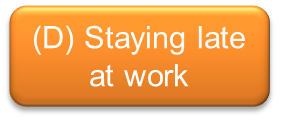
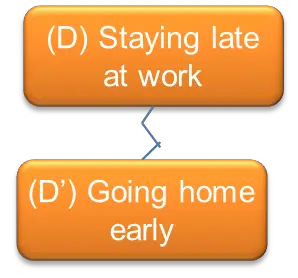
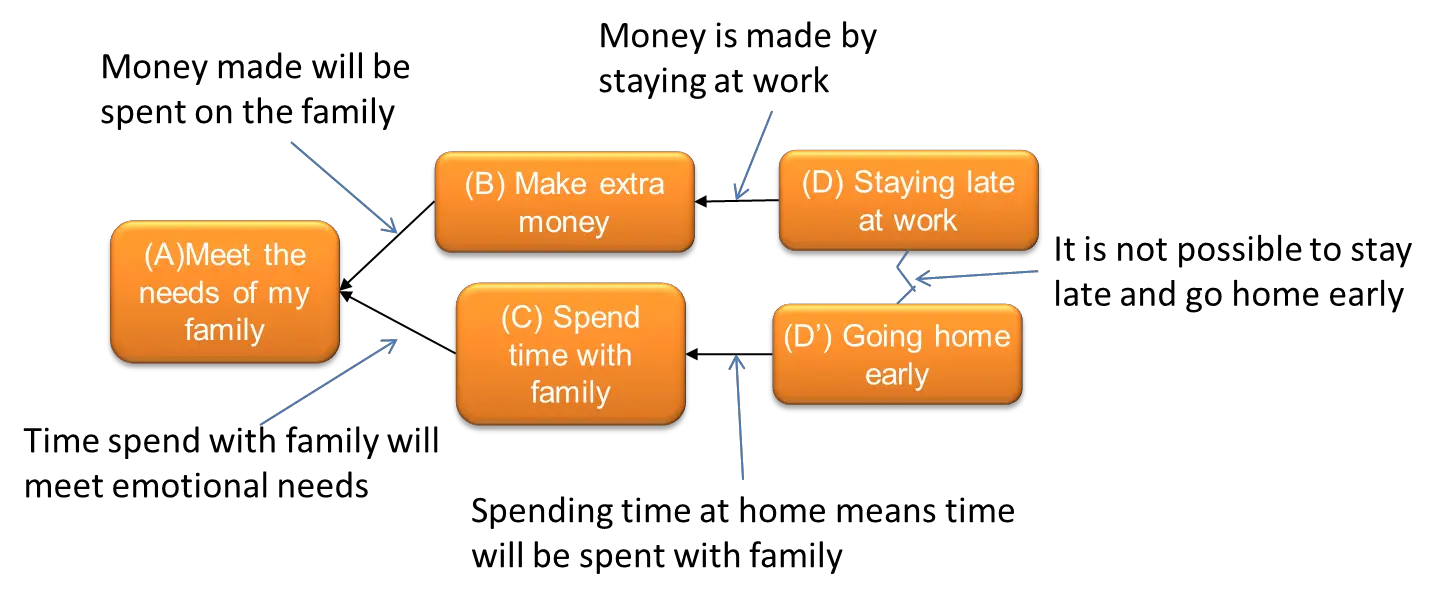
    As you will see, conflict clouds illustrate the logical argument for the existence of a conflict and can be used as the seed for the rest of the TOC thinking process. To begin, we need to find two mutually exclusive events. For this example I will use (D) Staying late at work and (Not D) Going home early.

    Identify the Conflict

    These two events cannot exist at the same time, so a conflict may arise. This conflict may exist if say I need to get some additional work finished up at the office but my wife wants me to come home. The elements are referred to as node D, denoted by D, and node Not D, denoted by D’. It is possible to stay at work and it is possible to go home early, but it is not possible to stay late at work and go home early. Formally, the D nodes are considered to be the prerequisites. We would lay the conflict out as follows.

    Identify Requirements

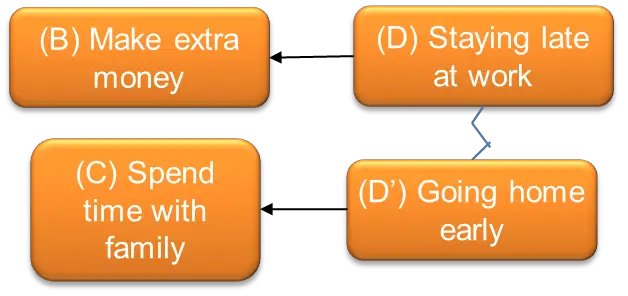
    Now let’s take a look at the requirements. The requirements are the nodes that create the need for the prerequisites. In our example the requirement for staying late at work may be to make some extra money, and the requirement for going home early may be to spend time with the family. The requirement for prerequisite D is node B, and the requirement for prerequisite D’ is node C.

    We could read the cloud as follows:

    “There is pressure to stay at work late in order to make some extra money, and to make some extra money I must stay at work late. There is also pressure to go home early in order to spend time with my family, and to spend time with my family I must go home early.”

    Reading the arguments aloud will help to determine the logical validity of the statements. Are D and D’ truly prerequisites to B and C? Does D’ put B into jeopardy, and does D put C into jeopardy? In other words, will (D) Staying late at work allow me to (C) spend time with my family? No.  Will (D’) going home early allow me to (B) make extra money? No. It looks like we have a logically valid conflict.

    The Goal

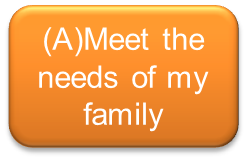
    Now that we see that the connections are valid, one might ask again why the conflict exists. The conflict exists because both instances are working for the same goal. In this case, the conflict would exist inside me, and the common goal to each course of action would be meeting the needs of my family. Extra money would help meet the monetary needs of the family, while time spent with them would meet the  emotional needs of the family. So, the final node is node A, which represents the objective or goal of each argument.

    The complete cloud is illustrated below.

    You can see how there is pressure from both sides of the cloud for two mutually exclusive events, yet both are needed for the final objective. The idea in a conflict cloud is to evaporate the conflict so the end goal can be achieved. Evaporating the cloud is achieved by introducing an injection that can meet the need of each side of the cloud to produce a win-win  situation.

    Finding an Injection

    Finding an injection comes from challenging the assumptions that link each node. Each of the arrows represents a seemingly logical relationship, but each of the relationships may be subject to scrutiny. With our example, a few assumptions that have been made are:

    Challenging these assumptions can lead to an injection that will evaporate the cloud. A few possible solutions in this case may be to work from home, spend the money I already have on the family, or bring my family with me to work. Remember, the idea is to create a solution that will allow for the family’s needs to be met.

    There may be many assumptions between each node, and in conducting a full thinking process it is not uncommon to note 5 or more assumptions at each junction in hopes of finding one to challenge. Many times simply thinking through your conflict to this extent will reveal a solution that you had not thought of before.

    A practical solution in the example provided may be to go home early today (Friday) and come in early on Monday to make up the lost time. Such a solution would allow for time to be spent with family and additional time to be invested into work for the sake of financial compensation.

    Cloud evaporated!

    For those who want to read more, there is a good write-up on wikipedia here.