Tag: First Business

  • The Secret Mind Of An Entrepreneur Is Not What You Think

    The Secret Mind Of An Entrepreneur Is Not What You Think

    When I started my business journey, I initially sought to find the secret to business success. I suspected there was a secret because only a handful of people experienced success while the majority of people found failure. Additionally of those that found success there were always those serial entrepreneurs that seemed to find one success after another. There was also a ton of examples of people failing at business. Why such a disparity?

    The nature of the secret I assumed was a tactical or methodical difference. If I could figure that out I could adopt the methods into my own businesses and live happily ever after. Sorry to say it is not that simple. The difference is more in line with how entrepreneurs think about and address their problems and relationships with people. I hate that this is true. I hate it because it means the answer I was looking for is not something that can be easily defined or discussed.

    Take a hall of fame sports star for example. One can’t pin point the things they do habitually that allowed them to make it to the hall of fame. They made it to the hall of fame because of who they are and how they approached their game. The unique reality and un-assessable truth is that they brought a piece of humanity to the table that few others have. Fundamentally they thought about their craft in a unique way.   

    The reason there are few successful serial entrepreneurs is because there are few people that focus on business and life in the way these people do.

    The Dark Side Of The Focused Individual.

    Before going into all the “amazing” things these business superheroes can do I would like to discuss the dark side. I have come to believe that how some entrepreneurs approach life and business is something I never want to recreate in my own life. For some serial entrepreneurs their identity is 100% tied to their commercial success. They are one dimensional with their only dimension being business success. That is great if the only thing in life is business but for most of us this will not be the case. For me a well-balanced life is much more important than a having only a commercially successful life.

    I discussed how entrepreneurs think in my piece: How to Become an Entrepreneur but I didn’t extrapolate my thoughts to their full conclusions. When entrepreneurs are young they are often misled by the pursuit of profit. While it is true that the goal of a business is to make money now and in the future (thank you Eli Goldratt) the goal of life is not. If the goal of a business is to make money perhaps we should ask; what is the purpose of a money making business? The answer to this will be different for everyone.

    I have been really challenged lately with how my time is spent. In his book Hero on a Mission: A Path to a Meaningful Life Donald Miller discusses a technique in which you write your own eulogy. Wow, what a mind bender. The idea isn’t his, Stephen Covey the author of The 7 Habits of Highly Effective People also suggests the exercise. In doing so you begin to see how finite the time we have is and what really matters. Children have forever, teenagers have forever, but a young aspiring entrepreneur may only have a decade or two. What is it you want to do with the handful of years you have left?

    How Buying A Machine Shop Changed My Perspective

    When I bought a machine shop, I achieved something I thought would never happen in my life time. All the equipment anyone could ask for and the ability to make anything was at my fingertips yet it didn’t take long for my “why” to change. I love manufacturing and making physical goods, solving interesting problems, and establishing sustainable solutions. I very much dislike exchanging time for money. A one to one exchange of time for money is no different than what occurs with a W2 income. It took a handful of breakeven projects for me to refine our approach to the market space. The funny thing was I was the reason we weren’t making money. I was so excited to land jobs that I landed jobs I should have passed on.  

    What you will find is; generating revenue is easy with a smallish business. Generating revenue that exceeded expenses is more complicated problem. Many of the projects that people want you to quote are projects that don’t have money in them. Buyers put projects out to bid in search of the lowest bidder. A starving shop bites and begins spinning their wheels. Sad really. A budding entrepreneur won’t necessarily be able to see these projects for what they are until they have committed. The silver lining to this is that these experiences are the building blocks to the entrepreneurial mindset.       

    I still love the machine shop but I love it in a different way today. Had I had the opportunity out of college to run the shop I don’t know if I would have had the maturity to make it work. I was young and ignorant to so many business truths and human conditions. It took spinning our wheels a few times to show us there is work out there that is better left to our competition.

    Accept That You Will Fail, Just Don’t Fail To Learn

    The one trait I have seen ring louder than almost any other with successful businesspersons is their ability to see through all the fluff. They don’t lean on forecasts, hope on promises, or blame things they can’t control. They are pragmatic to the core. They work off of hard figures, test their own assumptions, and distil all the noise around them down to fundamental truths. I wouldn’t say they are cynical, but they are certainly not going to bank on what other people tell them. Why do you think they are this way? The answer is because they have felt the pain and subsequent benefits of failure.

    Having the humility and wisdom to understand when you screwed up is essential to conducting business well. I personally like the motto of; fail fast. There is more out there that you don’t know that what you do know. Accept this and don’t pretend to have all the answers. This advice is nothing new. Proverbs 16:16 ; How much better to get wisdom than gold, to get insight rather than silver. The value of knowledge and wisdom cannot be understated.

    Entrepreneurs By Definition Don’t Follow The Crowd

    To be an entrepreneur one must fundamentally be able to see opportunity and add value where others do not. This means the way you think aught not be consistent with the masses. You have an obligation to solve problems and provide solutions that others need. Others need you because they can’t take care of their pain the way you can. I find this rather exciting.

    How cool is it that people need you? In what way is the world a better place because of what you do and how you do it? Your service to others will garner financial rewards but beyond the money I hope you can see the changes you are making!


  • Entrepreneur Types

    Entrepreneur Types

    As the years roll by I have been challenged by the seemingly unending spectrum of entrepreneur types. There are big ones, small ones, one-shot ones, bad ones, good ones, and sad ones. Some are exuberant sales man while others are unassuming, quiet, and reserved. This shouldn’t be surprising as no two people are alike so why would two entrepreneurs be alike. Seems silly now that I think about it. In any case this should be a word of encouragement for anyone wondering where they sit and if they have what it takes to be an entrepreneur.

    The short answer is you do. What type of entrepreneur you will be I can’t answer but I do know if you have a desire for business and enterprise you will in some way manifest entrepreneurship in your life. What exactly is an entrepreneur you ask? Well according to my 1939 Webster’s Collegiate Dictionary an entrepreneur is: An employer as the person who assumes the risk and management of business. For reference it points us to “Enterprise”.

    Enterprise is defines as: 1. An undertaking especially one which involves activity, courage, energy, or the like; an important or daring project. 2. The character or disposition that leads one to attempt the difficult, the untried, etc.

    So, from this it reasons that an entrepreneurial effort could be considered any project conducted for the sake of business. Is that an over simplification? I don’t know. This does open the door to allowing any employee to define themselves as an entrepreneur. An employee exchanges their time for money after all. Can you have entrepreneurial employees within an organization? I believe you can and should. I would love to have an employee that assumes the management of running business through courageous activities which attempt difficult, important, and daring projects. To me that sounds like a key figure for any organization.

    Entrepreneurial Mindset.

    Does this mean entrepreneurship is not what you do but rather how you do it? Yes. It is the mindset, drive, and bravado that is in the heart of change makers. Ok ok ok. So does this also mean there are prominent business men and women that would not be entrepreneurs? Exactly. Unfortunately there are “business people” that hide behind their titles, their employees, or previous success and do not have the heart of an entrepreneur. This of course won’t allow them to swim long in a free market environment but they are out there.
    When most people think of entrepreneurs they think of big name tech startup founders. This is an image of an entrepreneur but not the only image. Take the single mom working on a side business at night. Or, the college student who flips product on EBay. Both are entrepreneurs in their own right and will likely find themselves someday managing over their contemporaries that sat on the sidelines while they put in the extra effort to generate business.
    Allow me to segregate the entrepreneur types that you might find. You will see this in your own journey as well as with your business associates. If you think of this as a normal distribution broken into 3 parts you would have roughly the first 16% of entrepreneurs are babies (getting started), 70% are adolescent (regularly practicing), and 16% seasoned. (This highly scientific conclusion is based on nothing more than my need for a frame work so please poke holes.)

    Baby Entrepreneur (getting started)

    The baby entrepreneur is the individual that is cutting their teeth in the business world. This brings to mind the lemonade stands, paper routes, and candy brokers commonly heard about in the early stages of countless biographies. It also brings to mind the working professional that has decided they want to subsidize their income with a side job or buys their first rental property. Baby entrepreneurs won’t necessarily self-identify as an entrepreneur but are in fact on the spectrum.
    I would also put those of us that have sporadic sperts of ingenuity or creative problem solving. Evidence of this could be a project, an idea, an effort, or a tool. Any solution you have ever come up with that solved a problem is the seed of enterprise. They may not always be something that can be commercialized but is enterprising nonetheless. This spring of inspiration flows into the river of execution.

    Adolescent Entrepreneur (regularly practicing)

    I believe most entrepreneurs will find themselves under this classification. The adolescent entrepreneur is full of piss and vinegar. Ready to take on the world and all of its problem. Not yet emboldened by years of experience but also not at the starting gate. These would be the deal maker, opportunist, or small business owner that habitually makes money through their projects. This could be the firefighter that has a business that seals asphalt when he isn’t on duty or the teacher who paints houses every summer. They know the ins and outs of running a business but perhaps only in a single field. May have few or no employees and are regularly competing in the free market. They may not live solely on their entrepreneurial income but they see more cash flow from their efforts than the baby entrepreneurs.

    Seasoned Entrepreneur (never stops)

    The seasoned entrepreneur would be living solely on their entrepreneurial efforts. They may not be super wealthy but they do rely 100% on their own efforts to make ends meet. They would rather rely on themselves than anyone else. This means they have the most failures under their belt. Startups that flopped, deals that went south, and maybe even a bankruptcy or two. In short they have lived it. They are the ones who also have a track record of profitable ventures, habitually solve problems, and see the world through lenses of possibility. Likely have/had many employees and possibly active in many businesses. If they are aren’t still “in the game” they are probably on the board of directors for any number of organizations.

    Are you an entrepreneur?

    So, are you an entrepreneur? I bet you are, otherwise why would you be reading this? If you are a working professional that feels stuck or a full-time mom struggling to pay the bills you can be a SHY Entrepreneur on your own journey to build enterprise. Our desire is to bring you hope and confidence to take your next steps and add value to others in this world. Your unique perspective and approach to the problems you face is needed and I am excited to hear about the solutions you will bring.

  • Part Time Money Making Ideas

    It seems most people could use additional money on the side so I wanted to share with you a few things I have done to give you some part time money making ideas. What are the two things we never to seem to have enough of? Money and time. I believe this is why many people look for ways to make as much money on the side as they can.
    If you are a stay at home mom, college student, or the bread winner of the family there always seems to be a need for more time to do the things you want to do and more money to afford to do them. I am no different which is why I have a few irons in the fire that I want to share with you.

    Making Products To Sell Online

    My first experience making money part time came in high school when I made products and sold them on Ebay. At the time I was into paintballing and had purchased a paintball gun that came with a silencer. I decided I wanted to know how the silencer worked so I ripped it apart and figured out how to make them for my friends and I. That lead to selling them online and equated to a $240/h rate. Now, I only sold a few silencers but the money to time ratio was great. Little did I know selling such items is frowned upon so the experience was short lived. If you have the talent and tools to produce a simple product you can probably make a few bucks selling them online.

    Making products is one of my favorite methods for making money. It is what lead me into engineering and offers a very tangible means to provide value. This is by no means passive but if you can find a good niche and provide a decent product I guarantee you can make some good money.

    Buying Domains

    I began buying domains in 2008 as I could see that the finite availability of Dot Coms implied value. I currently have 98 under my belt and have developed a handful of them. Each runs $7 to $12 dollars a year to hold onto so you can see how that can get expensive quick but once liquidated that $7 or $12  dollars a year can turn into thousands. I purchased one domain for $7.95 and was offered 12,000.00 for it the following week. Talk about a good return. Now, this is the exception not the rule. If you want to invest into domains understand it will take a good deal of time and effort to land a decent one. It cost me a lot of money to find out most domains have a gestation period. Additionally the changing landscape of the internet could have adverse effects. The “semantic” web could discount a domain portfolio. If you do decide to go forward with domains understand the return will be slow. My preferred registrar is GoDaddy.com only because it was where I started. There are many other great options out there.


    Rental Property

    While another long term investment, rental properties can offer great part time revenue. This of course requires a good deal of cash up front and usually a good deal of work but it can be worth it. Real-estate is one of the few things you can purchase that generally increases in value. This is because of the finite availability of homes and lots. That said real-estate also demands a long term strategy. It is possible to flip properties but you need to be on your toes if you are going to go that route. Additionally rentals require to deal with renters. For me this is no big deal as I grew up working on rentals with my parents but for other it could be a game changer.

    Developing Online Properties

    The most notable effort is the site you are reading. ShyEntrepreneur.com came out of the efforts in my master’s program to provide small, young, and home based businesses owners/ entrepreneurs with exposure to the formal ideas I have picked up along the way. The site is young yet (a little over a year old) and is positioned for growth. With the help of a small part time team I have compiled some resources that were designed to edify the reader base. To date the site is still in the red but our breakeven is just around the corner.

    Total time invested: not sure, a lot at first to get it up and going then roughly an hour or two per article. With 64 posts that is roughly at least 120 hours. This doesn’t include the 7+ years of school or personal experiences that preceded the site just the time put into making it happen.

    The Common Thread

    I don’t know if you have picked up on it yet but in short there is not easy get rich quick program or model that works. Everything that has ever brought in money for me has required hard work and time. Even so called “passive” investments require a good deal of attention to perform well. Don’t get stuck in believing you don’t need to work, you do and you should. The neat thing is a little bit of hard work can go a long way. All businesses require someone behind them strategically directing the organization and pushing the people to make each day a success. If you are your first business you need to accept that you will need to put in hard work to make any king of money either part or fulltime. I believe it is David Ramsey who said “to get to where few are tomorrow you must do what few do today. ”

  • Are You Aligned With Your Profession?

    A conversation with a college student has pushed me to address the issue of alignment between oneself and one’s occupation.  If you have ever taken the Myers Brigs you may have an idea of what I am talking about. It may seem rudimentary but aligning one’s self with a complimentary profession is not a cut and dry task. The Myers Brigs predefined profiles often times can give great insight into what direction one may want to pursue but is it enough?

    People in large part don’t know what they want. We think we know what we want but we don’t. I am a perfect example. When I started college I wanted to be a music major. My parents knew that was a poor choice, my friends knew I wasn’t supposed to go down that path, but I was completely unaware that I was built with an engineer’s mind. After a few quarters of general classes I began to see the light. In retrospect I believe it was more Devine intervention than my own doing but ultimately I realized I was built to solve problems, not make music.

    So, why is alignment important? Ultimately it boils down to contentment. If you find yourself in a position that is not complimentary to who you are you will not be happy. Big surprise right? Well, it happens much more than you may realize. Often times people chase after a profession or business because they believe that is where they will find the money. This may be true but it is not where they will find their happiness. They will justify their decision by compensating outside of their daily obligations but when it comes down to it they spend so much time doing what they hate they don’t find the contentment they thought they would find.

    In your own business or in a job having alignment will result in amazing performance. People who love what they do fundamentally will do it better that those who don’t. This is an important principle to keep in mind when looking into starting a business. There are so many people competing in every market that there is no room for fakes or pseudo committed individuals. A small business that was started because someone thought they could make some easy money fast will ultimately fail.

    Being aligned provides a competitive advantage over the competition. Whether the competition is another employee or another business, your alignment will give you an edge that others won’t have. Properly aligned individuals are constantly thinking about new and creative ways to execute their business ideas. People that are not properly aligned simply want to put in what is required and then walk away.

    A prominent business owner I know consistently surprises me with all of his new ideas.  The man has more money than he knows what to do with yet he continues to find ways to refine his organization. The reason? He doesn’t do it for the money, he simply loves what he does. If he was only motivated by money his organization would at best be a mediocre business.

    Google is another great example of this. Larry Page and Sergey Brin built Google as a solution the nets inability to efficiently be queried. Now, they didn’t neglect the monetary side of business but their driving motive was not dollar bills. Take some time and look into the business culture of Google and you will quickly see it is not a company out only to make a dime.

    Now that I have addressed the importance of alignment, how can someone achieve it? An option that I have found very effective is the use to the Theory Of Constraints Thinking Process. Applying this to the individual to identify core competencies can uncover what is needed for alignment. The process is quite involved but yields great results and will show you more about yourself than you care to know.

  • Your First Business? You Are Your First Business.

    If you have been playing with the idea of starting a business because you want more freedom, a better return on your time invested, or just a better quality of life, start by looking in the mirror. You are your first business.

    As a contributing member of our society you provide a product or service in return for monetary compensation. You have an income and you have expenses. “You Company” is in the business of living your life and maintaining your standard of living.

    Your approach to business will parallel your approach to personal finances. Add six zeros to your financial situation and that is how you would perform as the CEO of a fortune 500 company. Ok, this may be a loose correlation but the principle is valid.

    If you are succeeding with your personal finances chances are you will do just fine starting a company. If however your personal finances are not in good shape and your savings account is not regularly growing you may want to think twice before jumping on the business wagon.

    The idea behind this stance is that money is not the issue, behavior is. No amount of money will fix the behavior that has brought you to your current situation. The behavior and choices that have brought you to your current situation will continue to take you down the same path if you don’t make a change.

    The secret is to know which behaviors lead to monetary and personal success. Incorporate these behaviors into your life and guess what, you become that guy/gal with the coroner office and the big house on the hill.

    I call it the flywheel effect. You won’t notice a change today or tomorrow but over time you will see everything come around. There are no definitive points along the way as you continue to give the wheel a push but over time the wheel picks up speed. The more you engage in successful behaviors the more successful you become, it is nothing more than continuing to choose to be successful.

    Successful Behaviors and Habits

    So, what are successful habits and behaviors? In short they are the choices that minimize expense and maximize return. People often live paycheck to pay check by choice, they may not realize it but it is by choice. Each choice compounds into the big picture;  the choice to have cable, the choice to have the I-phone, the choice to go out to eat tonight, are all choices that push someone to spend each dime they earn.

    Before I got married I spent a ton of money on food and entertainment. I would justify it by saying I am a single guy who does well so why not. The problem was that I began establishing horrible habits that cost a lot of money. I would buy breakfast and lunch at Subway, pick up the bill for my friends, and always be the driver without asking for gas money. While these are seemingly not bad actions, from a business perspective they were working against the business of me. (As a side note I still love to do all three of the above, but now in moderation)

    I am not saying you need to become a cheap money hording individual but I am saying you probably have some leaks in your bucket that could quickly be eliminated. You will be amazed at how quickly things can turn around.

    People often start a business thinking it will bring in more finances and consequently overshadow their behavior problems, and it is simply not true. I have heard it said that doctors and lawyers often have bigger issues with money than most. The reason is they were never taught how to manage what they have. Regardless of how much money one makes, if you spend more than you make you are heading towards bankruptcy.

    Starting a business is not something you want to take lightly, and as your first business you will want to start with your personal finances. Establishing new behaviors is simply a matter of repetition. Repetition becomes habit, habit become routine, routine becomes personality, and personality becomes character. If you want to start a business take the time to assess your personal situation.

  • Promotional Discretion, Appropriate Considerations When Selling a Product

    Well, we had our baby girl over the weekend and she is beautiful. I would love to go on and on about the new addition to our family but that is outside the scope of the site and probably wouldn’t be that interesting to anyone who doesn’t know us. Instead, I will expound on the clever marketing and promotional shots taken on new parents and bring to light possible promotional follies.

    The most interesting promotion I witnessed over the past 9 months was the free box of formula that showed up at our door one week before our baby. Talk about lucky timing! Some marketers somewhere were fortunate enough to send us formula right before we would need it. Well, this was less luck and more like intentional product placement.

    My wife has a few birthing sites she frequents which give her up to date info on where she is in the pregnancy and what to expect. When she signed up for this free service she entered in all of her dates so the site could stay current with her progress. On the back side of this process they famed out our information to a company that is in the business of selling formula. As the due date got closer a flag went off in their system and the formula was sent just in time with the hopes of us giving it a go and falling in love with what it does for our child. Unfortunately for this company we are breast feeders and will probably never open the freebee.

    After thinking wow, those guys are smart to target like they did, I though what about the unfortunate instances when a miscarriage takes place? I mention this as a word of caution to those who promote products in sensitive industries. Remember to always listen and truly take into account your customer’s needs. Those who have been in an industry long enough will know where this type of area exists but those who are just getting started may not have the foggiest idea.

    Know When to Apologize

    As a small business owner who is just getting started keep in mind that you will likely step on a few toes here and there. We would all like for this not to happen but it does. The important thing is to learn from the mistake make a sincere apology, and rectify the situation as quickly as possible. Everyone makes mistakes but not everyone takes the time to make it up.

    Long term vs Short term Strategies

    What comes to mind is the long term vs the short term growth strategy. This is the same principle as found in sales strategies. Are you in business to make a bunch of one time sales quickly? Or, are you looking for long time repeat customers who swear your product or service it the best? Personally I like the sound of the second approach. If I am going to invest a good deal of time and money into a venture I want to know that it is going to be around longer than a current trend or fad.

    Build The Relationship

    Business is highly relational and the stronger you relationship is with your customer base the stronger you business is as a whole. In preparation for our baby girl I needed some work done to our car. In reviewing my options I ended up going with the company that has served us excessively well in the past. They were not the cheapest option but the attention they gave, and their willingness to work with us was well worth a few extra bucks. I felt like I was helping a friend, and I am sure they felt the same.

    Fight The Selfishness

    The interesting dynamic about all of this is the human desire for instant gratification. People as a whole often don’t want to work for a modest reward. Generally speaking as a people we want something for nothing. The trick is to not allow this inclination make its way into your life and business practices. Take a second and think about your friends, which ones are the most selfish? Ok, which ones do you like spending the most time with? Are they the same people? I bet not. The same holds true with business.
    Businesses exist to make money, that is the nature of free enterprise but the money is made is another thing entirely. Business without integrity is like relationships without trust, they don’t exist. A modest profit for adding appropriate value is justifiable and appreciated. Excessive returns accompanies with no value added are poor profits that will come with a price far more costly than a monetary value.

    Get Some Sleep

    Anyhow, I hope these words sink in with some of you as the stronger the small business market place is the stronger our economy is as a whole. Smooth organic growth curves are much more valuable than any spike that can be created through temporary hype. Best of luck to you all and enjoy your sleep.

  • 5 Steps to Start a Small Business

    Steps-to-start-a-small-business

    With everyone talking about the economy I decided it would be a good idea to discuss an approach to small business that if followed would minimize the number of failures. These 5 steps to start a small business provide a solid foundation to any venture and should not be ignored. It is in the success of small business that the economy finds its strength so, take notes.

    1. Take a Look in the Mirror

    When thinking about starting a small business the first thing one should examine is their personal financial situation. You are your first business and the way you manage your personal finances is a reflection of how you will manage the finances of your business. If your personal finances are in order and you make more than you spend, you are probably ready to begin thinking about other business ventures. If on the other hand your situation is the other way around and you spend more than you make, I would suggest that you get your situation turned around before venturing into the world of small business.

    The management principles that lead to financial success on the personal level are the same principles in the business world. If you are employed you are providing a service to your employer and in exchange they are compensating you with a salary or an hourly wage. Think about this for a bit, you are already playing the small business game. Where are your week spots? Are there spending issues? Why are you looking to start yet another business? Examining your current situation with this perspective will give you an idea of what to expect if you were to get another business off the ground.

    2. Understand the Small Business Marketplace

    Before getting started make sure you understand Small Business Volatility. The most notable characteristic of the small business marketplace is its resistance to success.  The fact is the majority of small business startups will close their doors after two years of operation. If you don’t take note of this reality you are positioning yourself for failure. One of the biggest contributors to this reality is the fact that small businesses generally don’t have much money behind them and businesses fail because they don’t make enough money to cover their expenses.  In other words the small business marketplace is a marketplace averse to error. One must know where each penny is going and how each penny will help the bottom line.

    That said, there are advantages to small business. Being small means you are flexible and fast. You won’t have the layers of bureaucracy to slow you down when you need to make a decision or change something up. Leveraging this reality can afford you opportunities that your larger counterparts cannot act upon.  Commonalities exist among the small business and large business paradigms but keep in mind a small business approach will not work in a large business environment, and a large business approach will not work in a small business environment. Most consumer based organizations that we are accustom to follow the large business paradigm so keep yourself in check because a Wal-Mart approach to a custom boutique is a recipe for failure.

    3. Begin with Service

    Outside of yourself your first small business should be service oriented. There is a smaller financial barrier of entry for service based businesses than there is for product based models. This means you will reach a break even faster than you would if you decided to go with a product based model. Think about a janitorial agency. The startup costs would be rather small, especially if you had supplies you could use around the house.

    Additionally many service based business are better suited to handle fluctuations in demand. Market fluctuation can be killer for smaller organization. A service based model can have its expenses tied closely to the actual delivery of the service. This means unless you are providing the service, you are not incurring costs. There will be some overhead but not as much as there would be in a product oriented environment.

    4. Be Willing to Change Direction

    I have heard it said that companies change their focus an average of 5 times before they find success. As you begin to fulfill a need your intuition on that need will grow, as it does allow it to direct your company. Microsoft for example began in traffic analysis hardware, not software. There is freedom to try multiple directions (one at a time) to figure out how your company can best add value. Eric Ries in his book The Lean Startup: How Today’s Entrepreneurs Use Continuous Innovation to Create Radically Successful Businesses calls this “the pivot”.

    5. Dig In and Get to Work

    These precautions will safe guard you tremendously as you pursue each business venture but they are worthless if you don’t act. In order to make you business work you will have to work… a lot. A common trait I have witnessed among successful business men is their drive to get things done. They don’t sit around and wait for this or that, they figure out what needs to be taken care of and take care of it. The journey doesn’t have an end, being a business owner is a continuous effort to perpetuate your organization. If you don’t eat and breathe your business chances are you will play second fiddle to someone who’s passion is the business you claim to love.

    I hope you find this helpful. I know may people want to know How To Make Easy Money Fast, which can be done, but not continually and not with a small business. Business is hard work that will take time to produce fruits but trust me when I say diligent effort invested into a focused business will pay off handsomely in the time. Remember, the small business is the heart of our economy and anything that can be done for the sake of small business is a cause worth pursuing.

  • Business Model Generation Template

    The formula for success is a question that has long plagued entrepreneurs, but a helpful tool now exists that will assist in identifying the primary metrics of any business. The business model generation template comes from the minds of 470 contributors and was compiled in the book Business Model Generation: A Handbook for Visionaries, Game Changers, and Challengers, authored by Alexander Osterwalder.

    The approach that Mr. Osterwalder and his team established exists to identify the fundamental elements required for a viable business venture. The method has gained so much attention that it is being used in Stanford Universities’ ENGR 245 course. Professor Steve Blank teaches his students to set a baseline model for a venture and rapidly change the design as their intuition about the customer grows.

    I strongly encourage you to get the book and familiarize yourself with business model generation. Once you have, you can define your own ventures according to it. In turn, this will allow you to identify potential strategies as well as shortcomings your organization may have. A preview of the book is available here. Take half an hour and study the approach. It is fairly straightforward, so you may not even need that long.

    Entrepreneurs are often their own biggest enemy because they don’t fully understand their business. A contributor to this reality is the inability to standardize business dynamics. Business model generation, however, provides a framework by which entrepreneurs can iron out all of the major elements of their venture and visually communicate them to others. The generation model consists of the following 9 elements.

    The Customer

    It begins with the customer and the market your product or service will serve. Will you be targeting a specific demographic or geographic region, or is your focus a bit broader? What is the need you will be fulfilling, and why does it exist? These questions and more are answered through the model, and it provides an intimate understanding of your target market.

    The Value Proposition

    A value proposition is effectively your solution to the customer’s problem. How is your company providing value to your market? As you will see in the book, there are many ways to bring about value.

    Channels

    Channels are the means by which value is delivered to the customer. For physical products this could be distributors and warehouses. Digital products may include such channels as Amazon or Clickbank.

    Customer Relationships

    This probably goes without saying, but identifying how customer relationships are facilitated through your company is an important element to nail down.

    Revenue Streams

    How is the money coming in? Are their multiple streams? What are they? How do they work? What is the pricing structure? If a market is mature it will define much of this inherently. If you are competing in an emerging market, there will be more freedom to explore other possibilities.

    Key Resource

    What are the primary resources that allow you to fulfill your value proposition? This would relate to physical assets, people, and finances. This may also include proprietary methodologies that are not readily available.

    Key Activities

    What are the primary actions that allow you to deliver the value proposition? This will also be driven in large part by the nature of the market. Mass market products that focus on the general populace will require a great deal of marketing, whereas specialty manufacturing products will require specialized processes.

    Key Partnerships

    These are all of the relationships that aid in providing your value proposition to the customer. Suppliers, contributors, and joint venture partners would all fall under this category. Partnerships often play integral roles in small business because of the limited funding. A landscaper, for example, may team up with a home builder to perpetuate business. In all instances these will be win-win scenarios.

    Cost Structure

    All businesses require money to be spent in order to operate. What will it cost to provide your value proposition? There will always be more ways to spend money than you need. Identifying the primary elements that allow you to provide your solution and accounting for them appropriately is vital for success.

    Using the Tool

    The canvas template tool will allow you to outline a complete organization. Mr. Osterwalder suggests exploring multiple models when addressing your start-up. Much like prototyping a product, he mentions “prototyping” your business model. You may have originally set out to supply the end user with a single product, but perhaps it would be possible to create a subscription-style compensation in which your product is only available as long as the customer subscribes. If you don’t plan on pursuing alternative “prototypes” it is wise to explore the potential alternatives.

    I have taken the liberty to create a form-based Business Model Generation Template PDF.

    Using this visual allows you to convey to potential investors and people within your organization how your company operates. It will also help you to see the big picture. No single part is more important than the next; they all play a role in moving the business along. Once you establish your model, it would be wise to revisit it from time to time to update it and make any changes that may be required. Small business is very dynamic and in some cases changing your model entirely may be the most appropriate move.
    I have provided the canvas for SHYEntrepreneur.com to give an insider’s view of our organization.

  • How To Make Money On Craigslist Location Arbitrage: $60 Dollars in 30 minutes.

    I am living proof that $60.00 can be made in as little as 30 minutes on Craigslist.

    Location Arbitrage

    My wife and I were shopping for a rug at a well-known department store. The strange thing was that the rug was half price ($100.00) on one side of town and full price ($200.00) on the other. Not wanting to travel to the other side of town to pick up the rug, we asked if the sale price would be honored at the store closest to us. They politely told us that the clearance sale was a function of local inventory and could not be honored at all stores. So, we made the 20-minute drive across town to pick up the rug for half price.

    The rug was paid for, sitting in the back of our car, and we were headed out of the parking lot when I told my wife to turn around. This particular store is considered to have high-quality products, so I thought, “Why not purchase a second rug and post it on Craigslist and see if we could make a few bucks?” The return policy was 90 days, so if it didn’t sell in the next 2 months, we would have more than enough time to take it back for a full refund.

    I purchased the additional rug and put it in the car. On the ride home I started to write up the ad on my phone. By the time we got home I had put together what I considered to be a straightforward offer. The name of the store has been redacted.

    “[NAME REDACTED] AREA RUG 5′ x 7′ (NEW) Floral Brown – $160”
    Brand new, never used area rug. 5 feet by 7 feet in size. Great for a dining room or living room. Purchased from [NAME REDACTED]. Give me a call for this great deal.

    The offer was accompanied with a high-quality photograph and went live.

    I figured we could post the ad, see if there was a response, and lower the price incrementally if there were no hits. The first day there was nothing, no calls. Day two, still nothing, so I decided to renew the ad and post it again in another category. That night the ad was renewed and brought to the top of the listings in two categories. Day three, we received a text and a phone call from two separate people interested in the rug. Having two interested parties meant we were not going to have to come down in price. The gal who called said she wanted it and brought us the money that night.

    • Total time invested: 1800 seconds.
    • Total financial investment: $100.00
    • Final sale price: $160.00
    • Profit: 60.00
    • hourly earnings:  $120.00

    How Was Value Added?

    So, how is this possible? In order for us to make a profit, we must have had something of value and a competitive advantage over our competition. We were able to make money on this transaction because the demand for the product existed, and our competition (the local branch of the department store) was offering the same item for 25% more than what we were. Additionally, the product was new and unused, so buying from us (a non-credible source) was not an issue. This would not have been possible if the local branch was offering a lesser price, or if the demand didn’t exist. We added value to potential customers in our area by bringing the product to our neck of the woods and offering it for less than what they could get anywhere else.

    How Was Risk Assumed?

    We assumed risk in the respect that 100 dollars was invested without any guarantee that the item would sell. We did have a safety net because the store had a 90-day return policy, but returning the item in 90 days at no gain would almost equate to a loss. Committing funds for 90 days without a return could be considered a holding cost, and the opportunity loss from not having 100 dollars for 90 days could be as much as 100%.

    When to Buy and When to Sell

    The root cause of the opportunity above is the seasonality of consumer product lines. As we transition into the next season, major department stores lower their prices to move out the old inventory and bring in the new. These stores don’t want to hold onto the product for a whole year, because the demand will not be the same, and holding costs would be high. So, use this reality to your advantage and purchase goods out of season. In How to become an Entrepreneur I illustrate a similar opportunity to the one above that I failed to capitalize on but that existed for the same reason.

    Capitalizing on the seasonal demand means having your product available before the season begins. It also means marketing to the appropriate demographic. Many entrepreneurs fail to move product because their potential customers have no idea the offer exists. In the example above, I had to broaden exposure by adding a second listing and renewing the current one. Had I not, we would not have sold the rug so quickly. I can’t say exactly which ad the buyer saw, but the original was posted in “household” and the second was posted in “furniture.”

    Buying and selling goods like this can be a very lucrative way to make some cash on the side. If you are thinking about taking this up, I would suggest you establish a niche market to focus on. The more you can build your knowledge on one product line or target market, the more you will be able to identify a good buy when you see one. Additionally, you will become more familiar with where to find buyers. Like anything you do, the more you practice, the better you will get and the more fun it becomes.

    Lastly, I will leave you with a quote I recently heard from a friend. He heard it somewhere, so if you know who the original source is please let me know.

    “A good deal at the wrong time is not a good deal.”

  • What Is In A Name? What You Need To Know When You Name Your Company

    One of the hurdles you will undoubtedly run into when starting up a small business is choosing your company name. The quick and easy advice is to find something catchy, relevant, memorable, short, and unique, but I don’t want to leave it at that. What you call your company is very important and there are many reasons why. Follow me as I address considerations that may not have crossed your mind.

    Just as with you product or service, the first thing you want to think about is your target market. Your customers will care more than anyone about your company name. Your target demographic and market positioning should be well-defined; if they are, you may be able to fit your primary competitive advantage into your name. This will help your customers visualize the benefit of your business.

    Think about the idea you want to give people: You want to sound like you know what you’re doing right? A funny name may be fitting for a dog kennel but would be less fitting for a law office.

    For ideas, you can start by looking at your competition. Each industry may have a common convention or approach to company names. As an example, it is often easy to tell when a company is related to computers and technology–they often incorporate things like “Sys” or “Tech.” Ohh… SysTech… I wonder if that name has been taken?

    Appropriate Scope

    Don’t’ be too narrow or too broad in scope. If you are starting up a landscaping business, you may want to focus on just lawns. If that is the case, a name like “Lil’ Jimmies Lawn Care” may be appropriate. If, however, you are into moving dirt and want to focus on commercial accounts, a name like “Rocky’s Landscapes” may be a bit more fitting.

    Keep in mind where you will fall in directories or the phone book. Names starting with numbers or letters at the beginning of the alphabet may be desirable. AAA services vs. ZZZ Services. This concern is becoming less and less of an issue as we move towards a semantic web, in which case descriptive words will carry more weight.

    Keeping It Local

    It is advisable for local businesses to adopt a title associated with their town or city.  Doing this builds instant rapport and credibility as well as a sense of community. Google has been very intentional to list local companies when searches are made regarding local services. New York Window Cleaners may rank well for a search such as “window cleaning services” made in the New York area.

    Can it be abbreviated? People will naturally shorten the name. Pink Puddles Dog Care becomes the Pink Puddle.

    To Build or Not to Build a Brand

    Building a brand name = money, money, money. Regardless of what name you choose, building you brand will take a good deal of time and money. Most small businesses won’t need to worry about brand recognition, at least initially. Brand recognition holds more weight in highly saturated markets. Smaller firms by nature won’t be competing in highly saturated markets.

    When everything is said and done and the dust settles, the name means nothing if you don’t have a good product or service. Your product is your greatest advocate, so be sure to push a product or service that you believe in. Success will be knocking at your door if you have a business that exists to fulfill a true need.

    Lastly, before you decide, get a list of many possibilities and compare them to each other. Have anyone you know that is familiar with the industry give their opinion. Seeking the thoughts of others is always a prudent move.

    If after everything above you are still stuck, you can try the method used to come up with domain name variants. I did not come up with this complete process on my own; it is a compilation of my own method and ones adopted from others.

    The Matrix Method

    Set up a matrix in Excel, on a sheet of paper, or a whiteboard. Start with 5 columns and 5 rows. Grab a dictionary, thesaurus, and Google.

    In the first column write down all the words associated with your business. When you think of your business, what are the main things you thing about? Include products, services, names, and any other iconic embodiments of your business.

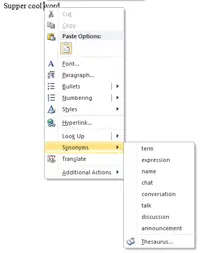
    In the second column write down words associated with the first column. Synonyms can be quickly generated by typing the word in Microsoft Word, right clicking, and hovering over “Synonyms.”


    In the third column write down verbs associated with your company, products or services. These would be action terms. It is ok if a term is a stretch–this is simply a brainstorming session.

    In the fourth column write down any words that have a double meaning. Draw upon words in other columns and find double meanings, insinuations, and variations. Alternative spellings or clever phrasings can be used to create a witty name that people will remember.

    In column five you will write down external references. You are looking for any phrases, quotes, or book titles associated with your industry. Identify existing manners of speech that are common knowledge and well-known. This will be especially helpful for businesses that are competing in a more ambiguous market.

    Once you have a good chunk of words and phrases, get rid of anything that is obvious garbage. Pair up words from each column, and mix and match to see if you can come up with a keeper.

    If this has been of any help let us know, and it would also be cool to see what names you came up with.