Tag: Growth Strategy

  • Unleashing Your Financial Freedom: A Guide for the Stuck Professional

    Unleashing Your Financial Freedom: A Guide for the Stuck Professional

    In the world of 9-to-5 jobs, it’s easy to feel trapped in a cycle of monotony, yearning for a change but not knowing where to start. If you’re a working professional feeling stuck in your job and dreaming of financial freedom, you’re not alone. The journey from employee to entrepreneur is fraught with challenges, yet it’s undeniably rewarding. This article is your beacon, guiding you through the murky waters of entrepreneurship and business creation, inspired by the ethos of the ShyEntrepreneur.

    Step 1: Embrace the Entrepreneurial Mindset

    The first step towards financial freedom is a mental shift. You must transition from an employee’s mindset, focused on tasks and waiting for directions, to an entrepreneur’s mindset, and realizing that you are your first business. This shift doesn’t happen overnight. It begins with cultivating self-discipline, resilience, and a constant thirst for knowledge. Embrace failure as part of the learning process. Every setback is a step towards success.

    Step 2: Identify Your Niche

    One common pitfall for aspiring entrepreneurs is the allure of jumping into highly competitive markets without a clear differentiation strategy. To stand out, you must find a niche that aligns with your passions and expertise. This approach ensures you’re not just another player in an over saturated market but a pioneer in a specific domain. Conduct market research, identify gaps, and evaluate how your unique skills can fulfill unmet needs.

    This step is very important and not always as easy to figure out as you may think. Jim Collins refers to it as the Hedge Hog concept. What is it that you can be the best in the world at that your deeply passionate about and can also make you money.  

    Step 3: Plan Your Escape Strategically

    Transitioning from a full-time job to entrepreneurship requires meticulous planning. Start by setting clear, achievable goals. How much do you need to save before you can quit your job? What milestones must your business achieve before it can support you financially? The goal is not to jump ship at the first sign of trouble but to navigate your way to entrepreneurship with a compass of wisdom and preparation. Just because you plan your exit doesn’t mean you will make one. Additionally, a lot can be gained by continuing with your current employer.

    If your entrepreneurial itch is in the same industry as your current employer wouldn’t it be a good idea to work together? If not together perhaps you may work with the same customers. The possibilities are endless and so long as you don’t have a conflict of interest you may very well be able to offer synergistic solutions. So, when we say plan your exit that is all we mean, plan. Don’t see that as the end goal but simply a tool that you can lean on.  

    Step 4: Build Your Brand

    In today’s digital age, your brand is your most valuable asset. Start building your brand even before you leave your job. Create a compelling online presence through a professional website, social media profiles, and engaging content that reflects your business values and mission. Networking is key. Connect with industry influencers, attend relevant workshops and seminars, and consider finding a mentor who can guide you through the initial stages of your business.

    Visit your current customers and suppliers. If you are in the industry you want to be in why would you not reach out to those around that are playing ball in the same field? These relationships will not only help you build “your brand” but so long as they are sincere they will likely also help your current employer. Win win.

    Step 5: Lean Start-Up Approach

    The lean start-up methodology is a game-changer for new entrepreneurs. Instead of launching with a complete product or service, start with a minimum viable product (MVP). The MVP is the most basic version of your offering that allows you to collect the maximum amount of validated learning about customers with the least effort. Use the feedback to refine your product or service, ensuring you’re investing resources into something your customers genuinely want.

    One of the biggest roadblocks people have is making their fist sale. Once you make your fist sale watch out because more are on the way. That first sale indicates that you have found a way to add value. If this is true you will be surprised at how many other customers are going to need what you provide.  

    Step 6: Master the Art of Financial Management

    Financial literacy is non-negotiable. You must understand the basics of accounting, budgeting, and financial planning. Keep your business and personal finances separate. Having a hard line between your business and your personal life is key to success. There will costs for you to provide your service and it isn’t always clear at the time what all of those are. This is especially true while you start up. Cash flow management is not a tough skill but it is essential to reach profitability.   

    Step 7: Prioritize Work-Life Balance

    The journey of an entrepreneur is marathon, not a sprint. It’s easy to fall into the trap of working around the clock, sacrificing your health and personal life at the altar of your business. True financial freedom includes the freedom to enjoy life. Set boundaries for your work hours, prioritize tasks, and make time for self-care and family. A balanced life fuels creativity and endurance.

    My wife and I ran into this a few years into each of our businesses. Both of our companies got an influx of orders at the same time and intern required us both to turn our focus away from the family for a season. That season sucked but it also taught us that at the end of the day all the money in the world isn’t worth a dime if it cost our family.

    Step 8: Embrace Continuous Learning

    The world of business is ever-evolving. Stay ahead of the curve by committing to continuous learning. This could mean taking online courses, reading industry publications, or attending conferences. The more you learn, the better equipped you’ll be to make informed decisions and innovate within your business.

    I really enjoy audio books and listen to them every day. Whenever I am in the car an audio book is going rather than the news or the radio. If I hit upon a book I really enjoy I buy the hard copy and go through it with a high lighter. Its amazing how much different the experience is. Knowledge has a compounding affect so keep leaning and don’t fall into the trap of thinking you know there is all there is to know about anything.

    Step 9: Scale Your Business

    Once your business is stable and profitable, consider scaling. Scaling involves expanding your business in a sustainable way that increases revenue without a corresponding increase in costs. This could mean diversifying your product line, expanding into new markets, or optimizing your operational processes. In all likelihood your business will initially be service based so think long and hard about how you will be able to do this. Scale too fast or in the wrong direction and your business and life balance will suffer.

    Conclusion

    Achieving financial freedom through entrepreneurship is a journey of transformation. It requires you to step out of your comfort zone and embrace the uncertainty of the entrepreneurial path. It’s a journey fraught with challenges but also filled with opportunities for growth, learning, and fulfillment. Remember, every successful entrepreneur started somewhere. With determination, resilience, and strategic planning, you too can navigate the path from feeling stuck in a job to thriving as an entrepreneur.

    The road to financial freedom is not for the faint of heart. It demands courage, creativity, and an unwavering belief in your vision. But for those who dare to embark on this journey, the rewards extend far beyond financial prosperity. They include the freedom to create, to innovate, and to make a difference in the world. So, take that first step today. Your future self will thank you.

  • Growth Strategy, When to Step Up Capacity.

    Small and home-based businesses need to operate as efficiently as possible and following a growth strategy is a significant part of that equation. Knowing how and when to grow is essential to expanding as fast as possible without overextending.

    In the survival phase growth is not the focus but as a small business matures growth should be addressed. Growing too quickly puts excess burden on your system. Mentally and physically if you are taking on too much change too quickly you will burn out and the company will not perform to its potential. Even worse, if financially the additional capacity requires more than what you have in your bank account you may be buying yourself into closure.

    On the other side of the coin growing too slow has the possibility of leaving a lot of opportunities and money on the table. Unless you are locked into some strange niche that only you know about you need to be thinking about how your market is changing and how you are going to react. With time small businesses fail so an intentional growth strategy should be in place. Having such a plan is a sign of a healthy company.

    You are your benchmark

    Don’t compare your growth with anyone other than yourself. If your market is blowing up and you aren’t seeing the same trend you may want to reassess your situation, but don’t get caught up in performing according to any other benchmark than yourself. Many businesses are taking part in your market but if you want to truly succeed keep the focus off of the competition. Trying to emulate a move a competitor makes is like trying to wear cloths that are not your size. Your path is your own.

    How is your capacity?

    Your capacity dictates your ability to grow. Too little capacity and it will be noticed in your services, to much capacity and operating expenses will be high. If you are sitting on an endless trust fund and can support a bloated overhead that is great, go for it. If you are like the majority of people out there you are probably hugging the other end of the spectrum. Knowing at what point you need to step things up is vital for long term success.

    A great indicator of one’s capacity is due date performance. Are you providing your product or service consistently on time? If not you may have too little capacity. If so, you may have enough or too much capacity. In one job I worked I gaged our capacity by the number of people calling complaining they hadn’t seen their parts yet. The more calls I received the closer to capacity we were.

    Knowing at what point you need to increase your capacity.

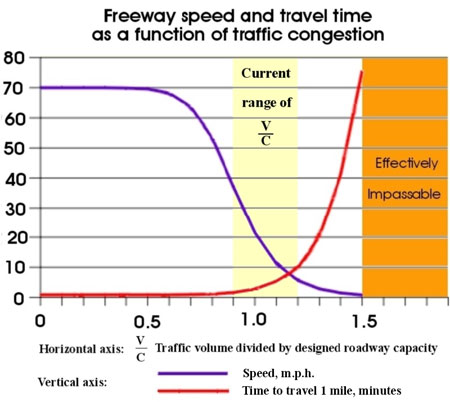
    A good number to work with is 70%. The output of a resource will decline as it is taxed beyond 70%. This truth is easily illustrated in the capacity of a road way.

    We are not shown the capacity or the volume but we are shown what happens when that ratio approached and exceeds 100%. The graphic has 90 to 120% highlighted but notice when our travelers start hitting their breaks. The first signs show up shortly after reaching 50% capacity but they really start to drop off when they hit the 70% mark.

    As a business, your capacity works the same way. Knowing this allows you to take the appropriate measures before your customer base realizes you have too much on your plate and no way to meet the demand. Using this metric is also helpful in making sure you don’t grow too much too fast. Increasing capacity to handle 10 times the volume a small company will see in the near future is a sure fire way to bring a company to its knees.

    How much capacity to add?

    The amount of capacity to add will be a function or your market and your growth strategy. As a hint, the overall throughput of a business is limited by a single resource. So, don’t think you have to double the capacity of every resource in order to double your total throughput. Identify the resource that is the constraint and follow the 5 focusing step of the Theory of Constraints to improve the system. This is by no means a hard science but it is a great place to start and a good general rule to follow. If you are not familiar with the Theory of Constraints we have some write ups available.

  • Reader’s Questions on Contemporary Business Issues.

    The following list was posed to me by a reader so I thought if this person had these questions others may also. Each refers to small business and the issue of growth. I left the questions as they were asked

    1. Are small to medium sized companies innovative needs, more crucial to their success than large companies?

    The level to which innovation plays a role in any business can be huge so it is hard to say under which paradigm it is more important. Innovation allows for greater competitive advantage regardless of one’s size, industry, or market. That said I would say it plays a larger role in the larger business environment for a few reasons.

    The first is that a small business by definition operates more on a service level. It is the speed and agility of a small business that give it an advantage. This service is generally not a cutting edge thing it is simply meeting the customers where they are to fulfill their specific needs. This means one does not have to be as innovative to bring customers in the door.

    The second reason I would say larger companies rely on innovation a bit more than the smaller business is the nature of the large business environment. The large business environment by definition is mature and does not allow much room for profitability (per unit). The products or services have been ringed down to their bare bones so every last cent is off the table. It is here that innovation can truly shine. Taking the old model and throwing a new spine or innovating can produce huge returns.

    2. Can you increase market share while staying small?

    The short answer is yes but this question suggests that the ability to step into a larger space exists. If you have a niche carved out and want to grow within this niche then increasing market share and remaining small can be a reality. If on the other hand one would like to step outside of their niche and grow their business through other avenues additional investments and external help may be required. It boils down to how quickly one wants to grow.

    Any business could grow to any level to serve any number of markets but how it does so depends on the paradigm it operates under. A small business has more of a flat organizational structure and generally has slower growth rate. A large business will likely have layers to their organizational structure, external investors and can grow quickly.
    One’s growth is subject to the resources available. Small businesses generally don’t have a ton of money behind them and can’t make huge moves in a short amount of time. A small business would also lack the network and infrastructure to attack a world market whereas a larger business may have these things in place.

    So, to answer the question; it depends on how you want to grow.

    3. What are some advantages and disadvantages to having stayed small?

    I have written two articles that I believe will answer this question.

    Advantages; The Advantages of a Small Business

    Disadvantages (realities); Small Business Volatility

    4. Is the product/service of a small company more prone to imitability?

    Everything can be copied, the value a business brings to the table is not simply the “What” but the “How”. A perfect example is McDonald’s. Most would say they could make a better burger than McDonald’s but very few can deliver their burgers around the world in less time than McDonald. By the time you drive up to the window your food is waiting for you.

    Think of the best burger you have ever had from a restaurant… now, which company do you think makes more money, the one in your head or McDonald’s?

    5. What is the ideal size of your company and do you believe that growth is inevitable?

    You need to be big enough to serve your customers yet small enough to keep your overhead low. Size is dependent on so many things that I believe it would be worthless to try and nail a head count or square footage down.  That said I think most would be surprised at how small a business can be and still compete on a big level.

    Growth is inevitable if you want the business to outlast you. In the short run any business can tread water without growth. Think of anyone you know that is self-employed. They are their business and as long as they continue to offer their product or service the business will exist. The second they stop offering their services the business halts. I maintain that growth is required if you want to see prolonged monetary success.

    I hope everyone got something out of the above and by all means if you have any questions let us know.
    TJ

  • Chaos Vs. Bureaucracy

    You may not realize this but as an entrepreneur one of your main functions is finding the balance between chaos and bureaucracy. If you take a look at successful organizations you will see they have somehow found a happy medium between these two extremes. It is this balance that allows organizations to flourish and will be required if you want to take your company to the next level.

    My first exposure to this dynamic came as I was trying to push a product line in an organization didn’t share my same directive.  The problem was that the product line required formal processes in order to continue to scale up but the organization as a whole operated on the “get-er-done” approach. Talk about frustrating, how is one supposed to facilitate the exponential growth of variability through putting out perpetual fires?

    This lead me to a book that gave me a new perspective on managing growth. The book was

    No Man’s Land: Where Growing Companies Fail.

    I enjoyed the book in that it helped me communicate my dilemma but a few assertions it made could be discounted by the now non-existent financial organizations it referenced to.  One exert that I especially appreciate was;

    “The resources and approaches that allowed for growth in the first place can be insufficient or an obstacle for growth in the future.”

    This is so vital to long-term success. Understanding organizational needs change with growth is huge. This begins right after startup and continues through each stage your company passes through. The book focuses on one significant stage referred to as “No Mans Land”. This is the point at which a company is too big to be small and too small to be big.

    So how does the size of an organization tie to the balance between chaos and bureaucracy? Generally speaking smaller organizations have fewer formal processes and operate under a flat management infrastructure. Larger organizations have more formal processes and operate under a hierarchical infrastructure. A deeper discussion on this and the small business advantage is discussed in the article The Advantages of Small Business. The balance however is not an easy one to find.

    Small businesses on the “Chaos” side of the spectrum have a great flexibility and agility to fulfill the customer’s changing needs in a moment’s notice but don’t have the ability to handle large volumes. Larger businesses on the “Bureaucratic” side have the ability to facilitate a common need over and over again at a high volume but lack the ability to change to accommodate a custom need. Too much towards Chaos and you will find yourself with a lot of waist, rework, and similar inefficiencies; too much toward Bureaucracy and you will find yourself buried in formalities, paperwork, and pointless meetings.

    So what is the answer? In short it is finding the right people. The intricacies of your business are known only to you and your people and they are the ones that will make the day to day decisions that will allow you to not weigh your organization down with bureaucracy while simultaneously avoiding excess chaos. To be honest with you this can be a hard answer to swallow, it means we need to trust and invest in people. If you are able to do this however you will find your life and business begin to operate at a higher standard.

    So, you have the right people and your company begins to grow so much so you now find yourself approaching “No Man’s Land”. This means you are faced with the challenge of making a leap forward from a small business paradigm to a large business paradigm. You have hundreds of customers, thousands of products and simply can’t keep up given your current infrastructure. What do you do? If you are a restaurant perhaps you head towards franchising, if you are a designer perhaps you create a proprietary line or product, and if you are a manufacturer perhaps you simply gear up to handle a worldwide market place. That is if you are willing to make the leap. As Doug Tatum mentions in his book making the leap may not be the best choice for you and your organization.

    What should you take away from all of this? Most of all understand that you won’t have all of the answers. Building a business is iterative and each step changes the game. You begin the learning cycle, build upon your intuition, keep the things that work, and get rid of the things that don’t. I would advise younger organization and entrepreneurs to simply dig in and work hard. A sole proprietor needs simply to push and push out of the gate and refine his or her game plane as the knowledgebase grows. Good business is meeting your customers’ needs it is not having immaculate paper work or flawless products. You will mess up but everyone does. Cater to your customer (within reason) and you and your company will have a bright future.

  • The Advantages of a Small Business

    It may not be evident at first glance, but small businesses have a huge advantage over large companies in many regards. Small firms don’t have the deep pockets to weather storms, but they do have the flexibility and focus that is not commonly found in larger corporations. This means that the ability to meet the true needs of the consumer is much higher than it is for big brother. This is a key truth that needs to be understood if you are pursuing a small business venture. Many small businesses lose sight of the value they offer by shooting to meet a larger general need without first addressing the specific needs of their niche.

    Economy of Scale

    How is this possible? It is tied into the economy of scale and the law of averages. Economy of scale comes into play when larger organizations obtain price breaks for bulk orders placed in advance. The large company has a historically high demand for a given product or material, so they seek to grab a bunch of it at once in order to save on a per-part basis. Evidence of this can be seen in the price difference between a grocery store and a convenience store. The grocery store has much larger volumes of any given product than the quick stop, and it has much higher prices than the grocery store for the exact same items.

    For the small business, this can be used as an advantage over larger counterparts. The company that has placed the larger order has effectively made a commitment to supply a specific something to a specific market share. In other words, they have targeted their focus on one demand. Consequently, this can prevent a large company from venturing outside of their chosen focus. The small business is free of this commitment and focus and has the ability to cater to the market share that is not facilitated by this cookie-cutter solution. Custom solutions that cannot come from larger companies are available from a small-scale business.

    Law of Averages

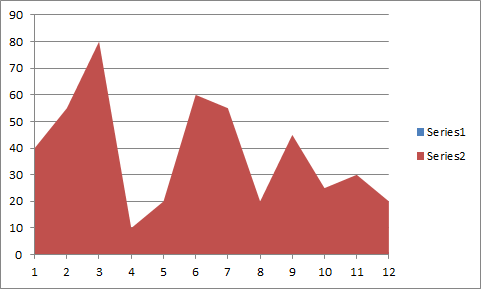
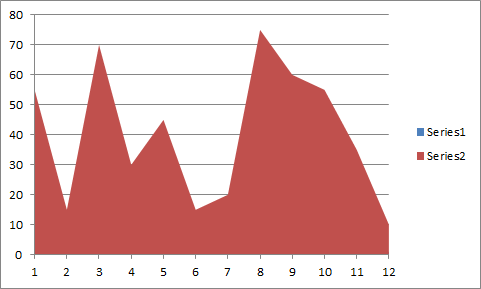
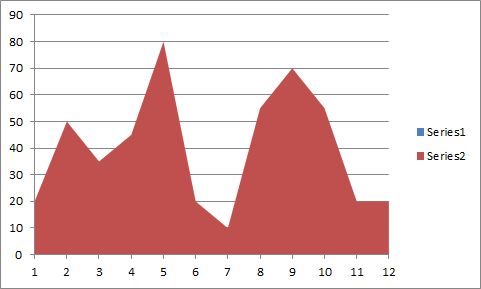
    The law of averages states that a series of random events will collectively even out, given a large enough sample set. So let us say that a large conglomeration wants to begin buying up all of its smaller competitors. The annual sales of three companies could plot out like the following:
    Company A:

    Company B:

    Company C:

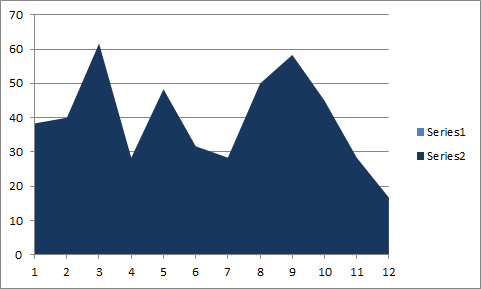
    Now, I am not concerned with specific numbers at this point, I am simply pointing out how the law of averages works. Once acquired, these three companies’ overall sales could combine to plot as follows:

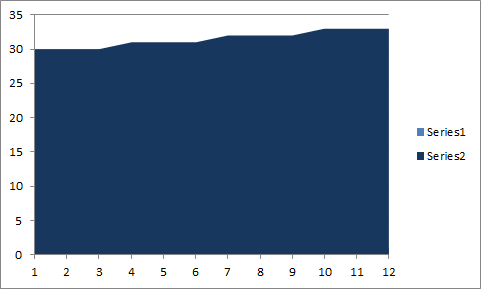
    Notice how the peaks have dropped and the valleys have elevated. If said conglomerate were to continue to acquire companies with similar numbers, the collective average would begin to mellow out even more. Large companies like this dynamic because the overall fluctuation is brought closer to zero. In the first three graphs, the difference between the highest peak and the lowest valley is as much as 70. In the averaged graph, the difference is less than 50. This consistent, stable arrangement creates fewer variables and fewer dependencies on a per annum basis. With time and enough acquisitions, the goal would be a graph similar to this one:

    The overall deviation is much lower, and there is a fairly constant growth rate.
    As a company begins this transition, it is fundamentally becoming less customer-focused and more business-focused. This is not necessarily a bad thing, as it will help keep the business and the jobs it creates around. It does, however, open the door for small businesses that seek to cater to custom solutions.

    Batching Departmental Resources

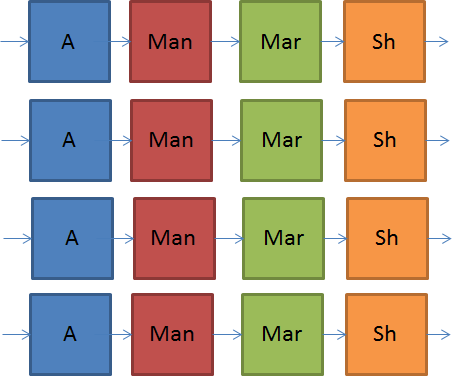
    To further illustrate the advantage small businesses can have, here is another way of looking at it. Let’s say a company type is comprised of four departments; Accounting (A), Manufacturing (Man), Marketing (Mar), and Shipping (Sh).  Let’s also assume that every purchase order must pass through each department for order fulfillment. The process would look something like this.

    Now, let’s suppose four similar companies are purchased at the same time, each focused on a slightly different niche. We would initially have four companies under one owner working in parallel.

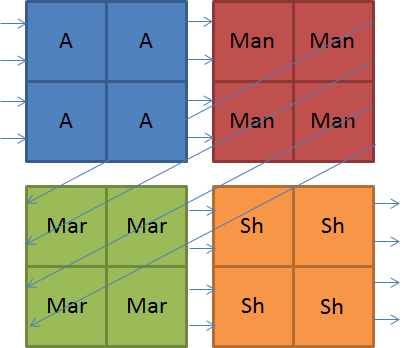
    At first there, is no disruption to each individual company’s flow. They each serve their customer base just as they had prior to being acquired. At some point, a bean counter decides that the overhead associated with four similar but different companies is not justifiable, and the decision is made to consolidate by department. One large facility is purchased, and all of the equipment and personnel are moved in order to facilitate a “more efficient” solution.  Rather than having four accounting departments, there is now only one. Instead of four manufacturing departments, there is only one. On this goes for each part of each company until it is all under one roof.

    Now, let’s push the same four orders through the system and see what happens. Remember, previously we had four parallel systems and now we have one large system in series. Like before, each order must pass through each department. The flow would look like this:

    In a linear world one could argue that there would be no difference in the turnaround time. The load-to-capacity ratio appears to be the same in both the separate parallel systems and the consolidated system in series. The truth, however, is that the complexity of the consolidated system has introduced layers of bureaucracy that were simply not needed when each system was in its original simplified form. Now when an order comes in, it must find its way to the appropriate accountant, then to the appropriate line on the manufacturing floor, then to the appropriate marketer, then to the appropriate shipper.  The additional paper pushing begins to clog the system and extend the overall turnaround time.

    Lost in Numbers

    With the new system, the ability to cater to a unique desire of one customer becomes more laborious. As a whole, the consolidated company fundamentally cannot service its customers as quickly and effectively as it could when every aspect of the company revolved around a single niche. The benefit to consolidating is a lower overhead and less overall fluctuation in demand. Each industry will be affected by this dynamic differently, but consolidating in this manner will slow down throughput.

    Long Live the Small Biz!

    I take the time to illustrate this so you can effectively focus your efforts in ways that will truly add value. Small business by nature is volatile and every bit of help that one can get is good. Don’t waste your efforts competing where you have no place. Play into the strengths you have as a small business and service the heck out of your market place. At some point, it may make sense to make the transitions mentioned above, but it is something that must be matured into.

  • Case Study of a Successful Little Business

    I recently had the privilege to review the 10 year performance of a successful little business and want to touch on some of the general business principles that allowed this success. Confidentiality prohibits me from including specific details but you probably don’t care about those anyway; you want to know what you can take away for yourself. The company operates as a small business and has the volume of a good size organization with annual revenues over 10 million.
    What makes this case study interesting is that the subject company has seen roughly a 20% annual growth rate for the past 8 years. In case you didn’t realize it a 20% annual growth is HUGE and to do that for 8 consecutive years is even more amazing. Another twist to the story is that this company competes in an industry consisting of large conglomerates.

    So, how did they do it? Well, the answer isn’t a short one; there are many factors that played into their initial and continued success. The best explanation I can find for this dynamic is the “Fly Wheel” effect found in Jim Collins book Good to Great: Why Some Companies Make the Leap… and Others Don’t. Basically there was no one single decisive point that shot the company into the world of success. Rather, it was a continued effort (pushes of the wheel) that collectively allowed the company to grow. Interestingly enough each “push” is in itself unique and wasn’t required until the “push” before it was in place. This means that one of the biggest challenges of growth is the dynamic nature of changing needs.
    Dynamic Needs of Growth

    As a business grows its needs change and efforts must be shifted to accommodate the new demands. This fundamental truth is in part the reason few people “Get rich quick.” Healthy sustainable growth happens at an organic rate and through iterative efforts. I believe this dynamic is also much of the reason small businesses have such a terrific failure rate.

    The needs that exist when you start a business will not be the needs required to grow your business. Additionally the needs required to grow your business initially will not be the needs required to grow your business down the road. These needs will obviously be business and industry specific but what you need to understand is that your business is a changing entity that requires more than a single fixed solution to survive. Think of it like a plant that needs water to sprout, then apple juice for the next three weeks, then beer after that. If you simply continue to give it water it sprouts and flounders for a bit then dies. Wait, sprout and flounder for a bit before it dies? That sounds a lot like most small businesses. Hmmm.

    Back to the Case Study

    An added advantage to our case study that I don’t want to leave out is that its parent company has the finances to pay for changes that need to be made. This may not seem like much but it is a big deal when a company has to find the money to make the changes needed to grow. If you can’t already foot the bill for your planned growth it means you will need to assume additional risk beyond that inherent to the change you want to make. The lesion here is that good old saying “Cash is King!” As a small business you simply cannot afford to be cash poor if you want to grow. In some respects this is where the art of business comes in. Depending on your circumstance the question of how to manage your business successfully will change.
    The subject company leveraged its parent companies willingness to foot the bill on many occasions. Resources were acquired and workers were put in place each time a legitimate need existed to do so.

    Market Positioning

    I mentioned earlier that the subject company was competing in an industry with many large players, how is this possible? It was made possible by sticking to a market position that played into the strengths of small business. As a smaller company it could provide a higher quality product and service to its customer base than its larger competitors. It could also offer these products and services in a fraction of time. The larger organizations have bigger pockets, a larger product scope, perhaps even greater human capital, but none of those matters when a customer needs a high quality solution with a fast turnaround. What would take the large company 2 months the subject company can do in 3 weeks. When problems arise the large organizations have layers of bureaucracy between the customer and the person with the solution while subject company has a non-automated phone system and customers are patched directly through to the parties they care to talk to.

    The subject company has also decided not to compete on cost. Meaning, they will pass on jobs if they don’t feel they are appropriately compensated. This is hard for most small businesses because business is not always coming in at a constant rate. Consequently the subject company receives more money for the time and resources it puts into its work. This is justifiable because of the quality and speed with which the customer is served.

     K.I.S.S and Get ‘er Done

    As an engineer I must admit that I have had trouble with these principles but have learned to greatly appreciate them. At the small business level the K.I.S.S (Keep It Simple Stupid) and Get ‘er done attitudes can go a long way with the customer base. Over complicating a solution or following a bloated process can actually get in the way of solving the customers true problem. Remember, the customer doesn’t want your product or service, they want what your product or service will do for them. In other words if you can address their problem not the means to the end you could be offering more value to the customer. The subject company recognized this and removed all layers that didn’t speak to the customer’s core problem. Upper management is kept thin with no middle managers, everyone wears many hats, and open communication is maintained among the staff. The human capital element is highly leveraged making each employee more of a craftsman if you will rather than a number.

    Do You See a Bright Future?

    After witnessing all of these realities in such a successful little business I am certain they have a bright future ahead of them. My hope with this assessment is that you will find ways to apply these principles and consequently see similar success. If you are having luck let us know, and if you have questions feel free to leave a comment.

  • How To Measure Business Performance. Effectiveness Vs. Efficiency

    I found myself in yet another interesting conversation with a successful entrepreneur on the topic of successful business practices. We were discussing what is needed within an organization as it grows from a mom and pop shop to a mature corporation. It is obvious that the demands of the company will change as it matures but how do we measure business performance? Other than the bottom line, what can we look at to know if we are on the right track?

    Industry Life Cycle

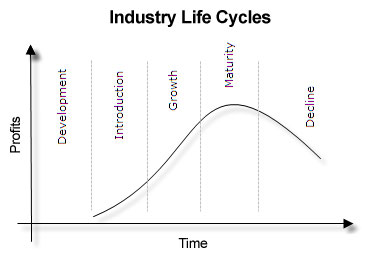
    The answer to these questions will differ depending on your industry and where the industry is in its life cycle. There are many good articles out there discussing the industry life cycle so I won’t explore that here other than to say if you are in a more mature industry you will have your work cut out for you. Here is a quick look at the life cycle.

    (PHOTO)

    A small business generally competes in non-mature industries. The reason for this is that a mature industry has been around long enough to attract the attention of big players who will have deep roots. It is not impossible to compete in a mature market but keep in mind you will need offer more than you would if you were in a new or growing industry. In a mature market purchase decisions are generally made on preference rather than on need.  Think of Coke and Pepsi or MacDonald’s and Burger King. Arguably the products don’t offer a different value, they are simply preferred. Hint: when dealing with preference you start to walk down the road of brand recognition and huge ad spend. This is where big marketing companies can come into play.

    I explained the above to give you an idea of where you may be in order that you may know where you are headed.

    Decisions Decisions

    Back to measuring business performance. The core conflict that can arise in any stage of the cycle is pursuing efficiency vs. pursuing effectiveness. As an engineer I must admit my bent is to go after efficiency with everything from the start but that is not always the best course of action. The entrepreneur I mentioned earlier shared a story from early in his career.

    When he was younger and working for a successful business owner he found himself struggling with some hard decisions that would affect the company. The owner noticed him in his dilemma and said “Just make a decision. Do what you can and get things done. If you make the right decision 50% of the time you will move forward, if you agonize about each decision the world will pass you by. Now I’m guessing you will do better than 50%” From that point on my friend has been much more of a “get er done” type of guy and has built a multimillion dollar business.

    Fear of Mistakes

    It is my belief that our fear of failure pushes us not to feel ok about making mistakes. It is this fear that leads to the all too common “Paralysis by Analysis”. We may argue that it is for the sake of efficiency that we weigh and reweigh our options but I would suspect fear is the main driver.

    That’s not to say we should never concern ourselves with efficiency because it is quite vital for continued success. I would argue however that in a small business, initial efforts should be concerned with effectiveness while later efforts, once you are established, can address efficiency. Remember the life cycle above? The efficiencies and the cutting of the fat are not introduced until more players enter the market and the need to be efficient is required for survival. So, said another way;

    Initially a business or organization does not need to be efficient they need to be effective. Efficiency comes into play later when market demand requires you to sharpen your pencil or resource availability becomes limited.

    So, don’t worry as much about how a job is done as long as it gets done and doesn’t put you in the red. This takes a bit of intuition but a mistake can often teach you more than success on the first try which in turn build your human capital.

  • Entrepreneurs, Take Advantage of the Business Cycle Phases

    Entrepreneurs, Take Advantage of the Business Cycle Phases

    I recently met with my financial advisor and our discussion sparked an idea for this post. I am going to discuss the business cycle and how as entrepreneurs we can better position ourselves to take advantage of the phase changes.
    The Business Cycle

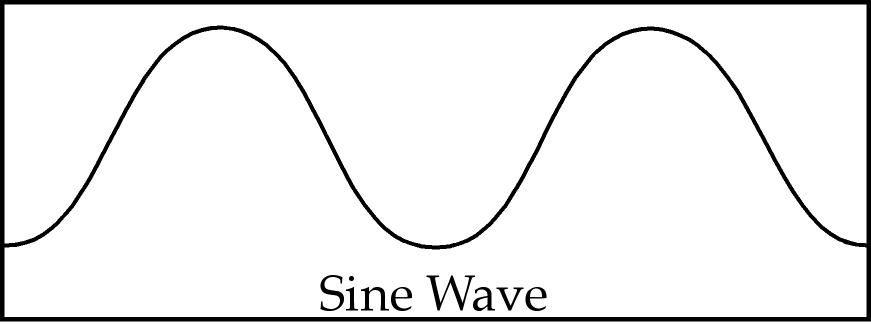
    As you know there is an ebb and flow to our economy with times of prosperity and times of poverty. If you are not aware of this you need to open your eyes. The big thing to note however is that the cycle is just that, a cycle. No time of prosperity or poverty ever lasts forever. What does this mean for you and I? It means there are continual opportunities to position yourself and your business to make a profit. This is the strategy my advisor and I are following with my portfolio.  The cycle can be thought of as the following a Sine wave;

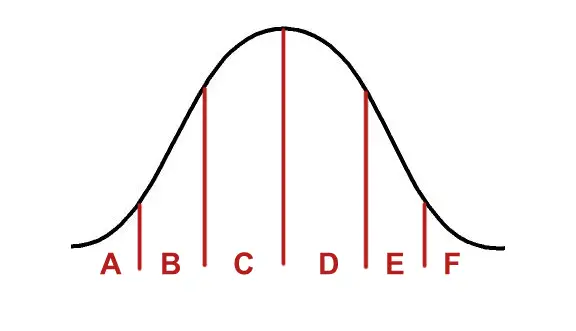
    This isn’t entirely true of course but it does illustrate the general rise and fall. The common approach is to break the cycle into four parts: Recovery, Prosperity, Recession, and Depression but, for the sake of this article I have broken the cycle into 6 parts. The image below breaks the cycle into 6 parts each found between inflection points. The idea here is that the inflection point denotes the beginning of a change.  “A” represents the recovery phase, “B” is growth, “C” indicates maturity, “D” can be considered to be a correction, “E” is decline, and “F” the beginning of the next recovery. This cycle as I said is not perfect but has roughly a 2-3 period.

    Why should you care? Just as an investor will change his portfolio for the coming economic land scape you can position yourself accordingly. For example companies that do well in recovery are generally smaller firms that assist in efficiencies. Doing more with less is the name of the game in recovery. IT businesses can find themselves in this group as IT products often allow for higher internal efficiencies.

    In the maturity phase (C) the companies that do well are the larger institutions that are less effected by the market landscape. These companies are often so big and so diversified that they never see large spikes in any regard. The law of averages keeps them on a steady path. For the entrepreneur this could mean moving away from the “want” areas of your industry and into the “need” areas. What is it that your customers absolutely cannot live without? How can you offer solutions that don’t focus on options but feed into the core need of a person or business.

    The time to position yourself or your company for each change is in the preceding phase. This will often be in the growth (B) and decline (E) periods. Some of you run businesses that can be easily tailored to these changes while others of you do not. Service based organizations can alter their packages to offer a better angle on the market whereas product oriented businesses may need to diversify their product line. Again, your specific industry and circumstance will need to be taken into consideration.

    Other Cycles

    Cycles are everywhere and if you are aware of them you can often profit greatly. Annual cycles that affect many industries are often tied to the weather. Construction for example often slows in the winter because of the snow fall in cooler climates. The warmth of summer is also a catalyst for the soft serve beverage establishments. In fact, because I live in a 4 season area I decided against opening a self-serve yogurt shop in 2008. I watched a few similar establishments go under because they couldn’t carry an overhead through the winter months. If I were to have moved forward I would have had to offer more than frozen yogurt and I didn’t want to go down that path.

    It would also be advisable to change your buying habits such that you purchase items in their off season. I haven’t tried the following but I have often wondered how much money one could make if they simply purchased lawnmowers in the winter from Craig’s list and sold them in the summer. The same could be done for snow blowers, picking them up in the summer and liquidating them in the winter. Doing this would exploit the cyclical nature of the demand that follows the weather. Of course this would require you to hold the items for half a year or so but I think it could pay off.

    Out of Phase

    As Warren puts it; “you should be fearful when others are greedy and be greedy when others are fearful.”  This phrase speaks to the idea of setting yourself apart from the rest and positioning yourself for the effects of group think. You want to stay out of phase with what the majority of people are doing. Staying ahead  of the curve often means not adopting what everyone else has adopted. Find a unique angle and go with it, don’t model your approach after the market you will be lost in the masses. To read up a bit more on how to set yourself apart check out The Competitive Advantage Spectrum.

    The dynamics we are talking about also hold true on the business to business level. Companies that sell out to other companies often do so because they plaid into the masses. By playing into what everyone wants you will water your business down until you find yourself in a financial crisis and in need of someone to bail you out. Pricing wars can quickly lead to this. If a competitor is selling a product for less than what you can make it for you are either in the wrong industry or your competitor won’t be in business long. Dropping your price to meet theirs will only lead them to do the same and ultimately lower the expectation in the customer’s mind of the price for your product or service. This is one of the reasons why I tell all small business owners never to compete on price.

    Conclusion

    Play your own game. Take the cycles of your industry into account but don’t allow them to shape your business. Just because your customers want to pay less doesn’t mean you need to lower your price. There are many creative ways to meet the coming changes but you will need to step outside of what everyone is telling you and find a unique position that has not yet been exploited.

  • How to Manage a Business Successfully

    I recently had an interesting conversation with a business owner on the topic of how to manage a business successfully. We concluded that all businesses are working towards further growth and that a primary management concern is growth strategy. So, to manage a business successfully, one must manage growth successfully. How is this accomplished, and what considerations should be made?

    Neil Churchill has an amazing write-up titled “The Five Stages of Small Business Growth.” In it he discusses the characteristics of small business types and what to expect at each stage of development. He defines five stages of development: 1.Existence, 2.Survival, 3a. Success-Disengagement, 3b. Success-Growth, 4. Take-off, and 5. Resource Maturity.
    As you can imagine, the concerns at each stage differ, and conflict can arise simply from people’s perspective of a company’s position. If a company is in stage 3a but a manager is under the impression that they are in stage 4, the decisions made could have negative ramifications. At the very least, having management on different pages will result in contention among management. So, the first thing that must be established is a defined company position.  Secondly, the direction the company is headed must be agreed upon and communicated to all. Churchill’s framework is only one model, but it can be used as a starting point. If the industry you are in has a better model, use it.

    An Example of Differing Management Directions

    As my conversation with the business owner progressed, he explained to me how some of the management was inclined to seek slow growth strategies, while others wanted to be a bit more aggressive. As a TOC practitioner, I know there are assumptions pushing each view, and before I gave my thoughts I needed to thoroughly examine each perspective.
    The company has been around for a while and is diversified into roughly 5 industry types. The positioning and market share in some of these industry types is more mature than in others. The trend has been that change does not arise until a good deal of “pain” is felt from not changing. In other words, until there is an instant return on investment, change won’t occur. For the mature segments of the company, this is not a problem, but for the younger branches striving for growth, this is quite the headache. Without an established presence in an industry, a younger business cannot afford to move at the pace of larger, pre-existing businesses. Can you see the dilemma?

    Opportunity Cost vs. Over-Extension

    Opportunity cost is the cost of an opportunity not taken. For example, say you had a dollar to invest and the choice of two investments: A or B. You invest in A, which returns 10%, while investment B returns 15%. The opportunity cost of A is the 5% gain that was not realized because B was not chosen. This dynamic shows up in managing growth in the area of resource utilization. A company can either step up their capacity before demand exceeds it or after the demand exceeds it.

    Benefits of Stepping up Capacity Ahead of Demand

    Knowing when to step up capacity allows a company to manage its resources appropriately so that its internal capacity is not exceeded by the demand of the market. The idea is that the opportunity cost associated with having less capacity than market demand is quite significant.

    A retail example:

    This season’s highly anticipated new Nike shoe is the best thing since sliced bread. It is all the rage and every shoe store needs to have some of these on their shelf. Mom & Pop Shoe Co. put in an early order for 100 pairs and eagerly await their arrival. These new shoes are so popular that if an early order wasn’t placed, there would be no chance of receiving them before the end of the season. The season comes and Mom & Pop sell out of the shoes in the first month. The season is 3 months long, which means that for 2 months Mom & Pop have to turn away potential customers looking for the new shoes. At first glance, one might consider it a victory to sell out of the stock so quickly, but the unrealized loss is the 2 months of sales that could have been if Mom & Pop had ordered more shoes. Demand has exceeded capacity, and the unrealized sales could be as much as 3 times the sales of the first month.

    Benefits of Stepping up Capacity after Demand

    On the other side of the coin, the amount of risk assumed by Mom & Pop Shoe Co. was less than what it would have been if they had decided to preorder more than 100 pairs of shoes. Had they known the demand was going to be so great, they could have extended themselves out a bit more, assumed a bit more risk, and ultimately reaped a greater reward. Over extending one’s self is a function of the available financial capital. A business with a good deal of reserves can extend themselves further than a company with fewer reserves. Most Mom & Pop shops don’t have much money behind them, so avoiding the risk often times takes precedence over greater potential gains.

    Allowing the demand to “pull” on one’s resources may also be desirable for a company that is well-established and wants to maintain conservative growth. In other words, a large organization with the ability to extend themselves out a great deal may ultimately choose not to because the potential of larger gains at higher risk does not outweigh moderate gains at a lower risk.

    Conclusion

    So, given the above dilemma, which direction is best? The answer of course is a function of the organization.
    Smaller businesses are advised to maintain as fast of a growth curve as possible without overtaxing their current resources and without assuming too much additional risk. This means working up to the point at which the business is around 70% of its total capacity. A small business doesn’t want to exceed this because they will begin to see a drop in their ability to deliver on time. One’s due date performance is critical and should never be compromised for the sake of quick profits. It is also prudent to maintain cash reserves so as to carry the company through the unavoidable market downturns.

    Larger organizations with greater cash reserves and more resources have their choice on which course to take. As I mentioned earlier, they may choose to go with a slower curve because they don’t feel the additional risk is worth the potential reward. Or, it may be determined that a faster curve is ideal to pick up market share at a time when competitors may be hurting because of a downturn.

    It is assumed that all companies pursue growth, but the question is how best to manage growth? I would love to hear your thoughts and experience with this dilemma. Leave a comment or shoot me an email.