Tag: How To Make Money

  • Is Starting A Business In 2023 Going To Be A Good Idea?

    Is Starting A Business In 2023 Going To Be A Good Idea?

    No one knows the future so its tough to give a solid answer to this but what I can say is that starting any business at any time is a great idea if you do it the correct way.

    If you read through this site you will find many articles on all facets of business creation but the main idea we want to drive home is that much of what you need to know about business can be found by looking in the mirror. You are your fist business.

    People seem to think that starting and running a business is some sort of special action. Its not, at its core it is no different that much of what you already know. Now, there are a lot of facets to business and scaling an organization, hiring help, competing, and much more are all things you will hopefully deal with later but for now don’t make it out to be more than it is.

    So Why Do So Many Small Businesses Fail?

    In short, they are easy to start and hard to keep alive.

     Many businesses are established on the wrong premise or without proper forethought. I have met many people that say they want to start a business, but I have met very few successful business owners who said that it was easy. Every business owner I know that has done well has an ethic of hard work, stubborn persistence, and a knack for the market space they are in. In other words, if you want to do well in business you will need to find the right market to get into, the right value to provide, and strong desire to work through the tough times ahead. If you enjoy what you do, who you do it for, and like a bit of a challenge you have the makings of a successful entrepreneur.

    The Importance of Human Capital And Alignment

    A fundamental truth is that successful companies focus on their core competencies and work to meet the need of many markets. They don’t go outside of what they are good at. They compete on very few things, but they are best at those very few things. If this is true for the business, its true for you and I.

    What Are Your Core Competencies?

    By this we are asking what are you good at? What are the things you excel in? How are you geared as a person? What do people ask you to help them with?

    This may seem like a simple thing to answer but it is much more involved than you may realize. Even if you are good in some area we want to know if this area would be one in which you can compete in the free market.

    I’ll give you an example. When I started college, I thought that when you graduated you got some sort of golden ticket that guaranteed you a job so I may as well choose something I enjoy. I chose music. Over the course of two classes I realized that the people sitting next to me were cut from a different cloth. I may have been a decent musician, but I was a far cry from my classmates. In other words, if I was to go head-to-head against these people in the free market, they would have stomped me. I had a skill, I had a desire, but I didn’t have great enough of either to compete.

    I later found out that the primary career path for a degree in music is to be a music teacher. That was not something I cared to do.        

    How Will You Reach Your Target Market?

    If you are able to find a competence, where will you take that competence to solve other people’s problems?

    If you can’t answer this, I would suggest you have more planning to do. Its great to have an ability and desire for a business but if you don’t have access to a market, you won’t make it. In manufacturing for example someone can set up a machine shop but if they don’t have a market to serve, they will be hurting for customers. If on the other hand someone is the president of their local car club and active in classic car communities then they will only be a discussion away from their next project.    

    What Are The Financial Considerations Of A New Small Business?

    Out of the gate you will want to earn a profit as quickly as possible. If you borrow a bunch of money and have interest payments each month it could make this difficult. We are a proponent of a lean service-based business so that the initial capital requirements are kept to a minimum. We want the success of the business to fund its growth. We don’t want to presuppose any income will exist until it does.

    Service-based businesses will require very little overhead to start. You could get started as a virtual assistant with as little as a laptop and a few monthly subscriptions (internet/QuickBooks/etc.). Janitorial and window cleaning? A computer, a few subscriptions and a bucket of supplies. You see where I am going with this.

    What If I Don’t Want to Be the Person to do the Work?

    Um…I think you are reading the wrong blog.

    Your first business may not be your forever business, but you will learn a lot by getting out there, dealing with people, and adding value others are willing to pay for.

    Wherever you are on your income journey be sure to check out The Four Stages Of Wealth Creation; From Clueless To Capitalist. We put this together as a guide for those looking to grow their financial acumen and take their next step towards financial independence.
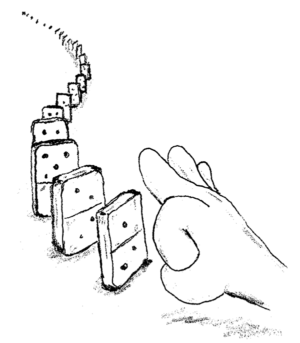

  • The Money Problem, The Rat Race, and Golden Handcuffs.

    The Money Problem, The Rat Race, and Golden Handcuffs.

    Throughout my early career I had people mention to me that I was smart. While that is a flattering comment, I would think to myself; “If I am so smart why am I still here” referring to my place of employment. This line of thought stems from the recognition that I was highly dependent on an employer. I later realized this isn’t the worst thing in the world but have long been intrigued by the fact that a smart guy like myself didn’t naturally solve this issue.  

    What is The Money Problem and The Rat Race?

    The “money problem” or “rat race” is simply a western culture idea that most people need to generate some money in order to make it through their day to day.

    Why was it that I could solve all sorts of problems for other people yet was not in control of my 9-5 reality? That perhaps is a bad way to state it, I was in control, but I chose to remain in a job that also made me feel stuck. What was going on here?

    Ok, so I’m not stuck, I choose to be in this job, yet part of me knows something is off. What’s off? Is it the justice of the value-added verses the compensation provided? Is that out of balance? Is it the freedom of schedule vs. the requirement to be at my desk? Was it the very nature of the work I was preforming?

    Hmm…. Let’s look at each of those.

    • Money. The money was good so I couldn’t say I was under paid or unjustly paid.
    • Schedule. While requiring most of my day, my schedule also offered a good deal of flexibility, but I didn’t have the schedule I was used to in college. Who does?  
    • Work. Solving other people’s problems and dealing with a degrading workforce was frustrating at times but the nature of the work itself wasn’t out of line with what I am geared to do. Some days I really enjoyed how much I was challenged. The hardest part was the politics and culture.

    Perspective, am I In the Race?

    It wasn’t the pay, the time, or the nature of the work that was bothering me. In hindsight I surmised that I simply needed to mature a bit and realize that my situation wasn’t bad, and my perspective was off. This pacified me for a while, and I continued moving forward. It would take a handful of years and a great deal more thought to return to the initial question.

    What was my end goal, what was my personal mission, and how is my current reality relative to those? I couldn’t answer this entirely. I knew much was lined up but not everything.

    Alignment, Is My Job in Line with Who I Am?

    I had alignment in my position and did well because of it. The way I am wired, my choice of education, and my fundamental entrepreneurial spirit allowed me to find success as an employee. At the time I didn’t realize it, but it was because I thought of my job as my business that I did well.

    I was hired into a division that was just about to take off and the pains/needs of growth were everywhere. I got a front row seat to a brand that would eventually become the leader in its market space. I by no means was the reason this happened but I was greatly involved from its adolescence to its maturity.

    I was hired before I finished college and brought on to do CAD modeling. I was considered “technical”, so it wasn’t long before I was given the task of building the website. Sure, I took a survey of computer class, but I had very little domain knowledge of the web. Fast forward a few years and a few sites later we were the number one result on Google for our direct competitors names and our customers had an online catalog at their fingertips. This may not sound like much by todays standards but at the time it was not the norm.

    The point is that the company had a need, I had the ability, and with those aligned a great deal of value was brought to the table.

    Opportunities Afforded by My Job

    Starting off in life with a good employer is a great thing. A W2 income in likely one of the fastest paths to generating cash. Once out of college a great deal of people find themselves going this direction. I would advise many to do the same.

    I would further advise someone to get in with an organization that is involved in a market that they have a passion for. The amount of experience and relationships that will build by means of working a W2 in your chosen industry is of great value. You can think of it as a risk-free way to lay the foundation for your future endeavors.

    I don’t remember the book I read it in but somewhere it was mentioned that if you want to start your own business spend the first 10 years of your career working in the industry you want to get into. Once you have a decade under your belt you are then fit to entertain the idea of starting a business.    


    Recognition of The Golden Handcuffs.

    So, with everything good that it brought me why was I still chewing on the question: “If I am so smart, what am I doing here?”

    Then it hit me.

    I realized that the business of me only had one customer…. Holy Crap!?!  That’s it!!!

    That customer paid well, paid on time, was very consistent, and great to work with. My family was provided for, and our quality of life was great. This customer provided a benefits package, paid me not to work a few weeks a year, and gave me money for a 401k retirement plan. All was well. In a lot of ways this was the best customer ever.  

    The problem was that this customer was the only one I had. All my eggs were in one basket and while it was a cushy basket the fundamental risk associated with this arrangement was less than prudent. I was wearing golden handcuffs. 

    Why didn’t I see this sooner? How could I let this happen? What was I thinking?

    In part because my head was down, and I was building my career and in part because that is what the environment around me expected so I expected it. In the early days I didn’t realize the risk of having one customer being responsible for all of my income.

    Many organizations establish limits to this. I have heard anywhere between 2% and 20% as the threshold. The point at which one becomes concerned that the tail can start wagging the dog.  

    I hold multiple degrees so the amount of control this position had over me may sound a bit exaggerated. If fired, I would not have a problem finding another job. The problem was even in a new position I would be left with the same dilemma of having an income from only one source.  

    Ok, now I understand the problem.

    Anatomy of The Money Problem and the Rat Race

    So, the money problem and the idea of the rat race was back at the front of my mind.

    The rat race is a term often used to describe the idea that we spend our live spinning our wheels to ultimately not go anywhere. Day in day out we work and are stuck in a never-ending cycle that sucks our lives from us. A dependance on the wheel to make the money.  

    My job didn’t suck my life from me so in that regard I was already outside the “rat race”. Once I established that my job was not the problem it was the larger picture what’s next?

    Let’s break up what we have.

    1. We need cash (what it provides us) every day until we die.
    2. I would like cash (what it provides them) for my family after I’m gone.
    3. A job creates cash.
    4. If a job is the only source of cash, I am dependent on my job.

    This is where many stop. They say ok I know all the above and as such will need to keep cranking the wheel. For many this is completely fine. They are content with this model and will keep showing up to play their role.

    A Plan to Break Free From the Race and Solve the Problem of Money.

    Applying fundamentals from the theory of constraints we can walk through a systematic way to address the above. 

    The rat race and the money problem are predicated on a fixed model and as such provide us with a fixed number of solutions. Finding one’s way out of the race is accomplished through the following options.

    1. Save your way out
      1. Save 10%
      1. Save 20%
      1. Save 50%
    2. Invest your way out
      1. Early investor in equities
      1. Later investor in equities
    3. Real-estate
      1. 1 home
      1. 2 homes
      1. 3 homes
    4. Entrepreneurship
      1. Cash machine

    Save Your Way Out Of The Race

    For many this is the chosen path to exist the cycle. There is absolutely nothing wrong with this path. It is a slow path, but it can work. A person with a good income that lives well below their means can save their way out over the course of a career. Here is a quick over simplified example.   

    Meet Berry. Berry has an average annual income (I) and started work when he was 20 years old. He lives off of 90% of that income and saves 10%. He worked 40 years and so we have;

    40I X 0.9 = 36I Spent.

    40I X 0.1= 4I saved.

    …wait, that means after 40 years he has only 4 years of income to live off of. That won’t work, lets try that again.

    Meet Gerry. Gerry has average annual income (I) and started work when he was 20 years old. He lives off of 80% of that income and saves 20%. He worked 40 years and so we have;

    40I X 0.8 = 32I Spent.

    40I X 0.1= 8I saved.

    …well this is better. Terry will be 68 when he runs out of money but that won’t cut it. One more time.

    Meet Kerry. Kerry has average annual income (I) and started work when he was 20 years old. He lives off of 50% of that income and saves 50%. He worked 40 years and so we have;

    40I X 0.5 = 20I Spent.

    40I X 0.5= 20I saved.

    Kerry at age 60 will have 20 years’ worth of income to live off of. This puts him at 80 years old when he goes broke. 

    Invest Your Way Out Of The Race

    Savings alone is a very straight forward path but perhaps not the most effective. To invest one’s way out we will put that savings to work through investments to see if we can improve the end result.

    Meet Merry. Merry decided early on to invest his savings in order to build up a buffer for her future life.

    Like the others she started work at 20 and worked for 40 years. She put 10% (0.1I) of her income aside for the 40 years and realized an average 7% a year return. With a fixed income over the 40 years adding .1I to her investment earnings every rear result in final value of 19.96I. Total invested was 4I.

    This means at age 60 Merry has roughly 20 years of capital. Or, in the same place as Kerry from above. I’ll bet Merry had a better quality of life along the way. 

    Meet Terry. Terry is a lot like Merry in that he is an investor. He differs in that he is a late investor. Rather than starting the investment strategy at age 20 Terry waited ten years and started at age 30. He put 10% (0.1I) of his income aside for the 30 years and realized an average 7% a year return. With a fixed income over the 30 years adding 0.1I to his investment earnings every rear result in final value of 9.45I.

    Ouch. While Terry followed Merry’s strategy his delay of ¼ of his working life cost him half of what he could have otherwise had.

    So far Merry is our winner and the only one that looks to be able to afford a decent meal.

    Real-Estate Your Way Out Of The Race

    Meet Serry. Serry likes real-estate and always knew she was going to invest in rental properties. Like everyone else she started working at age 20 and saved up to buy a rental house. A home requires a down payment of 0.5I.

    She saves 0.1I a year and at age 25 buys her first rental. This rental has a value of 2.5I and will generate an annual cash flow of 0.1I after debt service. To keep this simple we will say that rent increases 3% a year and the asset value of the home will increase 3.5% a year.  

    After 35 years the home will be worth 8.05I and the rent collected would equate to 6.05I. This would mean at age 60 with only a 0.5I investment when she was 25 Serry has assets totaling 14.1I.

    This assumes she only bought one home. Let’s see what happens if she buys another at age 30.   

    Doing the same thing 5 years after her first purchase the second home would only have 30 years to appreciate. This would yield rents collected of 4.76I and a home value of 6.78I. So home 2 added 11.54I to Serry resulting in a total of 25.64I.

    To recap Serry has invested a total of 1I over 10 years (0.5I for each home) into real-estate and with two rental properties has done better than anyone we have met up to this point.

    If we add one more home to her list again 5 years later, it will only have 25 years to appreciate. This would yield rents collected of 3.65I and a home value of 5.71I. Total for Serry for all three homes and rent collected would be 35I. Her total investment 1.5I    

    All of this is of course overly simplified but you can see how the return on investment could be quite large. Finding the right house at a good price that is cashflow positive is not always the easiest thing to do. I can speak from experience and tell you that it is quite possible.

    Build Your Way Out with Entrepreneurship.

    Up to this point we have leaned on some degree of passive growth to be the lever that gets us to where we want to go but what if we were to take a more active role? What if we could build a business that generated 1I every year?

    How many businesses with 1I of earnings would you need to retire?

    Well 1 of course. If every year the business generates an equivalent amount of what you need to live off of than that business is your ticket out of the race.

    This would take a great deal of effort, seed capital, and a whole lot of problem solving but it could be done.  

    Meet Jack. Jack is a “I’m going to run my own business someday” type of guy. Like the others he started working at age 20 but didn’t make as much as the rest. His annual income was a bit lower than the rest; we will say 0.9I. He was a hard worker though and he pushed for 10 years saving and learning everything he could about his industry. After these 10 years he was able to save a bit under 1I. He used this as his seed capital to start a company that filled in some gaps he knew the market had. 

    Year one wasn’t that great. He didn’t starve but he was not high on the horse. Total income was 0.4I. Year two was better and the systems he put into place and the relationships he built got him to 0.8I. He was still not where he would like to be, but the growth kept him going. When year three came he broke through the 1I income mark and was now making more than he consumed each year. He was out of the race. 

    Conclusion

    When we think about the money problem and the rat race, I don’t know that we always frame it appropriately. I know I didn’t. It wasn’t until I had income from each of the above routes that I began to feel the dynamics that are in play. I would do my taxes and see where money was coming from, where it was going out, and how much time I spent for each source. My life began to transition. I realized I didn’t have to keep all my eggs in one basket but I also didn’t need to throw my W2 basket away.

    These realities are not something that the educational system teaches. Money matters are not something that the education institutions focus on. Its likely that a great deal of you life will be spent generating revenue via going to work. I don’t believe this is bad, in many ways it is quite good. I do believe it is foolish to not question your current reality and at a minimum think about the options you have. I hope this was helpful and would love to her from you guys about your experience and path.

    Onward & Upward!

    Wherever you are on your income journey be sure to check out The Four Stages Of Wealth Creation; From Clueless To Capitalist. We put this together as a guide for those looking to grow their financial acumen and take their next step towards financial independence.
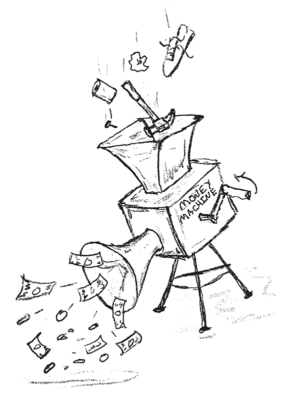
  • Earn To Invest, Buying Assets That Make You Money

    Earn To Invest, Buying Assets That Make You Money

    With your foundation of savings in place and a budget that allows you to continually add to your savings you will reach a point in which you will need to put some of your saved money to work. The best place to start with this is buying assets that make you money.

    Money has a time value and extra money sitting under a mattress is not just sitting there, it is actually losing value. Inflation is the quiet tax that plagues us all but more than that you have an opportunity cost to think about.

    In other words what is your money not earning by not being used?

    You will want to be prudent in your use of this money as it was the fruit of your hard work and discipline.

    Acquire Your Debtor’s Assets by Buying Back Your Debt Notes

    The fastest return on cash is the elimination of debt.

    Debt like credit cards, car loans, and student loans are all great places to start. These debts eat away at your excess cash and don’t just cost the additional interest, they also cost you what having the money in you pocket would afford you.

    Think about why people want to lend you money. They have extra money that they want to make money off of so they let you borrow it at a high percentage rate.     

    What is an Asset?

    One of the best definitions of an asset can be found in Robert Kiyosaki’s Rich Dad Poor Dad. He has his own way of describing it but in short, an asset is something you own that makes you money. This could many things some examples would be stocks, mutual funds, rental property, bonds, or a business. Robert maintains that your home is not an asset. You will have to read his book to see why.

    A dividend paying equity (stocks/mutual funds) can be a very easy thing to purchase at low prices to begin your asset acquisitions. I won’t go into the investment strategy at this point but what I want you to realize is that you can buy things that are able to make you passive money.    

    How Do Assets Make You Money?

    As the owner of an asset, you have a right to the earnings it generates. You also have a right/obligation to the expenses. So, in short you get a piece of the action. For a stock you would own equity in the underlining business. As the value of that business grows or as the company pays dividends you receive a commensurate amount for the amount of the company that you own.

    For a rental home you would receive the rent from the tenant, pay for all the expenses, and what is left over is your profit. Homes often also appreciate so you would likely see appreciation in the home value over time as well.

    A business works the same way. You take the money that came in, subtract the money that goes out to pay for everything, and what is left over would be your profit in the form of retained earnings. You could take the earnings out of the company or leave them in the company to cover future operations.  

    What Assets Should I Buy?

    Buy a Money Machine of course…

    Kidding, starting out you will want to find low risk opportunities with high liquidity.

    What you don’t want to do is lose the principle you worked so hard to get or tie up your money for a long time.  

    Mutual funds are a great way to go. They have a relatively low cost and an assessable history, so you know about what to expect. A common minimum for a fund is between $1,000.00 and $3,000.00 USD. The other nice thing about a mutual fund is that they are a collection of many equities. This means that you don’t have all of you eggs in one basket. If a company in the mutual fund portfolio goes belly-up you won’t lose all of your money.

    I love love love rental property. I grew up with rentals. My dad was an appraiser, so real-estate has been in my blood for a long time. I have helped fix, paint, clean, and redo just about everything that needs to happen for a rental home. I hated it at the time, what kid wouldn’t, but now am equipped to see an opportunity when one arises.

    Rentals have a higher barrier of entry in that you will likely need 20% of the sales price in cash in order to finance the home. So, on a $200k home you will need to put $40,000.00 down.

    Rental homes are not for everyone, but they can also be a great source of cash flow.  

    What Assets Shouldn’t I Buy?

    There is a saying “Profits are made in the purchase” and it means that you make money when you make a good buy. This means it’s possible to acquire a good asset at a bad price. Until you know what a good buy is don’t pull the trigger. This will require homework on your end.

    We would advise against anything that sounds too good to be true, digital currency, and anything your broke friends say is a good idea. These “assets” are likely not good assets at this point of your journey. I would also steer clear of land, partial ownership of anything, and lottery tickets. Do not buy a new car. Something like your car can be a necessity but it is not an asset.

    The whole point of an asset is to make you money.

    Ask yourself, will this make me money this month? This year? If so how and how much? If you have trouble answering these questions your potential purchase is likely one to avoid.

    How Much Will an Asset Make?

    This will vary but you could expect between 4% and 10% per year on average. Some years your portfolio will do better and some it will do worse. You will see negative returns over short periods but over all a 4-10% annual spread is what most people plan around. The 4% rule in retirement as an example is in place because it assumes that if you only take 4% of your account out in a year the principal balance will not depreciate over your time horizon.    

    How Much of My Savings Should I Use?

    In short you don’t want to use any of your savings. We want to use money beyond your savings. The money you use to invest with should be the money beyond what you need for short term fringe events. For some this could mean any money over one years living expenses. For others it could be any money beyond three months living expenses.  

    Wherever you are on your income journey be sure to check out The Four Stages Of Wealth Creation; From Clueless To Capitalist. We put this together as a guide for those looking to grow their financial acumen and take their next step towards financial independence.
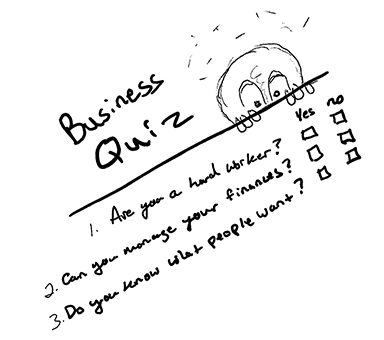
  • Can You Be a Business Owner Quiz

    Can You Be a Business Owner Quiz

    Ever want to know if you have wat it takes to be a business owner? Here is how to take the “Can You Be a Business Owner Quiz” to find out. Simply run a profit and loss statement on yourself to get the answer.

    A profit and loss statement simply records all the moneys in, all the moneys out, and finds the difference. If the difference is positive, you have profit, if it is negative, you have a loss. For an individual this should be a rather quick calculation. So, where did you land? Is the business of you profitable or is it losing money?

    This is how you will likely do if you decide you want to start a business. You see, you are your first business and the sale of your time is your first product. Your customer is your employer and the value you add is the service you provide. Soak that in for a bit. If you can wrap your head around this, then you are beginning to understand the true nature of a free market economy.

    Don’t get me wrong, being an employee is a great thing and a wonderful solution for most people. As an employee there are great benefits. Often the flexibility, insurance, time off, risk exposure, and pay create a great stack of perks to attract good talent. That talent however would be prudent to understand the game they are playing and ultimately why their employer is giving them money.  

    How Is Money Made?

    Money is simply a universally agreed upon currency provided in exchange for a good or service. What makes it so convenient is that its worth is agreed upon. Yes its value changes over time, and yes it changes differently relative to any number of indices but by and large people know what they can get for 5 dollars, 10 dollars, or 1,000 dollars.

    People generate money by virtue of adding value to others. This value is likely a service. One of my fist paying gigs was the hourly rate I received for doing work around the house above my normal chores. When my parents wanted to paint the house, I was paid $10.00 and hour to do the job. My job was to hit all the hard-to-reach areas such as the areas above the roof line that required a person to step on the shingles. My value: being smaller than my parents and able to complete the job without ripping shingles off the roof.

    Think about the money you spend in a given day and ask yourself why you have to pay for the things you buy. Why not simply acquire, make, or do the things needed to get you what you want? Is it because you want something fast? Something of a higher quality? Something you don’t know how to make? Whatever the reason you find the value of what you are buying to be commensurate to the amount you are willing to pay.    

    How is Money Lost?    

    This seems like a silly question, but you would be surprised to find that many business failures occur, and the owners are not quite sure where/why they couldn’t stay afloat. The sales were good, their customers loved them, and they had plans to open another shop. The problem is expenses were growing faster than the profits. This happens when people don’t keep an eye on their full situation. As revenue grows so do expenses. If a business owner doesn’t keep an eye on the money going out the door, they will soon find they don’t have a door for money to go out of. At a personal level this is where the beauty of budget begins to shine.

    I make great money so why am I living paycheck to paycheck?

    Well, by the time you factor out rent, fuel, subscriptions, Ten-dollar coffees, entertainment, credit card payments, and whatever else you role your eyes at, you will find you spent all that you earned.

    So, how is money lost? Answer: it was spent.      

    How Companies Grow And Compete

    This principle holds true with companies. A business that wants to grow must find a way to create value and offer it at a price that is greater than the cost to produce it. A baker has his equipment, raw materials, and time invested into making his bread. A fisherman has his equipment, fuel, and time invested in catching his fish. A restaurant has its building, food, and employees to pay for in order to provide a dining experience. In each of these the only way for these business owners to keep their business going and growing is to sell their product/service for more than their expenses. How much more? The answer to this is however much their market will endure.

    Competing in a market means that multiple people are fighting for given number of potential buyers. The market size and behaviors will drive how competitors work to win sales. Some markets are very price conscience, others are quality conscience, and others still time conscience. For more on this check out our write up: The Competitive Advantage Spectrum.    

    Smaller businesses and employees will find themselves competing with services. A job that is done well (quality), quickly (Lead time), and at a fair price (cost) will win clientele over every time. If this can be done at a profit you have yourself a winner. If multiple service providers are in a field, you will see that the big players compete in different fields. If you want something fast go with company A, if you want it cheap go with company B, and if you want the best quality go with company C.

    How Are You Competing?

    What is it that you bring to the table every day that your fellow employees do not? Is it a good attitude, domain knowledge, timeliness, problem solving, or do you fail to see any difference? If you are reading this, I know that last one isn’t true. Driven smart people make great employees and are not only hard to find they are hard to keep.   

    Back to the original question, how do you know if you can be a business owner? You know if you understand what it takes to be a good employee. Once you understand this the next question to ask is: do you want to be a business owner?

    Running a Company Is Not For Everyone

    Getting a business started is easy, keeping one going and growing is difficult. Its hard because what makes a company successful in the long run is not what is needed to get one off the ground. This is why we see such a high failure rate among small businesses. One of the biggest challenges habitually discussed among small business owners is attracting and keeping good employees. If you don’t like or have trouble with dealing with people, be very careful with which direction you decide to go.

    There are many types of businesses out there and don’t get caught up in believing there is simply business owners and non-business owners. For some a brick-and-mortar store may not be an appropriate path and going the Solopreneurs / micropreneur route is the way to go.      

    Micropreneurs and Solopreneurs

    Micropreneurs and Solopreneurs are relatively new terms used to define the individuals that run ultra-lean companies. Often consisting of only themselves and perhaps a temporary hired hand or two these people likely run an internet-based company. Blogger, Vloggers, and Affiliate Marketers can often be put into this group. They stay in this group if they decide not to grow beyond themselves. What makes them unique is the amount of revenue they can create without the use of other people. We plan to explore these shyentrepreneurs in later articles so stay tuned.

    Wherever you are on your income journey be sure to check out The Four Stages Of Wealth Creation; From Clueless To Capitalist. We put this together as a guide for those looking to grow their financial acumen and take their next step towards financial independence.

  • Earning To Spend, How To Increase Your Income

    Earning To Spend, How To Increase Your Income

    The first piece of the financial equation that people often address is; how to make more money? Naturally this is where people start when making career choices and planning their futures. So, lets take a look at how we can influence the “money in” side of things. How can we bring more money into your situation?

    There are two main approaches to this question.

    1. Increase the amount of your income source.
    2. Increase the number of income sources.

    It really is that simple. Any organization that wants to increase its sales numbers will either increase their sales price or find more customers. Your situation is much the same. The one caveat that I will mention is that you likely will not be able to increase your earnings without adding additional value. What I mean by this is don’t expect to make more money by doing nothing. According to the interweb many seek to make more money without doing work and I can tell you that is simply lazy and stupid. Ask yourself: who do you want to give money to, the person that did something for you or the person that does nothing for you? Now, there are ways to achieve passive income but that is for a later discussion.    

    Increasing The Amount Of Your Current Income Source.

    For many that work full time they have a single income source in the form of a job. Many working professionals in this situation put in a lot of hours with a single employer and live off of those earnings. These W2-preneurs show up, add value, and help their employer build their bottom-line profits. If an employee doesn’t allow an employer to make more money, or possibly minimize the loss of money than they are not a good hire and won’t be working for very long. Each employee in an organization must contribute to the end goal of the company making more money now and in the future.

    Understanding this reality can position you as an employee to negotiate a better income. I have seen firsthand individuals critical to a company coast along and make at or below market average pay. This happens because some people are either happy with what they are earning or don’t realize they should be getting paid more.

    My first salary negotiation was much the same.

    When I started as an engineer I began as a part time intern, then moved to full time hourly, and finally to a full-time salary position. This process was not one that the company initiated however. I had to push this along. How did I do it? In short, I simply added value and demanded commensurate pay. As promotions occurred, I likewise negotiated offers and counteroffers. What I didn’t do is simply say: “Hey Mr. boss, I want more money!”.

    Get An Offer From Industry Competitors.

    If you want to find out how much you are worth, get a few offers from others in your industry. This is similar to finding comps in real-estate. How much am I worth? Well, how much is company A willing to pay? What about company B? You will find out quickly what others are paying for you position. I found myself asking this same question. Here I was with two undergraduate degrees, two minors, and sneaking feeling that I was worth a bit more than what I was being paid. So, I interviewed with another establishment and was provided a very generous offer. I didn’t take the offer however as I wanted to stay with my current employer. What I did do is inform my current employer what others said I was worth. Guess what, I got the raise. It also boosted my confidence. Having others say they will pay more for you is a good feeling.

    Quantify your value.

    If perhaps you don’t have the above option, go the route of quantifying your value to your organization. This can be a bit tricky as people seem to think they are worth more than they truly are. Remain objective when assessing your worth. Asking hard questions like: if I leave tomorrow what will it cost for them to not have me? How quickly will they find my replacement? How long will it take for someone to get up to my level of training? Hopefully you can nail down some hard numbers and put your value in black and white.

    If you can objectively communicate the additional value that you bring above your current job duties it makes it a lot easier for your manager to grant you a raise. Remember, who the decision maker is and make it easy on them. Do not use “I think I should get a raise” or “I feel I deserve more” this fluff will not work to your benefit. What does work to your benefit is: “My efforts in project X netted the company an additional $2,000.00” or “When I instituted and enforced policy Y the fall out has dropped 10% which conservatively saved the company $3,000.00 this year”. Hard facts and hard numbers will make it much easier for your employer to justify paying you more.   

    Increase The Number Of Income Sources.

    If you have already maxed out your current income source the next option to increase your income is to find other sources of revenue. Your additional income sources will likely be service based and not capital intensive. By this I mean you will be working, not renting out assets. As your asset base grows you will get to that point but in the beginning the hard truth is that you don’t have much more than your skills and time to offer.   

     You need more people willing to pay you for the value you offer. Assuming that you are working full time this will mean you have to find other part time jobs or alternative side gigs. These nighttime or weekend gigs can be a very quick and effective way to earn more money. I would put overtime into this same bucket.  

    If you can offer what you are currently offering your full-time employer to others part time this will likely be your greatest return on your time. After all you spend the majority of your time doing what you do, you better be good at it.

    If perhaps you are limited by non-compete or conflicts of interest, then take your skill set to another industry. Someone that makes cabinets for example may not be able to work for a competing cabinet company, but they could use their wood working skills to make other furniture. The point here is don’t limit yourself to only the domain of your nine to five job.

    Finding Your Work Life Balance, Why You Work

    All of this extra income is great but at some point, you have to ask what it is all fore. Unless you simply love to work all of this extra time sold to others will begin to wear on you.  You will need to find the balance that works for you. For some this will mean a comfortable 9-5 position and having their nights and weekends free. For others it could mean a period of time focused on earning so as to afford additional expenses or to eliminate debt. Having the reason for your money known and establishing your financial goals will help make these decisions. In subsequent articles we will discus this balance and ways in which you can work to the appropriate end.   

    Wherever you are on your income journey be sure to check out The Four Stages Of Wealth Creation; From Clueless To Capitalist. We put this together as a guide for those looking to grow their financial acumen and take their next step towards financial independence.

  • Making money is simple but not easy

    Why making money is simple. Have you ever wondered why some people seem to make money hand over fist while others just seem to spin their wheels? Making money is nothing more than a result of adding value. Anyone can do that. Adding or providing value to someone happens every time you spend a dime. Next time you pull out your wallet ask yourself what it was exactly that you needed and could not facilitate on your own. If you bought a gallon of milk, did you actually need the milk or perhaps you were more concerned about a crying baby. I recently had to go to a close gas station and paid too much for a gallon of milk but was 100% ok with that because I had a baby at home and time was of the essence.

    In a free market things are sold on three predominant basis; cost, quality, and lead time. You buy on a cost basis when you are shopping for a value at the lowest price. This is often commoditized items that are available everywhere and don’t differ from one another. You buy on a quality basis when you purchase an item that “must be” a certain way. An example of this could be custom furniture or premium gasoline. You forgo other options when buying on a quality basis because your ultimate need stemming from the product or service is specific and recognized. Finally you buy on a lead time basis when time is more important than any other metric. This was the case when I purchased the milk for my crying baby.

    Can you see the value? Value is the thing that meets the need and this can be provided by a product or a service. An interesting thing to note is that the product or the service itself is not the value. The value comes from what the product or service provides. You don’t pay for window washing because you want to watch people wash windows, you pay to have clean windows when the washing is complete. The same holds true for all services. The service itself is of zero value if in the end the customer’s expectation is not met.

    This holds true for products as well. Any widget you buy from the hardware store is only of value because of what it will allow you to do. A hammer is worthless unless you have to drive some nails. You don’t need a wrench if you don’t have any bolts to tighten or loosen. A tape measure is a paper weight if you don’t need to know the dimension of something. Your vehicle exists to get you from point A to point B. To some this may seem obvious to others it may provide a new angle to think about the products or services you provide.

    Why making money is not always easy. While making money can be simple it is often times not always easy. There are a number of reasons for this but I believe the largest one is the competitive nature of free markets. In free markets everyone has the option to compete in a market space. This means there are a number of other players out to offer the same value that you want to offer. Because of this you won’t have an advantage as you enter a market simply because you are in the market. This can seem frustrating on the surface but it is also one of the things I find most intriguing about business. Those who do well in their business are part of a continuous dance of trying to figure out how they can stand out from the crowd.

    People are inherently selfish and as a result the free market is rife with stiff competition. The lively hood of people and their families is pushing many people to figure out how to find a way to the top and additionally how to stay there. What better motivation is there to compete? I believe this is one of the underlining realities that feed into the small business failure rate. People have a novel idea to start a business and think there isn’t much too it only to find that absolutely nothing will be handed to them if they don’t compete. All of the low hanging fruit was snatched up a long time ago by someone else who was already treading down that path.

     Adding value is hard work. Ask anyone who has had many years of success in business and I bet they will tell you it was hard work. Making money can be simple and chalk full of hard work at the same time. This is not a bad thing all it means is that you will need to dig in if you want your company to succeed. In fact, the sooner you realize that simply working harder you have an advantage the sooner you will find yourself as the market leader. Hard work is one of the single biggest differentiators in small business markets.

    The market will change.  Another dynamic that makes business challenging is that the market place is constantly changing. Driven in part by the competition stated earlier the marketplace is anything but stagnant. Business is a bunch of people interacting and if there is anything we know about people it is that they are not robots. Companies that get comfortable with their market position won’t enjoy their position for very long. This is one of the biggest reasons small business can have an advantage over large business. Large businesses can’t move at the speed of a smaller organization and as a result is at a fundamental disadvantage in many respects.

    Other factors that play into the flux of the market are technology and rising costs. As a market matures and spreads its tentacles out disruptive technologies will sprout up to change the game. Technology is simply a force multiplier and as a market grows it will gain more recognition from others. As this happens more and more people will be looking for ways to do what is being done in a more efficient manner. Many times this can be driven by rising costs. Rising costs are constant over the long run. This means that in 10 years your product or service will cost more than it does today if nothing is done to improve how it is delivered.

    What we know. In the end we know the secret to making money is focused persistent hard work. Once you have your niche defined and you are digging in keep this in mind. “Success” won’t happen overnight and it won’t hit you like a ton of bricks. It is a slow process that will require hard work and strategic thinking. It is not rocket science and if made more complicated than it needs to be will be much harder to attaint than simply getting out there and getting something done.

  • Top 5 Considerations for Small Business Success

    1. Business is simple; don’t make it more difficult than it needs to be. Having spent a lot of time studying organizations and business theory I am so surprised at how little of it makes its way into successful companies. This is especially true for smaller organizations. In the end a business fails because it can’t make money and a business succeeds because it can make money. To say it another way; Do the things that make money and quite doing the things that don’t make money. Simple enough?

    The idea of making money is an odd subject and one that seems people either understand or see as smoke and mirrors. For some people making money is something that happens after a slew of things fall into place and “magically” money finds its way into their account. For others there is a linear correlation; provide value and collect money. I have to admit I began as the former with the idea that making money was much more complicated than it really is. Even after being on the receiving end of transactions that were lucrative I questioned “can it really be this easy?”…Yes it can!!!

    The business theory side of me would communicate this as defining a value chain and operating lean. All that means is cut out the fat of your operation. Certain things you provide are needed and others are not. I would especially challenge you to question the things you see as adding indirect value. These would be the things that don’t make you any money but you feel are necessary because they are expected.

    2.  Effectiveness is more important than efficiency. This would be another area in which a small business can shine over a larger competitor. Often times larger organizations are so caught up in doing things perfectly that they lose sight of doing the right things. I have had the opportunity to work with a lot of big organizations and it would surprise you at how often they will forfeit their competitive advantage in the market place for the sake of their financial reports. In the article The Upside to Inefficiency I cover in a bit more detail where and when effectiveness should take precedence and when efficiency is needed. It may surprise you to learn that efficiency can at times do more damage than good.

    As an engineer I ran into this with quality groups that would hold up production because something wasn’t perfect. They identified a measurement or characteristic that was out of line and as they were instructed rejected the part. The problem was the measurement or characteristic that they identified had nothing to do with the form, fit, or function of the product. So they were putting the brakes on production for something that had no tie to the value the product provided. Don’t get me wrong I am all for constant improvement but when a quality group is given full authority over the big picture they will find the perfect way to run a company into the ground.

    As a small business one of your greatest assets will be the attitude to get things done. You may have to do things more than once or come back to the job site for a later fix. The sooner you can see it as an opportunity to strengthen your relationship with your customer the better. Being perfect is much too expensive for a small business. Your customers may not realize this but perfection was not what they were looking for when they called you up. They had a need and they simply want you to take care of that need.

    3. Keep an eye on your expenditures. Have you ever known someone to start a business and turn around the next day and buy a new car? There can exist a mindset that owning a business automatically means you have money. Sadly this is often not the case. Starting a business and running a successful business are two completely different things. Out of the starting gate you need to keep an eye on every penny and ensuring that you are not spending more money than you are making. If you can do this it won’t take long for your organization to grow to the point you dream.

    Don’t justify purchases because you can get a tax write off. We all want a nice work environment but buying a walnut executive desk would not be the best use of funds in your early stages. “ I can write it off” you say, well I don’t know what good a write off is to a company that doesn’t exist.

    If you don’t own a business or are just getting started take a look at your checking account. How have you managed it? The answer to this is exactly how you will manage your business. You are your fist business and I hope you have taken the time to budget accordingly and don’t find yourself at the end of the month wondering where all of your money went. If you don’t control your money it will control you. Keep an eye on where you spend and eliminate any of the spending that is not adding value to your company.

    4. Know your numbers. This may seem obvious but a lot of people don’t know if their product or service is making money. They are so caught up in putting out fires don’t realize they are the reason they can’t get ahead. When you do a quote or cost out your product you must know how much it cost and how long it will take to deliver. If you simply copied a number from the market or adopted what the other guy was doing you could be setting yourself up for failure.

    Additionally the more intimately you know your numbers the more likely you will be able to improve your company. There is a great example of Henry Ford utilizing the boxes that were used to ship him supplies in his automobiles. This is a great example of recognizing value in what others likely perceived as garbage. If you are in lawn care, how long does each lane take to maintain? How many guys are needed to do a lawn? How much gas is used? How many times a month does that lawn need attention? In one day how many laws can be cared for? How much weed eater line is consumed in a week/month/year? These are all things I would expect someone in lawn care to know and I don’t know much about lawn care.

    Knowing your numbers also allows you to make better judgments on the fly. In conversations with your customers you will be able to parse information very quickly and accurately to know when a job would be a winner or a looser. You will know when you are being competitive or when you are being conservative. If you have acquired a small business you will be able to identify the projects and customers that are loss leaders. One of the best business men I know could tell you more than anyone would care to know about his business because he minds the numbers.

    5. Buffer everything. In the end you cannot account for everything. Human behavior has a funny way of inviting murphy to every party. Buffers are very important when managing your customers’ expectations. Being strategic with your buffers will allow you to remain competitive and allow room for variability. In every case you want to be able to under promise and over deliver while remaining competitive. In the world of project management buffers are key to successful execution. An aggressive schedule with strategic buffers will outperform a loose schedule with no buffers every day of the week.

    Buffers can also help speed things up. If you know the amortized daily expense of an asset is say $98.60 you will be well served to quote at a cost of $100.00. This will speed up your quoting process and will give you a slight buffer on your expense estimate. This along with the prior point of knowing your numbers will equip you to cost things out quickly and effectively and in the world of small business this speed is key.

    These 5 principles are invaluable to the small business owner. Learn them, test them, and lean on them. I can assure you everyone reading this will benefit greatly by exercising these. If you have an example or a principle you have found helpful send us a comment and let us know your thoughts.

  • Island Economics

    Have you ever wondered why one company thrives while another fizzles? It is a question that I come back to on a continual basis. The more I process the factors associated with success and failure of businesses the more I realize the answers for both are numerous. I don’t like this. I have to believe there is an inherent simplicity underlining it all.

    How is it that a once successful business that was a world leader can crumble while a college kid and his roommate can create a huge venture out of lines of code? What are the sands that seem to shift under our feet, constantly changing the game that create an opportunity for one and mean doom to anther? This dynamic is constant and while I can’t quite put my finger on it I think I can demonstrate it through the following.

    I will do my best to illustrate where I am coming form with an example of a fake isolated economy consisting of two men on an island. I realize that in my example I may give into some traditional ways of thinking but for right now it is how I see it so bear with me.

    In an economy where currency does not exist value is present when one man has something another man needs. One could assimilate it to the potential difference with in an electrical circuit. In an electrical circuit electrons don’t flow until a potential difference exists. So long as both men on the island have everything the other has, there is equilibrium of value. It isn’t until there is an imbalance that value can exist.

    So, to create an imbalance let’s make one man big and tall and the other small and short.

    Now, in the day to day life of our two islanders both will encounter situations which the other is inherently better suited to handle. When this happens each man is in need of the other. For a moment each man is valued by the other. Equilibrium of value is once again established once each man assists the other equal number of times. If more is required of one man than of the other indefinitely we would consider that to be unjust if there wasn’t a correlative shift of debt. In other words one man would be habitually indebted to the other.

    In our fake economy business is simply the concert of maintaining the equilibrium. The imbalance is what many would refer to as a competitive advantage.

    Our real economy of course is not this straight forward. We have men and woman of all shapes and sizes, each with their own set of needs. This reality makes it possible for us to facilitate the needs of more than one person and consequently establish wealth. To think of it without currency; if we were to provide a service to 100 people we would have 100 people whom “owed” us their services in return, we would be wealthy. If no one needed the service that we had to provide we would be poor.

    I know this is a crude example but I hope it helps you understand where you can add value in your own situations. I see a lot of young zealous entrepreneurs who don’t seem to understand that value doesn’t simply fall from the sky; it is established by virtue of a potential difference. No venture is going to be successful until it can find a way to offer a product or service that isn’t already available.

    A great way to insure you are headed the right direction is to follow a pull strategy. Facilitate an unmet need that already exists. Rather than trying to force what you want to offer upon others, why not take some time to meet a need that no one else has met. This is one of my biggest concerns regarding many MLM businesses. People sign up thinking they have the world at their fingertips and don’t understand they are simply a marketing company competing with a bunch of other marketers to ultimately sell dreams. Without a potential difference or a fundamental value to bring to the table it becomes the job of the marketer to skillfully craft a sales pitch containing perceived value in order to expand their network.

    This idea of course is not new and years ago people began facilitating common needs. Companies that matured with their markets and made the appropriate changes over time are now leaders within their respective industry. However, if they don’t continue to adapt and change as the needs do they will lose their competitive advantage and an aspiring young company will rise up to take their place. This can happen more than you realize as companies become overly bureaucratic and lose the ability to compete with smaller businesses.  I hope you are that aspiring young company I read about next!

  • What Is Cash Flow Management And Why Should You Care?

    With the exception of volunteer organization cash is the life blood of every company. You know this reality more intimately than you may realize through the monthly expenses and income you experience. Are you living paycheck to paycheck? Or, are you making enough to cover your bills with some left over to put into savings? Being able to manage your cash is not an easy task but with time anyone can master it.

    Parkinson’s Law

    The difficulty of managing cash can best be understood by taking a look at Parkinson’s Law. The law states; “Work expands so as to fill the time available for its completion”. This idea of resource allocation is no different when it comes to cash. It I may be so bold as to restate the law in terms of cash flow; “Spending expands so as to fill the amount available to spend”. The reason for this I believe is because of the irrational and emotional nature of people. As much as I may not want to admit it my decisions are often based on emotions. People in general have a hard time holding back when they don’t have to. This is also the reason startups with less capital have a higher probability of success over startups that have more than enough capital available to them. The less you have the more intentional you have to be.

    Cash Flow Game

    Managing your personal finance is no different than managing the finances of a for profit organization. Money comes in and money goes out. Through this cycle either a standard of living is maintained or a profit is produced. Individuals and small businesses alike should understand that cash flow needs to remain positive. To help you with this there is a great online game provided by Rich Dad Poor Dad. I recommend you take a few minutes and try your hand at it.  Here is a screen shot:

    I have to admit I didn’t do well my first time around, in fact my first two tries were not successful. I did however manage to break out of the rat race and complete the game successfully. It isn’t a perfect simulation but it is enjoyable and teaches a few ideas on leveraging. The biggest take away is of course cash flow management. To win the game you must learn to obtain and maintain positive cash flow.

    It was interesting to play this game having executed a few of its principles earlier this year through the purchase of our first rental house. Without knowing Mr. Kiyosaki’s model we obtained an asset that basically pays for itself. Just as the voice overs say during the game this takes place when you purchase not when you sell. We were fortunate enough to intercept a property that was about to be seized by the county for auction. We purchase the property and then spent 6 months remodeling. When we finished we had a rental with positive cash flow.

    One of the other things I like about the game is that as a player you have both an income and expenses. As the game goes on both will fluctuate as cards are drawn and “life” happens. The pace of the game is of course faster than what one could expect in real life but I believe the principles are sound. If you see a game in there titled “ShyEntrepreneur.com” that’s me!

    Much can be said about cash flow and personal finance but all I wanted to do here was point out a tool the illustrates the importance of cash and maintaining a positive cash flow situation. My people currently live outside of their means and can’t quite figure out how to progress towards financial freedom. The solution is simple but it is not always easy.
    I hope you guys find the game as entertaining as I do and be sure to post comments at the end so others can learn from your experience.

  • Part Time Money Making Ideas

    It seems most people could use additional money on the side so I wanted to share with you a few things I have done to give you some part time money making ideas. What are the two things we never to seem to have enough of? Money and time. I believe this is why many people look for ways to make as much money on the side as they can.
    If you are a stay at home mom, college student, or the bread winner of the family there always seems to be a need for more time to do the things you want to do and more money to afford to do them. I am no different which is why I have a few irons in the fire that I want to share with you.

    Making Products To Sell Online

    My first experience making money part time came in high school when I made products and sold them on Ebay. At the time I was into paintballing and had purchased a paintball gun that came with a silencer. I decided I wanted to know how the silencer worked so I ripped it apart and figured out how to make them for my friends and I. That lead to selling them online and equated to a $240/h rate. Now, I only sold a few silencers but the money to time ratio was great. Little did I know selling such items is frowned upon so the experience was short lived. If you have the talent and tools to produce a simple product you can probably make a few bucks selling them online.

    Making products is one of my favorite methods for making money. It is what lead me into engineering and offers a very tangible means to provide value. This is by no means passive but if you can find a good niche and provide a decent product I guarantee you can make some good money.

    Buying Domains

    I began buying domains in 2008 as I could see that the finite availability of Dot Coms implied value. I currently have 98 under my belt and have developed a handful of them. Each runs $7 to $12 dollars a year to hold onto so you can see how that can get expensive quick but once liquidated that $7 or $12  dollars a year can turn into thousands. I purchased one domain for $7.95 and was offered 12,000.00 for it the following week. Talk about a good return. Now, this is the exception not the rule. If you want to invest into domains understand it will take a good deal of time and effort to land a decent one. It cost me a lot of money to find out most domains have a gestation period. Additionally the changing landscape of the internet could have adverse effects. The “semantic” web could discount a domain portfolio. If you do decide to go forward with domains understand the return will be slow. My preferred registrar is GoDaddy.com only because it was where I started. There are many other great options out there.

    Rental Property

    While another long term investment, rental properties can offer great part time revenue. This of course requires a good deal of cash up front and usually a good deal of work but it can be worth it. Real-estate is one of the few things you can purchase that generally increases in value. This is because of the finite availability of homes and lots. That said real-estate also demands a long term strategy. It is possible to flip properties but you need to be on your toes if you are going to go that route. Additionally rentals require to deal with renters. For me this is no big deal as I grew up working on rentals with my parents but for other it could be a game changer.

    Developing Online Properties

    The most notable effort is the site you are reading. ShyEntrepreneur.com came out of the efforts in my master’s program to provide small, young, and home based businesses owners/ entrepreneurs with exposure to the formal ideas I have picked up along the way. The site is young yet (a little over a year old) and is positioned for growth. With the help of a small part time team I have compiled some resources that were designed to edify the reader base. To date the site is still in the red but our breakeven is just around the corner.

    Total time invested: not sure, a lot at first to get it up and going then roughly an hour or two per article. With 64 posts that is roughly at least 120 hours. This doesn’t include the 7+ years of school or personal experiences that preceded the site just the time put into making it happen.

    The Common Thread

    I don’t know if you have picked up on it yet but in short there is not easy get rich quick program or model that works. Everything that has ever brought in money for me has required hard work and time. Even so called “passive” investments require a good deal of attention to perform well. Don’t get stuck in believing you don’t need to work, you do and you should. The neat thing is a little bit of hard work can go a long way. All businesses require someone behind them strategically directing the organization and pushing the people to make each day a success. If you are your first business you need to accept that you will need to put in hard work to make any king of money either part or fulltime. I believe it is David Ramsey who said “to get to where few are tomorrow you must do what few do today. ”