Tag: leadership

  • The Secret Mind Of An Entrepreneur Is Not What You Think

    The Secret Mind Of An Entrepreneur Is Not What You Think

    When I started my business journey, I initially sought to find the secret to business success. I suspected there was a secret because only a handful of people experienced success while the majority of people found failure. Additionally of those that found success there were always those serial entrepreneurs that seemed to find one success after another. There was also a ton of examples of people failing at business. Why such a disparity?

    The nature of the secret I assumed was a tactical or methodical difference. If I could figure that out I could adopt the methods into my own businesses and live happily ever after. Sorry to say it is not that simple. The difference is more in line with how entrepreneurs think about and address their problems and relationships with people. I hate that this is true. I hate it because it means the answer I was looking for is not something that can be easily defined or discussed.

    Take a hall of fame sports star for example. One can’t pin point the things they do habitually that allowed them to make it to the hall of fame. They made it to the hall of fame because of who they are and how they approached their game. The unique reality and un-assessable truth is that they brought a piece of humanity to the table that few others have. Fundamentally they thought about their craft in a unique way.   

    The reason there are few successful serial entrepreneurs is because there are few people that focus on business and life in the way these people do.

    The Dark Side Of The Focused Individual.

    Before going into all the “amazing” things these business superheroes can do I would like to discuss the dark side. I have come to believe that how some entrepreneurs approach life and business is something I never want to recreate in my own life. For some serial entrepreneurs their identity is 100% tied to their commercial success. They are one dimensional with their only dimension being business success. That is great if the only thing in life is business but for most of us this will not be the case. For me a well-balanced life is much more important than a having only a commercially successful life.

    I discussed how entrepreneurs think in my piece: How to Become an Entrepreneur but I didn’t extrapolate my thoughts to their full conclusions. When entrepreneurs are young they are often misled by the pursuit of profit. While it is true that the goal of a business is to make money now and in the future (thank you Eli Goldratt) the goal of life is not. If the goal of a business is to make money perhaps we should ask; what is the purpose of a money making business? The answer to this will be different for everyone.

    I have been really challenged lately with how my time is spent. In his book Hero on a Mission: A Path to a Meaningful Life Donald Miller discusses a technique in which you write your own eulogy. Wow, what a mind bender. The idea isn’t his, Stephen Covey the author of The 7 Habits of Highly Effective People also suggests the exercise. In doing so you begin to see how finite the time we have is and what really matters. Children have forever, teenagers have forever, but a young aspiring entrepreneur may only have a decade or two. What is it you want to do with the handful of years you have left?

    How Buying A Machine Shop Changed My Perspective

    When I bought a machine shop, I achieved something I thought would never happen in my life time. All the equipment anyone could ask for and the ability to make anything was at my fingertips yet it didn’t take long for my “why” to change. I love manufacturing and making physical goods, solving interesting problems, and establishing sustainable solutions. I very much dislike exchanging time for money. A one to one exchange of time for money is no different than what occurs with a W2 income. It took a handful of breakeven projects for me to refine our approach to the market space. The funny thing was I was the reason we weren’t making money. I was so excited to land jobs that I landed jobs I should have passed on.  

    What you will find is; generating revenue is easy with a smallish business. Generating revenue that exceeded expenses is more complicated problem. Many of the projects that people want you to quote are projects that don’t have money in them. Buyers put projects out to bid in search of the lowest bidder. A starving shop bites and begins spinning their wheels. Sad really. A budding entrepreneur won’t necessarily be able to see these projects for what they are until they have committed. The silver lining to this is that these experiences are the building blocks to the entrepreneurial mindset.       

    I still love the machine shop but I love it in a different way today. Had I had the opportunity out of college to run the shop I don’t know if I would have had the maturity to make it work. I was young and ignorant to so many business truths and human conditions. It took spinning our wheels a few times to show us there is work out there that is better left to our competition.

    Accept That You Will Fail, Just Don’t Fail To Learn

    The one trait I have seen ring louder than almost any other with successful businesspersons is their ability to see through all the fluff. They don’t lean on forecasts, hope on promises, or blame things they can’t control. They are pragmatic to the core. They work off of hard figures, test their own assumptions, and distil all the noise around them down to fundamental truths. I wouldn’t say they are cynical, but they are certainly not going to bank on what other people tell them. Why do you think they are this way? The answer is because they have felt the pain and subsequent benefits of failure.

    Having the humility and wisdom to understand when you screwed up is essential to conducting business well. I personally like the motto of; fail fast. There is more out there that you don’t know that what you do know. Accept this and don’t pretend to have all the answers. This advice is nothing new. Proverbs 16:16 ; How much better to get wisdom than gold, to get insight rather than silver. The value of knowledge and wisdom cannot be understated.

    Entrepreneurs By Definition Don’t Follow The Crowd

    To be an entrepreneur one must fundamentally be able to see opportunity and add value where others do not. This means the way you think aught not be consistent with the masses. You have an obligation to solve problems and provide solutions that others need. Others need you because they can’t take care of their pain the way you can. I find this rather exciting.

    How cool is it that people need you? In what way is the world a better place because of what you do and how you do it? Your service to others will garner financial rewards but beyond the money I hope you can see the changes you are making!
  • The Effective Executive. Peter F. Drucker

    So I have another note worthy book for anyone looking to become more effective as either an entrepreneur or in their place of business. The Effective Executive: The Definitive Guide to Getting the Right Things Done (Harperbusiness Essentials) by Peter F. Drucker is a classic resource for anyone looking for more exposure into the world of top executives. One of my favorite things about this book is that it came out in the 1960s. Why does this matter you ask? It matters because the fundamental truths that surpass the test of time will read as plain as day. It is also entertaining because it is as though you are taking a peak into the past.

    Mr. Drucker has written many pieces but this one stands out as one that many have found informative. You can read all over the net about what the book is about and its contents so I will simply say it reads in a way that will allow you to find more ways in which you can become effective in your place of business. Mr. Drucker maintains that anyone within an organization has the power to be an effective executive and challenges the paradigm that an executive is only at the top of the organization.

    One of the things we focus on at Shy Entrepreneur is that the individual is his/her first business and on that idea this book speaks volumes to those who are wondering where they are headed or what direction would be best for them. If you get a chance to check this book out let us know what you think.

  • How to get a Better Memory for Business and Networking

    How many times have you met someone and forgot their name right after they introduced themselves? How often do you forget to do one of the many tasks you wanted to complete in a day? If you are like me these type of things happen on occasion and although they aren’t the end of the world they are an inconvenience. These type of things along with the prospect of taking the P.E. exam to get my professional engineering license have pushed me to dig into how my memory works and what I can do to improve it.

    I did some looking and found that a book called
    Your Memory : How It Works and How to Improve It.
    The reviews for this were high and oddly enough the author is from my home town of Spokane WA. Anyhow I picked up a copy and devoured it. Books like this can often times be difficult to read and touch on things I don’t really care about but the author, Kenneth L. Higbee, does a great job of explaining things in a way anyone could understand. He has also studied the memory enough to know which topics are worth addressing and which ones are hogwash. I don’t usually read books twice but this is one I think I will read again.

    By focusing on the things you or I would care about and walking the reader through how to get results I found the read to be quite enjoyable. Mr. Higbee walks through how the filing system of the memory works, where things are lost, and why we have difficulty at times retrieving things we know we know. He builds a quick foundation and then expounds on how anyone can take advantage of the memory and become more efficient at learning. This is a book I wish I would have ready before going to college it would have saved me hours of study time.

    He covers study methods such as SQ3R and its derivatives (you will have to look this up), the “Peg” system, the “Loci” system, and what he calls Phonetic mnemonics. Phonetic Mnemonics to me was one of the most impressive ways to learn long numbers. Using it one could quickly memorize the first 20 digits of pie(the ratio of a circles diameter to its circumference). A few of the systems take a little bit of study up front to familiarize yourself with how they work but once you have them nailed down you will be able to remember things you never thought you could.

    The Loci system is also very impressive. I had heard about this before but until I read this book didn’t know exactly how it works. This isn’t proprietary to Higbee so I will expound a bit. The Loci system is a mnemonic that ties familiar physical locations to a list of things you want to remember. It works by mentally walking down the physical path and associating your list with the items you pass. To this day I can remember ( paper, tire, doctor, rose, ball) an arbitrary sample list Mr Higbee gave as an example. I may have missed an item or two but to I know he provided those five elements.

    I would highly suggest everyone to take the time to go through this work; it is an easy read and can be picked up used for a few bucks. It has also been around a while so your local library may have a copy. I promise you anyone can learn a thing or two that they can take with them to improve their business and networking skills regardless of the industry. So, if you want to learn how to get better memory for business and networking, remember names, and get everything done on your schedules check this book out. If you do read it I would love to hear what you think.

  • Chaos Vs. Bureaucracy

    You may not realize this but as an entrepreneur one of your main functions is finding the balance between chaos and bureaucracy. If you take a look at successful organizations you will see they have somehow found a happy medium between these two extremes. It is this balance that allows organizations to flourish and will be required if you want to take your company to the next level.

    My first exposure to this dynamic came as I was trying to push a product line in an organization didn’t share my same directive.  The problem was that the product line required formal processes in order to continue to scale up but the organization as a whole operated on the “get-er-done” approach. Talk about frustrating, how is one supposed to facilitate the exponential growth of variability through putting out perpetual fires?

    This lead me to a book that gave me a new perspective on managing growth. The book was

    No Man’s Land: Where Growing Companies Fail.

    I enjoyed the book in that it helped me communicate my dilemma but a few assertions it made could be discounted by the now non-existent financial organizations it referenced to.  One exert that I especially appreciate was;

    “The resources and approaches that allowed for growth in the first place can be insufficient or an obstacle for growth in the future.”

    This is so vital to long-term success. Understanding organizational needs change with growth is huge. This begins right after startup and continues through each stage your company passes through. The book focuses on one significant stage referred to as “No Mans Land”. This is the point at which a company is too big to be small and too small to be big.

    So how does the size of an organization tie to the balance between chaos and bureaucracy? Generally speaking smaller organizations have fewer formal processes and operate under a flat management infrastructure. Larger organizations have more formal processes and operate under a hierarchical infrastructure. A deeper discussion on this and the small business advantage is discussed in the article The Advantages of Small Business. The balance however is not an easy one to find.

    Small businesses on the “Chaos” side of the spectrum have a great flexibility and agility to fulfill the customer’s changing needs in a moment’s notice but don’t have the ability to handle large volumes. Larger businesses on the “Bureaucratic” side have the ability to facilitate a common need over and over again at a high volume but lack the ability to change to accommodate a custom need. Too much towards Chaos and you will find yourself with a lot of waist, rework, and similar inefficiencies; too much toward Bureaucracy and you will find yourself buried in formalities, paperwork, and pointless meetings.

    So what is the answer? In short it is finding the right people. The intricacies of your business are known only to you and your people and they are the ones that will make the day to day decisions that will allow you to not weigh your organization down with bureaucracy while simultaneously avoiding excess chaos. To be honest with you this can be a hard answer to swallow, it means we need to trust and invest in people. If you are able to do this however you will find your life and business begin to operate at a higher standard.

    So, you have the right people and your company begins to grow so much so you now find yourself approaching “No Man’s Land”. This means you are faced with the challenge of making a leap forward from a small business paradigm to a large business paradigm. You have hundreds of customers, thousands of products and simply can’t keep up given your current infrastructure. What do you do? If you are a restaurant perhaps you head towards franchising, if you are a designer perhaps you create a proprietary line or product, and if you are a manufacturer perhaps you simply gear up to handle a worldwide market place. That is if you are willing to make the leap. As Doug Tatum mentions in his book making the leap may not be the best choice for you and your organization.

    What should you take away from all of this? Most of all understand that you won’t have all of the answers. Building a business is iterative and each step changes the game. You begin the learning cycle, build upon your intuition, keep the things that work, and get rid of the things that don’t. I would advise younger organization and entrepreneurs to simply dig in and work hard. A sole proprietor needs simply to push and push out of the gate and refine his or her game plane as the knowledgebase grows. Good business is meeting your customers’ needs it is not having immaculate paper work or flawless products. You will mess up but everyone does. Cater to your customer (within reason) and you and your company will have a bright future.

  • How To Measure Business Performance. Effectiveness Vs. Efficiency

    I found myself in yet another interesting conversation with a successful entrepreneur on the topic of successful business practices. We were discussing what is needed within an organization as it grows from a mom and pop shop to a mature corporation. It is obvious that the demands of the company will change as it matures but how do we measure business performance? Other than the bottom line, what can we look at to know if we are on the right track?

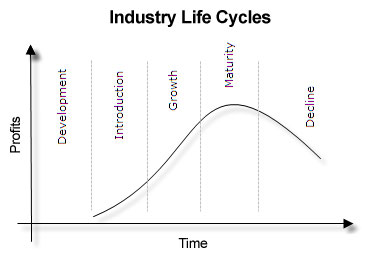
    Industry Life Cycle

    The answer to these questions will differ depending on your industry and where the industry is in its life cycle. There are many good articles out there discussing the industry life cycle so I won’t explore that here other than to say if you are in a more mature industry you will have your work cut out for you. Here is a quick look at the life cycle.

    (PHOTO)

    A small business generally competes in non-mature industries. The reason for this is that a mature industry has been around long enough to attract the attention of big players who will have deep roots. It is not impossible to compete in a mature market but keep in mind you will need offer more than you would if you were in a new or growing industry. In a mature market purchase decisions are generally made on preference rather than on need.  Think of Coke and Pepsi or MacDonald’s and Burger King. Arguably the products don’t offer a different value, they are simply preferred. Hint: when dealing with preference you start to walk down the road of brand recognition and huge ad spend. This is where big marketing companies can come into play.

    I explained the above to give you an idea of where you may be in order that you may know where you are headed.

    Decisions Decisions

    Back to measuring business performance. The core conflict that can arise in any stage of the cycle is pursuing efficiency vs. pursuing effectiveness. As an engineer I must admit my bent is to go after efficiency with everything from the start but that is not always the best course of action. The entrepreneur I mentioned earlier shared a story from early in his career.

    When he was younger and working for a successful business owner he found himself struggling with some hard decisions that would affect the company. The owner noticed him in his dilemma and said “Just make a decision. Do what you can and get things done. If you make the right decision 50% of the time you will move forward, if you agonize about each decision the world will pass you by. Now I’m guessing you will do better than 50%” From that point on my friend has been much more of a “get er done” type of guy and has built a multimillion dollar business.

    Fear of Mistakes

    It is my belief that our fear of failure pushes us not to feel ok about making mistakes. It is this fear that leads to the all too common “Paralysis by Analysis”. We may argue that it is for the sake of efficiency that we weigh and reweigh our options but I would suspect fear is the main driver.

    That’s not to say we should never concern ourselves with efficiency because it is quite vital for continued success. I would argue however that in a small business, initial efforts should be concerned with effectiveness while later efforts, once you are established, can address efficiency. Remember the life cycle above? The efficiencies and the cutting of the fat are not introduced until more players enter the market and the need to be efficient is required for survival. So, said another way;

    Initially a business or organization does not need to be efficient they need to be effective. Efficiency comes into play later when market demand requires you to sharpen your pencil or resource availability becomes limited.

    So, don’t worry as much about how a job is done as long as it gets done and doesn’t put you in the red. This takes a bit of intuition but a mistake can often teach you more than success on the first try which in turn build your human capital.

  • Why is Leadership Important in Business?

    Leadership is important in business because all people are silently asking to be led. If you want to learn how to make money, learn how to lead. Business is a collection of people working for the same cause, and a leader is required to define that cause. Growth of a business will only come through the time and talents of others. As small business owners and entrepreneurs, the sooner you realize this, the better. Using the time and talents of others will allow you succeed in larger projects faster and with a higher degree of quality.

    This lesson hit home with me when I hired a full-time drafter to take over drafting obligations. Previously I liked working designs out from start to finish so I knew everything about a new design or product. The trouble was that sales began to demand more and more of my time. So, I hired a full-time drafter to take over all of the modeling. It didn’t take long for me to see that he was 10 times better at putting together drawings than I was. On top of that, because he began working more closely with the product line, he began to notice inconsistencies that I glazed over. A good leader understands that specialized tasks are better facilitated by people with specialized training. I initially fought the push for more help, but once I relinquished the reigns, both the company and I were in a better place.

    Culture

    The leadership of an organization will also dictate the culture that a business operates in. Businesses often have a top-down management structure, and as such the leading authorities set the tone of the work environment. Authoritarian leaders will rule with an iron fist, creating a military-style environment, while laissez-faire leaders will promote a more laid-back culture. Each style is arguably more effective in different situations, but the point is that leaders are the ones responsible for the business culture. A good leader recognizes this dynamic and tailors the environment to best meet the needs of his or her workforce. This metric alone can result in the retention and recruitment of premium talent.

    Direction

    It is important not to confuse leadership with management. To manage is to make sure things are done right–to lead means determining the right things to do. Leaders define the direction and market placement of a company. They decide how to establish a competitive advantage and who to partner with in order to meet the needs of the customers. The leader has his or her sights set on where the company should be headed, who needs to be on the team in order to make it happen, and how the idea will ultimately be executed.

    How to Be a Quality Leader

    No organization operates without someone steering the ship, so if running a business is something you are currently doing, or looking into, understand that leadership is vital to your success.

    People want to be led by sincere individuals. It may be temping while in a leadership position to have all the answers all the time, but the truth is, no one has all the answers all the time. In fact, it is possible to build more loyalty with your workforce by admitting you don’t have an answer when you truly don’t. Employees will see through any attempt you make at giving an answer when you don’t have one.

    Fit a position to an employee, not the employee to the position. Employers often miss the mark when fitting employees to positions. They start with a fixed position that needs to be filled and fill it with the person that most closely aligns. There are times when this approach works, but a good leader understands that molding obligations to fit the strengths and aspirations of an employee will result in a happier employee and a more profitable bottom line. People that hate their jobs perform significantly worse than those that enjoy what they do. Be flexible and listen to the voice of your workforce.

    Be teachable. We already addressed the fact that you don’t have all of the answers, so listen when others talk. This falls in line with sincerity–people don’t like to work for someone who never listens and only dictates. The owner of a business should be the employee’s greatest advocate.

    What Happens Without Leadership?

    The best analogy that can be drawn here is a ship without a captain. Not leading an organization is a sure-fire way to make sure it sinks. Even with good middle management, if an organization lacks good leadership, the business will suffer. Eli Goldratt, the author of the theory of constraints, maintained that he would not work with second-generation companies. The idea was that poor leadership is not worth the trouble. I could give a specific example of an organization that thrived under the leadership of a father yet crumbled under the leadership of his son. Dad understood what it took to keep the business alive and well, son did not. Dad knew who to talk to when he didn’t have the answer, the son did not. Within two years of the company being handed over to the son, the business went belly-up.

    No matter who you are, or what your position, to some extent you are a leader to someone. Remember this while you pursue your endeavors.