Tag: Needs of small scale business

  • Looking to hire someone or are you looking for a job? Read this!

    Looking to hire someone or are you looking for a job? Read this!

    Do to some recent involvement in hiring processes I felt like it would be a good time to share some insight on what I have learned. As an employee or an employer the following information will help you find a good fit. It is amazing at how little thought is given to the pairing of workers and jobs. You would not ask a quarterback to play defensive end or a goalie to play center, so why do we throw people into positions they fundamentally are not geared to handle?

     
    Your customers pay you in the short run; your employees pay you in the long run. I don’t remember where I came across this this but it speaks to the gravity of your team dynamics and a business’s ultimate success or failure. Sports analogies seem to work best so I will continue to lean on them. Each year a lot of people pay close attention to what players their football team has drafted…why? This is because it is the talent that ultimately feeds into the team’s ability to perform. Really good coaching staffs find the players that they believe will best round out their current lineup. Super stars are nice but in many cases they don’t help the team perform on the whole. This is why you will see #1 draft picks traded off for any number of other players.

     
    A well balanced team that has strong players in each position will constantly out perform a team that was simply thrown together. In your organization if you are not being intentional about what players are needed, or which positions are at a deficit you may be setting yourself up for failure. At best you are not maximizing what could be. The sad thing is there is no way to quantify an opportunity loss by persisting a poor team. A good team on the other hand is quantifiable. You will look at your bottom line and be surprised at how your profits doubled when all you did was fire that trouble maker and replaced him with a good hire.

     
    A good employee will pay you in the long run because that is the perspective they have. They are looking around the corner to see how their actions are affecting others, and how what they do today will affect what happens tomorrow. A poor employee wants to punch a clock do as little as possible and leave the second their shift is up. There are positions that require this and for those you can pay the bottom dollar because anyone can do the work. For the positions that are a bit more involved or specialized you will want to keep an eye out for the employees that knock the ball out of the park. When you find one of these be quick to pay them what they deserve, they are already paying for themselves in ways you may never know.

     
    Fire fast and hire slow. By now you should be getting the idea that the people you hire are some of your biggest assets. No one know this better then Dave Ramsey. I recently went through Dave’s book Entreleadership and one of the areas that jumped out to me was his approach to personnel. To get into the specifics of Dave’s process you will need to read the book but on the surface let me tell you there is a lot to be said for giving your work force the attention it deserves. A good hire is worth their weight in gold, a bad hire is like cancer. So why would we not fire fast and hire slow?

     
    Fire fast. Firing someone is not fun but I can tell you keeping someone around that shouldn’t be is even less fun. By allowing someone to stay on your team that is a cancer will make your life miserable and bring down the moral of your entire group. It will also play into your productivity and eat into your bottom line. One thing to keep in mind when firing is that you will be doing yourself and the individual you are terminating a service. By allowing them to stay you are actually hurting them. It is obvious they are not a good fit, letting them go frees them up to find something that is.

     
    Hire Slow. Most people take time to make big commitments and bringing a new member to your team is a big commitment. A long vetting process may not sound like fun and will likely require you to go without the help you need right now but in the long run it will be worth it. If you can’t find the person you need in many cases you will be better off leaving the spot empty than settling for whoever walked in the door. This is also why you should always be on the lookout for good people. Jim Collins refers to this as getting the right people on the bus. He goes over this dynamic in detail in his book Good to Great.

     
    The right people don’t need a lot of direction or supervision. The time you take to make sure someone is the right fit will pay large dividends in the long run. This will require you to be very intentional when defining the jobs and positions you are looking to fill. Don’t expect to make a good hire if you haven’t taken the time to first understand everything you are calling them to do. The less you understand about the position you are looking to fill the less likely you will be to find an appropriate candidate.

     
    When you do hire begin with a probation period. This is a widely used practice that makes it safe for both the new hire and the company as they begin their working relationship. The employee has the right to walk away at any time and the company doesn’t have to carry the full cost of the employee benefits. Have a stated period of time such as 90 days at which point you can sit down together and decide what to do next. If one or both of you is on the fence it is the perfect opportunity to go your separate ways.


    Align the position with the employee’s aspirations. People are not machines and can’t be expected to fit in the box you create for them. Shape positions around your people, not people around your positions. This will allow the company to get its needs fulfilled and it will encourage and energize the employee. People want to spend their time doing what they enjoy. Conversely they don’t want to spend time doing things they don’t enjoy. If you force someone into doing a job they hate they won’t be doing it very long or very well.

     
    Working with people is delicate endeavor but can be one of the most rewarding things you do. Your people are your team and your responsibility. Much of their success and failure will hinge on how you lead them.


     

  • Top 5 Considerations for Small Business Success

    1. Business is simple; don’t make it more difficult than it needs to be. Having spent a lot of time studying organizations and business theory I am so surprised at how little of it makes its way into successful companies. This is especially true for smaller organizations. In the end a business fails because it can’t make money and a business succeeds because it can make money. To say it another way; Do the things that make money and quite doing the things that don’t make money. Simple enough?

    The idea of making money is an odd subject and one that seems people either understand or see as smoke and mirrors. For some people making money is something that happens after a slew of things fall into place and “magically” money finds its way into their account. For others there is a linear correlation; provide value and collect money. I have to admit I began as the former with the idea that making money was much more complicated than it really is. Even after being on the receiving end of transactions that were lucrative I questioned “can it really be this easy?”…Yes it can!!!

    The business theory side of me would communicate this as defining a value chain and operating lean. All that means is cut out the fat of your operation. Certain things you provide are needed and others are not. I would especially challenge you to question the things you see as adding indirect value. These would be the things that don’t make you any money but you feel are necessary because they are expected.

    2.  Effectiveness is more important than efficiency. This would be another area in which a small business can shine over a larger competitor. Often times larger organizations are so caught up in doing things perfectly that they lose sight of doing the right things. I have had the opportunity to work with a lot of big organizations and it would surprise you at how often they will forfeit their competitive advantage in the market place for the sake of their financial reports. In the article The Upside to Inefficiency I cover in a bit more detail where and when effectiveness should take precedence and when efficiency is needed. It may surprise you to learn that efficiency can at times do more damage than good.

    As an engineer I ran into this with quality groups that would hold up production because something wasn’t perfect. They identified a measurement or characteristic that was out of line and as they were instructed rejected the part. The problem was the measurement or characteristic that they identified had nothing to do with the form, fit, or function of the product. So they were putting the brakes on production for something that had no tie to the value the product provided. Don’t get me wrong I am all for constant improvement but when a quality group is given full authority over the big picture they will find the perfect way to run a company into the ground.

    As a small business one of your greatest assets will be the attitude to get things done. You may have to do things more than once or come back to the job site for a later fix. The sooner you can see it as an opportunity to strengthen your relationship with your customer the better. Being perfect is much too expensive for a small business. Your customers may not realize this but perfection was not what they were looking for when they called you up. They had a need and they simply want you to take care of that need.

    3. Keep an eye on your expenditures. Have you ever known someone to start a business and turn around the next day and buy a new car? There can exist a mindset that owning a business automatically means you have money. Sadly this is often not the case. Starting a business and running a successful business are two completely different things. Out of the starting gate you need to keep an eye on every penny and ensuring that you are not spending more money than you are making. If you can do this it won’t take long for your organization to grow to the point you dream.

    Don’t justify purchases because you can get a tax write off. We all want a nice work environment but buying a walnut executive desk would not be the best use of funds in your early stages. “ I can write it off” you say, well I don’t know what good a write off is to a company that doesn’t exist.

    If you don’t own a business or are just getting started take a look at your checking account. How have you managed it? The answer to this is exactly how you will manage your business. You are your fist business and I hope you have taken the time to budget accordingly and don’t find yourself at the end of the month wondering where all of your money went. If you don’t control your money it will control you. Keep an eye on where you spend and eliminate any of the spending that is not adding value to your company.

    4. Know your numbers. This may seem obvious but a lot of people don’t know if their product or service is making money. They are so caught up in putting out fires don’t realize they are the reason they can’t get ahead. When you do a quote or cost out your product you must know how much it cost and how long it will take to deliver. If you simply copied a number from the market or adopted what the other guy was doing you could be setting yourself up for failure.

    Additionally the more intimately you know your numbers the more likely you will be able to improve your company. There is a great example of Henry Ford utilizing the boxes that were used to ship him supplies in his automobiles. This is a great example of recognizing value in what others likely perceived as garbage. If you are in lawn care, how long does each lane take to maintain? How many guys are needed to do a lawn? How much gas is used? How many times a month does that lawn need attention? In one day how many laws can be cared for? How much weed eater line is consumed in a week/month/year? These are all things I would expect someone in lawn care to know and I don’t know much about lawn care.

    Knowing your numbers also allows you to make better judgments on the fly. In conversations with your customers you will be able to parse information very quickly and accurately to know when a job would be a winner or a looser. You will know when you are being competitive or when you are being conservative. If you have acquired a small business you will be able to identify the projects and customers that are loss leaders. One of the best business men I know could tell you more than anyone would care to know about his business because he minds the numbers.

    5. Buffer everything. In the end you cannot account for everything. Human behavior has a funny way of inviting murphy to every party. Buffers are very important when managing your customers’ expectations. Being strategic with your buffers will allow you to remain competitive and allow room for variability. In every case you want to be able to under promise and over deliver while remaining competitive. In the world of project management buffers are key to successful execution. An aggressive schedule with strategic buffers will outperform a loose schedule with no buffers every day of the week.

    Buffers can also help speed things up. If you know the amortized daily expense of an asset is say $98.60 you will be well served to quote at a cost of $100.00. This will speed up your quoting process and will give you a slight buffer on your expense estimate. This along with the prior point of knowing your numbers will equip you to cost things out quickly and effectively and in the world of small business this speed is key.

    These 5 principles are invaluable to the small business owner. Learn them, test them, and lean on them. I can assure you everyone reading this will benefit greatly by exercising these. If you have an example or a principle you have found helpful send us a comment and let us know your thoughts.

  • Key Small Business Success Factors

    Many factors play a role in the success or failure of a small business, but how can these factors be assessed across business types and how do we identify which ones are key? In previous articles we have addressed how businesses can compete relative to one another but here we will dig into the key factors that permit start-up and long-term success.

    Through the 80s, as the study of entrepreneurs and small businesses became more prevalent, it was recognized that a formal structure to describe venture creation would be helpful. William B. Gartner in his 1985 work ‘A Conceptual Framework for Describing the Phenomenon of New Venture Creation’ set out to establish such a structure.

    The goal is to identify the specific variables that describe how each new venture was created, in order that meaningful contrasts and comparisons among new ventures can be made.” (Gartner 1985, 701)

    As Gartner puts it

    The framework integrates four major perspectives in entrepreneurship: characteristics of the individual(s) who start the venture, the organization which they create, the environment surrounding the new venture, and the process by which the new venture is started.” (Gartner 1985, 696)

    Gartner’s first category the “individual” includes characteristics such as the need for achievement, locus or control, risk taking propensity, work experience, age, and education.

    The “organization” is the entity that is created and consists of the product or service, the customer contracts, licensing, focus, and resource usage.

    The “environment” is the external conditions outside the ventures scope of influence. Environmental factors include the available capital, skilled labor force, market accessibility, living conditions, and availability of supplies.

    Lastly the “process” is the behavior and activities of the individual. Examples of process would be finding a business opportunity, gathering resources, making the product, or marketing.

    This framework provides a common ground to compare the primary factors at a venture’s creation to the factors that play a role in the overall success. You will be suprised to find they are quite different.

    Key Start-up Success Factors

    The application of Gartner’s framework upon business startup was conducted by Marco Van Gelderen when he used the framework to assess the relative importance of factors in successfully getting a venture started. (Van Gelderen 2006). The empirical study followed 512 entrepreneurs over the course of three years and determined that there were three primary contributing variables in the startup phase.

    The first factor he found to be associated with startup success was the perceived risk of the market. In other words Individuals may or may not start a business given their perception of the risk associate with the venture. Van Gelderen points out that the actual risk may not be the same as the perceived risk but argues that a lower perceived risk will result in an earlier start to a venture.  Risk or perceived risk of the market would be considered by Gartner to be an environmental condition.

    The second factor associated with success at startup was found to be starting full time verses starting part time. Van Gelderen noted that starting part time is less risky but is also a sign of lower commitment. Starting full time assumes more risk but is also a sign of greater commitment. Individuals who started full time with a greater commitment are more likely to get their venture off the ground. Within the scope of Gartner’s frame work this would fall under the banner of an organizational factor.

    The last factor Van Gelderen cites is the early capital requirements. Van Gelderen noted that those who lower their capital requirements increase their chances of getting started while those who intend to use more startup capital have a lower probability of getting their business running. Capital requirements would be considered by Gartner to be an environmental factor.

    To summarize Van Gelderen’s findings in terms of Gartner’s framework, the primary success factors associated with getting a business started are (1) the perceived risk of the market, an environmental factor (2)starting full time verses starting part time, an organizational factor (3) the initial capital requirements, an environmental factor.

    Key Long-term Success Factors

    Once a venture has started the dynamics change and the factors that played a role at startup are no longer the primary concern. The study entitled ‘Why do Most Firms Die Young?’ by Robert Cressy develops a model to address the factors that contribute to success and failure in the first few years of operation and illustrates the exposure to risk through the life of a business. (Cressy 2006,111)

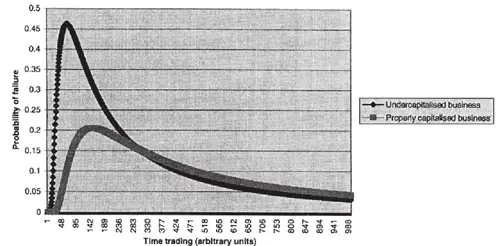
    Cressy defined the primary variables associated with life time failure probability to be managerial capital(Human Capital), financial capital, entrepreneurial risk aversion, and the decision on market positioning. Using these factors Cressy created a theoretical model to illustrate the risk distribution over the lifetime of a venture. His resulting distribution indicated that the peak of risk exposure exists within the first 18-24 months and then tapers off through the remaining life of the venture. The study also suggested that the appropriate initial startup capital, both financial and managerial, will delay and minimize the overall exposure a venture will face. Cressy’s distribution is illustrated in figure 5.

    Cressy, R., 2006, ‘Why do Most Firms Die Young?’
    Small Business Economics 26, 103-116.
    Figure 5

    Applying Gartner’s framework to Cressy’s findings the primary factors can be categorized as follows (1) managerial capital, an individual factor (2) financial capital, and environmental factor(3) risk aversion, an individual factor (4) market positioning, a process factor.

    Startup Vs. Long-term Success Factors

    Comparing the results of Cressy’s study to the results of Van Gelderen’s shows the difference between the key factors in startup and long-term success. Table 1 illustrates the comparison.

    Gartner’s Framework

    Pre Startup Success

    Long-term Success

    Individual

    II

    Organization

    I

    Environment

    II

    I

    Process

    I

    Table 1. Success factors and Gartner’s Framework

    From the studies we can make the following observations.

    • Long-term success is a function of four primary factors whereas startup success is a function of three.
    • The environment is the only factor that is considered in both startup and long-term success.
    • The specific environmental condition that existed in both cases was financial capital requirements.
    • The environment is the single biggest contributing factor associated with starting a venture.
    • The individual is the single biggest contributing factor associated with long-term success.

    This paints quite a picture, not only do the factors change from the startup to the long-term but long-term success is dependent on one more factor than startup. Additionally the individual is considered to be a large part of what makes a venture succeed but is not a primary factor at startup. This discontinuity between primary startup factors and long-term factors along with the high failure rate together imply that it may be easier to get a business started than it is to make a business successful.

    Could such a high small business mortality rate be due to the ease of getting a business started vs. the ease of making a business successful? What we do know is that the largest factor involved in long-term success is not required at startup and that the individual and financial capital requirements will always be a concern.

  • How to Finance a Small Business

    When starting and running a small business the question of how to finance will come up multiple times. There is often an initial startup cost for assets, materials, and initial operations. As the business grows the demands on your company will change and you will again need to look at acquiring more resources. Depending on your industry the financial barriers will differ but there are some fundamental truths you should adhere to as a small operation.

    Importance of Cash Flow

    I can’t stress enough the importance of cash flow for your biz. It is the life blood of your organization and without it you won’t last long. You can have all the net worth in the world but if you don’t have positive cash flow your company is worthless. Think of your business like a bucket that has holes in the bottom of it. Your cash flow would be the water pouring in the top while your expenses would be the water pouring out the bottom. Without cash flow your bucket will run dry.

    This is a simplistic analogy because in reality you will find that both the flow of water into your bucket and the flow out of the bucket are in constant flux. So much so that your “flow” in will sometimes be more like a drip at the same time your bucket loses its bottom entirely. The ideal circumstance is to have an organization that maintains a constraint positive cash flow and empties its reserves into savings for future market fluctuations.

    Little Money in a Dynamic Market

    As a small business you fundamentally have to deal with having little money in a market that is constantly changing. Understanding this you would be wise to play into the strengths of small business while at the same time staying conservative with your spending. Small business market places don’t see large sums of constant income; they see peaks and valleys. This comes from seasonality and the inconsistent demand inherent to the market.

    To combat this reality it is advisable to find ways to diversify your services and build your customer base. This can be a fine line because you can’t be all things to all people. A landscaping company could do snow removal in the winter, a painter could do both residential and commercial work, or the machinist could create a proprietary product to sell online. The trick it to focus on the company’s core competencies and serve the markets they benefit.

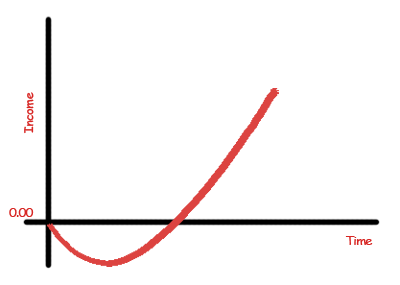
    What to Expect the “J” Curve

    If you take a step back and look at the gross financial positioning of a successful organization you would see a curve that resembles a J. The J curve implies an initial expense and a gradual return on investment. The rental house I just completed for example required initial finances to purchase and fix. Once rented however the home will produce an income and begin to offset those initial expenses. The point at which you have earned the amount you have invested is your breakeven point. In the case of the rental house it will take many years for the income to offset the expense.

    Ideally you will want as quick of a turn as possible but it can take as much as two years or more to recoup your initial investment. As you plan you financing keep this in mind so you have an idea as to when you can expect the initial expenses to stop and when you can expect to see a trend begin in the other direction. Generally all companies get two years. If you are fortunate enough to have made it past two years you will have experienced the majority of the threats your business will ever see.

    More isn’t Always Better

    There have been studies that suggest that surplus financial capital can be a detriment to startup performance. The reason for this is that the more money one has the less intentional they are with it. Another illustration of Parkinson’s law – expenses expand to fill the budget allocated. This is also one of the reasons venture capitalists assume so much risk when throwing money at a venture. It is also the part of the reason they have “rounds” of funding.

    A perfect example of this dynamic is again our rental. I had originally planned on throwing 20 to 30 thousand at the property for the fix ups that were required but found a 6 moth zero % interest credit card with a limit of 8k. I though ok let’s start there and see what happens.  Having free money for 6 months is a pretty good deal; if it could cover everything then I could pull a loan out against the house (in its remodeled state) at a great rate and pay the card off. So that is what we did and the 8k limit made us much more intentional with each dollar. We actually ended up just over 7k for all the materials leaving 1k as a buffer for unforeseen expenses.

    We could have easily spent 20 or 30k on the project but because we only allocated 8k we made it work. I can think of many instances in which we hunted for a deal rather than purchasing something new at the local hardware store. In fact I think I could write an entire post on “how much we are willing to spend for conveyance”. Shopping at the local habitat for humanity saved us thousands but cost us a little time. We had the time to spend so it was no big deal.

    Sources, Where to Find Funding

    Now that you have chewed on a few considerations regarding how much funding you may need where should you go to find it? There are a ton of options so I will only touch on my favorite few.

    Personal Saving.
    If you can save what you need for your business I would suggest you do so. Operating off your own hard earned cash will yield the best return for each dollar spent. It also means that you will have no debt. Having not debt gives you a huge upper hand for obvious reasons.

    Family and Friends
    Personally I don’t like to mix family and friends with business but this can often be a great way to get started. This is especially true for younger entrepreneurs who don’t have the credit history or income to merit larger formal loans.

    SBA
    The U.S. Small Business Administration has a few loan programs that may be what you need. You will need to read up on them to see but the idea is they will operate as your advocate to help you receive adequate funding.

    Be Self-Reliant

    The most successful business men I know will leverage other people’s money but could pay off 100% of their debt if they needed to. If you can get into this position you will be sitting pretty. Banks tend to only lend to those who can prove they don’t need the money  so when figuring out how to finance your small business try to be the one that doesn’t need the money.

    The borrower is slave to the lender (Proverbs 22:7)

  • Case Study of a Successful Little Business

    I recently had the privilege to review the 10 year performance of a successful little business and want to touch on some of the general business principles that allowed this success. Confidentiality prohibits me from including specific details but you probably don’t care about those anyway; you want to know what you can take away for yourself. The company operates as a small business and has the volume of a good size organization with annual revenues over 10 million.
    What makes this case study interesting is that the subject company has seen roughly a 20% annual growth rate for the past 8 years. In case you didn’t realize it a 20% annual growth is HUGE and to do that for 8 consecutive years is even more amazing. Another twist to the story is that this company competes in an industry consisting of large conglomerates.

    So, how did they do it? Well, the answer isn’t a short one; there are many factors that played into their initial and continued success. The best explanation I can find for this dynamic is the “Fly Wheel” effect found in Jim Collins book Good to Great: Why Some Companies Make the Leap… and Others Don’t. Basically there was no one single decisive point that shot the company into the world of success. Rather, it was a continued effort (pushes of the wheel) that collectively allowed the company to grow. Interestingly enough each “push” is in itself unique and wasn’t required until the “push” before it was in place. This means that one of the biggest challenges of growth is the dynamic nature of changing needs.
    Dynamic Needs of Growth

    As a business grows its needs change and efforts must be shifted to accommodate the new demands. This fundamental truth is in part the reason few people “Get rich quick.” Healthy sustainable growth happens at an organic rate and through iterative efforts. I believe this dynamic is also much of the reason small businesses have such a terrific failure rate.

    The needs that exist when you start a business will not be the needs required to grow your business. Additionally the needs required to grow your business initially will not be the needs required to grow your business down the road. These needs will obviously be business and industry specific but what you need to understand is that your business is a changing entity that requires more than a single fixed solution to survive. Think of it like a plant that needs water to sprout, then apple juice for the next three weeks, then beer after that. If you simply continue to give it water it sprouts and flounders for a bit then dies. Wait, sprout and flounder for a bit before it dies? That sounds a lot like most small businesses. Hmmm.

    Back to the Case Study

    An added advantage to our case study that I don’t want to leave out is that its parent company has the finances to pay for changes that need to be made. This may not seem like much but it is a big deal when a company has to find the money to make the changes needed to grow. If you can’t already foot the bill for your planned growth it means you will need to assume additional risk beyond that inherent to the change you want to make. The lesion here is that good old saying “Cash is King!” As a small business you simply cannot afford to be cash poor if you want to grow. In some respects this is where the art of business comes in. Depending on your circumstance the question of how to manage your business successfully will change.
    The subject company leveraged its parent companies willingness to foot the bill on many occasions. Resources were acquired and workers were put in place each time a legitimate need existed to do so.

    Market Positioning

    I mentioned earlier that the subject company was competing in an industry with many large players, how is this possible? It was made possible by sticking to a market position that played into the strengths of small business. As a smaller company it could provide a higher quality product and service to its customer base than its larger competitors. It could also offer these products and services in a fraction of time. The larger organizations have bigger pockets, a larger product scope, perhaps even greater human capital, but none of those matters when a customer needs a high quality solution with a fast turnaround. What would take the large company 2 months the subject company can do in 3 weeks. When problems arise the large organizations have layers of bureaucracy between the customer and the person with the solution while subject company has a non-automated phone system and customers are patched directly through to the parties they care to talk to.

    The subject company has also decided not to compete on cost. Meaning, they will pass on jobs if they don’t feel they are appropriately compensated. This is hard for most small businesses because business is not always coming in at a constant rate. Consequently the subject company receives more money for the time and resources it puts into its work. This is justifiable because of the quality and speed with which the customer is served.

     K.I.S.S and Get ‘er Done

    As an engineer I must admit that I have had trouble with these principles but have learned to greatly appreciate them. At the small business level the K.I.S.S (Keep It Simple Stupid) and Get ‘er done attitudes can go a long way with the customer base. Over complicating a solution or following a bloated process can actually get in the way of solving the customers true problem. Remember, the customer doesn’t want your product or service, they want what your product or service will do for them. In other words if you can address their problem not the means to the end you could be offering more value to the customer. The subject company recognized this and removed all layers that didn’t speak to the customer’s core problem. Upper management is kept thin with no middle managers, everyone wears many hats, and open communication is maintained among the staff. The human capital element is highly leveraged making each employee more of a craftsman if you will rather than a number.

    Do You See a Bright Future?

    After witnessing all of these realities in such a successful little business I am certain they have a bright future ahead of them. My hope with this assessment is that you will find ways to apply these principles and consequently see similar success. If you are having luck let us know, and if you have questions feel free to leave a comment.

  • Maslow’s Hierarchy of Needs for a Small Scale Business

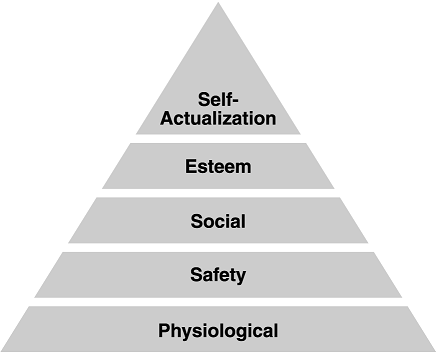
    For those of you who don’t know, Abraham Maslow published a paper in 1943 titled “A Theory of Human Motivation.” In this work he established a hierarchy of needs that he argued was fundamental to all humans.  The structure of his hierarchy is often portrayed as a pyramid with the more basic needs making up the base and the less essential needs towards the top. The needs in order are:

    1. Physiological
    2. Safety
    3. Love/belonging (social)
    4. Esteem
    5. Self-actualization

    Personification of Business

    You may be asking yourself how in the world a personal hierarchy can apply to a business. Businesses are an outpouring of their founder and as such carry many traits found in the individual. If you look at any company, large or small, you can trace its origin back to a person or a small group of people.  Additionally, the company was built to fulfill a need that others have, making it very much a relational entity. In short, you are your first business. I may explore this truth a bit more in future articles, but for now the above correlation is sufficient.

    Physiological Needs of a Business

    For the individual these are the literal requirements for survival; for the business this would consist of an audience, a need to fulfill, and a value proposition. If any one of these is removed a business will wither and die. The business is sustained through fulfilling the need of a group of people by posing its value proposition. Growth will come in the form of compensation.

    Safety Needs of a Business

    The safety needs of a business tie into how far away a company is from going bankrupt. This displacement is a function of how competitive the company’s value proposition is, how diversified its portfolio may be, and how much cash it has to weather unforeseen storms. The only threat to a business is its inability to turn a profit. So, anything that jeopardizes this would be in conflict with the safety needs.

    Social Needs of a Business

    Individuals realize love and belonging needs through friendship, intimacy, and family. A business is no different. Once a customer-supplier relationship is established through customer acquisition, the business must continue to invest into each customer in order to grow the relationship. A competitive advantage can bring new people to a business, but the relationship that is established is what will keep those people coming back and referring others. Said another way, the love and belonging needs would be the market’s acceptance and perception of the business as a member of their respective community.

    Esteem Needs of a Business

    For the individual, esteem needs speak to the desire to feel respected and to have a good self-image. For the business, the fulfillment of this need is made evident by expressed industry standing or awards. Awards and being number one in an industry may win over a few customers, but they are not required to turn a profit. This is why the esteem needs are further down the hierarchy. Having these fulfilled will help the business as an entity feel good about itself but are not required for survival. A company with a high collective self-esteem will cultivate a positive culture among its employees, which in turn will bring about more successful ventures.

    Self-actualization Needs of a Business

    Self-actualization is the fulfillment of one’s own potential. Companies that seek this fulfillment are the ones who so exceedingly meet a demand that they create new markets and innovations. Apple would be a prime example of self-actualization being fulfilled. In everything Apple has done, they have pushed the limits of how people create with technology. Steve Jobs directed the company towards excellence by helping people create in ways they could never achieve before.  Consequently, the iMac, the iPod, the iPhone, and the iPad all played a big role in the introduction of new markets. The self-actualization need of a business is tied tightly to the man steering the ship. The CEO of a business will dictate a company’s direction, which may or may not be towards self-actualization. CEO Steve Jobs led Macintosh through each of its largest innovations, but when he left, it began to lose its way and market share. Upon his return, Macintosh quickly returned to its initial direction and to profitability.

    Conclusion

    As an entrepreneur or small business owner you would be wise to realize the organic nature of the business you conduct. Businesses are living entities with needs that, if not met, will perish. If nurtured, however, they can grow to unprecedented levels, reaching and affecting the lives of many. As an entrepreneur, I know that there are many things on your plate, but I would challenge you to filter through the noise and find the one thing that you know you can do exceedingly well. It will be in that focus that you find your true genius.
    I have discussed another benefit to focusing your efforts in the article titled Successful Habits. In it I explore the ramifications of spreading yourself thin and the inefficiency of multitasking. When I learned this principle, my world changed, and everyone I have shared it with has also found it extremely helpful.