Tag: Small Business

  • Small Business Volatility

    Most people you talk to will agree that the likelihood for success of a small business is not high. If you were to ask why, most would not have an answer. It is common knowledge that small businesses have it rough, but it is not common knowledge as to why. In this article I will explore contributing factors to small business volatility in order to better equip aspiring business men and women for success.

    Small Business Paradigm

    The definition of a small business is much like the definition of an entrepreneur–many people think they know the definition but they truly do not. To understand why small business is risky business, it helps to identify the small business paradigm. This is not to be confused with Small Business Association’s definition of small business. The SBA defines small business as businesses with less than 500 employees.  This means that 99.9% of all businesses in the United States are small businesses. The trouble with this definition is that it ignores business type; it only acknowledges a head count. The most recent numbers I could find indicated a total business count in the US of 27.5 million. 21.5 million have no employees; of the remaining 6 million, only 18,000 have 500 employees or more.  The distribution would look like the following, with “large” business taking up the green sliver at 12 o’clock. I don’t agree with the SBA’s definition of small and large business, but the data does paint a picture of how many individuals operate as loan rangers.
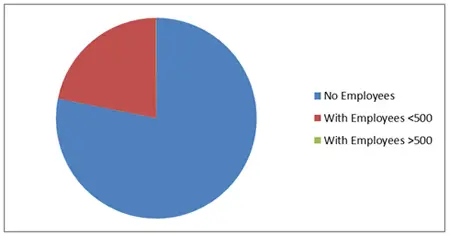

    Understanding the small business paradigm as a type of business and not in terms of employee count opens the door to understanding how small business should be conducted.

    To speak of small business as a paradigm is to outline the model that small business follows. Now I know that the specifics of each business will differ, but there are a few universal truths that can be drawn to help identify the small business paradigm as a whole.

    Small business is small business because large business has determined that pursuit of such a market is not worth the effort. Large business by nature pursues opportunities that require larger capital investments and yield minimal fluctuation. Small businesses by nature pursue opportunities that require a smaller capital investment and have higher market fluctuation. Consequently, many of the opportunities that will exist for a small business have demands that fluctuate and exist in markets that are inherently more risky. You can see how this has nothing to do with employee count.

    The resources and capabilities of a firm will attract them to a particular industry environment. (Dean, Brown, and Bamford 1998) A small firm is agile and flexible, allowing it to move and change to meet the varying demand of a quickly changing market. A larger firm, on the other hand, will be more inclined to focus on opportunities that can be exploited by greater finances and the requirement for more resources. Larger businesses avoid ventures that maintain high variability, and this creates a window of opportunity for smaller entities.

    In small businesses, potential customers are looking to be catered to or to have a custom solution. Maintaining real-time feedback and providing fast turnarounds are essential when conducting business on a smaller level. Customers turn to larger companies when they are looking for a lower priced, prepackaged solution. This is a fundamental truth of small business, and if not adhered to, the probability of failure will remain high.

    This dynamic alone should assist many of you in determining your market positioning. As a small business it is imperative that you demand a large profit margin and provide a quality product or service in a timely manner. Failing to adhere to this truth will result in a quick demise of your company.

    Stages of Business Development

    It is helpful to also understand the stages of business development so that a standard can be established to gauge viability. Churchill’s five stages of small business growth can be used as this standard. A start-up is concerned with the first two stages, stage one (existence) and stage two (survival). After the first two stages, a business begins to move out of the small business paradigm.

    In stage one:

    “The organization is a simple one – the owner does everything …systems and formal planning are minimal to non-existent. The company’s strategy is simply to stay alive. The owner is the business, performs all the important tasks, and is the major supplier of energy, direction, and, with relatives and friends, capital.” (Churchill1983, 3)

    Regarding stage two:

    “The ‘mom and pop’ stores are in this category, as are manufacturing businesses that cannot get their product or process sold as planned. Some of these marginal businesses have developed enough economic viability to ultimately be sold, usually at a slight loss. Or they may fail completely and drop from sight.” (Churchill 1983, 4)

    Knowing of these stages allows a founder to be conscious of the company’s progress. This is important for a start-up, because businesses should only remain small for a short period.

    “Small businesses are merely transitory and will largely disappear in the long run.” (Brock and Evans 1988, 10)

    Small Business Capital Requirements

    Capital requirements within any business need to be met in order to continue operation, and can be broken down into two categories, financial capital and human capital. Capital in general can be considered as the resources available for the use of production. Financial capital concerns the monetary resources, and human capital concerns the knowledge or intellectual resources.

    By definition, most small businesses have very little reserves, so small businesses are especially concerned about financial capital and the requirement for cash flow. If the demand for a service rises and falls inconsistently and the costs remain high, a small business can find itself in a compromising situation. Market fluctuations will always be a concern, but a bootstrapping small business is especially vulnerable, because they don’t have the capital to weather too long of or too many economic storms.

    “The main problems presented by seasonality relate to cash flow and overall profitability” (Getz and Carlson 2000, 554).

    A solution to cash flow concerns is often diversification.

    “Risk reduction for the firm is achieved by diversification across products and services produced, across clients supplied, and across input producers.” (Cressy 2006, 104).

    Although difficult for a small business, diversifying services to accommodate many markets or many needs can allow for a more stable cash flow. Anything that can be done to maintain a constant positive cash flow will be vital in keeping a small business viable.

    Cash flow requirements and the inability to diversify push for larger margins in smaller business. Larger margins are generally only available where competition is low, and competition is low in untapped markets. Creating a new path and plunging into the unknown is part of being a small business and is required to maintain a competitive advantage over those that have more capital and resources but lack the flexibility to meet needs that are not well-defined.

    Without cash a business is at risk. Additional cash flow offers more possibilities to diversify. Diversification leads to more stability, and more stability leads to consistent cash flow. The growth of a business and ultimately wealth depends on the cycle illustrated in figure 1.
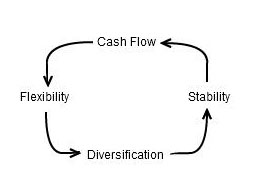
    Figure 1. Cash flow cycle

    A similar cycle plays into the human capital of a small business. The longer an individual operates within an industry, the more human capital he or she acquires.  The greater the human capital, the lower the probability of failure. Illustrated in figure 3, human capital dictates the actions, actions create experience, experience leads to understanding, and further understanding results in greater human capital.
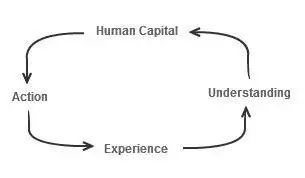
    Figure 3. Human capital cycle

    Small Business as a Service

    Given the principles stated above, it becomes advantageous to play into the strengths of small business. The advantage of a small business is the ability to be agile and meet ever-changing needs in a smaller niche. By nature, services fit well into the small business paradigm. Large businesses often lack the flexibility and agility to compete within such markets. The large businesses are in a position to leverage their resources and capital to break into markets that have larger capital and resource-oriented barriers of entry.

    “small businesses possess certain resources that allow them to overcome some barriers which create greater difficulties for their larger counterparts, as well as allow small businesses to exploit certain industry opportunities more readily than larger ones” (Dean, Brown, and Bamford 1998, 709)

    The labor and capital distribution will appear similar to the graph shown in figure 4 concerning market types of large and small businesses.
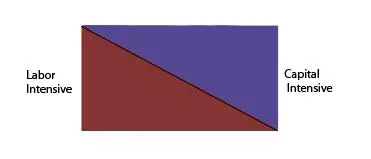
    Figure 4. Labor – Capital distribution

    High-capital businesses would include banks and investment organizations that leverage their capital in order to make a profit. The labor businesses would include organizations that require high man hours in order to produce. Potential entrepreneurs often don’t have the capital at their disposal to get into capital-intensive businesses, but they do have the ability to offer labor-intensive services.

    What to Take Away

    If it is possible to start a small business while taking into account the fundamental truths stated above, the probability for success will be much higher.  Understanding the paradigm of small business for what it is will allow you to make the appropriate choices for your organization as it grows. Small business is volatile by nature, and there is no getting around that, but it is possible to work with it.

  • Key Small Business Success Factors

    Many factors play a role in the success or failure of a small business, but how can these factors be assessed across business types and how do we identify which ones are key? In previous articles we have addressed how businesses can compete relative to one another but here we will dig into the key factors that permit start-up and long-term success.

    Through the 80s, as the study of entrepreneurs and small businesses became more prevalent, it was recognized that a formal structure to describe venture creation would be helpful. William B. Gartner in his 1985 work ‘A Conceptual Framework for Describing the Phenomenon of New Venture Creation’ set out to establish such a structure.

    The goal is to identify the specific variables that describe how each new venture was created, in order that meaningful contrasts and comparisons among new ventures can be made.” (Gartner 1985, 701)

    As Gartner puts it

    The framework integrates four major perspectives in entrepreneurship: characteristics of the individual(s) who start the venture, the organization which they create, the environment surrounding the new venture, and the process by which the new venture is started.” (Gartner 1985, 696)

    Gartner’s first category the “individual” includes characteristics such as the need for achievement, locus or control, risk taking propensity, work experience, age, and education.

    The “organization” is the entity that is created and consists of the product or service, the customer contracts, licensing, focus, and resource usage.

    The “environment” is the external conditions outside the ventures scope of influence. Environmental factors include the available capital, skilled labor force, market accessibility, living conditions, and availability of supplies.

    Lastly the “process” is the behavior and activities of the individual. Examples of process would be finding a business opportunity, gathering resources, making the product, or marketing.

    This framework provides a common ground to compare the primary factors at a venture’s creation to the factors that play a role in the overall success. You will be suprised to find they are quite different.

    Key Start-up Success Factors

    The application of Gartner’s framework upon business startup was conducted by Marco Van Gelderen when he used the framework to assess the relative importance of factors in successfully getting a venture started. (Van Gelderen 2006). The empirical study followed 512 entrepreneurs over the course of three years and determined that there were three primary contributing variables in the startup phase.

    The first factor he found to be associated with startup success was the perceived risk of the market. In other words Individuals may or may not start a business given their perception of the risk associate with the venture. Van Gelderen points out that the actual risk may not be the same as the perceived risk but argues that a lower perceived risk will result in an earlier start to a venture.  Risk or perceived risk of the market would be considered by Gartner to be an environmental condition.

    The second factor associated with success at startup was found to be starting full time verses starting part time. Van Gelderen noted that starting part time is less risky but is also a sign of lower commitment. Starting full time assumes more risk but is also a sign of greater commitment. Individuals who started full time with a greater commitment are more likely to get their venture off the ground. Within the scope of Gartner’s frame work this would fall under the banner of an organizational factor.

    The last factor Van Gelderen cites is the early capital requirements. Van Gelderen noted that those who lower their capital requirements increase their chances of getting started while those who intend to use more startup capital have a lower probability of getting their business running. Capital requirements would be considered by Gartner to be an environmental factor.

    To summarize Van Gelderen’s findings in terms of Gartner’s framework, the primary success factors associated with getting a business started are (1) the perceived risk of the market, an environmental factor (2)starting full time verses starting part time, an organizational factor (3) the initial capital requirements, an environmental factor.

    Key Long-term Success Factors

    Once a venture has started the dynamics change and the factors that played a role at startup are no longer the primary concern. The study entitled ‘Why do Most Firms Die Young?’ by Robert Cressy develops a model to address the factors that contribute to success and failure in the first few years of operation and illustrates the exposure to risk through the life of a business. (Cressy 2006,111)

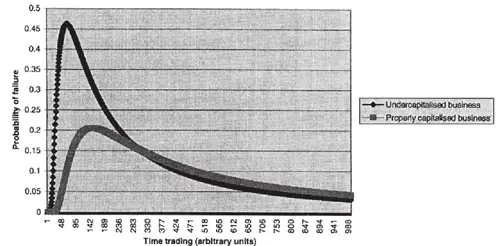
    Cressy defined the primary variables associated with life time failure probability to be managerial capital(Human Capital), financial capital, entrepreneurial risk aversion, and the decision on market positioning. Using these factors Cressy created a theoretical model to illustrate the risk distribution over the lifetime of a venture. His resulting distribution indicated that the peak of risk exposure exists within the first 18-24 months and then tapers off through the remaining life of the venture. The study also suggested that the appropriate initial startup capital, both financial and managerial, will delay and minimize the overall exposure a venture will face. Cressy’s distribution is illustrated in figure 5.

    Cressy, R., 2006, ‘Why do Most Firms Die Young?’
    Small Business Economics 26, 103-116.
    Figure 5

    Applying Gartner’s framework to Cressy’s findings the primary factors can be categorized as follows (1) managerial capital, an individual factor (2) financial capital, and environmental factor(3) risk aversion, an individual factor (4) market positioning, a process factor.

    Startup Vs. Long-term Success Factors

    Comparing the results of Cressy’s study to the results of Van Gelderen’s shows the difference between the key factors in startup and long-term success. Table 1 illustrates the comparison.

    Gartner’s Framework

    Pre Startup Success

    Long-term Success

    Individual

    II

    Organization

    I

    Environment

    II

    I

    Process

    I

    Table 1. Success factors and Gartner’s Framework

    From the studies we can make the following observations.

    • Long-term success is a function of four primary factors whereas startup success is a function of three.
    • The environment is the only factor that is considered in both startup and long-term success.
    • The specific environmental condition that existed in both cases was financial capital requirements.
    • The environment is the single biggest contributing factor associated with starting a venture.
    • The individual is the single biggest contributing factor associated with long-term success.

    This paints quite a picture, not only do the factors change from the startup to the long-term but long-term success is dependent on one more factor than startup. Additionally the individual is considered to be a large part of what makes a venture succeed but is not a primary factor at startup. This discontinuity between primary startup factors and long-term factors along with the high failure rate together imply that it may be easier to get a business started than it is to make a business successful.

    Could such a high small business mortality rate be due to the ease of getting a business started vs. the ease of making a business successful? What we do know is that the largest factor involved in long-term success is not required at startup and that the individual and financial capital requirements will always be a concern.

  • How to Finance a Small Business

    When starting and running a small business the question of how to finance will come up multiple times. There is often an initial startup cost for assets, materials, and initial operations. As the business grows the demands on your company will change and you will again need to look at acquiring more resources. Depending on your industry the financial barriers will differ but there are some fundamental truths you should adhere to as a small operation.

    Importance of Cash Flow

    I can’t stress enough the importance of cash flow for your biz. It is the life blood of your organization and without it you won’t last long. You can have all the net worth in the world but if you don’t have positive cash flow your company is worthless. Think of your business like a bucket that has holes in the bottom of it. Your cash flow would be the water pouring in the top while your expenses would be the water pouring out the bottom. Without cash flow your bucket will run dry.

    This is a simplistic analogy because in reality you will find that both the flow of water into your bucket and the flow out of the bucket are in constant flux. So much so that your “flow” in will sometimes be more like a drip at the same time your bucket loses its bottom entirely. The ideal circumstance is to have an organization that maintains a constraint positive cash flow and empties its reserves into savings for future market fluctuations.

    Little Money in a Dynamic Market

    As a small business you fundamentally have to deal with having little money in a market that is constantly changing. Understanding this you would be wise to play into the strengths of small business while at the same time staying conservative with your spending. Small business market places don’t see large sums of constant income; they see peaks and valleys. This comes from seasonality and the inconsistent demand inherent to the market.

    To combat this reality it is advisable to find ways to diversify your services and build your customer base. This can be a fine line because you can’t be all things to all people. A landscaping company could do snow removal in the winter, a painter could do both residential and commercial work, or the machinist could create a proprietary product to sell online. The trick it to focus on the company’s core competencies and serve the markets they benefit.

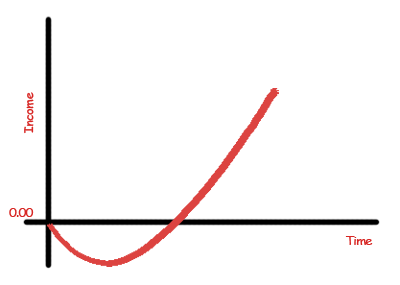
    What to Expect the “J” Curve

    If you take a step back and look at the gross financial positioning of a successful organization you would see a curve that resembles a J. The J curve implies an initial expense and a gradual return on investment. The rental house I just completed for example required initial finances to purchase and fix. Once rented however the home will produce an income and begin to offset those initial expenses. The point at which you have earned the amount you have invested is your breakeven point. In the case of the rental house it will take many years for the income to offset the expense.

    Ideally you will want as quick of a turn as possible but it can take as much as two years or more to recoup your initial investment. As you plan you financing keep this in mind so you have an idea as to when you can expect the initial expenses to stop and when you can expect to see a trend begin in the other direction. Generally all companies get two years. If you are fortunate enough to have made it past two years you will have experienced the majority of the threats your business will ever see.

    More isn’t Always Better

    There have been studies that suggest that surplus financial capital can be a detriment to startup performance. The reason for this is that the more money one has the less intentional they are with it. Another illustration of Parkinson’s law – expenses expand to fill the budget allocated. This is also one of the reasons venture capitalists assume so much risk when throwing money at a venture. It is also the part of the reason they have “rounds” of funding.

    A perfect example of this dynamic is again our rental. I had originally planned on throwing 20 to 30 thousand at the property for the fix ups that were required but found a 6 moth zero % interest credit card with a limit of 8k. I though ok let’s start there and see what happens.  Having free money for 6 months is a pretty good deal; if it could cover everything then I could pull a loan out against the house (in its remodeled state) at a great rate and pay the card off. So that is what we did and the 8k limit made us much more intentional with each dollar. We actually ended up just over 7k for all the materials leaving 1k as a buffer for unforeseen expenses.

    We could have easily spent 20 or 30k on the project but because we only allocated 8k we made it work. I can think of many instances in which we hunted for a deal rather than purchasing something new at the local hardware store. In fact I think I could write an entire post on “how much we are willing to spend for conveyance”. Shopping at the local habitat for humanity saved us thousands but cost us a little time. We had the time to spend so it was no big deal.

    Sources, Where to Find Funding

    Now that you have chewed on a few considerations regarding how much funding you may need where should you go to find it? There are a ton of options so I will only touch on my favorite few.

    Personal Saving.
    If you can save what you need for your business I would suggest you do so. Operating off your own hard earned cash will yield the best return for each dollar spent. It also means that you will have no debt. Having not debt gives you a huge upper hand for obvious reasons.

    Family and Friends
    Personally I don’t like to mix family and friends with business but this can often be a great way to get started. This is especially true for younger entrepreneurs who don’t have the credit history or income to merit larger formal loans.

    SBA
    The U.S. Small Business Administration has a few loan programs that may be what you need. You will need to read up on them to see but the idea is they will operate as your advocate to help you receive adequate funding.

    Be Self-Reliant

    The most successful business men I know will leverage other people’s money but could pay off 100% of their debt if they needed to. If you can get into this position you will be sitting pretty. Banks tend to only lend to those who can prove they don’t need the money  so when figuring out how to finance your small business try to be the one that doesn’t need the money.

    The borrower is slave to the lender (Proverbs 22:7)

  • 5 Steps to Start a Small Business

    Steps-to-start-a-small-business

    With everyone talking about the economy I decided it would be a good idea to discuss an approach to small business that if followed would minimize the number of failures. These 5 steps to start a small business provide a solid foundation to any venture and should not be ignored. It is in the success of small business that the economy finds its strength so, take notes.

    1. Take a Look in the Mirror

    When thinking about starting a small business the first thing one should examine is their personal financial situation. You are your first business and the way you manage your personal finances is a reflection of how you will manage the finances of your business. If your personal finances are in order and you make more than you spend, you are probably ready to begin thinking about other business ventures. If on the other hand your situation is the other way around and you spend more than you make, I would suggest that you get your situation turned around before venturing into the world of small business.

    The management principles that lead to financial success on the personal level are the same principles in the business world. If you are employed you are providing a service to your employer and in exchange they are compensating you with a salary or an hourly wage. Think about this for a bit, you are already playing the small business game. Where are your week spots? Are there spending issues? Why are you looking to start yet another business? Examining your current situation with this perspective will give you an idea of what to expect if you were to get another business off the ground.

    2. Understand the Small Business Marketplace

    Before getting started make sure you understand Small Business Volatility. The most notable characteristic of the small business marketplace is its resistance to success.  The fact is the majority of small business startups will close their doors after two years of operation. If you don’t take note of this reality you are positioning yourself for failure. One of the biggest contributors to this reality is the fact that small businesses generally don’t have much money behind them and businesses fail because they don’t make enough money to cover their expenses.  In other words the small business marketplace is a marketplace averse to error. One must know where each penny is going and how each penny will help the bottom line.

    That said, there are advantages to small business. Being small means you are flexible and fast. You won’t have the layers of bureaucracy to slow you down when you need to make a decision or change something up. Leveraging this reality can afford you opportunities that your larger counterparts cannot act upon.  Commonalities exist among the small business and large business paradigms but keep in mind a small business approach will not work in a large business environment, and a large business approach will not work in a small business environment. Most consumer based organizations that we are accustom to follow the large business paradigm so keep yourself in check because a Wal-Mart approach to a custom boutique is a recipe for failure.

    3. Begin with Service

    Outside of yourself your first small business should be service oriented. There is a smaller financial barrier of entry for service based businesses than there is for product based models. This means you will reach a break even faster than you would if you decided to go with a product based model. Think about a janitorial agency. The startup costs would be rather small, especially if you had supplies you could use around the house.

    Additionally many service based business are better suited to handle fluctuations in demand. Market fluctuation can be killer for smaller organization. A service based model can have its expenses tied closely to the actual delivery of the service. This means unless you are providing the service, you are not incurring costs. There will be some overhead but not as much as there would be in a product oriented environment.

    4. Be Willing to Change Direction

    I have heard it said that companies change their focus an average of 5 times before they find success. As you begin to fulfill a need your intuition on that need will grow, as it does allow it to direct your company. Microsoft for example began in traffic analysis hardware, not software. There is freedom to try multiple directions (one at a time) to figure out how your company can best add value. Eric Ries in his book The Lean Startup: How Today’s Entrepreneurs Use Continuous Innovation to Create Radically Successful Businesses calls this “the pivot”.

    5. Dig In and Get to Work

    These precautions will safe guard you tremendously as you pursue each business venture but they are worthless if you don’t act. In order to make you business work you will have to work… a lot. A common trait I have witnessed among successful business men is their drive to get things done. They don’t sit around and wait for this or that, they figure out what needs to be taken care of and take care of it. The journey doesn’t have an end, being a business owner is a continuous effort to perpetuate your organization. If you don’t eat and breathe your business chances are you will play second fiddle to someone who’s passion is the business you claim to love.

    I hope you find this helpful. I know may people want to know How To Make Easy Money Fast, which can be done, but not continually and not with a small business. Business is hard work that will take time to produce fruits but trust me when I say diligent effort invested into a focused business will pay off handsomely in the time. Remember, the small business is the heart of our economy and anything that can be done for the sake of small business is a cause worth pursuing.

  • Maslow’s Hierarchy of Needs for a Small Scale Business

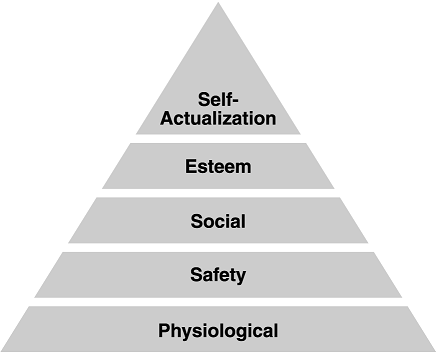
    For those of you who don’t know, Abraham Maslow published a paper in 1943 titled “A Theory of Human Motivation.” In this work he established a hierarchy of needs that he argued was fundamental to all humans.  The structure of his hierarchy is often portrayed as a pyramid with the more basic needs making up the base and the less essential needs towards the top. The needs in order are:

    1. Physiological
    2. Safety
    3. Love/belonging (social)
    4. Esteem
    5. Self-actualization

    Personification of Business

    You may be asking yourself how in the world a personal hierarchy can apply to a business. Businesses are an outpouring of their founder and as such carry many traits found in the individual. If you look at any company, large or small, you can trace its origin back to a person or a small group of people.  Additionally, the company was built to fulfill a need that others have, making it very much a relational entity. In short, you are your first business. I may explore this truth a bit more in future articles, but for now the above correlation is sufficient.

    Physiological Needs of a Business

    For the individual these are the literal requirements for survival; for the business this would consist of an audience, a need to fulfill, and a value proposition. If any one of these is removed a business will wither and die. The business is sustained through fulfilling the need of a group of people by posing its value proposition. Growth will come in the form of compensation.

    Safety Needs of a Business

    The safety needs of a business tie into how far away a company is from going bankrupt. This displacement is a function of how competitive the company’s value proposition is, how diversified its portfolio may be, and how much cash it has to weather unforeseen storms. The only threat to a business is its inability to turn a profit. So, anything that jeopardizes this would be in conflict with the safety needs.

    Social Needs of a Business

    Individuals realize love and belonging needs through friendship, intimacy, and family. A business is no different. Once a customer-supplier relationship is established through customer acquisition, the business must continue to invest into each customer in order to grow the relationship. A competitive advantage can bring new people to a business, but the relationship that is established is what will keep those people coming back and referring others. Said another way, the love and belonging needs would be the market’s acceptance and perception of the business as a member of their respective community.

    Esteem Needs of a Business

    For the individual, esteem needs speak to the desire to feel respected and to have a good self-image. For the business, the fulfillment of this need is made evident by expressed industry standing or awards. Awards and being number one in an industry may win over a few customers, but they are not required to turn a profit. This is why the esteem needs are further down the hierarchy. Having these fulfilled will help the business as an entity feel good about itself but are not required for survival. A company with a high collective self-esteem will cultivate a positive culture among its employees, which in turn will bring about more successful ventures.

    Self-actualization Needs of a Business

    Self-actualization is the fulfillment of one’s own potential. Companies that seek this fulfillment are the ones who so exceedingly meet a demand that they create new markets and innovations. Apple would be a prime example of self-actualization being fulfilled. In everything Apple has done, they have pushed the limits of how people create with technology. Steve Jobs directed the company towards excellence by helping people create in ways they could never achieve before.  Consequently, the iMac, the iPod, the iPhone, and the iPad all played a big role in the introduction of new markets. The self-actualization need of a business is tied tightly to the man steering the ship. The CEO of a business will dictate a company’s direction, which may or may not be towards self-actualization. CEO Steve Jobs led Macintosh through each of its largest innovations, but when he left, it began to lose its way and market share. Upon his return, Macintosh quickly returned to its initial direction and to profitability.

    Conclusion

    As an entrepreneur or small business owner you would be wise to realize the organic nature of the business you conduct. Businesses are living entities with needs that, if not met, will perish. If nurtured, however, they can grow to unprecedented levels, reaching and affecting the lives of many. As an entrepreneur, I know that there are many things on your plate, but I would challenge you to filter through the noise and find the one thing that you know you can do exceedingly well. It will be in that focus that you find your true genius.
    I have discussed another benefit to focusing your efforts in the article titled Successful Habits. In it I explore the ramifications of spreading yourself thin and the inefficiency of multitasking. When I learned this principle, my world changed, and everyone I have shared it with has also found it extremely helpful.