Tag: Starting Small Business

  • Unleashing Your Financial Freedom: A Guide for the Stuck Professional

    Unleashing Your Financial Freedom: A Guide for the Stuck Professional

    In the world of 9-to-5 jobs, it’s easy to feel trapped in a cycle of monotony, yearning for a change but not knowing where to start. If you’re a working professional feeling stuck in your job and dreaming of financial freedom, you’re not alone. The journey from employee to entrepreneur is fraught with challenges, yet it’s undeniably rewarding. This article is your beacon, guiding you through the murky waters of entrepreneurship and business creation, inspired by the ethos of the ShyEntrepreneur.

    Step 1: Embrace the Entrepreneurial Mindset

    The first step towards financial freedom is a mental shift. You must transition from an employee’s mindset, focused on tasks and waiting for directions, to an entrepreneur’s mindset, and realizing that you are your first business. This shift doesn’t happen overnight. It begins with cultivating self-discipline, resilience, and a constant thirst for knowledge. Embrace failure as part of the learning process. Every setback is a step towards success.

    Step 2: Identify Your Niche

    One common pitfall for aspiring entrepreneurs is the allure of jumping into highly competitive markets without a clear differentiation strategy. To stand out, you must find a niche that aligns with your passions and expertise. This approach ensures you’re not just another player in an over saturated market but a pioneer in a specific domain. Conduct market research, identify gaps, and evaluate how your unique skills can fulfill unmet needs.

    This step is very important and not always as easy to figure out as you may think. Jim Collins refers to it as the Hedge Hog concept. What is it that you can be the best in the world at that your deeply passionate about and can also make you money.  

    Step 3: Plan Your Escape Strategically

    Transitioning from a full-time job to entrepreneurship requires meticulous planning. Start by setting clear, achievable goals. How much do you need to save before you can quit your job? What milestones must your business achieve before it can support you financially? The goal is not to jump ship at the first sign of trouble but to navigate your way to entrepreneurship with a compass of wisdom and preparation. Just because you plan your exit doesn’t mean you will make one. Additionally, a lot can be gained by continuing with your current employer.

    If your entrepreneurial itch is in the same industry as your current employer wouldn’t it be a good idea to work together? If not together perhaps you may work with the same customers. The possibilities are endless and so long as you don’t have a conflict of interest you may very well be able to offer synergistic solutions. So, when we say plan your exit that is all we mean, plan. Don’t see that as the end goal but simply a tool that you can lean on.  

    Step 4: Build Your Brand

    In today’s digital age, your brand is your most valuable asset. Start building your brand even before you leave your job. Create a compelling online presence through a professional website, social media profiles, and engaging content that reflects your business values and mission. Networking is key. Connect with industry influencers, attend relevant workshops and seminars, and consider finding a mentor who can guide you through the initial stages of your business.

    Visit your current customers and suppliers. If you are in the industry you want to be in why would you not reach out to those around that are playing ball in the same field? These relationships will not only help you build “your brand” but so long as they are sincere they will likely also help your current employer. Win win.

    Step 5: Lean Start-Up Approach

    The lean start-up methodology is a game-changer for new entrepreneurs. Instead of launching with a complete product or service, start with a minimum viable product (MVP). The MVP is the most basic version of your offering that allows you to collect the maximum amount of validated learning about customers with the least effort. Use the feedback to refine your product or service, ensuring you’re investing resources into something your customers genuinely want.

    One of the biggest roadblocks people have is making their fist sale. Once you make your fist sale watch out because more are on the way. That first sale indicates that you have found a way to add value. If this is true you will be surprised at how many other customers are going to need what you provide.  

    Step 6: Master the Art of Financial Management

    Financial literacy is non-negotiable. You must understand the basics of accounting, budgeting, and financial planning. Keep your business and personal finances separate. Having a hard line between your business and your personal life is key to success. There will costs for you to provide your service and it isn’t always clear at the time what all of those are. This is especially true while you start up. Cash flow management is not a tough skill but it is essential to reach profitability.   

    Step 7: Prioritize Work-Life Balance

    The journey of an entrepreneur is marathon, not a sprint. It’s easy to fall into the trap of working around the clock, sacrificing your health and personal life at the altar of your business. True financial freedom includes the freedom to enjoy life. Set boundaries for your work hours, prioritize tasks, and make time for self-care and family. A balanced life fuels creativity and endurance.

    My wife and I ran into this a few years into each of our businesses. Both of our companies got an influx of orders at the same time and intern required us both to turn our focus away from the family for a season. That season sucked but it also taught us that at the end of the day all the money in the world isn’t worth a dime if it cost our family.

    Step 8: Embrace Continuous Learning

    The world of business is ever-evolving. Stay ahead of the curve by committing to continuous learning. This could mean taking online courses, reading industry publications, or attending conferences. The more you learn, the better equipped you’ll be to make informed decisions and innovate within your business.

    I really enjoy audio books and listen to them every day. Whenever I am in the car an audio book is going rather than the news or the radio. If I hit upon a book I really enjoy I buy the hard copy and go through it with a high lighter. Its amazing how much different the experience is. Knowledge has a compounding affect so keep leaning and don’t fall into the trap of thinking you know there is all there is to know about anything.

    Step 9: Scale Your Business

    Once your business is stable and profitable, consider scaling. Scaling involves expanding your business in a sustainable way that increases revenue without a corresponding increase in costs. This could mean diversifying your product line, expanding into new markets, or optimizing your operational processes. In all likelihood your business will initially be service based so think long and hard about how you will be able to do this. Scale too fast or in the wrong direction and your business and life balance will suffer.

    Conclusion

    Achieving financial freedom through entrepreneurship is a journey of transformation. It requires you to step out of your comfort zone and embrace the uncertainty of the entrepreneurial path. It’s a journey fraught with challenges but also filled with opportunities for growth, learning, and fulfillment. Remember, every successful entrepreneur started somewhere. With determination, resilience, and strategic planning, you too can navigate the path from feeling stuck in a job to thriving as an entrepreneur.

    The road to financial freedom is not for the faint of heart. It demands courage, creativity, and an unwavering belief in your vision. But for those who dare to embark on this journey, the rewards extend far beyond financial prosperity. They include the freedom to create, to innovate, and to make a difference in the world. So, take that first step today. Your future self will thank you.
  • What Is One Way for An Entrepreneur to Decrease Risk?

    What Is One Way for An Entrepreneur to Decrease Risk?

    Entrepreneurship by definition comes with risk so a prudent individual might want to ask the question; What is one way for an entrepreneur to decrease risk? It is a great question. To help us with that question we turn to the Theory of constraints in which there is an underlining assumption that inherent simplicity exists in complex systems. If we can find out what that is we can improve the system. In the case of entrepreneurship where would we look?

    The Entrepreneur as An Individual Is the Risk

    In short, the best place to look would be the mirror. You as the entrepreneur hold the keys to success or failure. You can decrease risk no matter what you are getting involved with if you make sure that you are the right person for the job.

    Every entrepreneur has their own unique set of strengths and weaknesses. The entrepreneur that knows where they are strong/weak will do much better than the one that thinks they can do anything.

    If you have ever watched Shark tank you may have noticed a phrase often used when backing out of a potential deal. They will often say; “its not for me”. It could be a great business, with good numbers, and little to no competition yet these serial entrepreneurs know immediately if it is something that they would be a good fit with.  

    Alignment Of the Entrepreneur and The Business

    Alignment between an entrepreneur and the business is the greatest determinants to business success. If you think about it who is going to compete best in any given market? The person who loves that space or the person who hates it.

    A good deal of intuition and understanding is required in every business venture and the people who love what they do tend to acquire the knowledge better than those that don’t care.

    You have heard the expression; never trust a skinny chef.

    This embodies the idea. If a person doesn’t love the food, why would they love to cook?

    What Are the Risks Involved With Entrepreneurship?

    In short you risk time and money when building enterprise.

    Beyond that the risks to your business are so vast that if you aren’t dialed into your business, you will have no luck staying afloat. The purpose of a business is to make money now and in the future. That means that not only today but tomorrow you will need to field any number of curve balls as a business leader.

    You risk losing time and money if you are not equipped to make your business thrive.

    What About Market Conditions?

    While they are something to consider market conditions are not the greatest thing you should worry about when you start. Out of the gate you want to make sure you are in the correct market for you, not what the particular considerations exist in any given market. No matter what market you pick there will be people both losing and making money. Its quite possible that the best market for you is one that is on a decline. If you are geared for a given space, you will find ways to add value an untimely make money.

    How do I know If I am Aligned with a Market?

    You know you are aligned with a market if it’s something that you would do all day for free.

    This doesn’t mean everything that you would do for free is a good place to start a business. There must be a way for you to solve a problem and add value to others for the market to be commercially viable.

    Here are some questions to help you out:


    1.What do you do on the weekends?
    2. What is something that you have done which was hard but you later really apricated?
    3. What do people commonly ask for your help with.


    All of these could be great seat questions to a market that you are aligned with.

    If you enjoyed this article you may also like Finding a Purpose With Donald Millers’s Hero on a Mission.

  • Is Starting A Business In 2023 Going To Be A Good Idea?

    Is Starting A Business In 2023 Going To Be A Good Idea?

    No one knows the future so its tough to give a solid answer to this but what I can say is that starting any business at any time is a great idea if you do it the correct way.

    If you read through this site you will find many articles on all facets of business creation but the main idea we want to drive home is that much of what you need to know about business can be found by looking in the mirror. You are your fist business.

    People seem to think that starting and running a business is some sort of special action. Its not, at its core it is no different that much of what you already know. Now, there are a lot of facets to business and scaling an organization, hiring help, competing, and much more are all things you will hopefully deal with later but for now don’t make it out to be more than it is.

    So Why Do So Many Small Businesses Fail?

    In short, they are easy to start and hard to keep alive.

     Many businesses are established on the wrong premise or without proper forethought. I have met many people that say they want to start a business, but I have met very few successful business owners who said that it was easy. Every business owner I know that has done well has an ethic of hard work, stubborn persistence, and a knack for the market space they are in. In other words, if you want to do well in business you will need to find the right market to get into, the right value to provide, and strong desire to work through the tough times ahead. If you enjoy what you do, who you do it for, and like a bit of a challenge you have the makings of a successful entrepreneur.

    The Importance of Human Capital And Alignment

    A fundamental truth is that successful companies focus on their core competencies and work to meet the need of many markets. They don’t go outside of what they are good at. They compete on very few things, but they are best at those very few things. If this is true for the business, its true for you and I.

    What Are Your Core Competencies?

    By this we are asking what are you good at? What are the things you excel in? How are you geared as a person? What do people ask you to help them with?

    This may seem like a simple thing to answer but it is much more involved than you may realize. Even if you are good in some area we want to know if this area would be one in which you can compete in the free market.

    I’ll give you an example. When I started college, I thought that when you graduated you got some sort of golden ticket that guaranteed you a job so I may as well choose something I enjoy. I chose music. Over the course of two classes I realized that the people sitting next to me were cut from a different cloth. I may have been a decent musician, but I was a far cry from my classmates. In other words, if I was to go head-to-head against these people in the free market, they would have stomped me. I had a skill, I had a desire, but I didn’t have great enough of either to compete.

    I later found out that the primary career path for a degree in music is to be a music teacher. That was not something I cared to do.        

    How Will You Reach Your Target Market?

    If you are able to find a competence, where will you take that competence to solve other people’s problems?

    If you can’t answer this, I would suggest you have more planning to do. Its great to have an ability and desire for a business but if you don’t have access to a market, you won’t make it. In manufacturing for example someone can set up a machine shop but if they don’t have a market to serve, they will be hurting for customers. If on the other hand someone is the president of their local car club and active in classic car communities then they will only be a discussion away from their next project.    

    What Are The Financial Considerations Of A New Small Business?

    Out of the gate you will want to earn a profit as quickly as possible. If you borrow a bunch of money and have interest payments each month it could make this difficult. We are a proponent of a lean service-based business so that the initial capital requirements are kept to a minimum. We want the success of the business to fund its growth. We don’t want to presuppose any income will exist until it does.

    Service-based businesses will require very little overhead to start. You could get started as a virtual assistant with as little as a laptop and a few monthly subscriptions (internet/QuickBooks/etc.). Janitorial and window cleaning? A computer, a few subscriptions and a bucket of supplies. You see where I am going with this.

    What If I Don’t Want to Be the Person to do the Work?

    Um…I think you are reading the wrong blog.

    Your first business may not be your forever business, but you will learn a lot by getting out there, dealing with people, and adding value others are willing to pay for.

    Wherever you are on your income journey be sure to check out The Four Stages Of Wealth Creation; From Clueless To Capitalist. We put this together as a guide for those looking to grow their financial acumen and take their next step towards financial independence.

  • Can You Be a Business Owner Quiz

    Can You Be a Business Owner Quiz

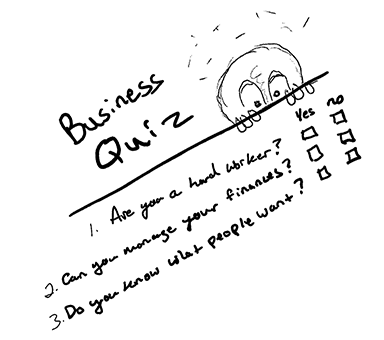
    Ever want to know if you have wat it takes to be a business owner? Here is how to take the “Can You Be a Business Owner Quiz” to find out. Simply run a profit and loss statement on yourself to get the answer.

    A profit and loss statement simply records all the moneys in, all the moneys out, and finds the difference. If the difference is positive, you have profit, if it is negative, you have a loss. For an individual this should be a rather quick calculation. So, where did you land? Is the business of you profitable or is it losing money?

    This is how you will likely do if you decide you want to start a business. You see, you are your first business and the sale of your time is your first product. Your customer is your employer and the value you add is the service you provide. Soak that in for a bit. If you can wrap your head around this, then you are beginning to understand the true nature of a free market economy.

    Don’t get me wrong, being an employee is a great thing and a wonderful solution for most people. As an employee there are great benefits. Often the flexibility, insurance, time off, risk exposure, and pay create a great stack of perks to attract good talent. That talent however would be prudent to understand the game they are playing and ultimately why their employer is giving them money.  

    How Is Money Made?

    Money is simply a universally agreed upon currency provided in exchange for a good or service. What makes it so convenient is that its worth is agreed upon. Yes its value changes over time, and yes it changes differently relative to any number of indices but by and large people know what they can get for 5 dollars, 10 dollars, or 1,000 dollars.

    People generate money by virtue of adding value to others. This value is likely a service. One of my fist paying gigs was the hourly rate I received for doing work around the house above my normal chores. When my parents wanted to paint the house, I was paid $10.00 and hour to do the job. My job was to hit all the hard-to-reach areas such as the areas above the roof line that required a person to step on the shingles. My value: being smaller than my parents and able to complete the job without ripping shingles off the roof.

    Think about the money you spend in a given day and ask yourself why you have to pay for the things you buy. Why not simply acquire, make, or do the things needed to get you what you want? Is it because you want something fast? Something of a higher quality? Something you don’t know how to make? Whatever the reason you find the value of what you are buying to be commensurate to the amount you are willing to pay.    

    How is Money Lost?    

    This seems like a silly question, but you would be surprised to find that many business failures occur, and the owners are not quite sure where/why they couldn’t stay afloat. The sales were good, their customers loved them, and they had plans to open another shop. The problem is expenses were growing faster than the profits. This happens when people don’t keep an eye on their full situation. As revenue grows so do expenses. If a business owner doesn’t keep an eye on the money going out the door, they will soon find they don’t have a door for money to go out of. At a personal level this is where the beauty of budget begins to shine.

    I make great money so why am I living paycheck to paycheck?

    Well, by the time you factor out rent, fuel, subscriptions, Ten-dollar coffees, entertainment, credit card payments, and whatever else you role your eyes at, you will find you spent all that you earned.

    So, how is money lost? Answer: it was spent.      

    How Companies Grow And Compete

    This principle holds true with companies. A business that wants to grow must find a way to create value and offer it at a price that is greater than the cost to produce it. A baker has his equipment, raw materials, and time invested into making his bread. A fisherman has his equipment, fuel, and time invested in catching his fish. A restaurant has its building, food, and employees to pay for in order to provide a dining experience. In each of these the only way for these business owners to keep their business going and growing is to sell their product/service for more than their expenses. How much more? The answer to this is however much their market will endure.

    Competing in a market means that multiple people are fighting for given number of potential buyers. The market size and behaviors will drive how competitors work to win sales. Some markets are very price conscience, others are quality conscience, and others still time conscience. For more on this check out our write up: The Competitive Advantage Spectrum.    

    Smaller businesses and employees will find themselves competing with services. A job that is done well (quality), quickly (Lead time), and at a fair price (cost) will win clientele over every time. If this can be done at a profit you have yourself a winner. If multiple service providers are in a field, you will see that the big players compete in different fields. If you want something fast go with company A, if you want it cheap go with company B, and if you want the best quality go with company C.

    How Are You Competing?

    What is it that you bring to the table every day that your fellow employees do not? Is it a good attitude, domain knowledge, timeliness, problem solving, or do you fail to see any difference? If you are reading this, I know that last one isn’t true. Driven smart people make great employees and are not only hard to find they are hard to keep.   

    Back to the original question, how do you know if you can be a business owner? You know if you understand what it takes to be a good employee. Once you understand this the next question to ask is: do you want to be a business owner?

    Running a Company Is Not For Everyone

    Getting a business started is easy, keeping one going and growing is difficult. Its hard because what makes a company successful in the long run is not what is needed to get one off the ground. This is why we see such a high failure rate among small businesses. One of the biggest challenges habitually discussed among small business owners is attracting and keeping good employees. If you don’t like or have trouble with dealing with people, be very careful with which direction you decide to go.

    There are many types of businesses out there and don’t get caught up in believing there is simply business owners and non-business owners. For some a brick-and-mortar store may not be an appropriate path and going the Solopreneurs / micropreneur route is the way to go.      

    Micropreneurs and Solopreneurs

    Micropreneurs and Solopreneurs are relatively new terms used to define the individuals that run ultra-lean companies. Often consisting of only themselves and perhaps a temporary hired hand or two these people likely run an internet-based company. Blogger, Vloggers, and Affiliate Marketers can often be put into this group. They stay in this group if they decide not to grow beyond themselves. What makes them unique is the amount of revenue they can create without the use of other people. We plan to explore these shyentrepreneurs in later articles so stay tuned.

    Wherever you are on your income journey be sure to check out The Four Stages Of Wealth Creation; From Clueless To Capitalist. We put this together as a guide for those looking to grow their financial acumen and take their next step towards financial independence.

  • Finding a Purpose with Donald Miller’s Hero on a Mission: A Path to a Meaningful Life

    I just finished going though Donald Miller’s new book Hero on a Mission: A Path to a Meaningful Life. I was exposed to the book while listening to the radio. Dave Ramsey had Donald on his show and gave him a short interview discussing the book. The hook that got me interested was when Donald said something like the following (I am paraphrasing):

    Many people feel like they are sitting in the movie theater of their life watching a blank screen. The story of their childhood is over, the story of their college years are over, the story of finding love and having kids are over and now they don’t have a story to live into.

    If you would like to hear the interview here is the link: https://youtu.be/W58tn7-agOE it is 41 min 30 seconds into the show. As Donald says he is attempting to take what Viktor Frankl discusses in his work Man’s Search for Meaning and distill it down to something less esoteric. He discusses logo therapy and provides actionable steps to move his readers along.

    Having spent a good deal of time trying to nail down mission statements and organizational focus I can really appreciate the angle he is taking. If you have ever written a personal mission statement or tried to identify a direction for a company you know how surprisingly difficult it can be to put this into words. I believe the tools Donald provides will be a great help for anyone that has wrestled with this.

    Re-framing the idea to read as a story is amazing. As an engineer in my early years I hated the idea of marketing. I still hate the idea of playing into people’s emotions but I have come to appreciate that separating people from emotion is not possible. Decisions are made on emotion not logic. I don’t care who you are you can never fully separate yourself from emotion to the point that a purely objective decision is made.

    So, if you are having trouble finding meaning in your day to day or can’t quite nail down your personal mission give this book a go.

  • Entrepreneur Types

    Entrepreneur Types

    As the years roll by I have been challenged by the seemingly unending spectrum of entrepreneur types. There are big ones, small ones, one-shot ones, bad ones, good ones, and sad ones. Some are exuberant sales man while others are unassuming, quiet, and reserved. This shouldn’t be surprising as no two people are alike so why would two entrepreneurs be alike. Seems silly now that I think about it. In any case this should be a word of encouragement for anyone wondering where they sit and if they have what it takes to be an entrepreneur.

    The short answer is you do. What type of entrepreneur you will be I can’t answer but I do know if you have a desire for business and enterprise you will in some way manifest entrepreneurship in your life. What exactly is an entrepreneur you ask? Well according to my 1939 Webster’s Collegiate Dictionary an entrepreneur is: An employer as the person who assumes the risk and management of business. For reference it points us to “Enterprise”.

    Enterprise is defines as: 1. An undertaking especially one which involves activity, courage, energy, or the like; an important or daring project. 2. The character or disposition that leads one to attempt the difficult, the untried, etc.

    So, from this it reasons that an entrepreneurial effort could be considered any project conducted for the sake of business. Is that an over simplification? I don’t know. This does open the door to allowing any employee to define themselves as an entrepreneur. An employee exchanges their time for money after all. Can you have entrepreneurial employees within an organization? I believe you can and should. I would love to have an employee that assumes the management of running business through courageous activities which attempt difficult, important, and daring projects. To me that sounds like a key figure for any organization.

    Entrepreneurial Mindset.

    Does this mean entrepreneurship is not what you do but rather how you do it? Yes. It is the mindset, drive, and bravado that is in the heart of change makers. Ok ok ok. So does this also mean there are prominent business men and women that would not be entrepreneurs? Exactly. Unfortunately there are “business people” that hide behind their titles, their employees, or previous success and do not have the heart of an entrepreneur. This of course won’t allow them to swim long in a free market environment but they are out there.
    When most people think of entrepreneurs they think of big name tech startup founders. This is an image of an entrepreneur but not the only image. Take the single mom working on a side business at night. Or, the college student who flips product on EBay. Both are entrepreneurs in their own right and will likely find themselves someday managing over their contemporaries that sat on the sidelines while they put in the extra effort to generate business.
    Allow me to segregate the entrepreneur types that you might find. You will see this in your own journey as well as with your business associates. If you think of this as a normal distribution broken into 3 parts you would have roughly the first 16% of entrepreneurs are babies (getting started), 70% are adolescent (regularly practicing), and 16% seasoned. (This highly scientific conclusion is based on nothing more than my need for a frame work so please poke holes.)

    Baby Entrepreneur (getting started)

    The baby entrepreneur is the individual that is cutting their teeth in the business world. This brings to mind the lemonade stands, paper routes, and candy brokers commonly heard about in the early stages of countless biographies. It also brings to mind the working professional that has decided they want to subsidize their income with a side job or buys their first rental property. Baby entrepreneurs won’t necessarily self-identify as an entrepreneur but are in fact on the spectrum.
    I would also put those of us that have sporadic sperts of ingenuity or creative problem solving. Evidence of this could be a project, an idea, an effort, or a tool. Any solution you have ever come up with that solved a problem is the seed of enterprise. They may not always be something that can be commercialized but is enterprising nonetheless. This spring of inspiration flows into the river of execution.

    Adolescent Entrepreneur (regularly practicing)

    I believe most entrepreneurs will find themselves under this classification. The adolescent entrepreneur is full of piss and vinegar. Ready to take on the world and all of its problem. Not yet emboldened by years of experience but also not at the starting gate. These would be the deal maker, opportunist, or small business owner that habitually makes money through their projects. This could be the firefighter that has a business that seals asphalt when he isn’t on duty or the teacher who paints houses every summer. They know the ins and outs of running a business but perhaps only in a single field. May have few or no employees and are regularly competing in the free market. They may not live solely on their entrepreneurial income but they see more cash flow from their efforts than the baby entrepreneurs.

    Seasoned Entrepreneur (never stops)

    The seasoned entrepreneur would be living solely on their entrepreneurial efforts. They may not be super wealthy but they do rely 100% on their own efforts to make ends meet. They would rather rely on themselves than anyone else. This means they have the most failures under their belt. Startups that flopped, deals that went south, and maybe even a bankruptcy or two. In short they have lived it. They are the ones who also have a track record of profitable ventures, habitually solve problems, and see the world through lenses of possibility. Likely have/had many employees and possibly active in many businesses. If they are aren’t still “in the game” they are probably on the board of directors for any number of organizations.

    Are you an entrepreneur?

    So, are you an entrepreneur? I bet you are, otherwise why would you be reading this? If you are a working professional that feels stuck or a full-time mom struggling to pay the bills you can be a SHY Entrepreneur on your own journey to build enterprise. Our desire is to bring you hope and confidence to take your next steps and add value to others in this world. Your unique perspective and approach to the problems you face is needed and I am excited to hear about the solutions you will bring.

  • Are Small Business Degrees For the Entrepreneur?

    The topic of formal education is often on the minds of entrepreneurs as they begin their journey the problem is formal education can be expensive and requires a great deal of time. So what does one really get from such a program and is it worth all of the investment? Only you will ultimately know the answer to this but to help you out I have compiled a quick Q and A to address common concerns.

    What is a Small Business Degree?

    A “small business degree” is a loose term that can refer to many degrees but are generally focused on management and administration. These degrees can be specific to a single area of business such as accounting or human resources or they can be as broad as addressing an entire industry. Degrees such as an MBA (Masters in Business Administration) are a higher level degree designed to augment one’s business prowess regardless of the industry they are in.

    While we at Shy Entrepreneur maintain that small business falls under a different paradigm than large business the vast majority of degrees don’t make this distinction. If you are entertaining the idea of pursuing a business degree know what area you want to go after before simply obtaining formal education.    

    Do you need a business degree to start a business?

    The short answer to this is no. However the more you know about your industry and business in general the more likely you will be to succeed. As I review the performance of all types of businesses the predominant thread that leads to either success or failure is the intellectual or human capital available to the company. In other words the people and what they know are the heart of any organization and a small business is generally a one man show.

    I am a fan of formal education and would advise most to obtain what they can. That said I also recognize that formal education is not everything and a driven entrepreneur can make it quite fare without it. In some cases formal education can be a roadblock to an entrepreneurial venture.

    This may sound silly but another thing that formal education provides is the knowledge of what those formally trained know. By this I mean you don’t have to wonder what someone with an MBA has over you because you have one yourself. The catch 22 here is once you obtain the education you still have to prove you can achieve results. Just because you jumped through the hoop doesn’t mean everything from that point on will come to you on a silver platter. In the end it all comes down to how you use your education. If you leverage a degree for your own edification you are using it as an employer or business owner. If you leverage a degree simply to have it as a credential then you are using it as an employee.       

    What degree is best for a small business owner?

    The answer to this question will differ depending on how you want to use the degree but so long as the degree is from an accredited university any type of business administration or management degree will come in handy. Make sure business or contract law is part of the curriculum. Knowing contract law was one of the most helpful pieces of knowledge in my early career. It isn’t supper complicated and you don’t need to be a master at it. If you know the building blocks of an agreement and what makes one legitimate you can quickly dismiss fraudulent claims and understand what needs to exist for a deal to really be a deal.

       
    A business law course should also go into the different types of business structures, how they are formed, and when each is required. As an example did you know that you can create any number of shares when you create a corporation and it doesn’t cost you a thing, but if you decide later on you want to change the number of shares fees are involved to do so.

    I would also say that if you are in a vertical industry (one that is very specific in scope) it may be most advantageous to go after programs specific to what you do. For example a piano tuner may be better served with a degree in piano tuning than one in management or administration.    

    Are online degree programs accredited?

    The short answer is yes and no. Depending on the institution and the degree you are going after some are accredited and others are not. Be sure to check on the program itself because an accredited college can offer a non-accredited program. Getting accredited is no small task. As an example Eastern Washington University, a university with many accredited colleges, didn’t have a full ME program until it pushed through its first graduating class under the 4 year program. This means those first students were taking a bit of a gamble when they signed up.

    Can online courses be transferred to a four year college?

    This will depend on the online program and the four year college. The only way to hedge this is to check with both before getting started. If you are not sure which colleges you want to go to try to stick with ones that are accredited. Even if the school you are looking into is accredited it doesn’t mean everything will transfer. I know of a gal who took care of two years of college while still in high school only to find out that Stanford would take them but the local university would not. It is a bit of a game but if you are diligent you will be able to find a match that will work for you.  

     
    Well, I hope this was helpful in guiding you on the right path. Remember that everyone’s path is unique and there is no one proven way to insure your success. You will get out of your education what you put into it formal or otherwise.

  • How to Finance a Small Business

    When starting and running a small business the question of how to finance will come up multiple times. There is often an initial startup cost for assets, materials, and initial operations. As the business grows the demands on your company will change and you will again need to look at acquiring more resources. Depending on your industry the financial barriers will differ but there are some fundamental truths you should adhere to as a small operation.

    Importance of Cash Flow

    I can’t stress enough the importance of cash flow for your biz. It is the life blood of your organization and without it you won’t last long. You can have all the net worth in the world but if you don’t have positive cash flow your company is worthless. Think of your business like a bucket that has holes in the bottom of it. Your cash flow would be the water pouring in the top while your expenses would be the water pouring out the bottom. Without cash flow your bucket will run dry.

    This is a simplistic analogy because in reality you will find that both the flow of water into your bucket and the flow out of the bucket are in constant flux. So much so that your “flow” in will sometimes be more like a drip at the same time your bucket loses its bottom entirely. The ideal circumstance is to have an organization that maintains a constraint positive cash flow and empties its reserves into savings for future market fluctuations.

    Little Money in a Dynamic Market

    As a small business you fundamentally have to deal with having little money in a market that is constantly changing. Understanding this you would be wise to play into the strengths of small business while at the same time staying conservative with your spending. Small business market places don’t see large sums of constant income; they see peaks and valleys. This comes from seasonality and the inconsistent demand inherent to the market.

    To combat this reality it is advisable to find ways to diversify your services and build your customer base. This can be a fine line because you can’t be all things to all people. A landscaping company could do snow removal in the winter, a painter could do both residential and commercial work, or the machinist could create a proprietary product to sell online. The trick it to focus on the company’s core competencies and serve the markets they benefit.

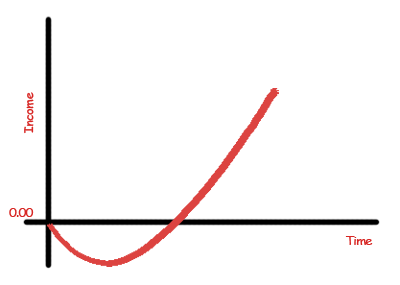
    What to Expect the “J” Curve

    If you take a step back and look at the gross financial positioning of a successful organization you would see a curve that resembles a J. The J curve implies an initial expense and a gradual return on investment. The rental house I just completed for example required initial finances to purchase and fix. Once rented however the home will produce an income and begin to offset those initial expenses. The point at which you have earned the amount you have invested is your breakeven point. In the case of the rental house it will take many years for the income to offset the expense.

    Ideally you will want as quick of a turn as possible but it can take as much as two years or more to recoup your initial investment. As you plan you financing keep this in mind so you have an idea as to when you can expect the initial expenses to stop and when you can expect to see a trend begin in the other direction. Generally all companies get two years. If you are fortunate enough to have made it past two years you will have experienced the majority of the threats your business will ever see.

    More isn’t Always Better

    There have been studies that suggest that surplus financial capital can be a detriment to startup performance. The reason for this is that the more money one has the less intentional they are with it. Another illustration of Parkinson’s law – expenses expand to fill the budget allocated. This is also one of the reasons venture capitalists assume so much risk when throwing money at a venture. It is also the part of the reason they have “rounds” of funding.

    A perfect example of this dynamic is again our rental. I had originally planned on throwing 20 to 30 thousand at the property for the fix ups that were required but found a 6 moth zero % interest credit card with a limit of 8k. I though ok let’s start there and see what happens.  Having free money for 6 months is a pretty good deal; if it could cover everything then I could pull a loan out against the house (in its remodeled state) at a great rate and pay the card off. So that is what we did and the 8k limit made us much more intentional with each dollar. We actually ended up just over 7k for all the materials leaving 1k as a buffer for unforeseen expenses.

    We could have easily spent 20 or 30k on the project but because we only allocated 8k we made it work. I can think of many instances in which we hunted for a deal rather than purchasing something new at the local hardware store. In fact I think I could write an entire post on “how much we are willing to spend for conveyance”. Shopping at the local habitat for humanity saved us thousands but cost us a little time. We had the time to spend so it was no big deal.

    Sources, Where to Find Funding

    Now that you have chewed on a few considerations regarding how much funding you may need where should you go to find it? There are a ton of options so I will only touch on my favorite few.

    Personal Saving.
    If you can save what you need for your business I would suggest you do so. Operating off your own hard earned cash will yield the best return for each dollar spent. It also means that you will have no debt. Having not debt gives you a huge upper hand for obvious reasons.

    Family and Friends
    Personally I don’t like to mix family and friends with business but this can often be a great way to get started. This is especially true for younger entrepreneurs who don’t have the credit history or income to merit larger formal loans.

    SBA
    The U.S. Small Business Administration has a few loan programs that may be what you need. You will need to read up on them to see but the idea is they will operate as your advocate to help you receive adequate funding.

    Be Self-Reliant

    The most successful business men I know will leverage other people’s money but could pay off 100% of their debt if they needed to. If you can get into this position you will be sitting pretty. Banks tend to only lend to those who can prove they don’t need the money  so when figuring out how to finance your small business try to be the one that doesn’t need the money.

    The borrower is slave to the lender (Proverbs 22:7)

  • The Advantages of a Small Business

    It may not be evident at first glance, but small businesses have a huge advantage over large companies in many regards. Small firms don’t have the deep pockets to weather storms, but they do have the flexibility and focus that is not commonly found in larger corporations. This means that the ability to meet the true needs of the consumer is much higher than it is for big brother. This is a key truth that needs to be understood if you are pursuing a small business venture. Many small businesses lose sight of the value they offer by shooting to meet a larger general need without first addressing the specific needs of their niche.

    Economy of Scale

    How is this possible? It is tied into the economy of scale and the law of averages. Economy of scale comes into play when larger organizations obtain price breaks for bulk orders placed in advance. The large company has a historically high demand for a given product or material, so they seek to grab a bunch of it at once in order to save on a per-part basis. Evidence of this can be seen in the price difference between a grocery store and a convenience store. The grocery store has much larger volumes of any given product than the quick stop, and it has much higher prices than the grocery store for the exact same items.

    For the small business, this can be used as an advantage over larger counterparts. The company that has placed the larger order has effectively made a commitment to supply a specific something to a specific market share. In other words, they have targeted their focus on one demand. Consequently, this can prevent a large company from venturing outside of their chosen focus. The small business is free of this commitment and focus and has the ability to cater to the market share that is not facilitated by this cookie-cutter solution. Custom solutions that cannot come from larger companies are available from a small-scale business.

    Law of Averages

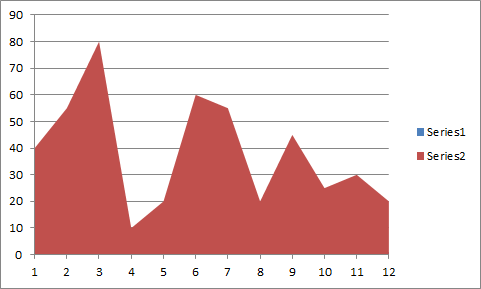
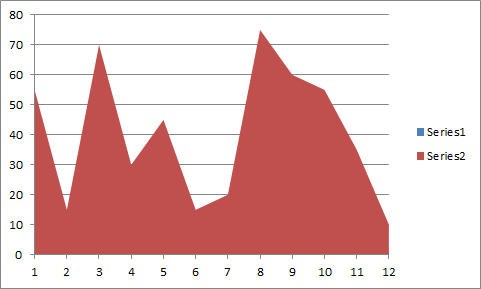
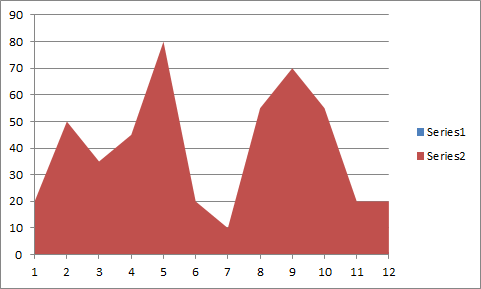
    The law of averages states that a series of random events will collectively even out, given a large enough sample set. So let us say that a large conglomeration wants to begin buying up all of its smaller competitors. The annual sales of three companies could plot out like the following:
    Company A:

    Company B:

    Company C:

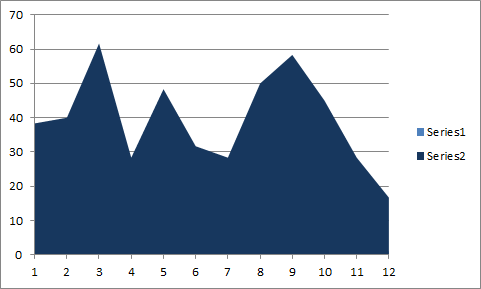
    Now, I am not concerned with specific numbers at this point, I am simply pointing out how the law of averages works. Once acquired, these three companies’ overall sales could combine to plot as follows:

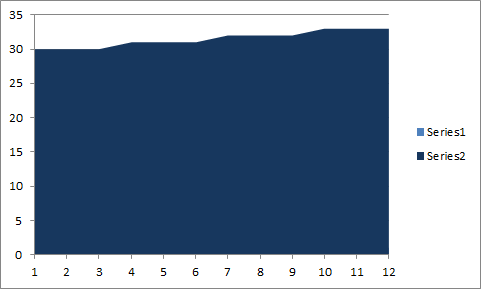
    Notice how the peaks have dropped and the valleys have elevated. If said conglomerate were to continue to acquire companies with similar numbers, the collective average would begin to mellow out even more. Large companies like this dynamic because the overall fluctuation is brought closer to zero. In the first three graphs, the difference between the highest peak and the lowest valley is as much as 70. In the averaged graph, the difference is less than 50. This consistent, stable arrangement creates fewer variables and fewer dependencies on a per annum basis. With time and enough acquisitions, the goal would be a graph similar to this one:

    The overall deviation is much lower, and there is a fairly constant growth rate.
    As a company begins this transition, it is fundamentally becoming less customer-focused and more business-focused. This is not necessarily a bad thing, as it will help keep the business and the jobs it creates around. It does, however, open the door for small businesses that seek to cater to custom solutions.

    Batching Departmental Resources

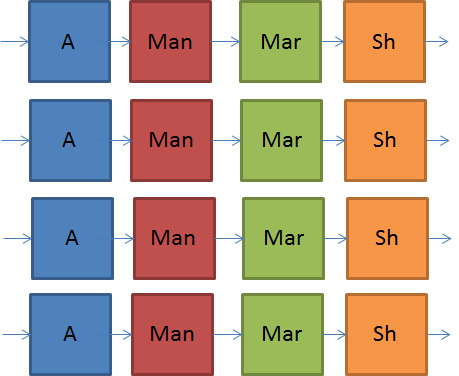
    To further illustrate the advantage small businesses can have, here is another way of looking at it. Let’s say a company type is comprised of four departments; Accounting (A), Manufacturing (Man), Marketing (Mar), and Shipping (Sh).  Let’s also assume that every purchase order must pass through each department for order fulfillment. The process would look something like this.

    Now, let’s suppose four similar companies are purchased at the same time, each focused on a slightly different niche. We would initially have four companies under one owner working in parallel.

    At first there, is no disruption to each individual company’s flow. They each serve their customer base just as they had prior to being acquired. At some point, a bean counter decides that the overhead associated with four similar but different companies is not justifiable, and the decision is made to consolidate by department. One large facility is purchased, and all of the equipment and personnel are moved in order to facilitate a “more efficient” solution.  Rather than having four accounting departments, there is now only one. Instead of four manufacturing departments, there is only one. On this goes for each part of each company until it is all under one roof.

    Now, let’s push the same four orders through the system and see what happens. Remember, previously we had four parallel systems and now we have one large system in series. Like before, each order must pass through each department. The flow would look like this:

    In a linear world one could argue that there would be no difference in the turnaround time. The load-to-capacity ratio appears to be the same in both the separate parallel systems and the consolidated system in series. The truth, however, is that the complexity of the consolidated system has introduced layers of bureaucracy that were simply not needed when each system was in its original simplified form. Now when an order comes in, it must find its way to the appropriate accountant, then to the appropriate line on the manufacturing floor, then to the appropriate marketer, then to the appropriate shipper.  The additional paper pushing begins to clog the system and extend the overall turnaround time.

    Lost in Numbers

    With the new system, the ability to cater to a unique desire of one customer becomes more laborious. As a whole, the consolidated company fundamentally cannot service its customers as quickly and effectively as it could when every aspect of the company revolved around a single niche. The benefit to consolidating is a lower overhead and less overall fluctuation in demand. Each industry will be affected by this dynamic differently, but consolidating in this manner will slow down throughput.

    Long Live the Small Biz!

    I take the time to illustrate this so you can effectively focus your efforts in ways that will truly add value. Small business by nature is volatile and every bit of help that one can get is good. Don’t waste your efforts competing where you have no place. Play into the strengths you have as a small business and service the heck out of your market place. At some point, it may make sense to make the transitions mentioned above, but it is something that must be matured into.

  • Part Time Money Making Ideas

    It seems most people could use additional money on the side so I wanted to share with you a few things I have done to give you some part time money making ideas. What are the two things we never to seem to have enough of? Money and time. I believe this is why many people look for ways to make as much money on the side as they can.
    If you are a stay at home mom, college student, or the bread winner of the family there always seems to be a need for more time to do the things you want to do and more money to afford to do them. I am no different which is why I have a few irons in the fire that I want to share with you.

    Making Products To Sell Online

    My first experience making money part time came in high school when I made products and sold them on Ebay. At the time I was into paintballing and had purchased a paintball gun that came with a silencer. I decided I wanted to know how the silencer worked so I ripped it apart and figured out how to make them for my friends and I. That lead to selling them online and equated to a $240/h rate. Now, I only sold a few silencers but the money to time ratio was great. Little did I know selling such items is frowned upon so the experience was short lived. If you have the talent and tools to produce a simple product you can probably make a few bucks selling them online.

    Making products is one of my favorite methods for making money. It is what lead me into engineering and offers a very tangible means to provide value. This is by no means passive but if you can find a good niche and provide a decent product I guarantee you can make some good money.

    Buying Domains

    I began buying domains in 2008 as I could see that the finite availability of Dot Coms implied value. I currently have 98 under my belt and have developed a handful of them. Each runs $7 to $12 dollars a year to hold onto so you can see how that can get expensive quick but once liquidated that $7 or $12  dollars a year can turn into thousands. I purchased one domain for $7.95 and was offered 12,000.00 for it the following week. Talk about a good return. Now, this is the exception not the rule. If you want to invest into domains understand it will take a good deal of time and effort to land a decent one. It cost me a lot of money to find out most domains have a gestation period. Additionally the changing landscape of the internet could have adverse effects. The “semantic” web could discount a domain portfolio. If you do decide to go forward with domains understand the return will be slow. My preferred registrar is GoDaddy.com only because it was where I started. There are many other great options out there.

    Rental Property

    While another long term investment, rental properties can offer great part time revenue. This of course requires a good deal of cash up front and usually a good deal of work but it can be worth it. Real-estate is one of the few things you can purchase that generally increases in value. This is because of the finite availability of homes and lots. That said real-estate also demands a long term strategy. It is possible to flip properties but you need to be on your toes if you are going to go that route. Additionally rentals require to deal with renters. For me this is no big deal as I grew up working on rentals with my parents but for other it could be a game changer.

    Developing Online Properties

    The most notable effort is the site you are reading. ShyEntrepreneur.com came out of the efforts in my master’s program to provide small, young, and home based businesses owners/ entrepreneurs with exposure to the formal ideas I have picked up along the way. The site is young yet (a little over a year old) and is positioned for growth. With the help of a small part time team I have compiled some resources that were designed to edify the reader base. To date the site is still in the red but our breakeven is just around the corner.

    Total time invested: not sure, a lot at first to get it up and going then roughly an hour or two per article. With 64 posts that is roughly at least 120 hours. This doesn’t include the 7+ years of school or personal experiences that preceded the site just the time put into making it happen.

    The Common Thread

    I don’t know if you have picked up on it yet but in short there is not easy get rich quick program or model that works. Everything that has ever brought in money for me has required hard work and time. Even so called “passive” investments require a good deal of attention to perform well. Don’t get stuck in believing you don’t need to work, you do and you should. The neat thing is a little bit of hard work can go a long way. All businesses require someone behind them strategically directing the organization and pushing the people to make each day a success. If you are your first business you need to accept that you will need to put in hard work to make any king of money either part or fulltime. I believe it is David Ramsey who said “to get to where few are tomorrow you must do what few do today. ”