Author: TJ

  • Earning To Spend, How To Increase Your Income

    Earning To Spend, How To Increase Your Income

    The first piece of the financial equation that people often address is; how to make more money? Naturally this is where people start when making career choices and planning their futures. So, lets take a look at how we can influence the “money in” side of things. How can we bring more money into your situation?

    There are two main approaches to this question.

    1. Increase the amount of your income source.
    2. Increase the number of income sources.

    It really is that simple. Any organization that wants to increase its sales numbers will either increase their sales price or find more customers. Your situation is much the same. The one caveat that I will mention is that you likely will not be able to increase your earnings without adding additional value. What I mean by this is don’t expect to make more money by doing nothing. According to the interweb many seek to make more money without doing work and I can tell you that is simply lazy and stupid. Ask yourself: who do you want to give money to, the person that did something for you or the person that does nothing for you? Now, there are ways to achieve passive income but that is for a later discussion.    

    Increasing The Amount Of Your Current Income Source.

    For many that work full time they have a single income source in the form of a job. Many working professionals in this situation put in a lot of hours with a single employer and live off of those earnings. These W2-preneurs show up, add value, and help their employer build their bottom-line profits. If an employee doesn’t allow an employer to make more money, or possibly minimize the loss of money than they are not a good hire and won’t be working for very long. Each employee in an organization must contribute to the end goal of the company making more money now and in the future.

    Understanding this reality can position you as an employee to negotiate a better income. I have seen firsthand individuals critical to a company coast along and make at or below market average pay. This happens because some people are either happy with what they are earning or don’t realize they should be getting paid more.

    My first salary negotiation was much the same.

    When I started as an engineer I began as a part time intern, then moved to full time hourly, and finally to a full-time salary position. This process was not one that the company initiated however. I had to push this along. How did I do it? In short, I simply added value and demanded commensurate pay. As promotions occurred, I likewise negotiated offers and counteroffers. What I didn’t do is simply say: “Hey Mr. boss, I want more money!”.

    Get An Offer From Industry Competitors.

    If you want to find out how much you are worth, get a few offers from others in your industry. This is similar to finding comps in real-estate. How much am I worth? Well, how much is company A willing to pay? What about company B? You will find out quickly what others are paying for you position. I found myself asking this same question. Here I was with two undergraduate degrees, two minors, and sneaking feeling that I was worth a bit more than what I was being paid. So, I interviewed with another establishment and was provided a very generous offer. I didn’t take the offer however as I wanted to stay with my current employer. What I did do is inform my current employer what others said I was worth. Guess what, I got the raise. It also boosted my confidence. Having others say they will pay more for you is a good feeling.

    Quantify your value.

    If perhaps you don’t have the above option, go the route of quantifying your value to your organization. This can be a bit tricky as people seem to think they are worth more than they truly are. Remain objective when assessing your worth. Asking hard questions like: if I leave tomorrow what will it cost for them to not have me? How quickly will they find my replacement? How long will it take for someone to get up to my level of training? Hopefully you can nail down some hard numbers and put your value in black and white.

    If you can objectively communicate the additional value that you bring above your current job duties it makes it a lot easier for your manager to grant you a raise. Remember, who the decision maker is and make it easy on them. Do not use “I think I should get a raise” or “I feel I deserve more” this fluff will not work to your benefit. What does work to your benefit is: “My efforts in project X netted the company an additional $2,000.00” or “When I instituted and enforced policy Y the fall out has dropped 10% which conservatively saved the company $3,000.00 this year”. Hard facts and hard numbers will make it much easier for your employer to justify paying you more.   

    Increase The Number Of Income Sources.

    If you have already maxed out your current income source the next option to increase your income is to find other sources of revenue. Your additional income sources will likely be service based and not capital intensive. By this I mean you will be working, not renting out assets. As your asset base grows you will get to that point but in the beginning the hard truth is that you don’t have much more than your skills and time to offer.   

     You need more people willing to pay you for the value you offer. Assuming that you are working full time this will mean you have to find other part time jobs or alternative side gigs. These nighttime or weekend gigs can be a very quick and effective way to earn more money. I would put overtime into this same bucket.  

    If you can offer what you are currently offering your full-time employer to others part time this will likely be your greatest return on your time. After all you spend the majority of your time doing what you do, you better be good at it.

    If perhaps you are limited by non-compete or conflicts of interest, then take your skill set to another industry. Someone that makes cabinets for example may not be able to work for a competing cabinet company, but they could use their wood working skills to make other furniture. The point here is don’t limit yourself to only the domain of your nine to five job.

    Finding Your Work Life Balance, Why You Work

    All of this extra income is great but at some point, you have to ask what it is all fore. Unless you simply love to work all of this extra time sold to others will begin to wear on you.  You will need to find the balance that works for you. For some this will mean a comfortable 9-5 position and having their nights and weekends free. For others it could mean a period of time focused on earning so as to afford additional expenses or to eliminate debt. Having the reason for your money known and establishing your financial goals will help make these decisions. In subsequent articles we will discus this balance and ways in which you can work to the appropriate end.   

    Wherever you are on your income journey be sure to check out The Four Stages Of Wealth Creation; From Clueless To Capitalist. We put this together as a guide for those looking to grow their financial acumen and take their next step towards financial independence.


  • The Secret Mind Of An Entrepreneur Is Not What You Think

    The Secret Mind Of An Entrepreneur Is Not What You Think

    When I started my business journey, I initially sought to find the secret to business success. I suspected there was a secret because only a handful of people experienced success while the majority of people found failure. Additionally of those that found success there were always those serial entrepreneurs that seemed to find one success after another. There was also a ton of examples of people failing at business. Why such a disparity?

    The nature of the secret I assumed was a tactical or methodical difference. If I could figure that out I could adopt the methods into my own businesses and live happily ever after. Sorry to say it is not that simple. The difference is more in line with how entrepreneurs think about and address their problems and relationships with people. I hate that this is true. I hate it because it means the answer I was looking for is not something that can be easily defined or discussed.

    Take a hall of fame sports star for example. One can’t pin point the things they do habitually that allowed them to make it to the hall of fame. They made it to the hall of fame because of who they are and how they approached their game. The unique reality and un-assessable truth is that they brought a piece of humanity to the table that few others have. Fundamentally they thought about their craft in a unique way.   

    The reason there are few successful serial entrepreneurs is because there are few people that focus on business and life in the way these people do.

    The Dark Side Of The Focused Individual.

    Before going into all the “amazing” things these business superheroes can do I would like to discuss the dark side. I have come to believe that how some entrepreneurs approach life and business is something I never want to recreate in my own life. For some serial entrepreneurs their identity is 100% tied to their commercial success. They are one dimensional with their only dimension being business success. That is great if the only thing in life is business but for most of us this will not be the case. For me a well-balanced life is much more important than a having only a commercially successful life.

    I discussed how entrepreneurs think in my piece: How to Become an Entrepreneur but I didn’t extrapolate my thoughts to their full conclusions. When entrepreneurs are young they are often misled by the pursuit of profit. While it is true that the goal of a business is to make money now and in the future (thank you Eli Goldratt) the goal of life is not. If the goal of a business is to make money perhaps we should ask; what is the purpose of a money making business? The answer to this will be different for everyone.

    I have been really challenged lately with how my time is spent. In his book Hero on a Mission: A Path to a Meaningful Life Donald Miller discusses a technique in which you write your own eulogy. Wow, what a mind bender. The idea isn’t his, Stephen Covey the author of The 7 Habits of Highly Effective People also suggests the exercise. In doing so you begin to see how finite the time we have is and what really matters. Children have forever, teenagers have forever, but a young aspiring entrepreneur may only have a decade or two. What is it you want to do with the handful of years you have left?

    How Buying A Machine Shop Changed My Perspective

    When I bought a machine shop, I achieved something I thought would never happen in my life time. All the equipment anyone could ask for and the ability to make anything was at my fingertips yet it didn’t take long for my “why” to change. I love manufacturing and making physical goods, solving interesting problems, and establishing sustainable solutions. I very much dislike exchanging time for money. A one to one exchange of time for money is no different than what occurs with a W2 income. It took a handful of breakeven projects for me to refine our approach to the market space. The funny thing was I was the reason we weren’t making money. I was so excited to land jobs that I landed jobs I should have passed on.  

    What you will find is; generating revenue is easy with a smallish business. Generating revenue that exceeded expenses is more complicated problem. Many of the projects that people want you to quote are projects that don’t have money in them. Buyers put projects out to bid in search of the lowest bidder. A starving shop bites and begins spinning their wheels. Sad really. A budding entrepreneur won’t necessarily be able to see these projects for what they are until they have committed. The silver lining to this is that these experiences are the building blocks to the entrepreneurial mindset.       

    I still love the machine shop but I love it in a different way today. Had I had the opportunity out of college to run the shop I don’t know if I would have had the maturity to make it work. I was young and ignorant to so many business truths and human conditions. It took spinning our wheels a few times to show us there is work out there that is better left to our competition.

    Accept That You Will Fail, Just Don’t Fail To Learn

    The one trait I have seen ring louder than almost any other with successful businesspersons is their ability to see through all the fluff. They don’t lean on forecasts, hope on promises, or blame things they can’t control. They are pragmatic to the core. They work off of hard figures, test their own assumptions, and distil all the noise around them down to fundamental truths. I wouldn’t say they are cynical, but they are certainly not going to bank on what other people tell them. Why do you think they are this way? The answer is because they have felt the pain and subsequent benefits of failure.

    Having the humility and wisdom to understand when you screwed up is essential to conducting business well. I personally like the motto of; fail fast. There is more out there that you don’t know that what you do know. Accept this and don’t pretend to have all the answers. This advice is nothing new. Proverbs 16:16 ; How much better to get wisdom than gold, to get insight rather than silver. The value of knowledge and wisdom cannot be understated.

    Entrepreneurs By Definition Don’t Follow The Crowd

    To be an entrepreneur one must fundamentally be able to see opportunity and add value where others do not. This means the way you think aught not be consistent with the masses. You have an obligation to solve problems and provide solutions that others need. Others need you because they can’t take care of their pain the way you can. I find this rather exciting.

    How cool is it that people need you? In what way is the world a better place because of what you do and how you do it? Your service to others will garner financial rewards but beyond the money I hope you can see the changes you are making!

  • Finding a Purpose with Donald Miller’s Hero on a Mission: A Path to a Meaningful Life

    I just finished going though Donald Miller’s new book Hero on a Mission: A Path to a Meaningful Life. I was exposed to the book while listening to the radio. Dave Ramsey had Donald on his show and gave him a short interview discussing the book. The hook that got me interested was when Donald said something like the following (I am paraphrasing):

    Many people feel like they are sitting in the movie theater of their life watching a blank screen. The story of their childhood is over, the story of their college years are over, the story of finding love and having kids are over and now they don’t have a story to live into.

    If you would like to hear the interview here is the link: https://youtu.be/W58tn7-agOE it is 41 min 30 seconds into the show. As Donald says he is attempting to take what Viktor Frankl discusses in his work Man’s Search for Meaning and distill it down to something less esoteric. He discusses logo therapy and provides actionable steps to move his readers along.

    Having spent a good deal of time trying to nail down mission statements and organizational focus I can really appreciate the angle he is taking. If you have ever written a personal mission statement or tried to identify a direction for a company you know how surprisingly difficult it can be to put this into words. I believe the tools Donald provides will be a great help for anyone that has wrestled with this.

    Re-framing the idea to read as a story is amazing. As an engineer in my early years I hated the idea of marketing. I still hate the idea of playing into people’s emotions but I have come to appreciate that separating people from emotion is not possible. Decisions are made on emotion not logic. I don’t care who you are you can never fully separate yourself from emotion to the point that a purely objective decision is made.

    So, if you are having trouble finding meaning in your day to day or can’t quite nail down your personal mission give this book a go.

  • Entrepreneur Types

    Entrepreneur Types

    As the years roll by I have been challenged by the seemingly unending spectrum of entrepreneur types. There are big ones, small ones, one-shot ones, bad ones, good ones, and sad ones. Some are exuberant sales man while others are unassuming, quiet, and reserved. This shouldn’t be surprising as no two people are alike so why would two entrepreneurs be alike. Seems silly now that I think about it. In any case this should be a word of encouragement for anyone wondering where they sit and if they have what it takes to be an entrepreneur.

    The short answer is you do. What type of entrepreneur you will be I can’t answer but I do know if you have a desire for business and enterprise you will in some way manifest entrepreneurship in your life. What exactly is an entrepreneur you ask? Well according to my 1939 Webster’s Collegiate Dictionary an entrepreneur is: An employer as the person who assumes the risk and management of business. For reference it points us to “Enterprise”.

    Enterprise is defines as: 1. An undertaking especially one which involves activity, courage, energy, or the like; an important or daring project. 2. The character or disposition that leads one to attempt the difficult, the untried, etc.

    So, from this it reasons that an entrepreneurial effort could be considered any project conducted for the sake of business. Is that an over simplification? I don’t know. This does open the door to allowing any employee to define themselves as an entrepreneur. An employee exchanges their time for money after all. Can you have entrepreneurial employees within an organization? I believe you can and should. I would love to have an employee that assumes the management of running business through courageous activities which attempt difficult, important, and daring projects. To me that sounds like a key figure for any organization.

    Entrepreneurial Mindset.

    Does this mean entrepreneurship is not what you do but rather how you do it? Yes. It is the mindset, drive, and bravado that is in the heart of change makers. Ok ok ok. So does this also mean there are prominent business men and women that would not be entrepreneurs? Exactly. Unfortunately there are “business people” that hide behind their titles, their employees, or previous success and do not have the heart of an entrepreneur. This of course won’t allow them to swim long in a free market environment but they are out there.
    When most people think of entrepreneurs they think of big name tech startup founders. This is an image of an entrepreneur but not the only image. Take the single mom working on a side business at night. Or, the college student who flips product on EBay. Both are entrepreneurs in their own right and will likely find themselves someday managing over their contemporaries that sat on the sidelines while they put in the extra effort to generate business.
    Allow me to segregate the entrepreneur types that you might find. You will see this in your own journey as well as with your business associates. If you think of this as a normal distribution broken into 3 parts you would have roughly the first 16% of entrepreneurs are babies (getting started), 70% are adolescent (regularly practicing), and 16% seasoned. (This highly scientific conclusion is based on nothing more than my need for a frame work so please poke holes.)

    Baby Entrepreneur (getting started)

    The baby entrepreneur is the individual that is cutting their teeth in the business world. This brings to mind the lemonade stands, paper routes, and candy brokers commonly heard about in the early stages of countless biographies. It also brings to mind the working professional that has decided they want to subsidize their income with a side job or buys their first rental property. Baby entrepreneurs won’t necessarily self-identify as an entrepreneur but are in fact on the spectrum.
    I would also put those of us that have sporadic sperts of ingenuity or creative problem solving. Evidence of this could be a project, an idea, an effort, or a tool. Any solution you have ever come up with that solved a problem is the seed of enterprise. They may not always be something that can be commercialized but is enterprising nonetheless. This spring of inspiration flows into the river of execution.

    Adolescent Entrepreneur (regularly practicing)

    I believe most entrepreneurs will find themselves under this classification. The adolescent entrepreneur is full of piss and vinegar. Ready to take on the world and all of its problem. Not yet emboldened by years of experience but also not at the starting gate. These would be the deal maker, opportunist, or small business owner that habitually makes money through their projects. This could be the firefighter that has a business that seals asphalt when he isn’t on duty or the teacher who paints houses every summer. They know the ins and outs of running a business but perhaps only in a single field. May have few or no employees and are regularly competing in the free market. They may not live solely on their entrepreneurial income but they see more cash flow from their efforts than the baby entrepreneurs.

    Seasoned Entrepreneur (never stops)

    The seasoned entrepreneur would be living solely on their entrepreneurial efforts. They may not be super wealthy but they do rely 100% on their own efforts to make ends meet. They would rather rely on themselves than anyone else. This means they have the most failures under their belt. Startups that flopped, deals that went south, and maybe even a bankruptcy or two. In short they have lived it. They are the ones who also have a track record of profitable ventures, habitually solve problems, and see the world through lenses of possibility. Likely have/had many employees and possibly active in many businesses. If they are aren’t still “in the game” they are probably on the board of directors for any number of organizations.

    Are you an entrepreneur?

    So, are you an entrepreneur? I bet you are, otherwise why would you be reading this? If you are a working professional that feels stuck or a full-time mom struggling to pay the bills you can be a SHY Entrepreneur on your own journey to build enterprise. Our desire is to bring you hope and confidence to take your next steps and add value to others in this world. Your unique perspective and approach to the problems you face is needed and I am excited to hear about the solutions you will bring.

  • 2030 And The Coming Opportunities For Those That Want To Buy A Business.

    2030 And The Coming Opportunities For Those That Want To Buy A Business.

    For those of you running your side hustles and banking some extra cash I hope you ear mark some of those funds to take advantage of the coming transfer of wealth. Baby boomer owned businesses that don’t have succession plans in place are going to offer great opportunities for those of you who have the wisdom to set some money aside. Between now and 2030 there will be many coming opportunities for those that want to buy a business.

    Depending on who you believe baby boomers were born between 1945 ish and 1965 ish which would make them somewhere between 50 and 70 years of age. The baby boom generation produced many great little companies and of those businesses not all of them have succession plans in place. What does that mean? That means that a time is coming when they will be forced to sell their business or liquidate their assets because there won’t be anyone around to keep the company going. Don’t believe me? Read on.

    Creating a succession plan is hard.

    Setting up a succession plan is difficult for business owners for many reasons and because of that they often don’t get put in place. Many founders find it difficult to entertain the idea that they won’t be the ones to continue running the company. They spent a lot of time and effort to build their organization now they have to come to grips that they can’t run it forever. How do they walk away from their baby and hand the keys over to someone they know doesn’t have the same love for the organization? How do they put their pride aside and admit they can’t continue calling the shots? In many cases business owners can’t bring themselves to do any of the above and in turn don’t set the business up to change hands.

    Generations after the founder don’t want to be in the business their parents started.

    It is a widely acknowledged fact that generation 2 business owners do not see the business the same way the founder did. Succeeding generations may differ in values or simply not have the fire behind them to want what the founders of the business wanted. When it comes time for the next generation to take over there are many that choose simply to go a different direction. This makes a lot of sense to me. How many children follow the same professions as their parents? Sure it happens but it is not as common as children going different directions. In some cases this dynamic may not be initially clear to the gen 2 owners. It’s not until they are knee deep in running the business that they find out that they are not interested in spending their lives doing what their parents did.

    Selling a successful business fore what its worth can be tough as the number of potential buyers is not great.

    Let’s say there is a retail store that sells furniture / décor and the owners decide they want to call it quits. They are doing a million a year in gross sales and want to sell for 5 times earnings. If they are making 10% this would be $500K. How many people want to buy a furniture/décor store for ½ a million dollars? Other than their primary competitor there are likely not many buyers. As it often goes the ones with the money don’t want the business and the ones that want the business often don’t have the money. In such a case the owners of the store would likely liquidate their inventory and sail off into the sunset. All of the goodwill that they had in the brand they built is simply thrown away. Seems crazy to me but it happens all the time.

    Are you going to be ready?

    I don’t expect this dynamic to be something that will have a hard start or stop date but it will be one that will play out under our noses if we aren’t paying attention. Now that you know its coming you can start to prepare. Set a little cash aside each month or from each job and keep that cash available for the time when you come across a great opportunity.

  • Being Shy

    Growing up I was not the most outgoing individual. I gravitated to sports and activities that were more individualistic. In high school I found it hard to relate to people if we didn’t have a shared objective to focus on. Anyone around me would have said yeah TJ is quit but once you get to know him he is a good guy. In my mind this wasn’t a bad thing I simply thought other people put too much effort into pointless conversation. I didn’t care to relate if there was no reason for relating in the first place. It turns out what most viewed as acts of shyness were in fact very common traits of an introvert.

    There is strength in reserve. I recently read: Quiet: The Power of Introverts in a World That Can’t Stop Talking and was interested to see how deep the author got into the ins and outs of introverts and extroverts. In a lot of ways I could identify with the examples she gave. IE at a party I am more inclined to stand off to the side and observe rather than being in the middle of every discussion. I also relate better one on one than I do one to many. She goes on to point out these traits that our society often labels as deficiencies are in fact key characteristics of deep thinkers and hyper responsive personalities.

    I don’t know what happened that made her want to dig so deeply into all of this but I am glad she did. It shed a lot of light into the common strengths and weaknesses of us introverts. One of my favorite things to point out to my wife is the fact that extroverts have an easier time falling into leadership roles but predominantly introverts make better leaders. If this sounds like you I suggest you pick the book up. It may help you see where you will naturally be effective and in what situations you may have a harder time.

    Networking for Introverts

    In business introverts are often challenged by the need to network with others. As you likely know it can be hard to carry a conversation the direction you want it to go without having the charismatic bent. I have had many instances in which I dropped the ball on this front. Odd silences, off topic tangents, or blatant misunderstandings are bound to happen but don’t let that bring you down. Like anything the more you work at it (and think about it) the better you can become at building those all-important relationships. Here are a few tips to get you started.

      • Find the common ground. What is it that brought you and the other person into the same room? What interests do you likely share? What do you know they care about that you also find important? Note: this process needs to be 100% sincere. There is no way faking your way through it. If you try you end up looking like a used car salesman. Build your list of bullet point issues that you see eye to eye on and build off of them as the conversation wains.
      • People are inherently selfish. As pleasant as anyone is they will generally prefer to talk about themselves. Conversations focused on them will be more naturally enjoyable than one in which the focus is on you. What is it that you can do for them that may give them an incentive to keep you in their black book? Ask yourself if you were them what do you have to offer that they can use. Dale Carnegie gets into this dynamic in his book: “How to win friends and influence people”.
      • What are their pains? There are things in other people lives that you can help fix, what are they and how can you and your business help fix them? This can be a great way to move the conversation along. Help them eliminate their pain and you will have not only a business partner you may even end up with a fried.
      • Remain happy. A smile is much more attractive and inviting than a frown. Interestingly enough there is work that suggests that the facial movements of a frown imply higher cognitive activity. The point is the better your mood the more people will care to talk to you. Simple enough. Personally I will not engage in certain conversation if I am in a bad mood or just got out of a strenuous situation. This same dynamic is also why I like to put more important conversations at the front end of my day.

    Business is relational. This is especially true for smaller businesses. When someone decides to do business with you they are not doing business with your business; they are doing business with you.
    I hope you were able to take something away from this. Let me know if there is anything I missed or worth adding to the conversation. God bless!

  • Making money is simple but not easy

    Why making money is simple. Have you ever wondered why some people seem to make money hand over fist while others just seem to spin their wheels? Making money is nothing more than a result of adding value. Anyone can do that. Adding or providing value to someone happens every time you spend a dime. Next time you pull out your wallet ask yourself what it was exactly that you needed and could not facilitate on your own. If you bought a gallon of milk, did you actually need the milk or perhaps you were more concerned about a crying baby. I recently had to go to a close gas station and paid too much for a gallon of milk but was 100% ok with that because I had a baby at home and time was of the essence.

    In a free market things are sold on three predominant basis; cost, quality, and lead time. You buy on a cost basis when you are shopping for a value at the lowest price. This is often commoditized items that are available everywhere and don’t differ from one another. You buy on a quality basis when you purchase an item that “must be” a certain way. An example of this could be custom furniture or premium gasoline. You forgo other options when buying on a quality basis because your ultimate need stemming from the product or service is specific and recognized. Finally you buy on a lead time basis when time is more important than any other metric. This was the case when I purchased the milk for my crying baby.

    Can you see the value? Value is the thing that meets the need and this can be provided by a product or a service. An interesting thing to note is that the product or the service itself is not the value. The value comes from what the product or service provides. You don’t pay for window washing because you want to watch people wash windows, you pay to have clean windows when the washing is complete. The same holds true for all services. The service itself is of zero value if in the end the customer’s expectation is not met.

    This holds true for products as well. Any widget you buy from the hardware store is only of value because of what it will allow you to do. A hammer is worthless unless you have to drive some nails. You don’t need a wrench if you don’t have any bolts to tighten or loosen. A tape measure is a paper weight if you don’t need to know the dimension of something. Your vehicle exists to get you from point A to point B. To some this may seem obvious to others it may provide a new angle to think about the products or services you provide.

    Why making money is not always easy. While making money can be simple it is often times not always easy. There are a number of reasons for this but I believe the largest one is the competitive nature of free markets. In free markets everyone has the option to compete in a market space. This means there are a number of other players out to offer the same value that you want to offer. Because of this you won’t have an advantage as you enter a market simply because you are in the market. This can seem frustrating on the surface but it is also one of the things I find most intriguing about business. Those who do well in their business are part of a continuous dance of trying to figure out how they can stand out from the crowd.

    People are inherently selfish and as a result the free market is rife with stiff competition. The lively hood of people and their families is pushing many people to figure out how to find a way to the top and additionally how to stay there. What better motivation is there to compete? I believe this is one of the underlining realities that feed into the small business failure rate. People have a novel idea to start a business and think there isn’t much too it only to find that absolutely nothing will be handed to them if they don’t compete. All of the low hanging fruit was snatched up a long time ago by someone else who was already treading down that path.

     Adding value is hard work. Ask anyone who has had many years of success in business and I bet they will tell you it was hard work. Making money can be simple and chalk full of hard work at the same time. This is not a bad thing all it means is that you will need to dig in if you want your company to succeed. In fact, the sooner you realize that simply working harder you have an advantage the sooner you will find yourself as the market leader. Hard work is one of the single biggest differentiators in small business markets.

    The market will change.  Another dynamic that makes business challenging is that the market place is constantly changing. Driven in part by the competition stated earlier the marketplace is anything but stagnant. Business is a bunch of people interacting and if there is anything we know about people it is that they are not robots. Companies that get comfortable with their market position won’t enjoy their position for very long. This is one of the biggest reasons small business can have an advantage over large business. Large businesses can’t move at the speed of a smaller organization and as a result is at a fundamental disadvantage in many respects.

    Other factors that play into the flux of the market are technology and rising costs. As a market matures and spreads its tentacles out disruptive technologies will sprout up to change the game. Technology is simply a force multiplier and as a market grows it will gain more recognition from others. As this happens more and more people will be looking for ways to do what is being done in a more efficient manner. Many times this can be driven by rising costs. Rising costs are constant over the long run. This means that in 10 years your product or service will cost more than it does today if nothing is done to improve how it is delivered.

    What we know. In the end we know the secret to making money is focused persistent hard work. Once you have your niche defined and you are digging in keep this in mind. “Success” won’t happen overnight and it won’t hit you like a ton of bricks. It is a slow process that will require hard work and strategic thinking. It is not rocket science and if made more complicated than it needs to be will be much harder to attaint than simply getting out there and getting something done.

  • Looking to hire someone or are you looking for a job? Read this!

    Looking to hire someone or are you looking for a job? Read this!

    Do to some recent involvement in hiring processes I felt like it would be a good time to share some insight on what I have learned. As an employee or an employer the following information will help you find a good fit. It is amazing at how little thought is given to the pairing of workers and jobs. You would not ask a quarterback to play defensive end or a goalie to play center, so why do we throw people into positions they fundamentally are not geared to handle?

     
    Your customers pay you in the short run; your employees pay you in the long run. I don’t remember where I came across this this but it speaks to the gravity of your team dynamics and a business’s ultimate success or failure. Sports analogies seem to work best so I will continue to lean on them. Each year a lot of people pay close attention to what players their football team has drafted…why? This is because it is the talent that ultimately feeds into the team’s ability to perform. Really good coaching staffs find the players that they believe will best round out their current lineup. Super stars are nice but in many cases they don’t help the team perform on the whole. This is why you will see #1 draft picks traded off for any number of other players.

     
    A well balanced team that has strong players in each position will constantly out perform a team that was simply thrown together. In your organization if you are not being intentional about what players are needed, or which positions are at a deficit you may be setting yourself up for failure. At best you are not maximizing what could be. The sad thing is there is no way to quantify an opportunity loss by persisting a poor team. A good team on the other hand is quantifiable. You will look at your bottom line and be surprised at how your profits doubled when all you did was fire that trouble maker and replaced him with a good hire.

     
    A good employee will pay you in the long run because that is the perspective they have. They are looking around the corner to see how their actions are affecting others, and how what they do today will affect what happens tomorrow. A poor employee wants to punch a clock do as little as possible and leave the second their shift is up. There are positions that require this and for those you can pay the bottom dollar because anyone can do the work. For the positions that are a bit more involved or specialized you will want to keep an eye out for the employees that knock the ball out of the park. When you find one of these be quick to pay them what they deserve, they are already paying for themselves in ways you may never know.

     
    Fire fast and hire slow. By now you should be getting the idea that the people you hire are some of your biggest assets. No one know this better then Dave Ramsey. I recently went through Dave’s book Entreleadership and one of the areas that jumped out to me was his approach to personnel. To get into the specifics of Dave’s process you will need to read the book but on the surface let me tell you there is a lot to be said for giving your work force the attention it deserves. A good hire is worth their weight in gold, a bad hire is like cancer. So why would we not fire fast and hire slow?

     
    Fire fast. Firing someone is not fun but I can tell you keeping someone around that shouldn’t be is even less fun. By allowing someone to stay on your team that is a cancer will make your life miserable and bring down the moral of your entire group. It will also play into your productivity and eat into your bottom line. One thing to keep in mind when firing is that you will be doing yourself and the individual you are terminating a service. By allowing them to stay you are actually hurting them. It is obvious they are not a good fit, letting them go frees them up to find something that is.

     
    Hire Slow. Most people take time to make big commitments and bringing a new member to your team is a big commitment. A long vetting process may not sound like fun and will likely require you to go without the help you need right now but in the long run it will be worth it. If you can’t find the person you need in many cases you will be better off leaving the spot empty than settling for whoever walked in the door. This is also why you should always be on the lookout for good people. Jim Collins refers to this as getting the right people on the bus. He goes over this dynamic in detail in his book Good to Great.

     
    The right people don’t need a lot of direction or supervision. The time you take to make sure someone is the right fit will pay large dividends in the long run. This will require you to be very intentional when defining the jobs and positions you are looking to fill. Don’t expect to make a good hire if you haven’t taken the time to first understand everything you are calling them to do. The less you understand about the position you are looking to fill the less likely you will be to find an appropriate candidate.

     
    When you do hire begin with a probation period. This is a widely used practice that makes it safe for both the new hire and the company as they begin their working relationship. The employee has the right to walk away at any time and the company doesn’t have to carry the full cost of the employee benefits. Have a stated period of time such as 90 days at which point you can sit down together and decide what to do next. If one or both of you is on the fence it is the perfect opportunity to go your separate ways.


    Align the position with the employee’s aspirations. People are not machines and can’t be expected to fit in the box you create for them. Shape positions around your people, not people around your positions. This will allow the company to get its needs fulfilled and it will encourage and energize the employee. People want to spend their time doing what they enjoy. Conversely they don’t want to spend time doing things they don’t enjoy. If you force someone into doing a job they hate they won’t be doing it very long or very well.

     
    Working with people is delicate endeavor but can be one of the most rewarding things you do. Your people are your team and your responsibility. Much of their success and failure will hinge on how you lead them.


  • Top 5 Considerations for Small Business Success

    1. Business is simple; don’t make it more difficult than it needs to be. Having spent a lot of time studying organizations and business theory I am so surprised at how little of it makes its way into successful companies. This is especially true for smaller organizations. In the end a business fails because it can’t make money and a business succeeds because it can make money. To say it another way; Do the things that make money and quite doing the things that don’t make money. Simple enough?

    The idea of making money is an odd subject and one that seems people either understand or see as smoke and mirrors. For some people making money is something that happens after a slew of things fall into place and “magically” money finds its way into their account. For others there is a linear correlation; provide value and collect money. I have to admit I began as the former with the idea that making money was much more complicated than it really is. Even after being on the receiving end of transactions that were lucrative I questioned “can it really be this easy?”…Yes it can!!!

    The business theory side of me would communicate this as defining a value chain and operating lean. All that means is cut out the fat of your operation. Certain things you provide are needed and others are not. I would especially challenge you to question the things you see as adding indirect value. These would be the things that don’t make you any money but you feel are necessary because they are expected.

    2.  Effectiveness is more important than efficiency. This would be another area in which a small business can shine over a larger competitor. Often times larger organizations are so caught up in doing things perfectly that they lose sight of doing the right things. I have had the opportunity to work with a lot of big organizations and it would surprise you at how often they will forfeit their competitive advantage in the market place for the sake of their financial reports. In the article The Upside to Inefficiency I cover in a bit more detail where and when effectiveness should take precedence and when efficiency is needed. It may surprise you to learn that efficiency can at times do more damage than good.

    As an engineer I ran into this with quality groups that would hold up production because something wasn’t perfect. They identified a measurement or characteristic that was out of line and as they were instructed rejected the part. The problem was the measurement or characteristic that they identified had nothing to do with the form, fit, or function of the product. So they were putting the brakes on production for something that had no tie to the value the product provided. Don’t get me wrong I am all for constant improvement but when a quality group is given full authority over the big picture they will find the perfect way to run a company into the ground.

    As a small business one of your greatest assets will be the attitude to get things done. You may have to do things more than once or come back to the job site for a later fix. The sooner you can see it as an opportunity to strengthen your relationship with your customer the better. Being perfect is much too expensive for a small business. Your customers may not realize this but perfection was not what they were looking for when they called you up. They had a need and they simply want you to take care of that need.

    3. Keep an eye on your expenditures. Have you ever known someone to start a business and turn around the next day and buy a new car? There can exist a mindset that owning a business automatically means you have money. Sadly this is often not the case. Starting a business and running a successful business are two completely different things. Out of the starting gate you need to keep an eye on every penny and ensuring that you are not spending more money than you are making. If you can do this it won’t take long for your organization to grow to the point you dream.

    Don’t justify purchases because you can get a tax write off. We all want a nice work environment but buying a walnut executive desk would not be the best use of funds in your early stages. “ I can write it off” you say, well I don’t know what good a write off is to a company that doesn’t exist.

    If you don’t own a business or are just getting started take a look at your checking account. How have you managed it? The answer to this is exactly how you will manage your business. You are your fist business and I hope you have taken the time to budget accordingly and don’t find yourself at the end of the month wondering where all of your money went. If you don’t control your money it will control you. Keep an eye on where you spend and eliminate any of the spending that is not adding value to your company.

    4. Know your numbers. This may seem obvious but a lot of people don’t know if their product or service is making money. They are so caught up in putting out fires don’t realize they are the reason they can’t get ahead. When you do a quote or cost out your product you must know how much it cost and how long it will take to deliver. If you simply copied a number from the market or adopted what the other guy was doing you could be setting yourself up for failure.

    Additionally the more intimately you know your numbers the more likely you will be able to improve your company. There is a great example of Henry Ford utilizing the boxes that were used to ship him supplies in his automobiles. This is a great example of recognizing value in what others likely perceived as garbage. If you are in lawn care, how long does each lane take to maintain? How many guys are needed to do a lawn? How much gas is used? How many times a month does that lawn need attention? In one day how many laws can be cared for? How much weed eater line is consumed in a week/month/year? These are all things I would expect someone in lawn care to know and I don’t know much about lawn care.

    Knowing your numbers also allows you to make better judgments on the fly. In conversations with your customers you will be able to parse information very quickly and accurately to know when a job would be a winner or a looser. You will know when you are being competitive or when you are being conservative. If you have acquired a small business you will be able to identify the projects and customers that are loss leaders. One of the best business men I know could tell you more than anyone would care to know about his business because he minds the numbers.

    5. Buffer everything. In the end you cannot account for everything. Human behavior has a funny way of inviting murphy to every party. Buffers are very important when managing your customers’ expectations. Being strategic with your buffers will allow you to remain competitive and allow room for variability. In every case you want to be able to under promise and over deliver while remaining competitive. In the world of project management buffers are key to successful execution. An aggressive schedule with strategic buffers will outperform a loose schedule with no buffers every day of the week.

    Buffers can also help speed things up. If you know the amortized daily expense of an asset is say $98.60 you will be well served to quote at a cost of $100.00. This will speed up your quoting process and will give you a slight buffer on your expense estimate. This along with the prior point of knowing your numbers will equip you to cost things out quickly and effectively and in the world of small business this speed is key.

    These 5 principles are invaluable to the small business owner. Learn them, test them, and lean on them. I can assure you everyone reading this will benefit greatly by exercising these. If you have an example or a principle you have found helpful send us a comment and let us know your thoughts.

  • Small Business Volatility

    Most people you talk to will agree that the likelihood for success of a small business is not high. If you were to ask why, most would not have an answer. It is common knowledge that small businesses have it rough, but it is not common knowledge as to why. In this article I will explore contributing factors to small business volatility in order to better equip aspiring business men and women for success.

    Small Business Paradigm

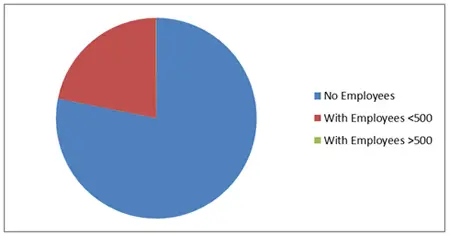
    The definition of a small business is much like the definition of an entrepreneur–many people think they know the definition but they truly do not. To understand why small business is risky business, it helps to identify the small business paradigm. This is not to be confused with Small Business Association’s definition of small business. The SBA defines small business as businesses with less than 500 employees.  This means that 99.9% of all businesses in the United States are small businesses. The trouble with this definition is that it ignores business type; it only acknowledges a head count. The most recent numbers I could find indicated a total business count in the US of 27.5 million. 21.5 million have no employees; of the remaining 6 million, only 18,000 have 500 employees or more.  The distribution would look like the following, with “large” business taking up the green sliver at 12 o’clock. I don’t agree with the SBA’s definition of small and large business, but the data does paint a picture of how many individuals operate as loan rangers.


    Understanding the small business paradigm as a type of business and not in terms of employee count opens the door to understanding how small business should be conducted.

    To speak of small business as a paradigm is to outline the model that small business follows. Now I know that the specifics of each business will differ, but there are a few universal truths that can be drawn to help identify the small business paradigm as a whole.

    Small business is small business because large business has determined that pursuit of such a market is not worth the effort. Large business by nature pursues opportunities that require larger capital investments and yield minimal fluctuation. Small businesses by nature pursue opportunities that require a smaller capital investment and have higher market fluctuation. Consequently, many of the opportunities that will exist for a small business have demands that fluctuate and exist in markets that are inherently more risky. You can see how this has nothing to do with employee count.

    The resources and capabilities of a firm will attract them to a particular industry environment. (Dean, Brown, and Bamford 1998) A small firm is agile and flexible, allowing it to move and change to meet the varying demand of a quickly changing market. A larger firm, on the other hand, will be more inclined to focus on opportunities that can be exploited by greater finances and the requirement for more resources. Larger businesses avoid ventures that maintain high variability, and this creates a window of opportunity for smaller entities.

    In small businesses, potential customers are looking to be catered to or to have a custom solution. Maintaining real-time feedback and providing fast turnarounds are essential when conducting business on a smaller level. Customers turn to larger companies when they are looking for a lower priced, prepackaged solution. This is a fundamental truth of small business, and if not adhered to, the probability of failure will remain high.

    This dynamic alone should assist many of you in determining your market positioning. As a small business it is imperative that you demand a large profit margin and provide a quality product or service in a timely manner. Failing to adhere to this truth will result in a quick demise of your company.

    Stages of Business Development

    It is helpful to also understand the stages of business development so that a standard can be established to gauge viability. Churchill’s five stages of small business growth can be used as this standard. A start-up is concerned with the first two stages, stage one (existence) and stage two (survival). After the first two stages, a business begins to move out of the small business paradigm.

    In stage one:

    “The organization is a simple one – the owner does everything …systems and formal planning are minimal to non-existent. The company’s strategy is simply to stay alive. The owner is the business, performs all the important tasks, and is the major supplier of energy, direction, and, with relatives and friends, capital.” (Churchill1983, 3)

    Regarding stage two:

    “The ‘mom and pop’ stores are in this category, as are manufacturing businesses that cannot get their product or process sold as planned. Some of these marginal businesses have developed enough economic viability to ultimately be sold, usually at a slight loss. Or they may fail completely and drop from sight.” (Churchill 1983, 4)

    Knowing of these stages allows a founder to be conscious of the company’s progress. This is important for a start-up, because businesses should only remain small for a short period.

    “Small businesses are merely transitory and will largely disappear in the long run.” (Brock and Evans 1988, 10)

    Small Business Capital Requirements

    Capital requirements within any business need to be met in order to continue operation, and can be broken down into two categories, financial capital and human capital. Capital in general can be considered as the resources available for the use of production. Financial capital concerns the monetary resources, and human capital concerns the knowledge or intellectual resources.

    By definition, most small businesses have very little reserves, so small businesses are especially concerned about financial capital and the requirement for cash flow. If the demand for a service rises and falls inconsistently and the costs remain high, a small business can find itself in a compromising situation. Market fluctuations will always be a concern, but a bootstrapping small business is especially vulnerable, because they don’t have the capital to weather too long of or too many economic storms.

    “The main problems presented by seasonality relate to cash flow and overall profitability” (Getz and Carlson 2000, 554).

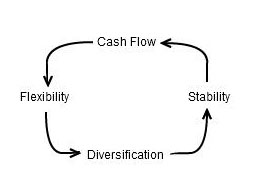
    A solution to cash flow concerns is often diversification.

    “Risk reduction for the firm is achieved by diversification across products and services produced, across clients supplied, and across input producers.” (Cressy 2006, 104).

    Although difficult for a small business, diversifying services to accommodate many markets or many needs can allow for a more stable cash flow. Anything that can be done to maintain a constant positive cash flow will be vital in keeping a small business viable.

    Cash flow requirements and the inability to diversify push for larger margins in smaller business. Larger margins are generally only available where competition is low, and competition is low in untapped markets. Creating a new path and plunging into the unknown is part of being a small business and is required to maintain a competitive advantage over those that have more capital and resources but lack the flexibility to meet needs that are not well-defined.

    Without cash a business is at risk. Additional cash flow offers more possibilities to diversify. Diversification leads to more stability, and more stability leads to consistent cash flow. The growth of a business and ultimately wealth depends on the cycle illustrated in figure 1.

    Figure 1. Cash flow cycle

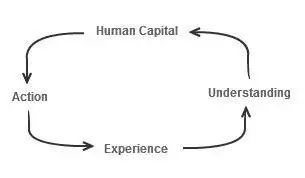
    A similar cycle plays into the human capital of a small business. The longer an individual operates within an industry, the more human capital he or she acquires.  The greater the human capital, the lower the probability of failure. Illustrated in figure 3, human capital dictates the actions, actions create experience, experience leads to understanding, and further understanding results in greater human capital.

    Figure 3. Human capital cycle

    Small Business as a Service

    Given the principles stated above, it becomes advantageous to play into the strengths of small business. The advantage of a small business is the ability to be agile and meet ever-changing needs in a smaller niche. By nature, services fit well into the small business paradigm. Large businesses often lack the flexibility and agility to compete within such markets. The large businesses are in a position to leverage their resources and capital to break into markets that have larger capital and resource-oriented barriers of entry.

    “small businesses possess certain resources that allow them to overcome some barriers which create greater difficulties for their larger counterparts, as well as allow small businesses to exploit certain industry opportunities more readily than larger ones” (Dean, Brown, and Bamford 1998, 709)

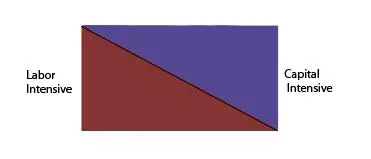
    The labor and capital distribution will appear similar to the graph shown in figure 4 concerning market types of large and small businesses.

    Figure 4. Labor – Capital distribution

    High-capital businesses would include banks and investment organizations that leverage their capital in order to make a profit. The labor businesses would include organizations that require high man hours in order to produce. Potential entrepreneurs often don’t have the capital at their disposal to get into capital-intensive businesses, but they do have the ability to offer labor-intensive services.

    What to Take Away

    If it is possible to start a small business while taking into account the fundamental truths stated above, the probability for success will be much higher.  Understanding the paradigm of small business for what it is will allow you to make the appropriate choices for your organization as it grows. Small business is volatile by nature, and there is no getting around that, but it is possible to work with it.