Author: TJ

  • Growth Strategy, When to Step Up Capacity.

    Small and home-based businesses need to operate as efficiently as possible and following a growth strategy is a significant part of that equation. Knowing how and when to grow is essential to expanding as fast as possible without overextending.

    In the survival phase growth is not the focus but as a small business matures growth should be addressed. Growing too quickly puts excess burden on your system. Mentally and physically if you are taking on too much change too quickly you will burn out and the company will not perform to its potential. Even worse, if financially the additional capacity requires more than what you have in your bank account you may be buying yourself into closure.

    On the other side of the coin growing too slow has the possibility of leaving a lot of opportunities and money on the table. Unless you are locked into some strange niche that only you know about you need to be thinking about how your market is changing and how you are going to react. With time small businesses fail so an intentional growth strategy should be in place. Having such a plan is a sign of a healthy company.

    You are your benchmark

    Don’t compare your growth with anyone other than yourself. If your market is blowing up and you aren’t seeing the same trend you may want to reassess your situation, but don’t get caught up in performing according to any other benchmark than yourself. Many businesses are taking part in your market but if you want to truly succeed keep the focus off of the competition. Trying to emulate a move a competitor makes is like trying to wear cloths that are not your size. Your path is your own.

    How is your capacity?

    Your capacity dictates your ability to grow. Too little capacity and it will be noticed in your services, to much capacity and operating expenses will be high. If you are sitting on an endless trust fund and can support a bloated overhead that is great, go for it. If you are like the majority of people out there you are probably hugging the other end of the spectrum. Knowing at what point you need to step things up is vital for long term success.

    A great indicator of one’s capacity is due date performance. Are you providing your product or service consistently on time? If not you may have too little capacity. If so, you may have enough or too much capacity. In one job I worked I gaged our capacity by the number of people calling complaining they hadn’t seen their parts yet. The more calls I received the closer to capacity we were.
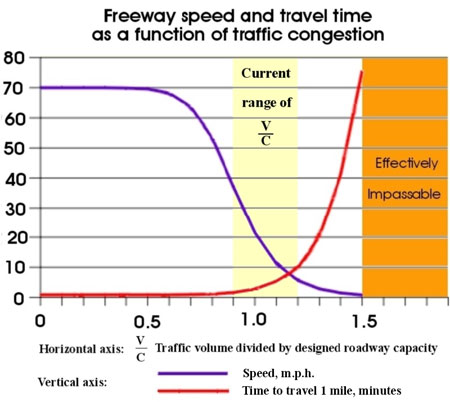
    Knowing at what point you need to increase your capacity.

    A good number to work with is 70%. The output of a resource will decline as it is taxed beyond 70%. This truth is easily illustrated in the capacity of a road way.

    We are not shown the capacity or the volume but we are shown what happens when that ratio approached and exceeds 100%. The graphic has 90 to 120% highlighted but notice when our travelers start hitting their breaks. The first signs show up shortly after reaching 50% capacity but they really start to drop off when they hit the 70% mark.

    As a business, your capacity works the same way. Knowing this allows you to take the appropriate measures before your customer base realizes you have too much on your plate and no way to meet the demand. Using this metric is also helpful in making sure you don’t grow too much too fast. Increasing capacity to handle 10 times the volume a small company will see in the near future is a sure fire way to bring a company to its knees.

    How much capacity to add?

    The amount of capacity to add will be a function or your market and your growth strategy. As a hint, the overall throughput of a business is limited by a single resource. So, don’t think you have to double the capacity of every resource in order to double your total throughput. Identify the resource that is the constraint and follow the 5 focusing step of the Theory of Constraints to improve the system. This is by no means a hard science but it is a great place to start and a good general rule to follow. If you are not familiar with the Theory of Constraints we have some write ups available.
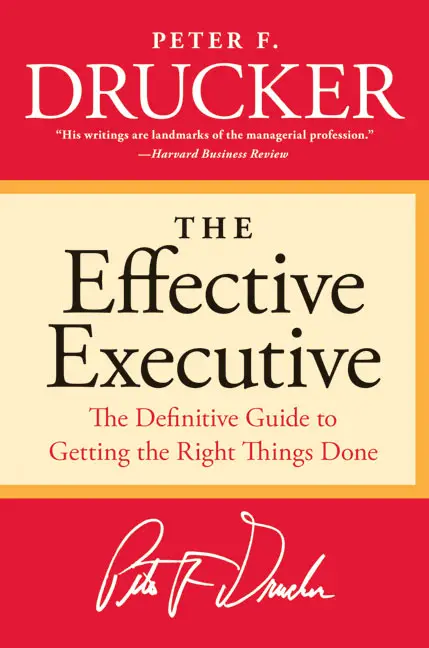
  • The Effective Executive. Peter F. Drucker

    So I have another note worthy book for anyone looking to become more effective as either an entrepreneur or in their place of business. The Effective Executive: The Definitive Guide to Getting the Right Things Done (Harperbusiness Essentials) by Peter F. Drucker is a classic resource for anyone looking for more exposure into the world of top executives. One of my favorite things about this book is that it came out in the 1960s. Why does this matter you ask? It matters because the fundamental truths that surpass the test of time will read as plain as day. It is also entertaining because it is as though you are taking a peak into the past.



    Mr. Drucker has written many pieces but this one stands out as one that many have found informative. You can read all over the net about what the book is about and its contents so I will simply say it reads in a way that will allow you to find more ways in which you can become effective in your place of business. Mr. Drucker maintains that anyone within an organization has the power to be an effective executive and challenges the paradigm that an executive is only at the top of the organization.

    One of the things we focus on at Shy Entrepreneur is that the individual is his/her first business and on that idea this book speaks volumes to those who are wondering where they are headed or what direction would be best for them. If you get a chance to check this book out let us know what you think.

  • Reader’s Questions on Contemporary Business Issues.

    The following list was posed to me by a reader so I thought if this person had these questions others may also. Each refers to small business and the issue of growth. I left the questions as they were asked

    1. Are small to medium sized companies innovative needs, more crucial to their success than large companies?

    The level to which innovation plays a role in any business can be huge so it is hard to say under which paradigm it is more important. Innovation allows for greater competitive advantage regardless of one’s size, industry, or market. That said I would say it plays a larger role in the larger business environment for a few reasons.

    The first is that a small business by definition operates more on a service level. It is the speed and agility of a small business that give it an advantage. This service is generally not a cutting edge thing it is simply meeting the customers where they are to fulfill their specific needs. This means one does not have to be as innovative to bring customers in the door.

    The second reason I would say larger companies rely on innovation a bit more than the smaller business is the nature of the large business environment. The large business environment by definition is mature and does not allow much room for profitability (per unit). The products or services have been ringed down to their bare bones so every last cent is off the table. It is here that innovation can truly shine. Taking the old model and throwing a new spine or innovating can produce huge returns.

    2. Can you increase market share while staying small?

    The short answer is yes but this question suggests that the ability to step into a larger space exists. If you have a niche carved out and want to grow within this niche then increasing market share and remaining small can be a reality. If on the other hand one would like to step outside of their niche and grow their business through other avenues additional investments and external help may be required. It boils down to how quickly one wants to grow.

    Any business could grow to any level to serve any number of markets but how it does so depends on the paradigm it operates under. A small business has more of a flat organizational structure and generally has slower growth rate. A large business will likely have layers to their organizational structure, external investors and can grow quickly.
    One’s growth is subject to the resources available. Small businesses generally don’t have a ton of money behind them and can’t make huge moves in a short amount of time. A small business would also lack the network and infrastructure to attack a world market whereas a larger business may have these things in place.

    So, to answer the question; it depends on how you want to grow.

    3. What are some advantages and disadvantages to having stayed small?

    I have written two articles that I believe will answer this question.

    Advantages; The Advantages of a Small Business

    Disadvantages (realities); Small Business Volatility

    4. Is the product/service of a small company more prone to imitability?

    Everything can be copied, the value a business brings to the table is not simply the “What” but the “How”. A perfect example is McDonald’s. Most would say they could make a better burger than McDonald’s but very few can deliver their burgers around the world in less time than McDonald. By the time you drive up to the window your food is waiting for you.

    Think of the best burger you have ever had from a restaurant… now, which company do you think makes more money, the one in your head or McDonald’s?

    5. What is the ideal size of your company and do you believe that growth is inevitable?

    You need to be big enough to serve your customers yet small enough to keep your overhead low. Size is dependent on so many things that I believe it would be worthless to try and nail a head count or square footage down.  That said I think most would be surprised at how small a business can be and still compete on a big level.

    Growth is inevitable if you want the business to outlast you. In the short run any business can tread water without growth. Think of anyone you know that is self-employed. They are their business and as long as they continue to offer their product or service the business will exist. The second they stop offering their services the business halts. I maintain that growth is required if you want to see prolonged monetary success.

    I hope everyone got something out of the above and by all means if you have any questions let us know.
    TJ

  • What Is Cash Flow Management And Why Should You Care?

    With the exception of volunteer organization cash is the life blood of every company. You know this reality more intimately than you may realize through the monthly expenses and income you experience. Are you living paycheck to paycheck? Or, are you making enough to cover your bills with some left over to put into savings? Being able to manage your cash is not an easy task but with time anyone can master it.

    Parkinson’s Law

    The difficulty of managing cash can best be understood by taking a look at Parkinson’s Law. The law states; “Work expands so as to fill the time available for its completion”. This idea of resource allocation is no different when it comes to cash. It I may be so bold as to restate the law in terms of cash flow; “Spending expands so as to fill the amount available to spend”. The reason for this I believe is because of the irrational and emotional nature of people. As much as I may not want to admit it my decisions are often based on emotions. People in general have a hard time holding back when they don’t have to. This is also the reason startups with less capital have a higher probability of success over startups that have more than enough capital available to them. The less you have the more intentional you have to be.

    Cash Flow Game

    Managing your personal finance is no different than managing the finances of a for profit organization. Money comes in and money goes out. Through this cycle either a standard of living is maintained or a profit is produced. Individuals and small businesses alike should understand that cash flow needs to remain positive. To help you with this there is a great online game provided by Rich Dad Poor Dad. I recommend you take a few minutes and try your hand at it.  Here is a screen shot:

    I have to admit I didn’t do well my first time around, in fact my first two tries were not successful. I did however manage to break out of the rat race and complete the game successfully. It isn’t a perfect simulation but it is enjoyable and teaches a few ideas on leveraging. The biggest take away is of course cash flow management. To win the game you must learn to obtain and maintain positive cash flow.

    It was interesting to play this game having executed a few of its principles earlier this year through the purchase of our first rental house. Without knowing Mr. Kiyosaki’s model we obtained an asset that basically pays for itself. Just as the voice overs say during the game this takes place when you purchase not when you sell. We were fortunate enough to intercept a property that was about to be seized by the county for auction. We purchase the property and then spent 6 months remodeling. When we finished we had a rental with positive cash flow.

    One of the other things I like about the game is that as a player you have both an income and expenses. As the game goes on both will fluctuate as cards are drawn and “life” happens. The pace of the game is of course faster than what one could expect in real life but I believe the principles are sound. If you see a game in there titled “ShyEntrepreneur.com” that’s me!

    Much can be said about cash flow and personal finance but all I wanted to do here was point out a tool the illustrates the importance of cash and maintaining a positive cash flow situation. My people currently live outside of their means and can’t quite figure out how to progress towards financial freedom. The solution is simple but it is not always easy.
    I hope you guys find the game as entertaining as I do and be sure to post comments at the end so others can learn from your experience.

  • Are Small Business Degrees For the Entrepreneur?

    The topic of formal education is often on the minds of entrepreneurs as they begin their journey the problem is formal education can be expensive and requires a great deal of time. So what does one really get from such a program and is it worth all of the investment? Only you will ultimately know the answer to this but to help you out I have compiled a quick Q and A to address common concerns.

    What is a Small Business Degree?

    A “small business degree” is a loose term that can refer to many degrees but are generally focused on management and administration. These degrees can be specific to a single area of business such as accounting or human resources or they can be as broad as addressing an entire industry. Degrees such as an MBA (Masters in Business Administration) are a higher level degree designed to augment one’s business prowess regardless of the industry they are in.

    While we at Shy Entrepreneur maintain that small business falls under a different paradigm than large business the vast majority of degrees don’t make this distinction. If you are entertaining the idea of pursuing a business degree know what area you want to go after before simply obtaining formal education.    

    Do you need a business degree to start a business?

    The short answer to this is no. However the more you know about your industry and business in general the more likely you will be to succeed. As I review the performance of all types of businesses the predominant thread that leads to either success or failure is the intellectual or human capital available to the company. In other words the people and what they know are the heart of any organization and a small business is generally a one man show.

    I am a fan of formal education and would advise most to obtain what they can. That said I also recognize that formal education is not everything and a driven entrepreneur can make it quite fare without it. In some cases formal education can be a roadblock to an entrepreneurial venture.

    This may sound silly but another thing that formal education provides is the knowledge of what those formally trained know. By this I mean you don’t have to wonder what someone with an MBA has over you because you have one yourself. The catch 22 here is once you obtain the education you still have to prove you can achieve results. Just because you jumped through the hoop doesn’t mean everything from that point on will come to you on a silver platter. In the end it all comes down to how you use your education. If you leverage a degree for your own edification you are using it as an employer or business owner. If you leverage a degree simply to have it as a credential then you are using it as an employee.       

    What degree is best for a small business owner?

    The answer to this question will differ depending on how you want to use the degree but so long as the degree is from an accredited university any type of business administration or management degree will come in handy. Make sure business or contract law is part of the curriculum. Knowing contract law was one of the most helpful pieces of knowledge in my early career. It isn’t supper complicated and you don’t need to be a master at it. If you know the building blocks of an agreement and what makes one legitimate you can quickly dismiss fraudulent claims and understand what needs to exist for a deal to really be a deal.

       
    A business law course should also go into the different types of business structures, how they are formed, and when each is required. As an example did you know that you can create any number of shares when you create a corporation and it doesn’t cost you a thing, but if you decide later on you want to change the number of shares fees are involved to do so.

    I would also say that if you are in a vertical industry (one that is very specific in scope) it may be most advantageous to go after programs specific to what you do. For example a piano tuner may be better served with a degree in piano tuning than one in management or administration.    

    Are online degree programs accredited?

    The short answer is yes and no. Depending on the institution and the degree you are going after some are accredited and others are not. Be sure to check on the program itself because an accredited college can offer a non-accredited program. Getting accredited is no small task. As an example Eastern Washington University, a university with many accredited colleges, didn’t have a full ME program until it pushed through its first graduating class under the 4 year program. This means those first students were taking a bit of a gamble when they signed up.

    Can online courses be transferred to a four year college?

    This will depend on the online program and the four year college. The only way to hedge this is to check with both before getting started. If you are not sure which colleges you want to go to try to stick with ones that are accredited. Even if the school you are looking into is accredited it doesn’t mean everything will transfer. I know of a gal who took care of two years of college while still in high school only to find out that Stanford would take them but the local university would not. It is a bit of a game but if you are diligent you will be able to find a match that will work for you.  

     
    Well, I hope this was helpful in guiding you on the right path. Remember that everyone’s path is unique and there is no one proven way to insure your success. You will get out of your education what you put into it formal or otherwise.

  • How to Become a Business Owner, The Layers of Resistance

    Most of the working class chooses to subscribe to the 9 to 5 paradigm yet many question why they chose this path. If you are stuck in a job you do not like or have wondered how to become a business owner read on. There is more going on behind the scenes than you may be aware of.

    First of all you are where you are because you have made the choices to get you there. If you are not content with your circumstance it is within your control to make a change. When addressing change however one must also address the risk associated with that change. In the corporate world as well is in our personal lives we make the changes we do because the reward outweighs the risk. We do not make certain changes because the perceived risk is too great to justify the effort. This is especially true in organizations that have more of a groupthink dynamic in place.

    So, the reason you haven’t broken out on your own and started a business is because the benefits of said business do not outweigh what it will cost you to get it going. I don’t blame you, the 9 to 5 paradigm offers many securities that a budding entrepreneur won’t be able to have when starting out. Things like insurance, consistency, and retirement plans work together to make a 9 to 5 a comfortable place to be.

    I want to explore this reality a little further by applying the 6 layers of resistance to the proposition of starting up a small business and see if we can conjure up a few more insights as to why the majority of people choose not to break out on their own. These layers come to us from the Theory of Constraints (TOC) and fit into the basic three questions TOC seeks to answer; what to change, what to change to, and how to cause the change.

    Layers of Resistance

    1. Lack of agreement of the problem
    2. Lack of agreement on the possible direction for a solution
    3. Lack of agreement that the solution will truly address the problem
    4. Concern that the solution will lead to new undesirable effects
    5. Lack of a clear path around obstacles blocking the solution
    6. Lack of follow-through even after agreement to proceed with the solution

    Lack of agreement of the problem

    The question of starting one’s own business often comes from circumstance. Think about this for a while, the better you can understand your problem (the thing that got you thinking about starting a business in the first place) the better you will be able to provide a solution. When did you first start thinking about starting a business? What is it you thing a business will bring you? Why do you want that? Before moving forward really try to nail down what you consider your “problem” to be.

    Lack of agreement on the possible direction for a solution

    A lack of contentment or the existence of an opportunity can lead to a person wanting to start a business but is a business really the direction you should go? When a person finds themselves contemplating starting a business they should understand a business is not the only possible solution. Starting a business can offer desirable outcomes but not always. Is starting a business truly going to solve your problem? How is starting a business going to help solve that problem? Are there other solutions that can solve your problem? For some professionals perhaps a change of company would align them with what they want. Or, perhaps it is a “job type” issue. If you don’t like working with customers perhaps you could work in the warehouse to get things ready for the retail side of things.

    Lack of agreement that the solution will truly address the problem

    It may be possible that a business could be your answer but is there also any possibility that it won’t solve your problem? For example many people believe a business will bring in the money and the lack of money is their problem. Well, while it is true businesses can be profitable they often require a good deal of startup capital and sometimes aren’t profitable for a few years. So, if say you just had a baby and need a quick influx of cash starting a business is probably not the answer you are looking for.

    Concern that the solution will lead to new undesirable effects

    Businesses can come with baggage. They require both financial and human capital in order to succeed and managing such capital is in itself a task. Additionally a business exists to fundamentally meet a need, what will be required of you to meet such a need. Small business startups are often service based, and generally speaking you will be the one providing that service so, you will probably spend a good deal of time on your new venture. Liabilities will also be a concern. If you are offering a professional service to others there will be an inherent level of liability put on your shoulders.

    Lack of a clear path around obstacles blocking the solution

    Whatever the obstacles are for you how you address them may not be clear. To continue off of the previous undesirable effects, you may not want to sacrifice time away from your family so you can concentrate on your venture. Or, perhaps you were looking at something like cleaning windows but have a huge fear of heights. No matter what obstacles stand in your way there are ways around them but it is your job to clearly define these paths and be ready to take them if the undesirable effects pop up.

    Lack of follow-through even after agreement to proceed with the solution

    Once you have decided that a business is indeed what you need to pursue you will need to put your feet to the pavement and get it done. Nothing will come without a good deal of work so be ready to put in some long tough hours in order to see your vision come to life. This follow through will also pertain to those in your social sphere such as family and friends. They may have supported you up to the point of you actually taking the plunge but once you do you may need to remind them of the sacrifices involved in getting a business off of the ground.

    Wrap UP

    As I look over the above points I sort of feel as if starting small business comes off as an impossible task but I want to stress that it is not. It is demanding, won’t come easy, and will require a lot of time but for those who can put forth the effort I suggest you do so. The above considerations are simply points to consider when getting started which I hope will increase your probability for success. If you can adequately provide an answer to each layer of resistance you will be that much more prepared for the road ahead. Best of luck to you all and let us know how you are doing on your ventures.

  • Conflict Management Strategies Used In The Workplace

    Whether you own your own business or simply work in an environment with other people you will run into situations that require you to manage conflict. Conflicts can be interpersonal, profession, or simply strategic in any case having the ability to work through conflict is a vital skill. You may not realize how much conflicts play a role in your day to day life so follow along as we explore conflict management strategies used in the workplace.

    “Why Won’t You Listen?”

    Even if you are one of the parties in conflict take note that people need to be heard. In the amazing book How To Win Friends and Influence People Dale Carnegie discusses how people will not listen to you if you don’t first listen to them. After all, how in the world could you possibly offer a solution if you didn’t listen well enough to understand the problem in the first place?. This is huge. Listening to a frustrated employee or someone advocating for something other than what you want will open the door for reciprocal communication. Cut them off mid-sentence and you may as well slam a door in their face.

    “I Have My Reasons!”

    If you don’t agree with someone’s stance step back and see if you can at least appreciate why they have the stance they have. No mature adult wants to disagree for the sake of disagreeing, there is a reason someone may not agree with you. This technique can be executed with the help of a conflict cloud if it isn’t initially obvious where someone is coming from. If you are working to mitigate two conflicting party’s a solution may arise simply by having each person state why they have taken their stance. Often times the reasons exist for a common goal. Even if two people are working towards different ends they may back off once they realize the reason why an action was taken.

    I can’t tell you how many times I have been able to untangle a conflict by simply walking through each position. Stepping through the conflict slowly to uncover the main point of contention and bring to light a possible solution.

    “Why Don’t You Care?”

    As a manager, owner, or fellow employee it is important to let your colleagues know that you care about them and their situation. If you don’t care you have no place “managing conflict”. If you do care make an effort to let the people involved know. People need the reassurance that you are on their side and empathize with the situation.

    “Don’t Assume!”

    Assumptions are often the underlining cause of your conflict. These assumptions are usually not obvious. A Socratic approach to why the conflict exists may help uncover some of these assumptions but if the conflict is big enough and you want to put in some effort the Theory of Constraints Thinking process can help immensely. The Thinking Process uses conflict clouds but takes everything a step further by outlining the situation as it exists, how you want it to exist, and ultimately how to get there.

    Complete books have been written on this method so it isn’t something you can do in 20 minutes. It is however an amazingly powerful tool that leaves me impressed every time I use is. The heart of it like I said earlier is to uncover assumptions so if this can be done without all the overhead of the Thinking Process I suggest going that route.

    Conflict Management Strategies Work

    Methods to manage conflict abound but the few mentioned above have proven very effective for me. Be careful not to make a mountain out of a mole hill. People often clash and conflict is not always a bad thing. In fact it can be quite constructive and necessary in some situations so long as one can communicate their position and listen to what others have to say. I hope this was helpful and by all means please let us know if there are specific issues you would like us to tough upon.

  • How to get a Better Memory for Business and Networking

    How many times have you met someone and forgot their name right after they introduced themselves? How often do you forget to do one of the many tasks you wanted to complete in a day? If you are like me these type of things happen on occasion and although they aren’t the end of the world they are an inconvenience. These type of things along with the prospect of taking the P.E. exam to get my professional engineering license have pushed me to dig into how my memory works and what I can do to improve it.

    I did some looking and found that a book called
    Your Memory : How It Works and How to Improve It.
    The reviews for this were high and oddly enough the author is from my home town of Spokane WA. Anyhow I picked up a copy and devoured it. Books like this can often times be difficult to read and touch on things I don’t really care about but the author, Kenneth L. Higbee, does a great job of explaining things in a way anyone could understand. He has also studied the memory enough to know which topics are worth addressing and which ones are hogwash. I don’t usually read books twice but this is one I think I will read again.

    By focusing on the things you or I would care about and walking the reader through how to get results I found the read to be quite enjoyable. Mr. Higbee walks through how the filing system of the memory works, where things are lost, and why we have difficulty at times retrieving things we know we know. He builds a quick foundation and then expounds on how anyone can take advantage of the memory and become more efficient at learning. This is a book I wish I would have ready before going to college it would have saved me hours of study time.

    He covers study methods such as SQ3R and its derivatives (you will have to look this up), the “Peg” system, the “Loci” system, and what he calls Phonetic mnemonics. Phonetic Mnemonics to me was one of the most impressive ways to learn long numbers. Using it one could quickly memorize the first 20 digits of pie(the ratio of a circles diameter to its circumference). A few of the systems take a little bit of study up front to familiarize yourself with how they work but once you have them nailed down you will be able to remember things you never thought you could.

    The Loci system is also very impressive. I had heard about this before but until I read this book didn’t know exactly how it works. This isn’t proprietary to Higbee so I will expound a bit. The Loci system is a mnemonic that ties familiar physical locations to a list of things you want to remember. It works by mentally walking down the physical path and associating your list with the items you pass. To this day I can remember ( paper, tire, doctor, rose, ball) an arbitrary sample list Mr Higbee gave as an example. I may have missed an item or two but to I know he provided those five elements.

    I would highly suggest everyone to take the time to go through this work; it is an easy read and can be picked up used for a few bucks. It has also been around a while so your local library may have a copy. I promise you anyone can learn a thing or two that they can take with them to improve their business and networking skills regardless of the industry. So, if you want to learn how to get better memory for business and networking, remember names, and get everything done on your schedules check this book out. If you do read it I would love to hear what you think.

  • Chaos Vs. Bureaucracy

    You may not realize this but as an entrepreneur one of your main functions is finding the balance between chaos and bureaucracy. If you take a look at successful organizations you will see they have somehow found a happy medium between these two extremes. It is this balance that allows organizations to flourish and will be required if you want to take your company to the next level.

    My first exposure to this dynamic came as I was trying to push a product line in an organization didn’t share my same directive.  The problem was that the product line required formal processes in order to continue to scale up but the organization as a whole operated on the “get-er-done” approach. Talk about frustrating, how is one supposed to facilitate the exponential growth of variability through putting out perpetual fires?

    This lead me to a book that gave me a new perspective on managing growth. The book was

    No Man’s Land: Where Growing Companies Fail.

    I enjoyed the book in that it helped me communicate my dilemma but a few assertions it made could be discounted by the now non-existent financial organizations it referenced to.  One exert that I especially appreciate was;

    “The resources and approaches that allowed for growth in the first place can be insufficient or an obstacle for growth in the future.”

    This is so vital to long-term success. Understanding organizational needs change with growth is huge. This begins right after startup and continues through each stage your company passes through. The book focuses on one significant stage referred to as “No Mans Land”. This is the point at which a company is too big to be small and too small to be big.

    So how does the size of an organization tie to the balance between chaos and bureaucracy? Generally speaking smaller organizations have fewer formal processes and operate under a flat management infrastructure. Larger organizations have more formal processes and operate under a hierarchical infrastructure. A deeper discussion on this and the small business advantage is discussed in the article The Advantages of Small Business. The balance however is not an easy one to find.

    Small businesses on the “Chaos” side of the spectrum have a great flexibility and agility to fulfill the customer’s changing needs in a moment’s notice but don’t have the ability to handle large volumes. Larger businesses on the “Bureaucratic” side have the ability to facilitate a common need over and over again at a high volume but lack the ability to change to accommodate a custom need. Too much towards Chaos and you will find yourself with a lot of waist, rework, and similar inefficiencies; too much toward Bureaucracy and you will find yourself buried in formalities, paperwork, and pointless meetings.

    So what is the answer? In short it is finding the right people. The intricacies of your business are known only to you and your people and they are the ones that will make the day to day decisions that will allow you to not weigh your organization down with bureaucracy while simultaneously avoiding excess chaos. To be honest with you this can be a hard answer to swallow, it means we need to trust and invest in people. If you are able to do this however you will find your life and business begin to operate at a higher standard.

    So, you have the right people and your company begins to grow so much so you now find yourself approaching “No Man’s Land”. This means you are faced with the challenge of making a leap forward from a small business paradigm to a large business paradigm. You have hundreds of customers, thousands of products and simply can’t keep up given your current infrastructure. What do you do? If you are a restaurant perhaps you head towards franchising, if you are a designer perhaps you create a proprietary line or product, and if you are a manufacturer perhaps you simply gear up to handle a worldwide market place. That is if you are willing to make the leap. As Doug Tatum mentions in his book making the leap may not be the best choice for you and your organization.

    What should you take away from all of this? Most of all understand that you won’t have all of the answers. Building a business is iterative and each step changes the game. You begin the learning cycle, build upon your intuition, keep the things that work, and get rid of the things that don’t. I would advise younger organization and entrepreneurs to simply dig in and work hard. A sole proprietor needs simply to push and push out of the gate and refine his or her game plane as the knowledgebase grows. Good business is meeting your customers’ needs it is not having immaculate paper work or flawless products. You will mess up but everyone does. Cater to your customer (within reason) and you and your company will have a bright future.

  • How to Finance a Small Business

    When starting and running a small business the question of how to finance will come up multiple times. There is often an initial startup cost for assets, materials, and initial operations. As the business grows the demands on your company will change and you will again need to look at acquiring more resources. Depending on your industry the financial barriers will differ but there are some fundamental truths you should adhere to as a small operation.

    Importance of Cash Flow

    I can’t stress enough the importance of cash flow for your biz. It is the life blood of your organization and without it you won’t last long. You can have all the net worth in the world but if you don’t have positive cash flow your company is worthless. Think of your business like a bucket that has holes in the bottom of it. Your cash flow would be the water pouring in the top while your expenses would be the water pouring out the bottom. Without cash flow your bucket will run dry.

    This is a simplistic analogy because in reality you will find that both the flow of water into your bucket and the flow out of the bucket are in constant flux. So much so that your “flow” in will sometimes be more like a drip at the same time your bucket loses its bottom entirely. The ideal circumstance is to have an organization that maintains a constraint positive cash flow and empties its reserves into savings for future market fluctuations.

    Little Money in a Dynamic Market

    As a small business you fundamentally have to deal with having little money in a market that is constantly changing. Understanding this you would be wise to play into the strengths of small business while at the same time staying conservative with your spending. Small business market places don’t see large sums of constant income; they see peaks and valleys. This comes from seasonality and the inconsistent demand inherent to the market.

    To combat this reality it is advisable to find ways to diversify your services and build your customer base. This can be a fine line because you can’t be all things to all people. A landscaping company could do snow removal in the winter, a painter could do both residential and commercial work, or the machinist could create a proprietary product to sell online. The trick it to focus on the company’s core competencies and serve the markets they benefit.

    What to Expect the “J” Curve

    If you take a step back and look at the gross financial positioning of a successful organization you would see a curve that resembles a J. The J curve implies an initial expense and a gradual return on investment. The rental house I just completed for example required initial finances to purchase and fix. Once rented however the home will produce an income and begin to offset those initial expenses. The point at which you have earned the amount you have invested is your breakeven point. In the case of the rental house it will take many years for the income to offset the expense.

    Ideally you will want as quick of a turn as possible but it can take as much as two years or more to recoup your initial investment. As you plan you financing keep this in mind so you have an idea as to when you can expect the initial expenses to stop and when you can expect to see a trend begin in the other direction. Generally all companies get two years. If you are fortunate enough to have made it past two years you will have experienced the majority of the threats your business will ever see.

    More isn’t Always Better

    There have been studies that suggest that surplus financial capital can be a detriment to startup performance. The reason for this is that the more money one has the less intentional they are with it. Another illustration of Parkinson’s law – expenses expand to fill the budget allocated. This is also one of the reasons venture capitalists assume so much risk when throwing money at a venture. It is also the part of the reason they have “rounds” of funding.

    A perfect example of this dynamic is again our rental. I had originally planned on throwing 20 to 30 thousand at the property for the fix ups that were required but found a 6 moth zero % interest credit card with a limit of 8k. I though ok let’s start there and see what happens.  Having free money for 6 months is a pretty good deal; if it could cover everything then I could pull a loan out against the house (in its remodeled state) at a great rate and pay the card off. So that is what we did and the 8k limit made us much more intentional with each dollar. We actually ended up just over 7k for all the materials leaving 1k as a buffer for unforeseen expenses.

    We could have easily spent 20 or 30k on the project but because we only allocated 8k we made it work. I can think of many instances in which we hunted for a deal rather than purchasing something new at the local hardware store. In fact I think I could write an entire post on “how much we are willing to spend for conveyance”. Shopping at the local habitat for humanity saved us thousands but cost us a little time. We had the time to spend so it was no big deal.

    Sources, Where to Find Funding

    Now that you have chewed on a few considerations regarding how much funding you may need where should you go to find it? There are a ton of options so I will only touch on my favorite few.

    Personal Saving.
    If you can save what you need for your business I would suggest you do so. Operating off your own hard earned cash will yield the best return for each dollar spent. It also means that you will have no debt. Having not debt gives you a huge upper hand for obvious reasons.

    Family and Friends
    Personally I don’t like to mix family and friends with business but this can often be a great way to get started. This is especially true for younger entrepreneurs who don’t have the credit history or income to merit larger formal loans.

    SBA
    The U.S. Small Business Administration has a few loan programs that may be what you need. You will need to read up on them to see but the idea is they will operate as your advocate to help you receive adequate funding.

    Be Self-Reliant

    The most successful business men I know will leverage other people’s money but could pay off 100% of their debt if they needed to. If you can get into this position you will be sitting pretty. Banks tend to only lend to those who can prove they don’t need the money  so when figuring out how to finance your small business try to be the one that doesn’t need the money.

    The borrower is slave to the lender (Proverbs 22:7)