Author: TJ

  • Steps to Saving a Company, Triage in Business

    If your business is seeing trouble times and needs some crisis management here are the steps that will turn things around. In a crisis situation every decision can mean the difference between saving or killing the company. Your job as a business owner is to manage the situation in a way that provides the best possibility for success. This process is straight forward and contains many parallels found in managing medical situations when there are limited resources.

    1. Triage.  Determine the priority of your issues. What do I address first?
    2. Crisis management. Stop negative cash flow. Increase margins lower overhead. Short term action plan
    3. Stabilize. Build a management team. Move to long term action plan
    4. Plan for the future.

    What does Triage mean in business

    Triage is a means to prioritize. So, what does triage mean in business? In business time is of the essence in a crisis situation and how you prioritize your time is critical to turning the business around. Triage is a suitable word as its medical origin paint a great picture for its use in the business world. The business is a wounded patient and you want to address the problems in the order of their severity. Don’t mess with the broken leg if the patient has a severed artery. You will also need to take into account the limited resources you have to do what you can do. If you lack the means to solve your largest problem perhaps you have what is needed to address your second largest problem. In the battle field the three categories that patients find themselves in are;

    • Those who are likely to live, regardless of what care they receive;
    • Those who are likely to die, regardless of what care they receive;
    • Those for whom immediate care might make a positive difference in outcome.

    Similar categories can be drawn for the problem areas of your company;

    • Issues that are likely not to cause further problems, regardless of what actions are taken;
    • Issues that are likely to cause further problems, regardless of what actions are taken;
    • Issues in which immediate action might make a positive difference in outcome.

    The first two categories are highlight time bandit issues that will only bring you closer to bankruptcy if you attend to them. The last category will contain the issues which if addressed could turn your situation around. Keep in mind however there may be times when an issue can be solved but the return on investment to make the change may not be justifiable. An example could be fixing an old piece of equipment for twice the cost of a new replacement.

    Crisis Management in Business

    After you have established the priority of your issues you will need to stop losing money. Your cash is the life blood of you business, if you are pissing it away the company will die before you know it. The metaphor of the wounded patient again holds true; stop the bleeding and stabilize the organization. Often times this will look like layoffs, budget cuts, or any other form of downsizing. These short term actions immediately lessen the drain to the bottom line to lower the possibility of having to close the doors. In short you will want to minimize the cash going out the door and maximize the cash coming in. A price increase may or may not be appropriate depending on your positioning and industry. As a small business however you should already be correctly positioned on the competitive advantage spectrum so a price increase won’t be out of the question.

    Stabilizing the Situation

    Once the bleeding has stopped you will want to turn your focus to longer term issues. What in the organization needs to change so these problems won’t resurface? Perhaps a pivot to a new market or service is in order? Or, you simply need to find the right person for a key position. In one instance I am familiar with the decision was made to withdraw from a market that was proving to be a drain on the company. What made it so interesting was the fact that the market was complimentary to the primary market of the business. The problem was that the cash reserves were not in place to facilitate both. Basically the money made in the primary industry was being poured into the secondary market for no overall gain. For additional ideas regarding stabilizing I wrote an article titled “Maslow’s Hierarchy of Needs for a Small Scale business”. My intent was to draw further correlations between business and humanity.

    Future Plans

    No one can predict the future and there is an exponential regression to every forecasting model so planning for the future often lies in deciding who will and will not be around to drive the ship tomorrow. A business is a living organism comprised of human parts. Finding the “parts” that fit is the best investment you can make for a long term growth strategy. Jim Collins refers to this as getting the right people on the bus in his book “Good To Great”.

    The Bottom Line

    The bottom line, changes need to be made. These changes need to be ones to the core conflict/s of the organization, not just the symptoms. All businesses at one point or another will find themselves in a position of reacting to market change. Advents of technology and the natural maturing of market needs are always in flux and will probably require you to take a second look at your business some day. Two great tools to aid in these efforts are The Thinking Process and the Five Focusing Steps of the Theory of Constraints.

    The goal of business is to make money now as well as in the future so you need to be doing all you can to make that happen. This will start to take place as you align your core competencies with the true need of your target market. Providing one product or service well will serve you better than offering many mediocre solutions. This is as true on a business level as it is on a personal one.

  • Why Additive Manufacturing is Shaping Your Future and What Small Business Can Learn From 3D Printing.

    If you haven’t heard by now there is an increasing amount of buzz behind the world of 3D printing. 3D printing,  also referred to as; Fused Deposition, Stereo Lithography, Desktop Manufacturing, Rapid Prototyping, and Selective Laser Sintering is an additive manufacturing process in which material is added layer by layer to produce a desired geometry. This differs from conventional additive manufacturing processes such as casting in that a mold is not required. In sand casting or injection molding a mold creates the cavity that the material is introduced into. 3D printing on the other hand adds material layer by layer eliminating the need for preexisting tooling and opening the door to a more flexible environment. The following video illustrates the process.

    BTOMC

    3D printing follows the principles of Build To Order Mass Customization which is a the corner stone of its value. Any item can be produced quickly. If you have followed Shy Entrepreneur for very long this should sound familiar. If you are a small business owner take note of the fundamental value in fast custom solutions. As computer aided machines 3d printers also offer value in their quality and repeatability. The deviation from one job to the next is not significant…hmm could this be another parallel for small businesses?

    Build to order is a “pull” based approach to business. By that I mean the demand dictates what is produced. This differs from pure mass production in that a million of one widget is not pushed onto the market. Ford found its success in part through mass production but I would argue that the small businesses you operate need not follow that model. The “push” approach may have its place but small business is fundamentally positioned to cater to a pull environment.

    Technology

    This technology behind fused deposition rapid prototyping is not new but is beginning to see more commercial acceptance. When I was in school we had one of the first three dimensional printers and at that time the secret sauce was starch and sugar. A layer of sugar was pushed over each previous layer then starch was added to solidify the layer. Now there are a number of materials that are either extruded on to each layer or in the case of laser sintering a liquid is solidified to create the layers. As this technology has improved commercial establishments have decided it is worth the investment.

    Initial machines didn’t speak to the customer’s core need and for 20 or so years the demand remained flat. As things progressed however and the printers began creating solutions that solved manufactures core need more and more of the machines could be found in use. Early machines didn’t offer the structural integrity in their printed models which made a secondary process necessary. The sugar and starch prints that we had needed to be dipped into a wax to keep them falling apart. I point this out so you can see how technology alone offers little value; it is the practical application of the technology that makes the sales. So, ask yourself how is the product or service you offer meeting the core needs of your customers?

    Where Are The Manufacturers Making The Money?

    With a new technology like this I find it interesting to look at the costs over time. As we all know there is a life cycle with products and these printers will be the same way. The neat thing is we are currently at front of the curve. I remember the sugar machine in college having a huge price tag in the neighborhood of 60k now you can get a much more modern fused deposition machine for around 30k. The DIY community also offers a few kits and machines that fall around $800.00 to $1200.00. I don’t know enough about each technology to say which is better for any given application but I can say from a consumer stand point I like the direction of the trend. So who is making money on these machines?

    The early players had the market cornered by being the only competitor but no one knew of their product. They charged a premium because they could and in part because they had to make up in price what they didn’t have in volume. As the market matured however and new players popped up prices began to drop but the demand began to grow. Who would you want to be, the guys pushing the innovation or the guys responding to the market? Personally I would rather be the guy responding to the market but I would position myself to offer a high quality product at a premium.

    Getting a Piece of the 3D Craze

    I can’t tell you exactly how 3d printing will exist in our future but I know it won’t be going away. There are so many benefits to the additive manufacturing process that I would be more surprised to see it fade away. That said how can an engineer and entrepreneur get a piece of the action? We have decided to grab a piece of the 3D craze by registering the domain FusedDeposition.com.

    I don’t know what we will do with it quite yet but I figured it would be an investment that could have dividends down the line. As the cost of 3d printers drops we may start to provide a printing service. Or, we could put together a community of printers and designers and come from the DIY angle. Whatever we end up doing I will be sure to let you guys in on our direction and the processes behind it. As an engineer with a manufacturing focus it makes sense for me to explore this avenue so I don’t mean to push this onto all of you. Some of you reading this I would suggest not to get involved with the craze but you should appreciate the technology.

  • The Advantages of a Small Business

    It may not be evident at first glance, but small businesses have a huge advantage over large companies in many regards. Small firms don’t have the deep pockets to weather storms, but they do have the flexibility and focus that is not commonly found in larger corporations. This means that the ability to meet the true needs of the consumer is much higher than it is for big brother. This is a key truth that needs to be understood if you are pursuing a small business venture. Many small businesses lose sight of the value they offer by shooting to meet a larger general need without first addressing the specific needs of their niche.

    Economy of Scale

    How is this possible? It is tied into the economy of scale and the law of averages. Economy of scale comes into play when larger organizations obtain price breaks for bulk orders placed in advance. The large company has a historically high demand for a given product or material, so they seek to grab a bunch of it at once in order to save on a per-part basis. Evidence of this can be seen in the price difference between a grocery store and a convenience store. The grocery store has much larger volumes of any given product than the quick stop, and it has much higher prices than the grocery store for the exact same items.

    For the small business, this can be used as an advantage over larger counterparts. The company that has placed the larger order has effectively made a commitment to supply a specific something to a specific market share. In other words, they have targeted their focus on one demand. Consequently, this can prevent a large company from venturing outside of their chosen focus. The small business is free of this commitment and focus and has the ability to cater to the market share that is not facilitated by this cookie-cutter solution. Custom solutions that cannot come from larger companies are available from a small-scale business.

    Law of Averages

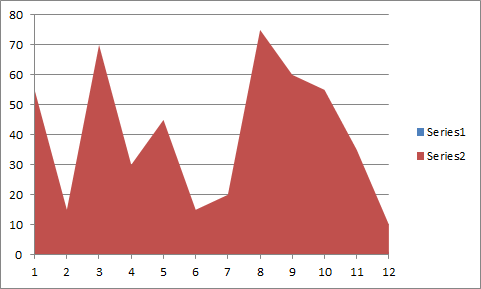
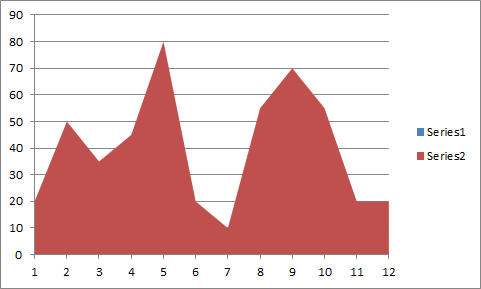
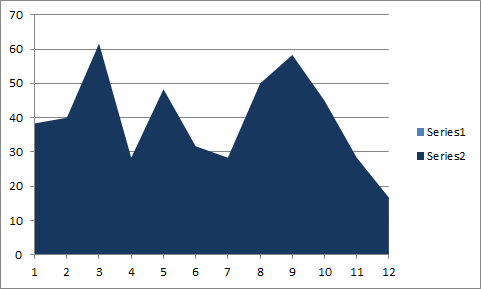
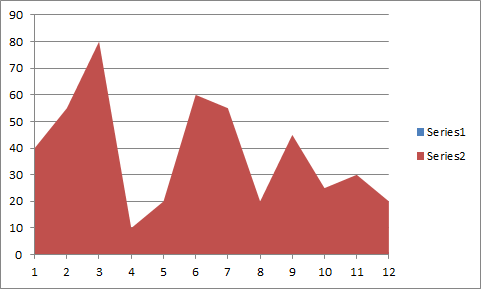
    The law of averages states that a series of random events will collectively even out, given a large enough sample set. So let us say that a large conglomeration wants to begin buying up all of its smaller competitors. The annual sales of three companies could plot out like the following:
    Company A:

    Company B:

    Company C:

    Now, I am not concerned with specific numbers at this point, I am simply pointing out how the law of averages works. Once acquired, these three companies’ overall sales could combine to plot as follows:

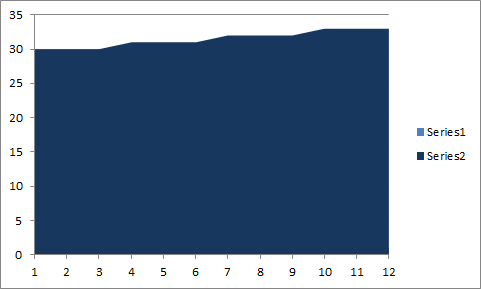
    Notice how the peaks have dropped and the valleys have elevated. If said conglomerate were to continue to acquire companies with similar numbers, the collective average would begin to mellow out even more. Large companies like this dynamic because the overall fluctuation is brought closer to zero. In the first three graphs, the difference between the highest peak and the lowest valley is as much as 70. In the averaged graph, the difference is less than 50. This consistent, stable arrangement creates fewer variables and fewer dependencies on a per annum basis. With time and enough acquisitions, the goal would be a graph similar to this one:

    The overall deviation is much lower, and there is a fairly constant growth rate.
    As a company begins this transition, it is fundamentally becoming less customer-focused and more business-focused. This is not necessarily a bad thing, as it will help keep the business and the jobs it creates around. It does, however, open the door for small businesses that seek to cater to custom solutions.

    Batching Departmental Resources

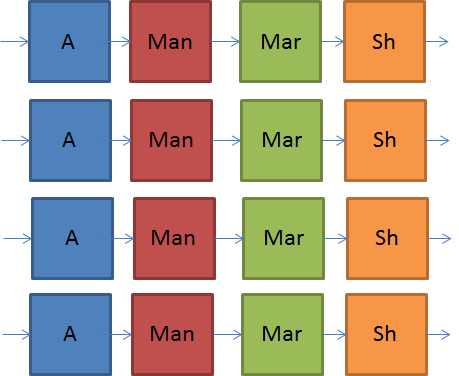
    To further illustrate the advantage small businesses can have, here is another way of looking at it. Let’s say a company type is comprised of four departments; Accounting (A), Manufacturing (Man), Marketing (Mar), and Shipping (Sh).  Let’s also assume that every purchase order must pass through each department for order fulfillment. The process would look something like this.

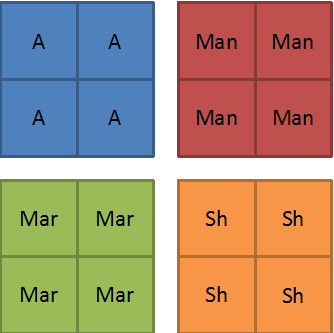
    Now, let’s suppose four similar companies are purchased at the same time, each focused on a slightly different niche. We would initially have four companies under one owner working in parallel.

    At first there, is no disruption to each individual company’s flow. They each serve their customer base just as they had prior to being acquired. At some point, a bean counter decides that the overhead associated with four similar but different companies is not justifiable, and the decision is made to consolidate by department. One large facility is purchased, and all of the equipment and personnel are moved in order to facilitate a “more efficient” solution.  Rather than having four accounting departments, there is now only one. Instead of four manufacturing departments, there is only one. On this goes for each part of each company until it is all under one roof.

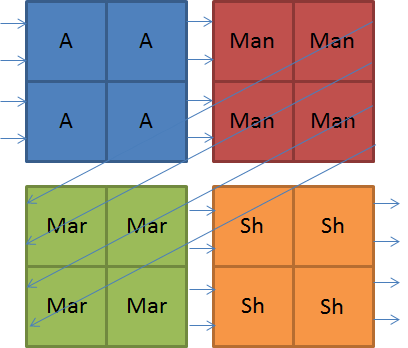
    Now, let’s push the same four orders through the system and see what happens. Remember, previously we had four parallel systems and now we have one large system in series. Like before, each order must pass through each department. The flow would look like this:

    In a linear world one could argue that there would be no difference in the turnaround time. The load-to-capacity ratio appears to be the same in both the separate parallel systems and the consolidated system in series. The truth, however, is that the complexity of the consolidated system has introduced layers of bureaucracy that were simply not needed when each system was in its original simplified form. Now when an order comes in, it must find its way to the appropriate accountant, then to the appropriate line on the manufacturing floor, then to the appropriate marketer, then to the appropriate shipper.  The additional paper pushing begins to clog the system and extend the overall turnaround time.

    Lost in Numbers

    With the new system, the ability to cater to a unique desire of one customer becomes more laborious. As a whole, the consolidated company fundamentally cannot service its customers as quickly and effectively as it could when every aspect of the company revolved around a single niche. The benefit to consolidating is a lower overhead and less overall fluctuation in demand. Each industry will be affected by this dynamic differently, but consolidating in this manner will slow down throughput.

    Long Live the Small Biz!

    I take the time to illustrate this so you can effectively focus your efforts in ways that will truly add value. Small business by nature is volatile and every bit of help that one can get is good. Don’t waste your efforts competing where you have no place. Play into the strengths you have as a small business and service the heck out of your market place. At some point, it may make sense to make the transitions mentioned above, but it is something that must be matured into.

  • Case Study of a Successful Little Business

    I recently had the privilege to review the 10 year performance of a successful little business and want to touch on some of the general business principles that allowed this success. Confidentiality prohibits me from including specific details but you probably don’t care about those anyway; you want to know what you can take away for yourself. The company operates as a small business and has the volume of a good size organization with annual revenues over 10 million.
    What makes this case study interesting is that the subject company has seen roughly a 20% annual growth rate for the past 8 years. In case you didn’t realize it a 20% annual growth is HUGE and to do that for 8 consecutive years is even more amazing. Another twist to the story is that this company competes in an industry consisting of large conglomerates.

    So, how did they do it? Well, the answer isn’t a short one; there are many factors that played into their initial and continued success. The best explanation I can find for this dynamic is the “Fly Wheel” effect found in Jim Collins book Good to Great: Why Some Companies Make the Leap… and Others Don’t. Basically there was no one single decisive point that shot the company into the world of success. Rather, it was a continued effort (pushes of the wheel) that collectively allowed the company to grow. Interestingly enough each “push” is in itself unique and wasn’t required until the “push” before it was in place. This means that one of the biggest challenges of growth is the dynamic nature of changing needs.
    Dynamic Needs of Growth

    As a business grows its needs change and efforts must be shifted to accommodate the new demands. This fundamental truth is in part the reason few people “Get rich quick.” Healthy sustainable growth happens at an organic rate and through iterative efforts. I believe this dynamic is also much of the reason small businesses have such a terrific failure rate.

    The needs that exist when you start a business will not be the needs required to grow your business. Additionally the needs required to grow your business initially will not be the needs required to grow your business down the road. These needs will obviously be business and industry specific but what you need to understand is that your business is a changing entity that requires more than a single fixed solution to survive. Think of it like a plant that needs water to sprout, then apple juice for the next three weeks, then beer after that. If you simply continue to give it water it sprouts and flounders for a bit then dies. Wait, sprout and flounder for a bit before it dies? That sounds a lot like most small businesses. Hmmm.

    Back to the Case Study

    An added advantage to our case study that I don’t want to leave out is that its parent company has the finances to pay for changes that need to be made. This may not seem like much but it is a big deal when a company has to find the money to make the changes needed to grow. If you can’t already foot the bill for your planned growth it means you will need to assume additional risk beyond that inherent to the change you want to make. The lesion here is that good old saying “Cash is King!” As a small business you simply cannot afford to be cash poor if you want to grow. In some respects this is where the art of business comes in. Depending on your circumstance the question of how to manage your business successfully will change.
    The subject company leveraged its parent companies willingness to foot the bill on many occasions. Resources were acquired and workers were put in place each time a legitimate need existed to do so.

    Market Positioning

    I mentioned earlier that the subject company was competing in an industry with many large players, how is this possible? It was made possible by sticking to a market position that played into the strengths of small business. As a smaller company it could provide a higher quality product and service to its customer base than its larger competitors. It could also offer these products and services in a fraction of time. The larger organizations have bigger pockets, a larger product scope, perhaps even greater human capital, but none of those matters when a customer needs a high quality solution with a fast turnaround. What would take the large company 2 months the subject company can do in 3 weeks. When problems arise the large organizations have layers of bureaucracy between the customer and the person with the solution while subject company has a non-automated phone system and customers are patched directly through to the parties they care to talk to.

    The subject company has also decided not to compete on cost. Meaning, they will pass on jobs if they don’t feel they are appropriately compensated. This is hard for most small businesses because business is not always coming in at a constant rate. Consequently the subject company receives more money for the time and resources it puts into its work. This is justifiable because of the quality and speed with which the customer is served.

     K.I.S.S and Get ‘er Done

    As an engineer I must admit that I have had trouble with these principles but have learned to greatly appreciate them. At the small business level the K.I.S.S (Keep It Simple Stupid) and Get ‘er done attitudes can go a long way with the customer base. Over complicating a solution or following a bloated process can actually get in the way of solving the customers true problem. Remember, the customer doesn’t want your product or service, they want what your product or service will do for them. In other words if you can address their problem not the means to the end you could be offering more value to the customer. The subject company recognized this and removed all layers that didn’t speak to the customer’s core problem. Upper management is kept thin with no middle managers, everyone wears many hats, and open communication is maintained among the staff. The human capital element is highly leveraged making each employee more of a craftsman if you will rather than a number.

    Do You See a Bright Future?

    After witnessing all of these realities in such a successful little business I am certain they have a bright future ahead of them. My hope with this assessment is that you will find ways to apply these principles and consequently see similar success. If you are having luck let us know, and if you have questions feel free to leave a comment.

  • Characteristics of a Good Entrepreneur

    Many of my posts stem from ideas or issues that arise in my life, this one is no different. Yesterday a series of events played out that made me want to discuss the characteristics of a good entrepreneur. To be frank these characteristics are also ones found in all productive people.

    The event yesterday had to do with a promising individual that received some push back for their efforts. As a result the individual was upset, and rightfully so, because they believed they were doing everything they should be doing only to have the door slammed in their face. Does this sound familiar? If it doesn’t right now some day it will.

    As entrepreneurs, or in the work place there will come times when no matter what you do it will fill like you are fighting an uphill battle. You will need to have discretion here but there is a good chance you are indeed doing exactly what you need to be doing. Whether it be the market or other people that push back you are bound to get it even with the best ideas or with your best efforts. In my situation I was able consul the individual and remind them that their inherent value will prevail regardless of circumstance.

     Luck, a Zero Sum Game.

    In his recent book Great by Choice: Uncertainty, Chaos, and Luck–Why Some Thrive Despite Them All Jim Collins discusses the zero sum nature of luck. His team found that comparable organizations with differing performance were exposed to the same number of “good luck” circumstances as they were to “bad luck” circumstance. His assessment determined that circumstance played less of a role in how a company preformed than did the company’s response to the circumstance. Said another way it’s not what happens to you that matters but rather how you respond. In the case of the pre-mentioned individual I reminded them about this reality and pointed out that we always have a choice to dwell on misfortune or use it to fuel our next step.

    Inherent Value Over Clever Play

    This point is especially pertinent for those of you in a work environment. If you are currently working under an employer and are working your way through the ranks it would be prudent of you to understand your inherent value. What is it that you specifically bring to the table that others don’t? I am not talking about responsibilities mind you; I am talking about your specific characteristics. A good employee does what they are told at great employee leverages their strengths for the betterment of their organization.

    In highly competitive environments leveraging your inherent value will server you better than trying to out maneuver your competition. If you allow yourself to get caught up in the games people play you will only be hurting yourself in the long run. People that play games in the workplace are a cancer and may see short term recognition but will never see long term success. We can’t fake who we are, our performance is a direct consequence of our character not the result of strategic plays. Here is a link for more tips on succeeding in the workplace.

    Direction

    That said, you need to know your direction. Where are you now and where are you headed? If you can answer this you are on the right track. You would be surprised at how many people don’t know where they are headed. Having a direction is the first characteristics of a good entrepreneur. You will never run into a successful business man or woman that isn’t thinking a few steps ahead. They can do this because they know where they want to be in 5,10, 20 years.
    (Warning! Shameless plug coming…) In an effort to help entrepreneurs find their focus I created a process modeled after the Theory of Constraints thinking process in my eBook; “Zero Risk Startup”. (…Shameless plug over).

    Truth be told finding ones direction is not the easiest thing to do. Even if you have an idea of where you are headed you probably don’t know the specifics of how you are going to get there. So, don’t be discouraged if this proves to be challenging, it should be. The mere fact that you are taking the time to put things in black and white will help you down the road.

    Persistence

    I have heard it said that the single common thread among successful individuals is persistence. With enough persistence you can achieve anything. Edison and the light bulb, Gates with Microsoft, and the forefathers of our nation all pushed through tremendous challenges to achieve their goals. If you push hard enough long enough there is nothing that can stand in your way.

    There is an analogy in the Theory of Constraints that talks about a crack in a brick wall. In addressing your challenge (the wall) your initial goal is not to knock it down or blow through it, you simply must make a crack. If you can make a crack you know it is only a matter of time before you will be through. Personally I have found this quite encouraging especially when I started building websites. It took a while before I made my first $1.00 online but once I did I knew I had found my crack and only time stood in my way.

    Willingness to Work

    Lastly I want to mention that nothing will come to you if you are not willing to work for it. There is no 100% passive means to succeed. The closest you will get to passive income or success will come in the form of a flywheel. After a fly wheel gets spinning it doesn’t take much to keep it going but more work is required to keep it from stopping. This means you probably won’t see a return for your efforts right away but know that with time fruit will come from your continued hard work.

    My Dad is a superb example of someone with a great work ethic. He could have retired years ago but chose not to because he feels (and I agree) that a man needs his work. When he could hire out a job he did it himself. When there is a job to be done he leans into it rather than shying away. Think of the successful entrepreneurs you know and ask yourself how hard do they work? I will guarantee they work hard.

    As a side note I have seen in recent years a decline in younger generation’s willingness to work and a rise in their sense of entitlement. I don’t know why this is but finding good help is becoming a harder and harder task.

    That’s All

    I hope that helps shed some light on the fundamental truths the lie behind good entrepreneurs. There is no special sauce just good old fashion hard work, focus, and persistence. If you can obtain these qualities I can bet you will see great improvement regardless of your situation.

  • Lessons Learned from Rental Property.

    The last 6 months my life has been consumed by a remodeling project which has taught me a few valuable lessons. I hope to get into the specifics of the project in a later series of posts but for now all you need to know is that we tore a rental house down to the bones and built it back up. As you can imagine there was a lot of work to be done and a lot of lessons to be learned.

    Why a Case of Beer is More Powerful than Money

    So, “Why is a case of beer more powerful than money?” simply because it is true. In our project beer was used to acquire as much material as we paid for. How is this possible you ask? Well, it helps to know the right people. My brother who helped me out had contacts in the construction industry who were sitting on surplus trim, doors, cabinets, and laminate. Thinking back on it the entire kitchen owes its existence to hookups. It is not uncommon for people in any industry to have surplus material that they don’t need. Offering them something in trade can be a great way to get what you need for a fraction of what it would cost to buy new. In one case a gentleman wanted simply to clean out his garage. So, in his eyes we were paying him to hall off his junk.
    The only catch to this approach is that it takes time and someone who knows the right contacts. After this project I half way wonder if I could warehouse a complete home given enough time. I could watch Craigslist, talk to local business owners, and comb suppliers for items they don’t care to hold onto. After a few years I could have everything I need to build a new home! Ok, that may be a bit of a stretch but there is no doubt value in the approach.

    The Cost / Time trade off.

    I haven’t taken the time yet to model the idea but for you do-it-yourselfers out there I want you to recognize there is a direct correlation between the cost of a project and the time required to complete it. If you have all the time in the world you will be able to wait for the good deals and strike when the time is right. If you are working in a window however be ready to pay a little more for product. For our next project home I plan to take the later route. If I can turn a house around in half the time for more money I will be happy with it.

    There were many times in this project that I could have hit up Home depot or Lowes to get what I needed but held out for something to come up.( In fact I am currently looking for a white stove if anyone has one in the Spokane area.) My reasoning for this stems from the success factors of small business. Watching where every dime goes is very important at the small business level. I must admit it isn’t always easy to wait for a good deal when you know what you need is available at your local retailer.

    The Emotional Tie to Deadlines.

    If you have tried your hand at any large project you will have witnessed firsthand the difficulty of forecasting milestones.  There are many reasons for this but the biggest one for us on the house was the lack of deadlines. Our position on this property allowed very few time restraints which consequently pushed completion out. Why is this? The short of it is that a deadline institutes an emotional tie to the work. Without a deadline, and consequently no emotional tie, there is little incentive to push through any rough patches. If you’re tired you stop, if you are hungry you eat, if anything pulls you away you don’t resist because you don’t have to. Now, if you have hard deadlines the story changes and you are much more intentional with your time in the project. This dynamic exists everywhere and anyone who tells you different doesn’t know what they are talking about.

    Every business large and small needs a “push man”. This will often be the owner or general manager of an organization. What is their job you ask? Among other things, their role is to create the emotional tie between workers and their work. The contrast between a company with someone like this and one without is staggering.

    Balancing Work, Family and Play

    That was a bit of a tangent but while we are talking about the house project I would also like to touch on balancing work, family, and personal time. My wife and I had a baby girl in October so finding time to do everything has been difficult. I wanted to put a lot of sweat equity into this project but I have to admit I won’t be doing it again. My time is much more valuable than what we will get in return on this house and my baby is only going to grow older by the day. I would challenge all entrepreneurs to make time for you family and don’t lose sight of why you are working so hard.

  • The Goal by Eli Goldratt

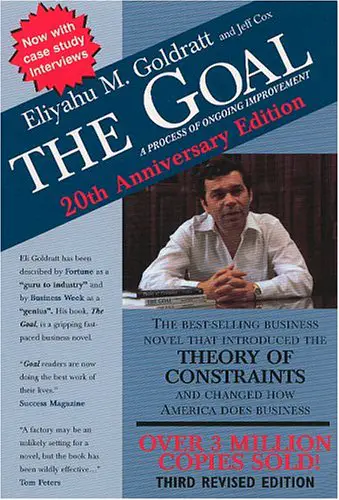
    Every practitioner of the Theory of Constraints (TOC) is familiar with “The Goal: A Process of Ongoing Improvement – 30th Anniversary Edition” by Eli Goldratt. The book is an oldie but a goodie with the first edition published in 1984. I don’t know that it was Eli’s first book but it is most certainly his most recognized work. In it he illustrates many fundamental concepts of TOC through the story of Mr. Rogo, a plant manager, who is fighting to keep his plant from going under. The nice thing about the book and the reason I think it has been around for so long is that the principles are presented in a non-esoteric manner. You follow Mr. Rogo as he works through his day to day challenges of optimizing his organization.

    I really appreciated the book because it applies a scientific bent to operational management. As a physicists, Dr. Goldratt was quite capable of applying the scientific method to the phenomenon’s found within organizations. It gained popularity because he was able to do this without losing the dynamic of entertainment.

    If you have ever experienced the strain of bottle necks in your organization this would be a good book for you. Pay close attention to Herbie…

  • How To Measure Business Performance. Effectiveness Vs. Efficiency

    I found myself in yet another interesting conversation with a successful entrepreneur on the topic of successful business practices. We were discussing what is needed within an organization as it grows from a mom and pop shop to a mature corporation. It is obvious that the demands of the company will change as it matures but how do we measure business performance? Other than the bottom line, what can we look at to know if we are on the right track?

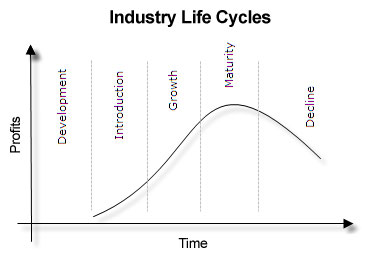
    Industry Life Cycle

    The answer to these questions will differ depending on your industry and where the industry is in its life cycle. There are many good articles out there discussing the industry life cycle so I won’t explore that here other than to say if you are in a more mature industry you will have your work cut out for you. Here is a quick look at the life cycle.

    (PHOTO)

    A small business generally competes in non-mature industries. The reason for this is that a mature industry has been around long enough to attract the attention of big players who will have deep roots. It is not impossible to compete in a mature market but keep in mind you will need offer more than you would if you were in a new or growing industry. In a mature market purchase decisions are generally made on preference rather than on need.  Think of Coke and Pepsi or MacDonald’s and Burger King. Arguably the products don’t offer a different value, they are simply preferred. Hint: when dealing with preference you start to walk down the road of brand recognition and huge ad spend. This is where big marketing companies can come into play.

    I explained the above to give you an idea of where you may be in order that you may know where you are headed.

    Decisions Decisions

    Back to measuring business performance. The core conflict that can arise in any stage of the cycle is pursuing efficiency vs. pursuing effectiveness. As an engineer I must admit my bent is to go after efficiency with everything from the start but that is not always the best course of action. The entrepreneur I mentioned earlier shared a story from early in his career.

    When he was younger and working for a successful business owner he found himself struggling with some hard decisions that would affect the company. The owner noticed him in his dilemma and said “Just make a decision. Do what you can and get things done. If you make the right decision 50% of the time you will move forward, if you agonize about each decision the world will pass you by. Now I’m guessing you will do better than 50%” From that point on my friend has been much more of a “get er done” type of guy and has built a multimillion dollar business.

    Fear of Mistakes

    It is my belief that our fear of failure pushes us not to feel ok about making mistakes. It is this fear that leads to the all too common “Paralysis by Analysis”. We may argue that it is for the sake of efficiency that we weigh and reweigh our options but I would suspect fear is the main driver.

    That’s not to say we should never concern ourselves with efficiency because it is quite vital for continued success. I would argue however that in a small business, initial efforts should be concerned with effectiveness while later efforts, once you are established, can address efficiency. Remember the life cycle above? The efficiencies and the cutting of the fat are not introduced until more players enter the market and the need to be efficient is required for survival. So, said another way;

    Initially a business or organization does not need to be efficient they need to be effective. Efficiency comes into play later when market demand requires you to sharpen your pencil or resource availability becomes limited.

    So, don’t worry as much about how a job is done as long as it gets done and doesn’t put you in the red. This takes a bit of intuition but a mistake can often teach you more than success on the first try which in turn build your human capital.

  • Part Time Money Making Ideas

    It seems most people could use additional money on the side so I wanted to share with you a few things I have done to give you some part time money making ideas. What are the two things we never to seem to have enough of? Money and time. I believe this is why many people look for ways to make as much money on the side as they can.
    If you are a stay at home mom, college student, or the bread winner of the family there always seems to be a need for more time to do the things you want to do and more money to afford to do them. I am no different which is why I have a few irons in the fire that I want to share with you.

    Making Products To Sell Online

    My first experience making money part time came in high school when I made products and sold them on Ebay. At the time I was into paintballing and had purchased a paintball gun that came with a silencer. I decided I wanted to know how the silencer worked so I ripped it apart and figured out how to make them for my friends and I. That lead to selling them online and equated to a $240/h rate. Now, I only sold a few silencers but the money to time ratio was great. Little did I know selling such items is frowned upon so the experience was short lived. If you have the talent and tools to produce a simple product you can probably make a few bucks selling them online.

    Making products is one of my favorite methods for making money. It is what lead me into engineering and offers a very tangible means to provide value. This is by no means passive but if you can find a good niche and provide a decent product I guarantee you can make some good money.

    Buying Domains

    I began buying domains in 2008 as I could see that the finite availability of Dot Coms implied value. I currently have 98 under my belt and have developed a handful of them. Each runs $7 to $12 dollars a year to hold onto so you can see how that can get expensive quick but once liquidated that $7 or $12  dollars a year can turn into thousands. I purchased one domain for $7.95 and was offered 12,000.00 for it the following week. Talk about a good return. Now, this is the exception not the rule. If you want to invest into domains understand it will take a good deal of time and effort to land a decent one. It cost me a lot of money to find out most domains have a gestation period. Additionally the changing landscape of the internet could have adverse effects. The “semantic” web could discount a domain portfolio. If you do decide to go forward with domains understand the return will be slow. My preferred registrar is GoDaddy.com only because it was where I started. There are many other great options out there.
    Rental Property

    While another long term investment, rental properties can offer great part time revenue. This of course requires a good deal of cash up front and usually a good deal of work but it can be worth it. Real-estate is one of the few things you can purchase that generally increases in value. This is because of the finite availability of homes and lots. That said real-estate also demands a long term strategy. It is possible to flip properties but you need to be on your toes if you are going to go that route. Additionally rentals require to deal with renters. For me this is no big deal as I grew up working on rentals with my parents but for other it could be a game changer.

    Developing Online Properties

    The most notable effort is the site you are reading. ShyEntrepreneur.com came out of the efforts in my master’s program to provide small, young, and home based businesses owners/ entrepreneurs with exposure to the formal ideas I have picked up along the way. The site is young yet (a little over a year old) and is positioned for growth. With the help of a small part time team I have compiled some resources that were designed to edify the reader base. To date the site is still in the red but our breakeven is just around the corner.

    Total time invested: not sure, a lot at first to get it up and going then roughly an hour or two per article. With 64 posts that is roughly at least 120 hours. This doesn’t include the 7+ years of school or personal experiences that preceded the site just the time put into making it happen.

    The Common Thread

    I don’t know if you have picked up on it yet but in short there is not easy get rich quick program or model that works. Everything that has ever brought in money for me has required hard work and time. Even so called “passive” investments require a good deal of attention to perform well. Don’t get stuck in believing you don’t need to work, you do and you should. The neat thing is a little bit of hard work can go a long way. All businesses require someone behind them strategically directing the organization and pushing the people to make each day a success. If you are your first business you need to accept that you will need to put in hard work to make any king of money either part or fulltime. I believe it is David Ramsey who said “to get to where few are tomorrow you must do what few do today. ”

  • Entrepreneurs, Take Advantage of the Business Cycle Phases

    Entrepreneurs, Take Advantage of the Business Cycle Phases

    I recently met with my financial advisor and our discussion sparked an idea for this post. I am going to discuss the business cycle and how as entrepreneurs we can better position ourselves to take advantage of the phase changes.
    The Business Cycle

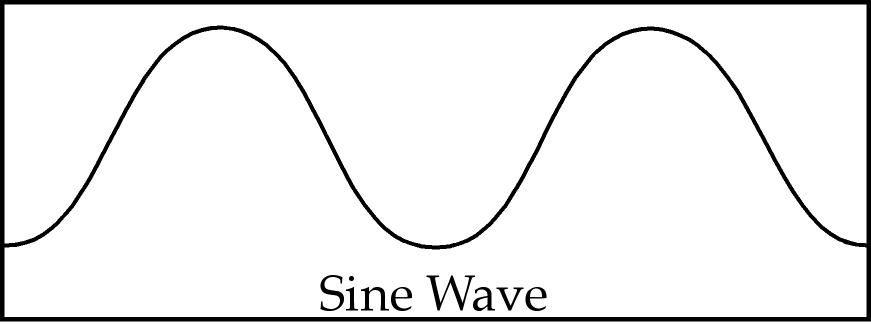
    As you know there is an ebb and flow to our economy with times of prosperity and times of poverty. If you are not aware of this you need to open your eyes. The big thing to note however is that the cycle is just that, a cycle. No time of prosperity or poverty ever lasts forever. What does this mean for you and I? It means there are continual opportunities to position yourself and your business to make a profit. This is the strategy my advisor and I are following with my portfolio.  The cycle can be thought of as the following a Sine wave;

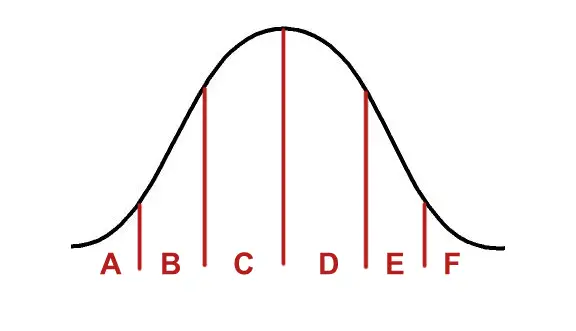
    This isn’t entirely true of course but it does illustrate the general rise and fall. The common approach is to break the cycle into four parts: Recovery, Prosperity, Recession, and Depression but, for the sake of this article I have broken the cycle into 6 parts. The image below breaks the cycle into 6 parts each found between inflection points. The idea here is that the inflection point denotes the beginning of a change.  “A” represents the recovery phase, “B” is growth, “C” indicates maturity, “D” can be considered to be a correction, “E” is decline, and “F” the beginning of the next recovery. This cycle as I said is not perfect but has roughly a 2-3 period.

    Why should you care? Just as an investor will change his portfolio for the coming economic land scape you can position yourself accordingly. For example companies that do well in recovery are generally smaller firms that assist in efficiencies. Doing more with less is the name of the game in recovery. IT businesses can find themselves in this group as IT products often allow for higher internal efficiencies.

    In the maturity phase (C) the companies that do well are the larger institutions that are less effected by the market landscape. These companies are often so big and so diversified that they never see large spikes in any regard. The law of averages keeps them on a steady path. For the entrepreneur this could mean moving away from the “want” areas of your industry and into the “need” areas. What is it that your customers absolutely cannot live without? How can you offer solutions that don’t focus on options but feed into the core need of a person or business.

    The time to position yourself or your company for each change is in the preceding phase. This will often be in the growth (B) and decline (E) periods. Some of you run businesses that can be easily tailored to these changes while others of you do not. Service based organizations can alter their packages to offer a better angle on the market whereas product oriented businesses may need to diversify their product line. Again, your specific industry and circumstance will need to be taken into consideration.

    Other Cycles

    Cycles are everywhere and if you are aware of them you can often profit greatly. Annual cycles that affect many industries are often tied to the weather. Construction for example often slows in the winter because of the snow fall in cooler climates. The warmth of summer is also a catalyst for the soft serve beverage establishments. In fact, because I live in a 4 season area I decided against opening a self-serve yogurt shop in 2008. I watched a few similar establishments go under because they couldn’t carry an overhead through the winter months. If I were to have moved forward I would have had to offer more than frozen yogurt and I didn’t want to go down that path.

    It would also be advisable to change your buying habits such that you purchase items in their off season. I haven’t tried the following but I have often wondered how much money one could make if they simply purchased lawnmowers in the winter from Craig’s list and sold them in the summer. The same could be done for snow blowers, picking them up in the summer and liquidating them in the winter. Doing this would exploit the cyclical nature of the demand that follows the weather. Of course this would require you to hold the items for half a year or so but I think it could pay off.

    Out of Phase

    As Warren puts it; “you should be fearful when others are greedy and be greedy when others are fearful.”  This phrase speaks to the idea of setting yourself apart from the rest and positioning yourself for the effects of group think. You want to stay out of phase with what the majority of people are doing. Staying ahead  of the curve often means not adopting what everyone else has adopted. Find a unique angle and go with it, don’t model your approach after the market you will be lost in the masses. To read up a bit more on how to set yourself apart check out The Competitive Advantage Spectrum.

    The dynamics we are talking about also hold true on the business to business level. Companies that sell out to other companies often do so because they plaid into the masses. By playing into what everyone wants you will water your business down until you find yourself in a financial crisis and in need of someone to bail you out. Pricing wars can quickly lead to this. If a competitor is selling a product for less than what you can make it for you are either in the wrong industry or your competitor won’t be in business long. Dropping your price to meet theirs will only lead them to do the same and ultimately lower the expectation in the customer’s mind of the price for your product or service. This is one of the reasons why I tell all small business owners never to compete on price.

    Conclusion

    Play your own game. Take the cycles of your industry into account but don’t allow them to shape your business. Just because your customers want to pay less doesn’t mean you need to lower your price. There are many creative ways to meet the coming changes but you will need to step outside of what everyone is telling you and find a unique position that has not yet been exploited.