
Author: TJ

  • What is The Importance of Human Capital in Small Business?

    A series of conversations has prompted me to address the importance of the human element as it pertains to small business. It seems as though most understand the importance of financial capital and overlook the role human capital plays in successful companies. I find this interesting especially because the significance of human capital can arguably be greater the smaller the company.

    Why you ask? In short, as companies grow their paradigm changes such that they have many people who know a lot about a few things (the specialists) whereas a smaller company requires fewer people to know a little about everything (the generalists). Ideally an organization wants to find employees that fit both profiles. People that know enough about the big picture to better preform at their specialty and people that know enough about the specifics to better manage the big picture. Owners of small business don’t have much say in the matter, they are forced to know both by virtue of the fact that they cannot afford to bring on much help.

    What about creating specialized generalists? Training the few employees you can afford to excel in all areas resulting in a smaller skilled labor pool rather than having a bloated workforce of general laborers? This approach would be quite contrary to what is commonly practiced. Putting much stock into employees is often viewed as a good way to corner a business if anything happened to them or to the relationship. This is unfortunate. I maintain leveraging ones human capital can prove to be more profitable than discounting it to the point of making employees easily replicable. Now, I’m sure there are instances where easily replicable labor is desirable but as a small company the more you can lean on your workers the faster you will find business success.

    By having a well trained workforce you will also allow be positioning yourself for a stronger competitive advantage. As we mentioned in The Competitive Advantage Spectrum a small business should be set up to provide a quality solution in a short amount of time. This is because a company’s ability to respond to its customer’s is directly tied to the human capital at all levels of the organization. Think of the last time you called a tech support line and were redirected to an overseas call center. How quickly was your problem resolved? Was it resolved? It is not that the call centers can’t point you to a solution but if you could talk directly to someone intimately familiar with the product you are calling about you would have a much faster and more pleasant experience.

    Human Capital Needs to Add Value

    You will be doing yourself and your customers a disservice if you subscribe to the idea that some roles in your organization don’t require trained employees. All employees need to add value to your organization beyond their daily tasks. The more everyone in your company knows the better. An example of where this isn’t true can be found in procurement departments all over the place. You would be surprised at how often purchasers buy the wrong items simply because they don’t have a grasp of the big picture. Often times finding the lowest price takes priority over buying the right items. This dynamic will play out anytime you thrust an untrained individual into a role that requires preexisting understanding.

    A good progression begins by starting someone out on the basics and moving them up as their understanding grows. This even holds true at the professional level. Green college graduates can’t hold a light to a non-formally educated employee with years of experiences. As a business owner you need to recognize that if you are not an expert there is a good chance your company could be in trouble.

    Design Vs. Quality

    To illustrate the point further think of a master craftsman who has been making wood odds and ends all his life. Now, someone comes to him and asks “hey mister, would you build me a guitar?” to which he replies “no problem”. Some time passes and our master craftsman finishes his work and presents it to the customer. What would you expect the end result to be? Well, unless our master craftsman had a preexisting understanding of how to build guitars the final product would probably not be what the customer had in mind. It could have the highest level of “quality” and be a beautiful product but it could also lack greatly in the area of Design. Positioning of the frets, the shape of the neck, and the acoustics of the body are all design considerations that require a deeper level of understanding than simply wood working. If this same request was given to a trained luthier not only would he know the correct shapes and positioning he would also probably know which woods would work best given the time of year and geographic location. The point is the intent or purpose of a product needs to be fully understood.

    Managing Human Capital in Growth

    There is no cut and dry answer to managing human behavior but much of the issues you will come across can be circumvented by simply hiring the right people. By that I mean find people who are characterized by their hard work and integrity. In his book Good to Great: Why Some Companies Make the Leap… and Others Don’t , Jim Collins refers to this dynamic as getting the right people on the bus. He says it doesn’t matter if you don’t have a job for them, if you come across a quality individual get them on your team and figure out the rest from there. The right people will bring your business to new heights, the wrong people will hold you down.

    Conclusion

    Small businesses must leverage the human element, not discount it. There is a lot to gain from the skills of your workers if you are willing to put the ball in their court. That said you must also be willing to compensate them accordingly. A justifiable wage should accompany quality talent.

  • Iterative Development Model

    I have heard a lot of talk lately about lean and iterative startups and I must say I fully agree with the approach. People seem to jump in with both feet before they even know if there is water in the pool. Starting small and releasing a product as quick as possible cuts out a lot of variables. The biggest of which is “Does a market exist?” The thing to remember as the provider of such a product or service is that even though you haven’t fully tweaked your offer you are still providing value. An iterative development model is a good safe way to explore new possibilities.

    Small businesses are especially susceptible to losing a lot of time and money by chasing an idea that is not substantiated. It isn’t that difficult to raise enough funds to launch a business or new product line but if you are leveraging yourself you better know there are profits in your future.

    I would not be surprised if part of the reason small businesses see such a high failure rate is in part due to the dynamic of; “Ready, Fire, Aim!”. I get it, the zeal many entrepreneurs have push them to action before they fully know what they are in for. The longer I study the world of business the more I have witnessed the reasoning of companies to or not to go after additional ventures and it has proved to me that there are often many hidden reasons why NOT to go after a given market.

    Perfection Vs. Completion

    Another benefit to the iterative approach is that projects get completed. We are currently working on the release of a new product and I find myself wrestling with making things perfect verses wrapping it up and getting it out there. I have to remind myself that absolute perfection will never exist and that I may be wasting time by not getting the product to the market. I know it is a successful habit to focus on one project at a time but If I am perfecting something based on a false assumption no matter how “perfect” I make it no one will care.

    Often times a future concern may not be apparent until the product is in the final users hands. Your customers are your ultimate litmus test. They will tell you in a heartbeat if you are on point or not. Don’t view this as a bad thing, it is an opportunity to engage in dialog and find out what they really need.

    An example: I was working on a proprietary ERM project and needed to create a back ordering feature that would allow the sales staff to enter the parts shipped and create an automatic back order. This was an easy enough task but the ERM software was so involved that I couldn’t possible account for every third and fourth order effect. I produced the feature and launched the new version as quickly as I could. Come to find out a date that needed to be updated which the sales staff “always” updated was not populated and production thought the sky was falling. Word got back to me and I fixed the hole. The point is I could have combed the complete ERM suit for a year and would have never found out about this issue as it was related to the user’s mode of operation. By releasing it the use of the software brought the bugs to the surface.

    Everyone Changes

    Both the markets and the providers are not static, everyone changes. I heard that on average a company can change its direction as many as 5 times before it finds the path that leads them to fortune and fame. Microsoft for example got its start in monitoring traffic. Their needs for an IC lead them into computing and ultimately operating systems. Remember there are usually many markets that can be served by your existing set of core competencies.

    As you provide your product or service keep the dynamic nature of the market at the forefront of your mind. If you are not ready for a looming change and it hits there are ten people behind you waiting to pick up your market share. Don’t look at this as a negative reality embrace it and work with it. It is from this dynamic nature many opportunities will pop up. If you adopt a constant state of change as a normal business practice you will be hard pressed to find yourself outdated.

    Change is constant and how you react to each change will determine your ultimate success or failure. The new buzz words are lean and iterative but these models have long been in effect; take a look at the software and book industries. There is always a newer version or release around the corner. Wait a minute, I never looked at the current version as incomplete, I always looked at the newest version as improved. Aha, perhaps now you can turn your work in progress into an early release and offer each fix as a new an improved version, at a premium of course.

    If you found any of the above information to be helpful leave us a comment and let us know. We also love to hear your perspectives.

  • Small Business Inventory Management

    Managing inventory variability is a constant struggle in business one tool to help manage this is a regression analysis. A regression analysis is a statistical assessment of date that seeks to identify a general overlaying trend. It defines a sample set of date as a line. Like all statistical tools a regression analysis has limitations and without an intuition of the sample data a regression analysis is useless. The following is a sample of how a regression analysis could be used in small business inventory management and how knowledge of the real world implications was taken into account.

    As an operations engineer of an aluminum and bronze casting facility that produces a proprietary line of electrical transmission components it was my job to address product requisitions, generate quotes and do what I can to make the fulfillment of orders go smoothly. One of the dilemmas that we faced was providing parts with a minimal lead time.

    More often then not customers came to us looking for parts they needed quickly, and in the world of power transmission a day can mean thousands upon thousands of dollars lost. We did what we could to get the needed parts out as fast as we could but if a part was not on the shelf there would most certainly be a delay. It isn’t practical to maintain a large inventory all the time due to the carrying costs involved so, as an alternative we kept a select inventory of our most popular parts available.

    As our name grew and more people heard about the product line, our market share also saw growth. This selective inventory model worked nicely for us but with the continual rise in sales comes a need for more parts on hand. The question became; at what rate should we continue to add to our selective inventory?

    Each part had a separate demand so for the sake of this exercise I focused on only one item. I have gathered the quantities sold of this part over a 34 month period. The data is as follows:

    Monthly

    date By Month

    Sum Of qty


    January 2003

    245

    February 2003

    186

    March 2003

    55

    April 2003

    326

    May 2003

    510

    June 2003

    329

    July 2003

    110

    August 2003

    52

    September 2003

    677

    October 2003

    100

    November 2003

    37

    December 2003

    362

    January 2004

    1014

    February 2004

    45

    March 2004

    136

    April 2004

    186

    May 2004

    196

    June 2004

    60

    July 2004

    213

    August 2004

    239

    September 2004

    191

    October 2004

    151

    November 2004

    32

    December 2004

    190

    January 2005

    1003

    February 2005

    100

    March 2005

    361

    April 2005

    154

    May 2005

    161

    June 2005

    561

    July 2005

    338

    August 2005

    135

    September 2005

    820

    October 2005

    1259

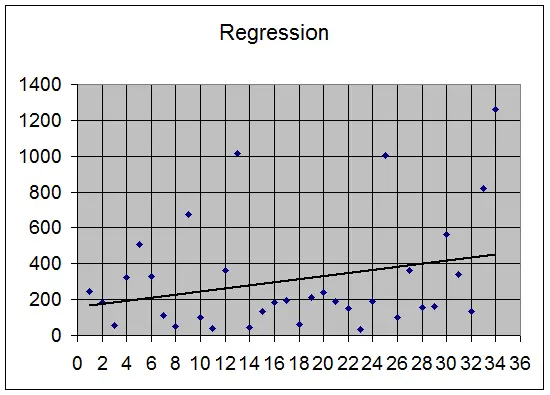
    Now that we have the data we can plot a regression and see our trend. Using Excel QM we find the definition of this trend line to be Y=8.52X+160

    As you can see our quantities are all over the place but there is an indication that we were experiencing an upward trend in our average volume.

    This regression suggests that we were selling 8.52 additional parts every month. If this were the case it would be wise to add 8.52 additional parts to our on hand inventory every month to compensate. The result would be an out put that doubles roughly every 2 years.
    A product that doubles in sales every two years is a great for a company but lets look at the over all sales for each year to see how they match up. Taking a step back to make sure we see the full picture proved to be prudent.  

    Yearly

    date By Year

    Sum Of qty


    2003

    2989

    2004

    2653

    2005

    4892

       The data that we used to generate our regression shows a dip in sales in 2004 and a spike in 2005. It would be wise to take note of this as the deviation in sales is a good indication that the demand is not constant. If our demand isn’t constant we need to be careful about producing more parts then what we can sell.

    One way to combat this is to make the on site inventory a function of the prior month’s sales. Knowing that the ratio of standard orders to rush orders was about 7:1 we could determine a good starting point for our inventory to be 20% of the prior month’s sales. While this may result in a larger on site inventory then what is required for rush orders, it is more then likely not going to exceed the quantity that we will sell for the month.

    Every bit of data helps us determine what tomorrow might bring but no extent of data will ever insure us as to what tomorrow will bring. The regression analysis provided an indication to our macro rate of change while a quick look at our over all sales showed us that the distribution of sales was not uniform.

    A good practice would be to continually run the regression analysis for different time periods and see if perhaps we could identify potential cycles or seasonal trends that we could later exploit in order to maximize profit.

    I hope this illustrates how a tool like a regression analysis can be helpful but could lead to making wrong decisions if the practical circumstances are not understood. Many people right out of college have a great deal of tools under their belt but often do not know how to properly us them in the real world. My hope is that this illustration will push you to better understand your problems before spouting off a potential solution.  


  • Are You Aligned With Your Profession?

    A conversation with a college student has pushed me to address the issue of alignment between oneself and one’s occupation.  If you have ever taken the Myers Brigs you may have an idea of what I am talking about. It may seem rudimentary but aligning one’s self with a complimentary profession is not a cut and dry task. The Myers Brigs predefined profiles often times can give great insight into what direction one may want to pursue but is it enough?

    People in large part don’t know what they want. We think we know what we want but we don’t. I am a perfect example. When I started college I wanted to be a music major. My parents knew that was a poor choice, my friends knew I wasn’t supposed to go down that path, but I was completely unaware that I was built with an engineer’s mind. After a few quarters of general classes I began to see the light. In retrospect I believe it was more Devine intervention than my own doing but ultimately I realized I was built to solve problems, not make music.

    So, why is alignment important? Ultimately it boils down to contentment. If you find yourself in a position that is not complimentary to who you are you will not be happy. Big surprise right? Well, it happens much more than you may realize. Often times people chase after a profession or business because they believe that is where they will find the money. This may be true but it is not where they will find their happiness. They will justify their decision by compensating outside of their daily obligations but when it comes down to it they spend so much time doing what they hate they don’t find the contentment they thought they would find.

    In your own business or in a job having alignment will result in amazing performance. People who love what they do fundamentally will do it better that those who don’t. This is an important principle to keep in mind when looking into starting a business. There are so many people competing in every market that there is no room for fakes or pseudo committed individuals. A small business that was started because someone thought they could make some easy money fast will ultimately fail.

    Being aligned provides a competitive advantage over the competition. Whether the competition is another employee or another business, your alignment will give you an edge that others won’t have. Properly aligned individuals are constantly thinking about new and creative ways to execute their business ideas. People that are not properly aligned simply want to put in what is required and then walk away.

    A prominent business owner I know consistently surprises me with all of his new ideas.  The man has more money than he knows what to do with yet he continues to find ways to refine his organization. The reason? He doesn’t do it for the money, he simply loves what he does. If he was only motivated by money his organization would at best be a mediocre business.

    Google is another great example of this. Larry Page and Sergey Brin built Google as a solution the nets inability to efficiently be queried. Now, they didn’t neglect the monetary side of business but their driving motive was not dollar bills. Take some time and look into the business culture of Google and you will quickly see it is not a company out only to make a dime.

    Now that I have addressed the importance of alignment, how can someone achieve it? An option that I have found very effective is the use to the Theory Of Constraints Thinking Process. Applying this to the individual to identify core competencies can uncover what is needed for alignment. The process is quite involved but yields great results and will show you more about yourself than you care to know.

  • Your First Business? You Are Your First Business.

    If you have been playing with the idea of starting a business because you want more freedom, a better return on your time invested, or just a better quality of life, start by looking in the mirror. You are your first business.

    As a contributing member of our society you provide a product or service in return for monetary compensation. You have an income and you have expenses. “You Company” is in the business of living your life and maintaining your standard of living.

    Your approach to business will parallel your approach to personal finances. Add six zeros to your financial situation and that is how you would perform as the CEO of a fortune 500 company. Ok, this may be a loose correlation but the principle is valid.

    If you are succeeding with your personal finances chances are you will do just fine starting a company. If however your personal finances are not in good shape and your savings account is not regularly growing you may want to think twice before jumping on the business wagon.

    The idea behind this stance is that money is not the issue, behavior is. No amount of money will fix the behavior that has brought you to your current situation. The behavior and choices that have brought you to your current situation will continue to take you down the same path if you don’t make a change.

    The secret is to know which behaviors lead to monetary and personal success. Incorporate these behaviors into your life and guess what, you become that guy/gal with the coroner office and the big house on the hill.

    I call it the flywheel effect. You won’t notice a change today or tomorrow but over time you will see everything come around. There are no definitive points along the way as you continue to give the wheel a push but over time the wheel picks up speed. The more you engage in successful behaviors the more successful you become, it is nothing more than continuing to choose to be successful.

    Successful Behaviors and Habits

    So, what are successful habits and behaviors? In short they are the choices that minimize expense and maximize return. People often live paycheck to pay check by choice, they may not realize it but it is by choice. Each choice compounds into the big picture;  the choice to have cable, the choice to have the I-phone, the choice to go out to eat tonight, are all choices that push someone to spend each dime they earn.

    Before I got married I spent a ton of money on food and entertainment. I would justify it by saying I am a single guy who does well so why not. The problem was that I began establishing horrible habits that cost a lot of money. I would buy breakfast and lunch at Subway, pick up the bill for my friends, and always be the driver without asking for gas money. While these are seemingly not bad actions, from a business perspective they were working against the business of me. (As a side note I still love to do all three of the above, but now in moderation)

    I am not saying you need to become a cheap money hording individual but I am saying you probably have some leaks in your bucket that could quickly be eliminated. You will be amazed at how quickly things can turn around.

    People often start a business thinking it will bring in more finances and consequently overshadow their behavior problems, and it is simply not true. I have heard it said that doctors and lawyers often have bigger issues with money than most. The reason is they were never taught how to manage what they have. Regardless of how much money one makes, if you spend more than you make you are heading towards bankruptcy.

    Starting a business is not something you want to take lightly, and as your first business you will want to start with your personal finances. Establishing new behaviors is simply a matter of repetition. Repetition becomes habit, habit become routine, routine becomes personality, and personality becomes character. If you want to start a business take the time to assess your personal situation.

  • Promotional Discretion, Appropriate Considerations When Selling a Product

    Well, we had our baby girl over the weekend and she is beautiful. I would love to go on and on about the new addition to our family but that is outside the scope of the site and probably wouldn’t be that interesting to anyone who doesn’t know us. Instead, I will expound on the clever marketing and promotional shots taken on new parents and bring to light possible promotional follies.

    The most interesting promotion I witnessed over the past 9 months was the free box of formula that showed up at our door one week before our baby. Talk about lucky timing! Some marketers somewhere were fortunate enough to send us formula right before we would need it. Well, this was less luck and more like intentional product placement.

    My wife has a few birthing sites she frequents which give her up to date info on where she is in the pregnancy and what to expect. When she signed up for this free service she entered in all of her dates so the site could stay current with her progress. On the back side of this process they famed out our information to a company that is in the business of selling formula. As the due date got closer a flag went off in their system and the formula was sent just in time with the hopes of us giving it a go and falling in love with what it does for our child. Unfortunately for this company we are breast feeders and will probably never open the freebee.

    After thinking wow, those guys are smart to target like they did, I though what about the unfortunate instances when a miscarriage takes place? I mention this as a word of caution to those who promote products in sensitive industries. Remember to always listen and truly take into account your customer’s needs. Those who have been in an industry long enough will know where this type of area exists but those who are just getting started may not have the foggiest idea.

    Know When to Apologize

    As a small business owner who is just getting started keep in mind that you will likely step on a few toes here and there. We would all like for this not to happen but it does. The important thing is to learn from the mistake make a sincere apology, and rectify the situation as quickly as possible. Everyone makes mistakes but not everyone takes the time to make it up.

    Long term vs Short term Strategies

    What comes to mind is the long term vs the short term growth strategy. This is the same principle as found in sales strategies. Are you in business to make a bunch of one time sales quickly? Or, are you looking for long time repeat customers who swear your product or service it the best? Personally I like the sound of the second approach. If I am going to invest a good deal of time and money into a venture I want to know that it is going to be around longer than a current trend or fad.

    Build The Relationship

    Business is highly relational and the stronger you relationship is with your customer base the stronger you business is as a whole. In preparation for our baby girl I needed some work done to our car. In reviewing my options I ended up going with the company that has served us excessively well in the past. They were not the cheapest option but the attention they gave, and their willingness to work with us was well worth a few extra bucks. I felt like I was helping a friend, and I am sure they felt the same.

    Fight The Selfishness

    The interesting dynamic about all of this is the human desire for instant gratification. People as a whole often don’t want to work for a modest reward. Generally speaking as a people we want something for nothing. The trick is to not allow this inclination make its way into your life and business practices. Take a second and think about your friends, which ones are the most selfish? Ok, which ones do you like spending the most time with? Are they the same people? I bet not. The same holds true with business.
    Businesses exist to make money, that is the nature of free enterprise but the money is made is another thing entirely. Business without integrity is like relationships without trust, they don’t exist. A modest profit for adding appropriate value is justifiable and appreciated. Excessive returns accompanies with no value added are poor profits that will come with a price far more costly than a monetary value.

    Get Some Sleep

    Anyhow, I hope these words sink in with some of you as the stronger the small business market place is the stronger our economy is as a whole. Smooth organic growth curves are much more valuable than any spike that can be created through temporary hype. Best of luck to you all and enjoy your sleep.

  • Thanksgiving, an Entrepreneur’s Endeavor

    It could be argued that Thanksgiving is something we celebrate because early entrepreneurs did what no one before them could. To that I lift a glass. Thinking about the obstacles that stood in from of the early settlers gives me a greater level of appreciation for what we have. Our standard of life is so far beyond what many in this world experience and for that I am humbled.

    I don’t know why we have been blessed to live the charmed lives that we do but I do know that we have an obligation to pass the blessings along.

    As entrepreneurs you have a bravado and perspective that will change this world. I urge you to heed this reality and do what few before you have done for the sake of those in need. The smallest gestures can make the largest impression.

    Hoping you all have a wonderful Thanksgiving.

    TJ


  • 5 Steps to Start a Small Business

    Steps-to-start-a-small-business

    With everyone talking about the economy I decided it would be a good idea to discuss an approach to small business that if followed would minimize the number of failures. These 5 steps to start a small business provide a solid foundation to any venture and should not be ignored. It is in the success of small business that the economy finds its strength so, take notes.

    1. Take a Look in the Mirror

    When thinking about starting a small business the first thing one should examine is their personal financial situation. You are your first business and the way you manage your personal finances is a reflection of how you will manage the finances of your business. If your personal finances are in order and you make more than you spend, you are probably ready to begin thinking about other business ventures. If on the other hand your situation is the other way around and you spend more than you make, I would suggest that you get your situation turned around before venturing into the world of small business.

    The management principles that lead to financial success on the personal level are the same principles in the business world. If you are employed you are providing a service to your employer and in exchange they are compensating you with a salary or an hourly wage. Think about this for a bit, you are already playing the small business game. Where are your week spots? Are there spending issues? Why are you looking to start yet another business? Examining your current situation with this perspective will give you an idea of what to expect if you were to get another business off the ground.

    2. Understand the Small Business Marketplace

    Before getting started make sure you understand Small Business Volatility. The most notable characteristic of the small business marketplace is its resistance to success.  The fact is the majority of small business startups will close their doors after two years of operation. If you don’t take note of this reality you are positioning yourself for failure. One of the biggest contributors to this reality is the fact that small businesses generally don’t have much money behind them and businesses fail because they don’t make enough money to cover their expenses.  In other words the small business marketplace is a marketplace averse to error. One must know where each penny is going and how each penny will help the bottom line.

    That said, there are advantages to small business. Being small means you are flexible and fast. You won’t have the layers of bureaucracy to slow you down when you need to make a decision or change something up. Leveraging this reality can afford you opportunities that your larger counterparts cannot act upon.  Commonalities exist among the small business and large business paradigms but keep in mind a small business approach will not work in a large business environment, and a large business approach will not work in a small business environment. Most consumer based organizations that we are accustom to follow the large business paradigm so keep yourself in check because a Wal-Mart approach to a custom boutique is a recipe for failure.

    3. Begin with Service

    Outside of yourself your first small business should be service oriented. There is a smaller financial barrier of entry for service based businesses than there is for product based models. This means you will reach a break even faster than you would if you decided to go with a product based model. Think about a janitorial agency. The startup costs would be rather small, especially if you had supplies you could use around the house.

    Additionally many service based business are better suited to handle fluctuations in demand. Market fluctuation can be killer for smaller organization. A service based model can have its expenses tied closely to the actual delivery of the service. This means unless you are providing the service, you are not incurring costs. There will be some overhead but not as much as there would be in a product oriented environment.

    4. Be Willing to Change Direction

    I have heard it said that companies change their focus an average of 5 times before they find success. As you begin to fulfill a need your intuition on that need will grow, as it does allow it to direct your company. Microsoft for example began in traffic analysis hardware, not software. There is freedom to try multiple directions (one at a time) to figure out how your company can best add value. Eric Ries in his book The Lean Startup: How Today’s Entrepreneurs Use Continuous Innovation to Create Radically Successful Businesses calls this “the pivot”.

    5. Dig In and Get to Work

    These precautions will safe guard you tremendously as you pursue each business venture but they are worthless if you don’t act. In order to make you business work you will have to work… a lot. A common trait I have witnessed among successful business men is their drive to get things done. They don’t sit around and wait for this or that, they figure out what needs to be taken care of and take care of it. The journey doesn’t have an end, being a business owner is a continuous effort to perpetuate your organization. If you don’t eat and breathe your business chances are you will play second fiddle to someone who’s passion is the business you claim to love.

    I hope you find this helpful. I know may people want to know How To Make Easy Money Fast, which can be done, but not continually and not with a small business. Business is hard work that will take time to produce fruits but trust me when I say diligent effort invested into a focused business will pay off handsomely in the time. Remember, the small business is the heart of our economy and anything that can be done for the sake of small business is a cause worth pursuing.

  • How to Increase Profits in Business

    In discussing profitability we are effectively discussing the efficiency of a business to make money. In other words, how can we squeeze a little more money out of the existing establishment? This topic is well worth discussing as most people find themselves in need of small business financial help. There are many effective ways in which this can be done but before doing so you want to make sure your efforts won’t be in vain.  The following considerations will help you to identify root issues that may be leading to your initial question of how to increase profits in business.

    When to address profitability?

    Addressing profitability should be addressed at startup and again after you have passed the survival phase.  I discuss the phases of business development in the article; Small Business Volatility. The short of it is there is no point working on your profitability if you are not sitting on a proven business model. If you find that your model is not one that will fly in a small business environment than profitability is not your problem, your premise is. Upon such a discovery you should immediately pivot your focus to an approach that works with small business. If you are sitting on a proven business model than your next concern will be market positioning.

    Adjust Your Market Positioning

    First things first, be sure you are playing into The Advantages of a Small Business. Small business should already have a fairly healthy profit margin. If this is not the case you may want to look at your market positioning. Make sure you are not using a large business approach in your small business environment. This adjustment alone can turn your company around in record time. Profit per order will see a huge increase, your customers will love you, and you will no longer be pulling out your hair trying to figure out how to pay the bills while pushing tones of product out the door.
    As a small business you should not compete on price. Small businesses should be competing on quality and lead time. If you are already positioned to compete on quality and lead time than the hurdle simply becomes acquiring more orders. This is accomplished by letting the market know you exist through various marketing efforts.

    Up Your Marketing Efforts

    You don’t want to spend much if anything on this so you will need to team up with local organizations and co-sponsor events. In many cases a donated widget or two will buy you a booth for an event that draws in hundreds to thousands of people.
    If you are having trouble finding events figure out how to hold one yourself. If you go this direction I strongly suggest you approach a local TV or radio station and ask if they would like to co-sponsor the event with you. If you can get them to bite they will run adds in their dead time promoting themselves and your event at the same time. Once you are able to increase your exposure what you will find is many people already know you exist, they simply were not aware of your current products or promotions. This leads us into one of your greatest pools of potential customers.

    Approach Existing Customers

    One of the largest pools of untapped income is consistently your existing customer base. Think about it, if they purchased from you once they are highly likely to do so again. Take your customer list, which I know you have, and shoot out a promotional email and see if you get any response. It would be prudent to record which customers purchase, these are your gold mines and will probably continue to buy in the future.
    If you don’t have a customer list start putting one together. Most database applications can output this information if you have been using something like QuickBooks. For those of you who may have customer lists but they are small, start gathering potential customer information through free giveaways or on your website. The one that always makes me laugh is the fitness club giveaway that says “Sign up to win a free week at our gym!” you know that they call each and every name entered into the drawing. On top of that they probably already offer a free week to every person who signs up.

    Ask For Referrals

    Many of your existing customers may not be willing to make another purchase right away but they probably know someone else who will. Ask them if they know someone that could benefit from what you have to offer. Personally I would have no reservation pointing a supplier in someone else’s direction. It gives the supplier another potential lead and allows me to feel like good about myself even though I decided not to purchase anything that day.

    Increase Your Baseline

    Finally, if you have tried all of the above, the last thing to do is raise your price. I will assume that you price was already acceptable to your market so you will need to justify this increase. The two big areas that will without question justify a price increase are your quality and lead time. Higher quality and faster turnaround times inherently demand higher price tags. An example would be a custom wood worker guaranteeing a finished product in one month at an additional cost. Or, a seamstress could double stich an entire article of clothing for 20 additional dollars. These small incentives will obviously be specific to your situation but you get the idea, added value at a slightly higher price.

    Wrap up

    I hope that gives you a few ideas on how you can squeeze a little more out of your organization. The hunt for further profitability is one you should never stop pursuing. You will find some products or customer’s seem to be more trouble than they are worth while others are simply a dream. As you identify your cash cows you want to focus your efforts in their direction. You can’t please everyone so you may as well work hard pleasing those that can be pleased.

  • How to Manage a Business Successfully

    I recently had an interesting conversation with a business owner on the topic of how to manage a business successfully. We concluded that all businesses are working towards further growth and that a primary management concern is growth strategy. So, to manage a business successfully, one must manage growth successfully. How is this accomplished, and what considerations should be made?

    Neil Churchill has an amazing write-up titled “The Five Stages of Small Business Growth.” In it he discusses the characteristics of small business types and what to expect at each stage of development. He defines five stages of development: 1.Existence, 2.Survival, 3a. Success-Disengagement, 3b. Success-Growth, 4. Take-off, and 5. Resource Maturity.
    As you can imagine, the concerns at each stage differ, and conflict can arise simply from people’s perspective of a company’s position. If a company is in stage 3a but a manager is under the impression that they are in stage 4, the decisions made could have negative ramifications. At the very least, having management on different pages will result in contention among management. So, the first thing that must be established is a defined company position.  Secondly, the direction the company is headed must be agreed upon and communicated to all. Churchill’s framework is only one model, but it can be used as a starting point. If the industry you are in has a better model, use it.

    An Example of Differing Management Directions

    As my conversation with the business owner progressed, he explained to me how some of the management was inclined to seek slow growth strategies, while others wanted to be a bit more aggressive. As a TOC practitioner, I know there are assumptions pushing each view, and before I gave my thoughts I needed to thoroughly examine each perspective.
    The company has been around for a while and is diversified into roughly 5 industry types. The positioning and market share in some of these industry types is more mature than in others. The trend has been that change does not arise until a good deal of “pain” is felt from not changing. In other words, until there is an instant return on investment, change won’t occur. For the mature segments of the company, this is not a problem, but for the younger branches striving for growth, this is quite the headache. Without an established presence in an industry, a younger business cannot afford to move at the pace of larger, pre-existing businesses. Can you see the dilemma?

    Opportunity Cost vs. Over-Extension

    Opportunity cost is the cost of an opportunity not taken. For example, say you had a dollar to invest and the choice of two investments: A or B. You invest in A, which returns 10%, while investment B returns 15%. The opportunity cost of A is the 5% gain that was not realized because B was not chosen. This dynamic shows up in managing growth in the area of resource utilization. A company can either step up their capacity before demand exceeds it or after the demand exceeds it.

    Benefits of Stepping up Capacity Ahead of Demand

    Knowing when to step up capacity allows a company to manage its resources appropriately so that its internal capacity is not exceeded by the demand of the market. The idea is that the opportunity cost associated with having less capacity than market demand is quite significant.

    A retail example:

    This season’s highly anticipated new Nike shoe is the best thing since sliced bread. It is all the rage and every shoe store needs to have some of these on their shelf. Mom & Pop Shoe Co. put in an early order for 100 pairs and eagerly await their arrival. These new shoes are so popular that if an early order wasn’t placed, there would be no chance of receiving them before the end of the season. The season comes and Mom & Pop sell out of the shoes in the first month. The season is 3 months long, which means that for 2 months Mom & Pop have to turn away potential customers looking for the new shoes. At first glance, one might consider it a victory to sell out of the stock so quickly, but the unrealized loss is the 2 months of sales that could have been if Mom & Pop had ordered more shoes. Demand has exceeded capacity, and the unrealized sales could be as much as 3 times the sales of the first month.

    Benefits of Stepping up Capacity after Demand

    On the other side of the coin, the amount of risk assumed by Mom & Pop Shoe Co. was less than what it would have been if they had decided to preorder more than 100 pairs of shoes. Had they known the demand was going to be so great, they could have extended themselves out a bit more, assumed a bit more risk, and ultimately reaped a greater reward. Over extending one’s self is a function of the available financial capital. A business with a good deal of reserves can extend themselves further than a company with fewer reserves. Most Mom & Pop shops don’t have much money behind them, so avoiding the risk often times takes precedence over greater potential gains.

    Allowing the demand to “pull” on one’s resources may also be desirable for a company that is well-established and wants to maintain conservative growth. In other words, a large organization with the ability to extend themselves out a great deal may ultimately choose not to because the potential of larger gains at higher risk does not outweigh moderate gains at a lower risk.

    Conclusion

    So, given the above dilemma, which direction is best? The answer of course is a function of the organization.
    Smaller businesses are advised to maintain as fast of a growth curve as possible without overtaxing their current resources and without assuming too much additional risk. This means working up to the point at which the business is around 70% of its total capacity. A small business doesn’t want to exceed this because they will begin to see a drop in their ability to deliver on time. One’s due date performance is critical and should never be compromised for the sake of quick profits. It is also prudent to maintain cash reserves so as to carry the company through the unavoidable market downturns.

    Larger organizations with greater cash reserves and more resources have their choice on which course to take. As I mentioned earlier, they may choose to go with a slower curve because they don’t feel the additional risk is worth the potential reward. Or, it may be determined that a faster curve is ideal to pick up market share at a time when competitors may be hurting because of a downturn.

    It is assumed that all companies pursue growth, but the question is how best to manage growth? I would love to hear your thoughts and experience with this dilemma. Leave a comment or shoot me an email.