Author: TJ

  • Youth Entrepreneur

    Entrepreneurship is in many ways a mindset and often times can be identified at a young age. Entrepreneurs in their youth exhibit many of the traits found in their later years. Inventive problem solving, challenging the norm, and an ability to adapt are all signs of an entrepreneur.

    If this can be identified and nurtured early on, the dividends will be significant. As we are exposed to business and the world around us, we become more and more accustomed to how things operate. This can desensitize us into thinking the way we have always done something is the only way it can be done. A young mind has a significant advantage in that the slate can be clean of false assumptions, which are often the only barriers to change.

    Problem solving can mean any number or things, but most often it is simply getting things done. The single biggest trait that I have personally witnessed among successful individuals is their ability to get things accomplished. There is no blaming of others or waiting for certain circumstances–rather, there are only two questions to ask: What is in the way, and how do we put it behind us?

    Often underlining assumptions are the reason a project is not moving forward, and challenging such assumptions is a trait common to entrepreneurs. Not taking what is handed to you at face value can many times open up doors that are commonly missed. Challenging assumptions is an integral part of being an entrepreneur.

    If  it is not natural for you to go against the grain, don’t worry–there is still hope. Like anything else, viewing the world through a lens of entrepreneurship can be developed. Learning how to become an entrepreneur and developing successful habits is not difficult–it simply requires a little persistence.

    There is a popular quote that says: “the only constant is change”–with that, it is not a surprise that success is often accompanied with adaptation. Individuals with the ability to see and react to change possess a skill many lack. If someone you know embodies any of what was stated above, it is quite possible you have an entrepreneur on your hands.

  • Where to Invest Into Your Small Business

    Investing into your business is essential if you want it to grow. Your company is a living organism and it must be fed, the question is how to feed it. In “Growth Strategy, When to Step Up Capacity” we addressed when to step up capacity, here we address where the focus should be. Throwing money or time into an area that won’t help you grow is a waist, you need to identify where the efforts are required and focus your investment accordingly.

    Using the theory of constraints (TOC) as a tool to direct our efforts the first step is to identify the constraint. What is the current bottle neck of the operation that is constraining through put and ultimately the company’s ability to perform? The constraint can be a physical process, a policy, or even the culture that the company has been built upon.

    Working on any other aspect of the business may have positive second or third order affects but it will not address the core issue that is currently keeping the business from growing. Growth must be funded and a growing company that cannot support its own growth is a dying company.

    Subscribing to the TOC way we assume there is a single fundamental conflict standing in the way and it is our goal to identify it and leverage it to control the business. The five focusing steps are applied.

    1. Identify the constraint
    2. Exploit the constraint
    3. Subordinate to the constraint
    4. Elevate the constraint
    5. Go back to step one

    This process of ongoing improvement (POOGI) works to gain control of the single factor that is limiting the company as a whole. Steps 1 through 3 should have no additional cost and can increase the throughput of an organization by 60%. Steps 4 and 5 are pursued when more capacity is required.

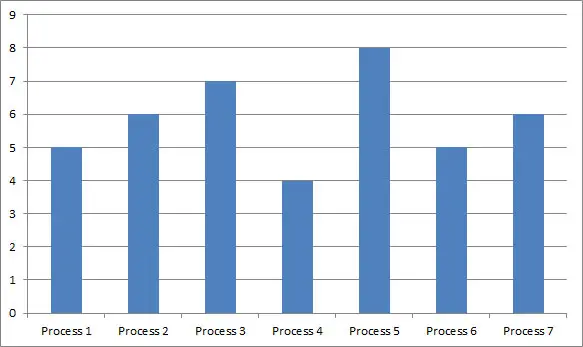
    If you are wondering how all of this is possible allow me to paint you a picture. If your business can be described as a series of 7 processes each with a unique finite capacity it may be illustrated like this.

    The flow moves from left to right through the 7 processes and each process is dependent on the one before it. With this scenario what would you say is the constraint? If you said process 4 you would be correct. As a whole if process 4 can only complete 4 units a day the business can only complete 4 units a day. The capacity of the other processes mean nothing when looking at the big picture. If you think of the constraint like a valve, once you find it you have the ability to control the flow of the company.

    The next question that I hear you asking is “what if the constraint changes?” Good question. In many environments the constraint can hop around depending on a slew of variables. If this is your environment I would suggest you do your best to minimize the constraints movement as much as possible. This can be done in many cases by simply declaring one element as the constraint and elevating all other processes to a point at which they never serve as a bottle neck.

    If you are able to get your organization to a place at which it has a single point of control you will be amazed at the results. Due date performance will go through the roof, lead times will be cut dramatically, and your customers will love you for being so consistent. In manufacturing quality increases as variability decreases, we are simply decreasing the variability of the overall production process.

  • Three Basics of Small Businesses

    Small businesses have a very dynamic existence for many reasons and as such it doesn’t take much for one to fail. That said I want to touch on a few basics that can help minimize the chance of failure and hopefully lead to further success. The following list is not exhaustive but it does touch on three principles that are essential for success.

    1.What business is

      Business is the exchange of a good or service for compensation. Compensation is often monetary but does not have to be. For a small business it can often times be more “profitable” to trade ones services for another. An example of this would be building a website in exchange for a bathroom remodel. If a budding young web designer happens to know a budding young construction worker an arrangement may be made that can be more beneficial for both parties. Small businesses by nature do not have much finance behind them so offering a service as compensation can often times be a great option.

      2. Relation

        Business is relational. This is no more obvious than with the push of social media. Businesses want to establish a dialog with their customer base in order to facilitate relationship. Believe it or not these relationships translate into dollar bills. A quick caveat, relationships must be genuine. Entrepreneurs that are only building relationships for the sake of monetary gain will quickly find that ulterior motives will be recognized. If you are doing what you love don’t push relationships, build quality ones that will last. A burn and turn approach will do more harm than good.

        3. Win Win

          As an entrepreneur you should be on the lookout for win win situations. All of your business transactions should be a win win. If any party leaves the table at a loss the transaction was not a success. Individuals that push to profit at the loss of another will not foster long term growth.


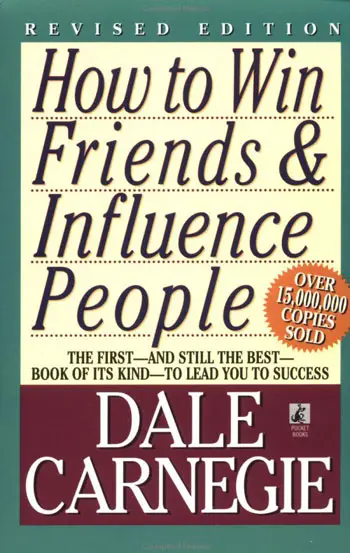
        1. How To Win Friends and Influence People

          If you have not read this book by now, log off you computer, drive to your local book store and pick it up. “How to win friends and influence people” by Dale Carnegie is a must read for every business professional.

          The coolest thing about this book which is explained in the foreword is that it was not produced for commercial gain, rather it was the result of over 10 years of research on business professionals. Consequently it is rife with fundamental truths that govern our behaviors.

          I also enjoyed the structure of each thought. It is very much a point by point read that can be used as reference tool as much as it can be enjoyed as a book.

          I pick up my copy while I was perusing through a book store one day and noticed it fit my purchase algorithm;

          My algorithm for purchasing a book

          • Have I heard people reference this title before? (Implies other people liked it)
          • Are there more than one copy of the book currently on the shelf?(Implies that it is a commonly sold item)
          • Was it published more than 5 years ago?(Implies value)

          If the answer to all of these questions is yes than I have just found a recourse to add to my collection.

          How to win friends and influence people will change your life. It is pertinent not only in business but in all of your relationships. I would love to hear what others think about the book. Have you been able to put its principles into action?

        2. Sales Approach: Hard and Fast vs. Soft and Slow

          I had a conversation with a gentleman that I do business with and we got onto the subject of different approaches to sales. He is a well-established individual who has successfully run many businesses, and his current operation follows a zero-pressure sales approach. The company he runs is not a start-up and his brand is well-established. This got me thinking about which sales models are better, or at what point should each sales model be used.

          I broke the sales approach into two mutually exclusive styles:

          1. Hard and fast
          2. Soft and slow

          Hard and Fast

          The hard and fast approach is what most consumers are used to seeing. This would be the car salesman, or cold call approach, in which the salesperson is trying to close the sale as fast as possible. As you can see, there is a lot to be said for this approach from a business perspective. A business has a financial pressure to persuade a consumer into committing to a purchase. The window of opportunity is often short and, if not taken advantage of, will pass.

          The downside to this approach is that it can often leave the customer feeling used or taken advantage of. The level of integrity can quickly be compromised if the sale becomes more important than the customer. This was the point of contention with my friend. His competition pushes a poor product on people and does not inform them on the potential downside of their purchase. They have ramped up their marketing campaign, so they are often the first place people go, and the high-pressure sales approach usually gets them to commit to the purchase right away.

          The advantage of this approach is that it brings money in the door quickly. This is especially beneficial for a small company that does not have the finances to cover the month-to-month bills. The other upside is that it can lead to a sale with someone who was not intending on making a purchase.

          Soft and Slow         

          The soft and slow approach is much more common among well-established organizations that often market very little. I am a fan of this approach because it removes the possibility of compromising integrity. The customer relationships are less business and more personal. An example of this approach may be found with your realtor. I understand there are pushy realtors, but most of the ones I have dealt with seemed to be more interested in what I wanted than what they wanted to sell.

          The downside to this approach is that it takes time. Establishing rapport with a customer doesn’t always happen overnight, so a sale may take a few interactions. As a small business this can be a problem because of cash flow requirements. If each sale requires a month-long investment, it could quickly become difficult to pay the bills.

          The upside to this approach is that a single sale could win you a customer for life. If a customer trusts you and you can help solve the problem, they will often times keep coming back, even if your product or service is slightly more expensive.

          Relational Aspect of Business

          The two approaches above each exist for valid reasons and each have a downside. A start-up with little capital behind it will find it difficult to not push to make a sale. A more mature company on the other hand may be leaving money on the table by not creating a call to action for their potential customers.

          It should also be recognized that the slow approach will result in a stable customer base, while the fast approach will result in a volatile customer base. The customers that were sold on the fast approach will have zero loyalty and will move on to the next offer once they find one they like better. Customers sold on the slow approach will be fewer and further between but will likely come back time and time again.

          Conclusion

          I am an advocate of quality products delivered with quality service with zero compromise, so the slow approach is much more appealing to me. I appreciate the stability of the customer base that comes along with it and I don’t mind investing the time to provide the added value. That said, I would like to hear what you have to say. I know both have pros and cons, so which one works for you? Or, if you have not started yet, which one will you implement and why?

        3. How to Become an Entrepreneur

          Becoming an entrepreneur is nothing more than changing the way you see the world. As an entrepreneur you are always looking for and taking advantage of new angles and opportunities.

          Knowing the true definition of entrepreneur provides a start to becoming the entrepreneur inside. The single biggest thing you can do to become an entrepreneur is to act. One of the biggest hurdles on the road to being an entrepreneur is not taking action.

          Not taking action
          As an example, I was visiting Nashville, TN, and while I was there I decided to shop for some shorts. I came to a discount store that carried boxes upon boxes of name-brand shorts, which I knew to be valued between $50 and $60 a pair. Their price…$4 to $7 each. Wow, what a deal!

          It was winter, so I could see how the discount store justified selling the shorts at such a price to keep the inventory moving. I snagged six pairs for less than the price I was ready to pay for one. This was a great deal, but I did not exercise the entrepreneurial muscle that I know now I should have.

          As I was walking out of the store I thought to myself, “If I buy $400 worth of these shorts and hold onto them until summer, I bet I could easily double or triple my money.” I chewed on it for a second then left. I didn’t take action.

          Well, summer came and I enjoyed my shorts, but I didn’t enjoy the fact that I left hundreds of dollars on the table. Had I taken the time and put in the little bit of effort required to buy the shorts and ship them home, I would have been able to cover the cost of my entire trip down there.

          Taking action
          I can’t share the bad without discussing the good, so here is an example of what can happen when you do take action.

          I was solicited by my sister to help clean out an office building that was left vacant by a high-tech company that left town. It was a professional environment, and apparently they didn’t care about leaving a few items behind.

          I began gathering everything together and running it down to the dumpster. When I got my first load to the parking lot, it occurred to me that these toner cartridges and office supplies must have some value. With this thought I picked through my load and put the items I thought may be worth something into the back of my truck.

          I finished cleaning out office space and went home to list my finds on eBay.  Over the course of the next few weeks, I sold all sorts of clerical and office supplies that were once destined for the garbage. When everything was said and done my total earnings on the “garbage” was $1600.

          Can you see the difference between these two examples? When I took the time to execute my idea, I was able to bring home a good deal of change. When I failed to execute I was left wondering what if.

          Chance are those great ideas you have bouncing around your head have been thought of before, but the question is, are you willing to take the chance and make something happen?

        4. Ideas for Home Business

          If you are looking for ideas for home based business there are a few things to keep in mind. Business is simple as long as you know what to look for once you have that figured out you have the keys to the world.

          I have said it before and I will say it again, people don’t want the product or service you are offering, they want what that product or service provides them. Keep this in mind when you are exploring potential business opportunities.

          Step 1. Solving a problem or facilitating a need.

          You wouldn’t start a Popsicle stand in the North Pole so why try to sell what you have to offer if what you have to offer doesn’t have a demand? It doesn’t make sense. What does make sense is starting with the pull of the market. What is it that is already in need and has a current and consistent demand?

          The most successful people in the world play off of this very dynamic. Think about it for a second, who are the most successful people you know or know about?…Ok, how are they involved with something people use on a daily basis?

          Take a land lord for example; they own a building that is used every day by its tenants. Mr. Gates created the platform that I am using this very moment to express my thoughts while you are using it to read them. Mr. Buffet has his hands in companies who’s products are almost guaranteed to be in arms length of you this very moment.

          Unless you have some overwhelming desire to peruse a super small micro niche, don’t waist your time with a market that won’t support you,

          Step 2. Assess competition

          Once you have established the need you want to facilitate take a second and observe how that need is currently being met. This is very important for the home based business owner as capital is usually limited and the cost to break into an overly saturated market may be too great to bear.

          Ideally you will want to find a market that has as large of a demand and as little competition as possible. Follow the equation for motivation:

          (The extent of the reward) X (the likelihood of achieving the reward) = level of motivation

          Any market that will allow for a decent profit margin and high likelihood for sales will be worth pursuing. Remember all of the low hanging fruit is long gone, so no matter what direction you go a good deal of diligent work will be required.

          It should also be understood that small business by definition must facilitate a small ever changing need. This will eliminate the pursuit of any market that is well established and consistent.

          Step 3 Create your game plan

          Now that you found a need in a market that you can compete in it is time to create your game plan. This will vary from market to market of course but it is a step that is essential for your success.

          Take the time to address every nook and cranny of your newly found direction and get to know it inside and out. Your expertise in the area is a cheap insurance policy against the variability of a free market. If you know your market better than anyone else, guess who is going to be on top of the next big opportunity.

          Line up your direction for your potential business with your own personal direction. If you are pushing something you are passionate about the entire process will be much easier. If you don’t like what you do it will be reflected to your potential customers and consequently in your sales.

          Step 4 Get started!!!

          After completing the above steps it is time for the rubber to meet the road. There are very few things standing in the way of what you truly want, often times we are our own anchor. Don’t fall into this trap, figure out the tasks that need to be completed in order for you to get your business up and running. Chances are you will have a service oriented business model in mind so after you lay out the few pre business elements hit the streets and make something happen.

          Having trouble finding a direction?

          If you are having trouble finding a direction for a home based business I will give you a model that always works; buy and sell in classified adds and on Ebay. There is no more straight forward business model than buying and selling physical items. While in college I followed this very model to pay for many of my expenses.

          Pick a single item and begin to purchase and sell them in your town. Go with something you know and are confident about. Best of luck to all of you budding entrepreneurs and please let us know how your efforts turn out.

        5. Selling a Business Checklist

          Depending on the complexity of your small/home based business there may not be a whole lot to account for in the event of a sale but if there is I highly recommend the use of a certified accountant. A professional such as this will have insights you are not aware of or even care about. Having a professional working alongside you will also offer comfort to your potential buyers.

          That said here is a quick “selling a business checklist” that will get the ball rolling. This list is intended to address general items that will exist with in most if not all small and home based businesses.

          • Financial Having your books available for review will make a sale much easier. Balance sheet, cash flow, income statement, and statement of retained earnings should all be included. This will need to be in black and white, good books imply a good company which translates to a higher value for the potential buyer.
          • Assets The assets that will be included in the sale. This will include all hard and soft goods that are property of the company. Items such as equipment, fixtures, patents or copyrights, trade names, insurance policies; notes and accounts receivable, securities for debts, and outstanding contracts.
          • Motor vehicle titles. You will need documentation reflecting the transfer of titles to the buyer.
          • Agreement/Contract This is the terms of the sale, what you as the seller and your potential buyer have agreed upon. Each item in this list will be part of the agreement. I have seen many businesses sold in which the owner stuck around as a consultant. Much of a company’s value can exist as intellectual property and keeping the previous owner around may prove to be invaluable.

          The following are items that also may be needed. Again, a professional accountant will be all too familiar with what will be needed for your specific situation.

          • Tax rulings
          • Assumption by buyer of the lease
          • Principal warranties and covenants
          • Representations by seller
          • Collective bargaining agreement.

          For more information on what is needed for a small business valuation see: Selling a Small Business

        6. Small Business Resource Management

          As an entrepreneur or small business owner there is constantly a demand for three primary resources. The three resources are human capital (knowledge), financial capital (money), and time. Entrepreneurs have to find the balance on which to use in place of the other often a conflict can exists between spending time or spending money?

          With many home based business operating on a small budget at some point you will have to decide if you should work directly on the issue yourself or pay to have it taken care of. The nature of the issue and your specific situation will determine this but I strongly suggest that if other people’s time and talent can be leveraged at a reasonable rate to go that route.

          The majority of the tasks you will need to tackle can be taken care of by just about anyone, hire it out, don’t waist your time on simple tasks. In his book “The 7 Habits of Highly Effective People” Stephen Covey identifies the following time management matrix.
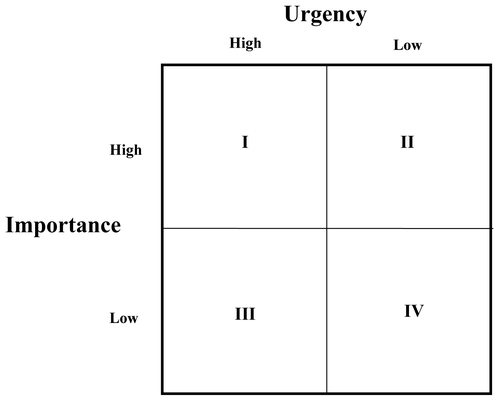


          First Quadrant

          This is where activities related to the daily grind are found.

          Second Quadrant

          This is where preparation and planning take place

          Third Quadrant

          This would include interruptions and distractions

          Fourth Quadrant

          Activities not directly related to your current situation.

          Identify the tasks you take part in according to this matrix, and hire people to handle the matters found in the high urgency column. Other people can often be leveraged to handle these matters which in turn leave you free to spend more time planning and strategizing.

          You are the captain of the ship. You are responsible for directing the ships course. A single individual can manage a row boat but many are required to manage an ocean liner. Entrepreneurs often start in a row boat but soon realize a larger vehicle will be required to get them where they want them to go but a larger vehicle demands many hands.

          Your business is the manifestation of your vision; no one knows your vision better than you. Remember, many people can file papers, answer the phone, and do data entry often times faster than you can.

        7. Home Based Business for Women

          I was recently asked by a stay at home mom, what is a good home based business for woman. What is something that can be done part time, doesn’t require uninterrupted focus, and can be done form home? While I am sure there are dozens of models out there, the one model that I know could work every time is running a blog.

          There is a bit more to the business model than simply starting and running a blog, but once someone has their ducks in a row there is very little upkeep and maintenance. Running a blog also leaves the door open to be focused on any subject someone cares to write about. Posts and replies can be made any time day or night, and if you are too busy for a few days the blog still does its job.

          How money is made with a blog

          The first thing you need to look at is how exactly money will be made. Money is only made when there is a point of sale and finances are exchanged for a product or service. For the blogger the hope is to be the conduit between the potential buyer and the seller. In other words, running ads.

          Adsense

          The easiest implementation of running ads is with Google adsense. Google adsense is in part what made google what it is today. A visitor visits a site, clicks on the Google ad and is redirected to the advertiser’s page. Google is paid by the advertiser, and the blog owner is paid by Google. While this model is extremely straight forward the yield is not that high, and unless you have a ton of visitors it will be a long time until a check is received. Google’s minimum payment is $100.00 so if you are only getting a click or two a day don’t bank on seeing any quick change.

          Amazon Ads

          Like Google, Amazon also provides and pays you to have ads on your blog or website. The difference with Amazon is that their ads push people to their site, and you are only paid if a purchase is made. The cool thing with Amazon is that you can get a percentage of a sale that may not be associated with the ad on your site. By this I mean if a visitor clicks on the Amazon ad on your site, decides they don’t want that specific product and searches for something else entirely different, Amazon will still kick you back a percentage if a purchase is made.

          Affiliate Offers

          The last way to make some change that I will cover in this article is through direct affiliate offers. This basically cuts out the middle man (Amazon/Google) and puts an offer for a product or service directly on your site, or at least one click away. For example if someone is selling candles and you blog about candles, it is possible to get paid a commission for anyone purchasing candles that were channeled through your site.

          Just like all avenues of business, the low hanging fruit has long been picked over so don’t think your site will be producing a huge return right away. That said, if you do your homework, write good content, and optimize for quality search terms it is possible to get a site up that will produce a daily return on a continuous basis.

          I am hoping to address this process a bit more in its entirety in the future but for now my suggestion would be to focus on a topic, buy a domain specific to that topic, and invest a little time each day researching the market, building content, or learning more about successful blogs.

          Tools you will need

          Domain name: Godaddy

          Hosting: Hostgator

          Blog software: WordPress (this is included with a Hostgator account)

          There is plenty of information online regarding each of the above. Even if your first few steps are simply getting your blog up and going, don’t fret it, just keep pounding away. If you have a little one around the house we also have info on entrepreneur ideas for kids.

          Remember: To get to where few have been you must do what few have done.