Author: TJ

  • The Thinking Process

    The TOC Thinking Process is an interactive, logic-based approach to problem solving that can be applied to the most complex of systems. We as people often don’t think through issues to the extent that we should. The Thinking Process brings to light the assumptions we make in our thinking habits, and illustrates the ramifications of those assumptions.
    With the Thinking Process, you will be able to identify and eliminate the core conflict that is the cause of your organization’s shortcomings.

    The Thinking Process answers the following three questions:

    1. What to change?
    2. What to change to?
    3. How to cause the change?

    In answering these questions it is possible to unlock the hidden potential and excess capacity that is not currently recognized in your organization.

    3 Cloud Method, Identify the Core Conflict

    The first step in solving any problem is correctly identifying the root cause. This allows us to focus on the root issue rather than the symptoms. In organizations, the root issue is referred to as the core conflict and can be identified using conflict clouds. The core conflict is one that exists because of opposing pressures, both often due to noble reasons. The core conflict is there because the organization must appease both pressures in order to stay viable. An example that is often used in a manufacturing environment is the push to run large batches vs. the push to run small batches. Running large batches is appealing because of the volumes that can be completed, but smaller batches can provide more flexibility. If it were possible to maintain flexibility without compromising large volumes, we would not have a conflict, but because running large volume orders does inhibit flexibility, a conflict exists.

    Not every organization has the same issues, so not every organization has the same core conflict. So, how to you identify a core conflict? A core conflict can be identified using the three cloud method. The three cloud method is a means by which multiple undesirable effects can be assessed to point one toward the core conflict. The method itself is a bit involved and requires an extensive write-up in itself, so I won’t go into specifics here. The basic idea is that a core conflict can be identified through essentially averaging out three independent conflicts that exist within an organization.

    Establish the Current Reality Tree

    Once the core conflict is realized, it is possible to map out an organization’s current reality in a logical sequence known as the Current Reality Tree (CRT). The CRT is a logical map that lays out the correlation of the core conflict to all of the other undesirable effects. This step alone will educate you extensively on the whys in your organization. A CRT uses sufficiency-based logic, which forces one to link the elements in the tree in a cause and effect manner. Feedback loops are illustrated to show the “perpetual” nature of the requirements that cause the core conflict.

    “IF we can only produce three widgets a day, AND IF the minimum order is 5 widgets, THEN every order will require at least two days to ship.”

    The CRT will help to build a consensus as to what common problems are and how they are viewed. It also forces one to think through the conditions required for each effect. A properly structured CRT will align with the structure of your core conflict and thus validate its existence.

    Establish the Future Reality Tree

    The Future Reality Tree (FRT) can be thought of as the inverse of the CRT. All of the undesirable effects that existed in the CRT are transformed into desirable effects, and the desirable future reality is proposed. The conflict is replaced with injections that won’t allow the conflict to exist. The injections are the actions, policies, or procedures that the organization will change in order to address the initial core conflict.

    Like the CRT the FRT also incorporates feedback loops. The feedback loops in the FRT, however, work to continually lessen the problems and increase the desirable affects you are looking for. This is the initial stage of a solution, but at this point it is left unchallenged and operates as more of an idealist direction worth pursuing.

    Negative Branch Reservations

    In addressing change, one must also address risk. Up to any point change has not occurred because the risk associated with that change has not been eliminated. So we must address the risk, or there will be negative branches associated with the proposed solutions brought about by the FRT. Negative Branch Reservations (NBR) are the negative ramifications that come from instituting a proposed solution.

    This is one of the easiest parts of the thinking process to complete; it is simply stating all the reasons a proposed solution won’t work. What are the worst things that can happen if an action is taken? What are the possible losses associated it? How will we ever survive not staying where we are?!? People naturally resist change, so you won’t have trouble here.

    With all of the negative branches in place you begin to comb through the potential risks and set up measures to trim the negative branch. You set up the possible safety nets that will be required to eliminate the risk associated with the proposed change.

    The Prerequisite Tree

    Now that we have a solution to our core conflict, the ideal future reality, and have brought to light all of the negative ramifications associated with change, it is time to iron out all of the bumps that will allow the strategy to be executed. The Prerequisite Tree (PRT) compiles the FRT, NBR, and a slew of other “prerequisites” needed to overcome obstacles that arise along the way. Identifying obstacles differs from identifying negative branches in that obstacles may simply be obtaining a license, or acquiring a resource, where as a negative branch is a ramification that comes as the result of change.

    The PRT uses necessity-based logic to define what is needed to accomplish the final objective. Unlike sufficiency-based logic, which accounts for what is sufficient to cause an outcome, necessity-based logic accounts for everything needed for an outcome. The PRT structure is such that each intermediate objective must be accomplished before the final objective can be achieved. Like in the NBR, many objections and prerequisites will arise, but the more that are accounted for, the more complete the final solution will be.

    Transition Tree

    The final step the Thinking Process is the Transition Tree (TRT). This is the sequential layout of how actions will be completed. The TRT will fill in the gaps between the intermediate objectives that were left by the PRT. The TRT in a way can be thought of as a step-by-step outline for others to use in order to transition from the current reality to the future reality.

    I have been amazed at how effectively the thinking process can work in seemingly impossible situations. I have also been amazed at how much we don’t think through issues. In conducting a full thinking process, you begin to understand the number of assumptions we make in our thinking habits and begin to see how damaging those assumptions can be. Take the time to think through your situations and let us know what you find.
  • Conflict Clouds – Evaporating Clouds

    Conflict Clouds – Evaporating Clouds

    Conflict Clouds, also known as Evaporating Clouds, are a conflict resolution tool used in the theory of constraints (TOC) to maintain the logical integrity of two mutually exclusive events and their existence for a common goal. The premise of a conflict cloud is that conflicts exist because two events that cannot exist at the same time are working against each other to achieve the same end. The conflict exists in the prerequisites, which are needed for the requirements, which ultimately lead to the objective.

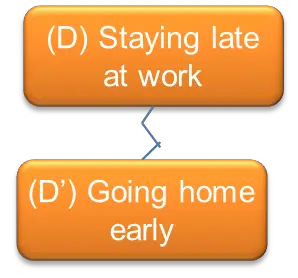
    As you will see, conflict clouds illustrate the logical argument for the existence of a conflict and can be used as the seed for the rest of the TOC thinking process. To begin, we need to find two mutually exclusive events. For this example I will use (D) Staying late at work and (Not D) Going home early.

    Identify the Conflict

    These two events cannot exist at the same time, so a conflict may arise. This conflict may exist if say I need to get some additional work finished up at the office but my wife wants me to come home. The elements are referred to as node D, denoted by D, and node Not D, denoted by D’. It is possible to stay at work and it is possible to go home early, but it is not possible to stay late at work and go home early. Formally, the D nodes are considered to be the prerequisites. We would lay the conflict out as follows.

    Identify Requirements

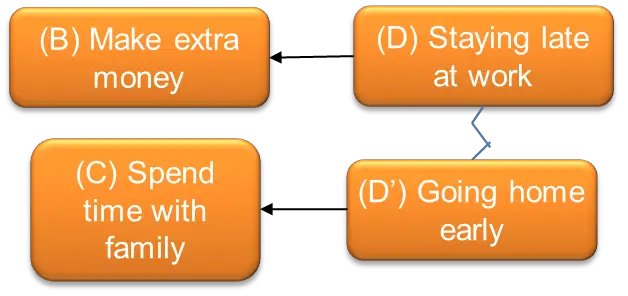
    Now let’s take a look at the requirements. The requirements are the nodes that create the need for the prerequisites. In our example the requirement for staying late at work may be to make some extra money, and the requirement for going home early may be to spend time with the family. The requirement for prerequisite D is node B, and the requirement for prerequisite D’ is node C.

    We could read the cloud as follows:

    “There is pressure to stay at work late in order to make some extra money, and to make some extra money I must stay at work late. There is also pressure to go home early in order to spend time with my family, and to spend time with my family I must go home early.”

    Reading the arguments aloud will help to determine the logical validity of the statements. Are D and D’ truly prerequisites to B and C? Does D’ put B into jeopardy, and does D put C into jeopardy? In other words, will (D) Staying late at work allow me to (C) spend time with my family? No.  Will (D’) going home early allow me to (B) make extra money? No. It looks like we have a logically valid conflict.

    The Goal

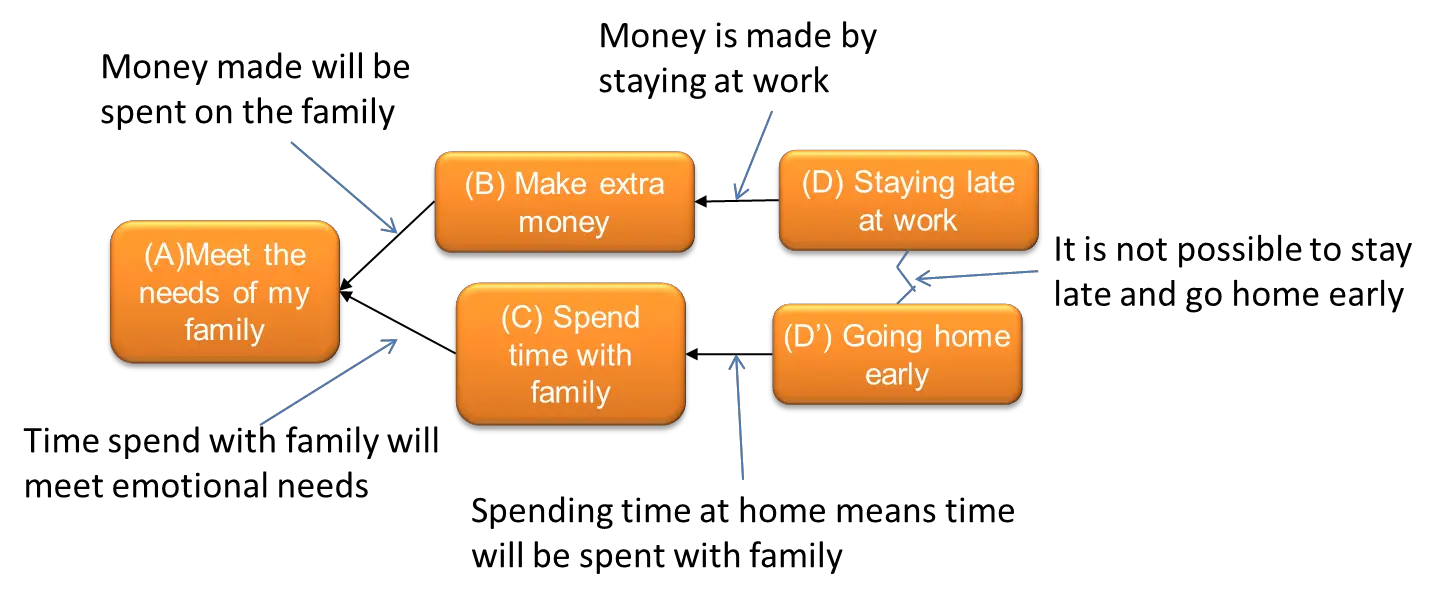
    Now that we see that the connections are valid, one might ask again why the conflict exists. The conflict exists because both instances are working for the same goal. In this case, the conflict would exist inside me, and the common goal to each course of action would be meeting the needs of my family. Extra money would help meet the monetary needs of the family, while time spent with them would meet the  emotional needs of the family. So, the final node is node A, which represents the objective or goal of each argument.

    The complete cloud is illustrated below.

    You can see how there is pressure from both sides of the cloud for two mutually exclusive events, yet both are needed for the final objective. The idea in a conflict cloud is to evaporate the conflict so the end goal can be achieved. Evaporating the cloud is achieved by introducing an injection that can meet the need of each side of the cloud to produce a win-win  situation.

    Finding an Injection

    Finding an injection comes from challenging the assumptions that link each node. Each of the arrows represents a seemingly logical relationship, but each of the relationships may be subject to scrutiny. With our example, a few assumptions that have been made are:

    Challenging these assumptions can lead to an injection that will evaporate the cloud. A few possible solutions in this case may be to work from home, spend the money I already have on the family, or bring my family with me to work. Remember, the idea is to create a solution that will allow for the family’s needs to be met.

    There may be many assumptions between each node, and in conducting a full thinking process it is not uncommon to note 5 or more assumptions at each junction in hopes of finding one to challenge. Many times simply thinking through your conflict to this extent will reveal a solution that you had not thought of before.

    A practical solution in the example provided may be to go home early today (Friday) and come in early on Monday to make up the lost time. Such a solution would allow for time to be spent with family and additional time to be invested into work for the sake of financial compensation.

    Cloud evaporated!

    For those who want to read more, there is a good write-up on wikipedia here.

  • Starting Up a Small Business

    If you are looking into the idea of starting up a small business there are a few things you should know before taking the leap. Small business is tricky business and unless you know what you are doing you will end up like the majority of people who give business a try by shutting your doors in 2 years or less. The up side is that you can be successful in starting up a small business if you keep in mind a few main realities.

    Volatility

    In a previous article I dug a bit deeper into small business volatility but it is worth mentioning again especially in the context of getting a business started. Small business exists because large business has carved out a method to meeting the needs that doesn’t reach everyone in a market place. In other words small business is small business because large business has deemed the pursuit of such market places not worth the effort. Large businesses seek opportunities that exist in well-established mature markets. These would be markets that yield smaller margins but are also less volatile. Consequently this leaves the more dynamic and volatile markets for the small businesses. This is part of why small businesses don’t last long, they compete in an ever changing market place.

    So, what does this mean for you? It means that the opportunities that will exist for you and the business you aspire to open will be opportunities that require quality and custom solutions quickly. This also means there will be a good deal of work involved in order to gain market share for you niche. Abandon any idea of providing a single product or service, you will need to diversify your products/service, customers, and possibly industries. To combat the ebb and flow of the small market place you will need diversify all aspects of your company.

    Alignment

    Ok, now that you understand a little about the realities of the small business market place the next thing to look into is how well your potential business aligns with who you are. In the beginning stages of a business the founder is the business and the business is the founder. To offer the most value the business should be the embodiment of you and you should be the embodiment of the business. The realization of a single opportunity should not be the only deciding metric for starting a business. As an example; A few years ago I had the opportunity to start a frozen yogurt shop in my town that would have been modeled after a profitable model that was doing well in other cities. I did my homework and found that for $40,000.00 I could have everything I needed to open the doors and start selling yogurt. I decided against it for two reasons, 1. I live in a four season’s area and I did not want to have a feast or famine demand and 2. I am not that crazy about yogurt.  Now, the opportunity was there, and since then many of these shops have opened, but I didn’t want to invest 80 hours a week into a frozen yogurt business.

    Market Positioning

    So you have an idea that aligns with who you are, and you have come to understand the nature of the small business market place, how are you going to position your product or service? How are you going to meet the needs of the customer? The answer is somewhat laid out above, but because of the nature of the small business market place you will need to become a high quality, quick turnaround company. Small businesses have the advantage in small volume custom areas. Your competitive advantage will be your ability to cater to the specific needs of your customer. In factors of competitive advantage I explore in more detail where a competitive advantage exists, here I am stating that as a small business you have no business competing on price.

    Margin

    You are your business, and chances are you do not have much capital behind you. This means that achieving a positive cash flow situation as quickly as possible is key. Cash is king and without it you don’t have a business. The upside is small volume high quality work demands top dollar. That’s right, by being a small business you are competing in a large margin arena. The mark up on your products and services can and should be high. The market will let you know when you are too far out of range, but a healthy profit margin is to be expected with small businesses. Individuals that fail to understand this begin to lower their prices in hopes of gaining some sales but what they don’t realize is they are diluting the market and putting themselves out of business. So, don’t be afraid to charge for your work!

    Growth Strategy

    The last thing I will mention for those looking to start a small business is that a growth strategy is imperative. You need to have an idea of where you are going if you ever expect to make it as a business owner. By nature small businesses should only remain small for a while, if you company is not growing it is dying. Markets mature, customer needs mature, and guess what… your business should also be maturing. Knowing where your business is headed will allow you to take the appropriate measures today to set up for tomorrow’s market. A growth strategy can be vague. You don’t need to define every variable, but you should use your intuition to determine where you should position your company.

    If you are planning on starting a small business understand it is a lot of hard work and there are no rules. There is no one telling you what to and not to do, you will be responsible for your success or your failure. You must be persistent and willing to invest more of yourself than the next guy in line. If it were easy everyone would do it, but because it is demanding there are only a few to compete with.

  • Home Based Occupation

    Working form home can be a huge blessing and for stay at home moms it is a great way to generate supplemental income, but how should business be conducted? I discussed Ideas for home business in previous articles but what I want to address here is helpful tips that will assist you with your home based occupation.

    Obviously the industry you are taking part in will have a huge role on how your day to day will look but if you are serious about succeeding with your home based business you need to treat it as serious as you would any other business. The home based business market is huge, people everywhere are doing business out of their homes, but not everyone is treating their business with the severity it demands.

    Take Your Home Business Seriously

    Take the term “you get what you pay for” This phrase is from the consumers perspective, but as a business owner you should also think about it from the suppliers perspective. If you are to provide a product or service and require people to pay for it, it is your responsibility to deliver.

    By taking the time to set up policies, procedures, and designated schedules you are minimizing variability which in turn will increase your quality. You will have a happier customer base which will be much more likely to come back to you time and time again. I am not saying you need to nail everything down but I am saying the more you can define about how you provide your product or service the higher your inherent quality should be. That said do not compromise your product or service for the sake of policy, there are times when it make sense and times when it does not.

    Keep in mind, the second you think you have the right to slouch off is the second your company starts its trend into the red. Maintaining a method of continuous improvement is the first defense against failing to meet customer’s expectations.

    Separate Personal and Professional Life

    I use to have a representative that worked out of his home in Alabama and he told me that every day he awoke at the same time, conducted his morning routine, and got dressed in his suit just as if he were headed to the office. When I asked him why he said if he didn’t he mentally did not feel as though he was going to work. Not everyone will need to go to such great lengths to get into the right mind set but once you find the groove that allows you to separate your personal and professional life, stick with it. A home office is nice until the kids and dog come running in during a conference call with a potential client.

    Pay For Quality Recourses

    For some reason people tend to believe that simply because business is conducted at home it must also operates on a shoe string budget. While it is wise to keep an eye on your expenses and not overextend yourself, don’t be afraid to pay for quality recourses. If you are looking into graphic design, get the nice computer with the benchmark software. If you are looking into landscaping, stich with industrial level products like Toro and stay away from the consumer products found at the local hardware store.

    This can be used to your advantage. If the market you are involved in is saturated with home based businesses and you go the extra mile to print on your own letter head or send personalized swag as a thank-you your customers will recognize your efforts. Being home based does not mean unprofessional or cheap! If anything it will require a more intentional approach to how your company is perceived.

    Be Accessible

    Having a dedicated cell phone, land line, or answering service would be prudent move for most. As a bootstrapping small business you don’t want to pay a ton for any of these but you want to make sure customers can get a hold of you. Land lines can be as little as $20.00 a year, and as stone age as it may sound a having a fax machine on a land line adds to the professional ambiance of your company.

    Call everyone back regardless of the issue. Your customers are coming to you because you offer a value they can’t find down the street. Calling customers back, building report, and staying in touch lets them know that you are there and that you care. I would also suggest making phone calls in response to an email. If someone sends you an email regarding an issue, respond in an email and follow up with a phone call.

    Be Timely

    As a small business one of the biggest things your customers will be looking for is a quick response or a fast turnaround. Having a fast lead time is part of small business and is essential if you want to succeed in the long run. In many industries a faster lead time may be all you have over your larger competitors.

    It can sometimes be difficult to handle many inquiries for your product or service but the more you define and redefine your system the faster you will be able to get back to your customer base. This won’t apply to everyone but as a rule of thumb; if you find yourself repeating a process over and over again, write a program. Computers are great at handling repetitive and semi repetitive tasks.

    The longer you provide your product or service the more intuition you build and ultimately the faster you become at meeting your customer’s needs.

    Add More Value

    The smaller the business the more it should be positioned to offer custom solutions. If your operation consists of only you it will be your job to tailor your solutions to your customer’s needs. Little things like sending flowers to a client in the hospital, or fixing a problem that you weren’t hired to fix can speak volumes about you and your company. This will also set you up for a customer base that is willing to refer others to you.

    The more value you provide and the more relational you are, the more your customers will love doing business with you. Let us know your experience regarding home based businesses, we are here to help.

  • Five Focusing Steps

    As an individual you are your first business, and as your first business you must realize that continued adjustment and change is part of succeeding. Problems will always arise do to the change around you and your ability to accommodate the changes required can be made easier with a few simple steps. One of the strengths of the Theory of Constraints is its focus on continuous improvement. Business by nature is constantly changing and any process that recognizes this dynamic is in my opinion one to follow. If you are looking to increase your bottom line keep reading.  The five focusing steps were derived to identify the single conflict in a business that inhibits throughput of the facility and if applied correctly can increase profits for little to no cost.

    The five steps are;

    1. Identify the constraint
    2. Exploit the constraint
    3. Subordinate to the constraint
    4. Elevate the constraint
    5. Go back to step one

    To give you an idea of the effectiveness, steps 1,2, and 3 come at no cost and can often times increase throughput by 60%. Think about that for a second… if you could increase the throughput of your company without laying down a dime would it be worth the investment? Of course it would! This is made possible by the inherent simplicity that exists within any “complex” system. Keep in mind that this works as effectively on a personal level just as it does on an organization level.

    The first steps concern the capacity that already exists within a system and work to fully exploit what currently exists.

    Identifying The Constraint
    The constraint within a system will be a single assumption or conflict that is the root cause to your pain and heart ache. If you can identify this single element you will be well on your way to a better reality. If the conflict is not initially apparent a logical tool known as the thinking process can be used to derive the core issue. The conflict consists of two mutually exclusive pressures pulling in opposite directions. An example in a production environment may be recording the status of each part as it moves through processing or pushing items though as quickly as possible and not recording their status.  There is pressure for both cases but the status is either recorder or it is not. This push and pull has a trickling effect which will cause many other issues in a system, the other issues however are symptoms of the root conflict. Individuals that have intuition of their system will know inherently what the constraint of their system is. Over time they will have seen one area in which throughput is constantly held up.

    Exploit The Constraint
    With the constraint identified it becomes possible throttle production. The constraint is the limiting factor of the facilities output so it becomes a single point of control for the entire system. Exploiting the constraint simply means using the constraint to its full capacity. If the constraint is a CNC in a machine shop, and every part that is shipped must pass through that CNC, that CNC should be running as close to 100% of the time as possible. If this means alternating operators over a lunch period than so be it, as the constraint it should see as little down time as possible.


    Subordinate To The Constraint
    As in the example above if the constraint is a piece of machinery we want to make sure everything else in the facility takes second seat to the constraint. This means that the constraint should never be waiting one a prior process. All prior processes are scheduled such that the constraint is running 100% of the time. The constraint is the pull for all prior processes and the push for all post processes. In the TOC community it is referred to as the “Drum” in “drum buffer rope”. The drum sets the pace and all other processes before and after the constraint follow the beat.

    Having a single point of control such as this can be huge for any organization. Due date performance will increase and as we will see in another post lead time can be greatly minimized. I said it before but I will say it again because it is worth repeating, these first three steps will cost an organization NOTHING and on average result in a 60% increase in throughput.

    Elevate The Constraint
    Once the system is conditioned to operate around the TOC methodology stated above the constraint can be elevated. This will require financial commitment but one that is easily justified. In the machine shop discussed previously an additional CNC may be the solution, or perhaps adding additional cutting heads would do the trick. Whatever the case the constraint is still limiting the throughput of the facility and increasing it will increase throughput. Be careful at this point, elevating the constraint without keeping the rest of the facility subordinated will only move the constraint and bring you back to square one. If need be, increase the capacity before and after the constraint to maintain the constraints location.

    Go Back to Step One
    In some cases a constraint will be eliminated completely in which case it becomes necessary to go back to step one. It is also required to go back to step one if the constraint is moved. Say for example a semi-conductor plant can easily escalate all pieces of machinery except one. It may be desirable to increase capacities and move the bottle neck until the machine that is not easily elevated becomes the constraint.

    Hopefully you can see how these steps can bring about great improvement in almost all situations. These steps maintain the idea of ongoing improvement and can have a significant influence on even the most complex system. Profit margins can be increased and lead times diminished.

  • How To Make Easy Money Fast

    Making money is easy; making money fast is where the challenge begins. If you want to learn proven methods of how to make easy money fast read on. Money is made as value is provided. Value can take the form of a product or service. So, the faster you can provide a product or a service the faster you can make money. It is that straight forward and that simple, anyone who tries to tell you otherwise is not making money. The principles discussed here apply to all situations but if you are interested in how to make money for kids a previous article discusses in more detail what kids can do to make some change.

    So, the fastest way to sell a product is to start with something you already have. Old widgets that have been sitting on the shelf can sometimes have a tremendous value. To liquidate these widgets you can use platforms such as eBay, craigslist, local classifieds, consignment stores, or a good old fashion garage/yard sale.

    Keep in mind that people make decisions based on emotion so what ever you are selling should look good. Products that are newer and still have a box will sell much faster than old used ones. A quick layer of paint on a picture frame or a nice scrub down could mean the difference between an item that demands $20 and one that only demands $5.

    A good technique to help move items is to create a sense of urgency. You need to maintain your integrity so by no means should you lie or mislead your potential customers but you can let them know that you are only going to have the item for sale for a short amount of time. Limited sales happen all the time and are a huge push for higher sales volumes.

    Now that we have covered products, let’s dive into some services. A service I could have offered over the winter was shoveling driveways. If I had walked through the neighborhood knocking on doors offering to shovel a drive way for $9 I could have easily paid for all of my Christmas presents within one day. A normal size driveway doesn’t take more than ½ hour, sometimes less. Given that it would not be hard to create a cash flow between $18 and $27 an hour. That is some significant earnings for your spare time.

    The same goes for mowing lawn, cleaning windows, or washing cars. What you want to do is offer a fixed cost for a fixed service, and you want your cost to be low enough customers can justify paying it. Most tasks around the house don’t require a ton of time. I would suggest focusing on the tasks that take 20 minuets or less. Take washing a car for example. It takes maybe 20 minuets and you could easily sell the service for 5-7 dollars a pop. THAT’S $15-$21 DOLLARS AN HOUR!!! I know of professions that require masters degrees that don’t pay that well.

    I hope that gives you some ideas on how to make some easy money fast. People often say well that is not easy, and to that I say, yes it is, stop being lazy. Don’t confuse easy with effortless. Nothing and I mean nothing will come to you if you believe effort is not required. This holds as true for relationships, for your health, and for your pocket book.

    Feel free to leave a comment below discussing your success or failure to generate some quick cash.

  • Franchises & Opportunities

    If you are looking to get a start in business but don’t know where to begin, franchise opportunities can be the way to go. As a franchisee you are effectively paying to implement someone else’s way of doing business. There are both pros and cons to this approach of business but for some it is the only way to go.

    One hurdle is of course the fee to get into a franchise. Depending on the industry you are getting involved with the fee may be well worth it. Having a proven business model, established supply chain, and national marketing are all perks that can mean the difference between being successful and striking out. There is generally an initial fee followed by a recurring monthly obligation. These fees cover many of the expenses associated with the franchise and in each case will differ considerable.

    While franchises have a cost associated with them the effectiveness of a well done franchise is truly amazing. Working with a refined and proven system will open your eyes to a whole new world of business. In his book the The E-Myth Revisited : Why Most Small Businesses Don’t Work and What to do about it Michael Gerber examines these dynamics and shows how a franchise style model can be adapted in many industries. I must admit I experienced a bit of a paradigm shift when I finished his book. It is all about the system. You may have heard; “you can’t manage what you can’t measure” well, it’s true and successful franchises prove it better than any other business model. Have a reason for doing what you do and measure its effectiveness.



    New franchises are popping up all the time and are available in all industries but they do not all supply the same value. I would suggest going with a proven company with an established track record. A properly structured franchise will be worth the investment, a poorly structured franchise will be waste of time and money. Do the homework before you move forward and make sure you know what you are getting into. Entrepreneur Magazine does an annual assessment of the top 500 franchises, the information is quality and it is great place to start.

    Regardless of the industry you are looking at getting into keep in mind that a proven system will be more advantageous in a mature, saturated, and highly competitive market than it will be in a less crowded one. A franchise will not be helpful if you are looking to pioneer a new product or service. Operating a franchise is operating a model that is already in place. The processes are structured, supply chains are defined, and training of new employees has been standardized. A franchise will not offer great flexibility; it is the lack of variability that allows them to succeed.

    If you want to scale up it is often possible to own more than one of the same franchise. Many of the Subway stores in my town are owned by the same guy and one family is known for multiple MacDonald’s. I suppose once someone becomes familiar with a specific business model it makes sense to continue with what works.

    Franchises are an answer but they are not the only answer. As a small entrepreneur chances are you don’t have much behind you to get started which can make the prospect of a franchise harder to swallow. Many people who would be great prospects for a franchise struggle with the idea because they don’t want to over extend themselves. An example would be someone who lost their job and is looking for other options to pay the bills. A franchise could help, but the expense could be high. Going to school is an option but again requires a good deal of time and money. What if there were a low cost, meet you where you are solution, that would have a low startup expense yet offer continued support as your business gets established.

    For those of you looking for other options, I will have you know that Shy-Entrepreneur is here to help. We are currently formulating a model that will fill the gap between starting a business completely on your own and paying a bunch of money for a boxed solution. Building on fundamental truths of success we are deriving a methodology that can add the value provided by formal schooling, or franchising while maintaining a reasonable expense.

  • Succeeding In The World of Work

    Succeeding In The World of Work

    Succeeding in the workplace is the same as succeeding in any free market. Unless your employer hired you for some other reason than to help them turn a profit, you are operating on the same principles as every other small business. In a previous article I touched on how you are your first business, and as an employee the same holds true.   

    Remember, you are your first company. You have an input, and you have an output. The process or you may exist within the scope of 9-5 employment but that does not change the way success is achieved.

    What is Your Competitive Advantage

    So, how does a business succeed again? By identifying a need that can be facilitated by your core competencies and maintaining a competitive advantage! What are the factors of competitive advantage? A competitive advantage exists when offering a product or service at a lower cost, higher quality, or shorter lead!

    There is no employer in the world that wouldn’t love to hire you for a lower rate, if you do quality work, and if you finish your tasks quickly. That is the dream employee. Wait, work for a lower rate..? That is in direct contradiction with the goal of a business (To make money now and in the future.) Well, yes and no. Depending on the saturation of a market there are times in which lowering your price is required in order to make a sale. This is especially true in a highly saturated job market. I would suggest against getting into such a market but some people find their passion in a place like this.   

    If lowering your wage is out of the question, which for most it is, concentrate your efforts on providing quality results in the shortest amount of time possible. Price is only one metric of your competitive advantage. In fact, if you have the ability to do a job faster than anyone else you may be able to charge a premium for your services. An example of this may be a CPA charging an additional fee the closer they get to April 15th.

    The same holds true for quality work. Perhaps you have a skill that allows you to perform a position better than anyone else in a given price range. The quality of your work could possibly push you into a new echelon. Hair dressers see this all the time. Women pay a ton to have their hair done by a quality stylist because they know they will get a quality cut. So, if you have an ability that is not common it may be possible to use that to set you apart from the rest.

    To recap the three metrics:

    1. Cost
    2. Quality
    3. Lead

    COST, How Much Should You Charge For Your Services?

    For most this question will be answered by the market. If there are other employers out there filling your same position than you can find the answer to this very quickly. The longer you are in a job or with a company this becomes more complicated.

    If you have years of experience and knowledge that others do not, you carry intellectual capital that is of value to the company. As such you deserve a premium for it. Be careful here, many people tend to believe they are indispensable and worth much more than they truly are. The business can likely survive without you no matter how special you are.

    Objectify your worth by nailing down the dollar amount you either save or lose the company. If you can put this in black and white it will help you and your employer determine how much you should be paid.

    Quality, How good is the work you do?

    Quality can be a tough metric to really nail down. To do a “good” job will mean many different things in different roles. A analytical individual may make a great number cruncher but is not well suited to be a server at a restaurant. While the person with people skills does great as a bar tender a would suffer as an accountant. They key here is to find alignment with your core competencies.

    If you get this alignment and try just a little you will do great. You and your employer will both be happier.

    The amount of emotional investment you make into your role will show. If you are engaged and excited, it will reflect in your work. If you are removed and despondent it will be very clear.

    Lead, How quickly can you get the job done?

    The turn around time on the service you provide is important. It should not come at the expense of quality, but shorter lead times equates to happy customers. Happy customers lead to a happy employer. The amount of time that people wait for you is directly corelated to the value you offer.   

    Are you someone that knows how to get the job done and does it? Or do you wait for others, make excuses, twiddle your thumbs, and waste time?

    Think about the people that you like to work with. Who comes to mind? Who do you hate working with? Now apply that same scrutiny to your work ethic, how do you line up?

    A quick caveat, the only time anyone will have the advantage in all three areas is in a new market. This means unless you are the only person who can do what you do it is only possible to have a competitive advantage in at most two of the above areas. Understand though that whichever area you focus on will come at the expense of the other two. An example of this would be a seasoned airbrush painter who can paint custom bikes. The level of quality will likely come with a long lead and a steep price. You have heard the phrase, “you get what you pay for” well, this is why.    

    If you are starting a new position understand that producing the highest quality work in the shortest amount of time may take a while. As your intuition of the position grows you will learn where you can speed things up or increase your quality. Employers know this and won’t expect you to know everything right out of the gate.        

    There you have it; the secret formula to succeeding in the workplace is the same as succeeding as a small business. Do a quality job in a reasonable amount of time for a reasonable fee and success will follow. Don’t forget that markets change, and demands change so be sure to flexible in all that you do and don’t be surprised if your obligations today are not your obligations tomorrow.    

  • Succeeding In Sales

    Succeeding in sales is all about knowing what your potential customer wants. This means you need to have a more intimate understanding of their problem then they do. The truth is that they don’t want the product or service you are offering, they want what t product or service will do for them.

    Another truth about consumer behavior is that customers don’t blindly make a purchase. The customer cycle is as follows: Know > Like > Trust >Trial > Buy > Repeat >Refer. Many sales funnels have been built around this concept so understanding it will help greatly.

    So, how do you solve their problem and get them to trust you? Here is the big secret… build a relationship with your customers. All relationships are built on trust, including business relationships. If a potential customer knows you care nothing about them and only want to make a sale do you think they will buy from you? No, they will feel like they are being used and move to the next guy. If on the other hand you continually bail them out of a jam and direct them to the products they need regardless of what they ask for you will have a customer for life.

    The more you give, the more you get. In working sales we would often direct customers to more efficient solutions even if the resulting sale was less than what the original bill of material would have been. The result? Next time the customer needed a part we were the first place they called. The pennies lost the first go around were gained 100 fold through repeat sales. This is a more holistic view that won’t produce fruit in a week but will most certainly create long term prosperity.

    A sale is arguably an art and as such each person will have a different sales approach. Personally I am under the belief that quality long lasting solutions that take a while to produce are of more value than a fast solution with quick results. I like the idea of a stable customer base that comes back to you for repeat business time and time again.

    Having zero relationship with a customer is the biggest road block to making a sale. Look at all of the MLM business models out there, who are everyone’s first customers? Their friends and family. Why? Because of a preexisting relationships.

    Competitive advantage

    Another component that plays strongly into making a sale is the competitive advantage of the product or service you are pushing. Knowing the factors of competitive advantage will allow you to understand why the potential customer is purchasing from the competition, it may have nothing to do with your sales approach. A good sales man or woman won’t do a thing if a product is too expensive, of low quality, or requires a long of a turnaround.

    On the other side of the coin, if the product or service has an advantage in cost, quality, or lead that should be a crowing point of your sales approach. In an industry that constantly needs parts quickly a short lead time may be all that is needed to win someone over. Some industries may be more interested in price. It will be your job to understand where your target market is coming from and how you can help them out.

    Make Money Not Sales

    This may seem obvious but If you are fortunate enough to be in a position to negotiate the price of a good during a sale make sure you never sell at a loss. I have heard people say “what we are losing in markup we are making up in volume” WHAT? That doesn’t make any sense. If you can’t make money on selling one of something, how is it possible to make money selling 100 of that same item?

    A good salesman will know when to say no and walk away. I remember a specific transaction in which a customer told me they could get the bill of material for 10% less then what we were offering. It would have been a $15,000.00 order so to win them over they were suggesting I take $1500.00 off the price. I politely told them that it sounded like they may have a better offer from the competition and that it would be wise to go that route. The order came in the next day. I don’t know if it was our lead that won them over or if they were simply lying to me, but in either case I was able to not lose $1500.00.

    Follow Up

    A popular phrase that is commonly used in sales is; “the fortune is in the follow up” I had a conversation with a friend of mine who sells cars and he was expressing his frustration with how lazy some sales man can be. He said the guys who consistently do well are the ones who take the time to follow up with perspective buyers. His frustration came from the perception of an additional step as additional work. Yeah you have to make another phone call but who cares, that phone call could seal the deal.

    If someone has expressed interest in your product or service they have a need and even if they don’t buy they probably still have the need. Take the time to follow up with them and you will find yourself closing many more sales. Sales can be a lot of fun and can be extremely rewarding both monetarily and otherwise. If you guys have examples or additional insights you would like to share please do so.

  • How To Make Money for Kids

    I covered in entrepreneur ideas for kids a step by step procedure for finding, buying, and selling products but today I would like to cover an alternative method on how to make money for kids. Children often times live under the umbrella of their parents and may not need or care to make some extra change but for those that do read on. If a child has the desire making money they can start in less time then it takes to read this article.

    The fastest most proven way for a child to make some money is through services. Children are a crowning point of many neighborhoods and as such loved by almost everyone. This means that very few people will say no to a kid who wants to weed a garden, shovel a drive way, or pick up dog poop for a few bucks.

    I would suggest focusing on one service and repeatedly approaching neighbors to offer the service. Have a fixed rate for a fixed service. I know there a ton of jobs around my house that I would love to have completed for a mere 5 bucks. The crazy thing is that most of the jobs don’t require more than a half hour to complete; I simply don’t have the time to get them all done.
    Offering services in a neighbor hood is also a great way to teach children good work ethic, and money management. As a kid takes part in commerce and sees how it works first hand they build an appreciation for how the world operates.

    While this method is primarily focused on children it also works with adults. Anyone can offer a service in their neighborhood for a few extra bucks. The secret formula for making money is simply to add value. If you can perform a service that someone else finds valuable then you can make money.

    It truly is that easy. Remember, if a need exists the opportunity to make money exists. If you are having trouble figuring out what to do think in terms of your potential customers. They don’t want your service; they want what your service brings them. They don’t want you mowing their lawn, they want a good looking yard, they don’t want you washing their car, they want a clean car, get it.

    Before you know it you will be making a good deal of change. If you stick to one service you will find that with time it becomes easier and faster for you to provide. What originally took you 2 hours to complete could dwindle down to ½ hour. As an upsell perhaps you can get a monthly fee for upkeep on whatever initial service you provided. Think about it for $20 a month for keeping weeds out of a garden, or 5 dollars a week for watering a lawn, or walking a dog.