
Product Designer, Machinist, Inventory Manager, E-commerce Manager, Order Fulfillment Specialist, Content Creator, Content Strategist, SEO Specialist, Social Media Manager, Email Marketing Manager, Affiliate Manager, Digital Product Developer, Course Creator, Customer Service Representative, Marketing Manager, Domain Portfolio Manager, Property Manager, Bookkeeper, Financial Analyst, Operations Manager, Automation Engineer, Systems Administrator, Business Strategist, Legal/Compliance Officer.
Read that list again. Take a breath.
If you are running a solopreneur business: or even a small side hustle: that is the list of people you are currently pretending to be. That’s 24 distinct professional roles. In a traditional corporation, those would be 24 separate salaries, 24 desks, and 24 specialized skill sets.
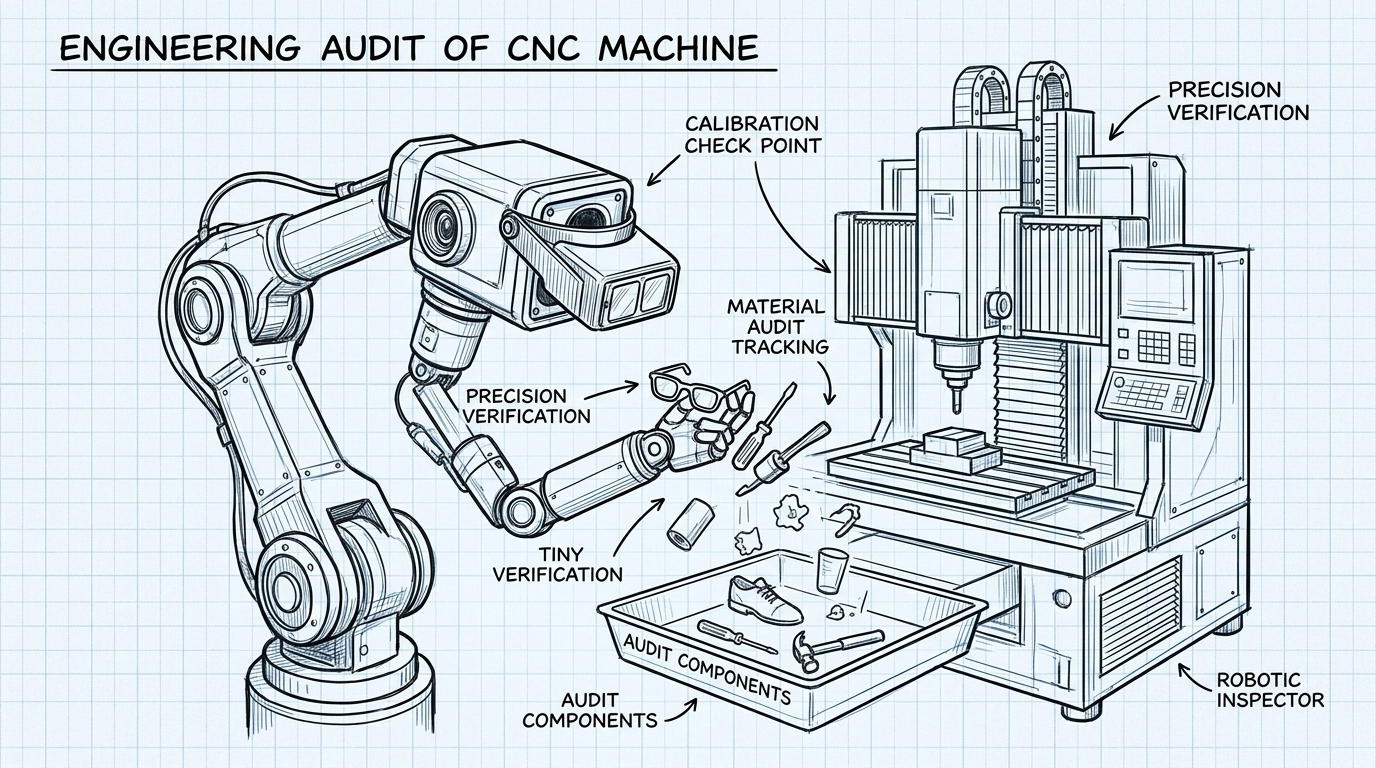
As a mechanical engineer by trade, I look at systems. When a machine fails, it’s usually because one component was pushed past its tolerance. When a solopreneur fails, it’s because they’re trying to be a 24-component system with only one power source: themselves.
I recently decided to run a cold, hard audit on my own side business, Spokane Machine, using a custom AI tool I built. I wanted to see exactly how much of this “burden” was actually necessary, and how much of it was just friction that could be engineered away.
The Solopreneur Burden: Why You’re Actually Stuck
Most people starting a business think the hard part is the “work”: the machining, the writing, the designing. They’re wrong. The hard part is the management of the work.
As a solopreneur, you don’t get to pick which roles you fill. You fill all of them, or the business stops. If you don’t do the bookkeeping, the taxes fail. If you don’t do the SEO, the customers don’t find you. If you don’t do the fulfillment, the product stays on the shelf.

The problem is that we treat every task with the same level of reverence. We think we “need” to be the one to send the shipping confirmation or check the keyword rankings. We treat our time like an infinite resource until we hit a wall of burnout. I hit that wall, and as an engineer, my instinct wasn’t to “work harder”: it was to find the bottleneck.
The Framework: Decomposing the Machine
To run this audit, I used the Hormozi AI Implementation Framework. If you aren’t familiar with Alex Hormozi’s approach to scaling, it’s deeply logical. It’s about breaking a business down into its smallest possible units so you can see where the value is actually created.
The framework works in four stages:
- Roles: Who does the work? (e.g., SEO Specialist)
- Tasks: What high-level outcomes do they produce? (e.g., Keyword Monitoring)
- Actions: What specific, individual steps are taken? (e.g., Log into dashboard, export CSV, compare to last week’s rankings)
- Score: How automatable is each action on a scale of 0–100?
Most people skip straight to “I’ll use AI to write a blog post.” That’s amateur hour. True efficiency comes from identifying the hundreds of tiny, invisible actions that eat 5 minutes here and 10 minutes there.
The Tool: The AI Workflow Decomposer
I didn’t want to do this by hand: that would defeat the purpose. I built a tool called the AI Workflow Decomposer.
The logic is simple: I feed it the blueprint of my business: Spokane Machine: which involves manufacturing physical CNC products, running an e-commerce store, and managing a content brand. The AI then walks through the Hormozi framework, identifies every role required to keep that specific engine running, and breaks every role into its component actions.
It doesn’t just give you a “to-do list.” It gives you a map of your own cognitive load.

The Findings: Cold, Hard Data
When I ran Spokane Machine through the Decomposer, the results were a wake-up call, even for someone who likes systems as much as I do.
The tool identified 24 roles and mapped a staggering 561 total actions across those roles. Here is how the scoring broke down:
- 315 actions (56%) were flagged as Fully Automatable. These are things AI can handle without a human even looking at them.
- 211 actions (38%) were AI-Assisted. AI does the heavy lifting, but I need to provide the final “yes” or the creative spark.
- 35 actions (6%) were Human Required. These are the tasks where my specific hands or my specific judgment are non-negotiable.
The bottom line: Roughly 75% of the operational effort in my business could be reduced or eliminated through AI implementation.
If you’re a W-2 professional trying to build freedom income, that 75% is the difference between a side hustle that dies in six months and a business that actually scales.
Quick Wins: The Tasks Eating Your Life
When I looked at the highest-scoring actions (those 95–100 out of 100), a very clear pattern emerged. They weren’t “creative” or “strategic.” They were administrative, repetitive, and data-driven.
Here are some of the “Quick Wins” my audit found:
- Monitor Keyword Ranking Positions (Score: 100): Why am I checking Google manually? A script can do this and alert me only if something drops.
- Send Order and Shipping Confirmations (Score: 99): Standard e-commerce fodder, yet many small shops still handle customer inquiries about “where is my stuff?” manually.
- Check Reorder Thresholds (Score: 98): Inventory management is pure math. AI knows when I’m low on aluminum stock before I do.
- Schedule Posts to Platforms (Score: 95): The “social media manager” role is almost entirely automatable once the content is created.
Notice something? None of these require judgment. None of them require a “soul.” They are just the tax you pay for being in business. If you’re paying that tax with your own hours, you’re overpaying. You can find more about these types of business tools here.
The Human Wall: Where AI Fails (And That’s a Good Thing)
As much as people like to hype the “AI takeover,” my audit showed exactly where the technology hits a brick wall. These are the actions that scored near zero (3–10 out of 100):
- Perform Manual Lathe Operations (Score: 3)
- Setup Workholding and Fixtures (Score: 5)
- Pick and Package Products (Score: 8)

The machines require a human. The craft requires a human. The physical act of turning a piece of raw metal into a finished product is my “Human Wall.”
As a Shy Entrepreneur, your goal isn’t to replace yourself entirely. It’s to use AI to protect your time so you can only do the things behind the Human Wall. For me, that’s machining and high-level strategy. Everything else is just noise.
The Real Reason Solopreneurs Fail
A solopreneur doesn’t fail because they are a bad machinist or a poor designer. They fail because they get buried in the 315 automatable tasks.
They spend their Saturday mornings updating tracking numbers and their Tuesday nights worrying about SEO rankings. By the time they get to the “actual work”: the thing that generates value: they are exhausted. They have no “throughput” left. (If you want to dive deeper into this, check out my posts on the Theory of Constraints).
The analysis showed that over half of my business’s actions don’t need me. They just need a system. If you are struggling to get your side business off the ground, I can almost guarantee it’s because you are filling roles that an AI script could do for $20 a month.
What This Means for You
You don’t need to be a mechanical engineer or an AI developer to apply this logic. You just need to be a pragmatic realist.
Whether you’re currently in a 9-to-5 or you’ve already started your transition into entrepreneurship, you need to perform your own mental audit.
- List your roles. Are you the bookkeeper today? The janitor? The marketer?
- Identify the Human Wall. What is the one thing only you can do that actually moves the needle?
- Audit the rest. Every task that isn’t behind that wall is a candidate for automation.

Entrepreneurship is a marathon, not a sprint. You can’t run a marathon carrying 24 different backpacks. Put the 21 backpacks of administrative weight down, let the AI carry them, and focus on the path ahead.
The rewards of persistence and strategic planning are there: but only if you have the discipline to stop doing work that doesn’t require a human.
What are the 315 tasks in your business that don’t need you? It’s time to find out.
Happy Easter, everyone.