
Every business has a conflict that won’t resolve. You keep investing in marketing, but cash is tight, so you pull back, so growth stalls, so you invest again. You know you need to hire, but you can’t afford to until revenue grows, and revenue won’t grow until you hire. These aren’t bad decisions. They’re conflict clouds: two legitimate needs pulling toward the same goal through mutually exclusive actions. The Theory of Constraints gives you a tool to stop arguing about which side wins and start finding the injection that eliminates the conflict entirely.
Conflict Clouds, also known as Evaporating Clouds, are a conflict resolution tool used in the theory of constraints (TOC) to maintain the logical integrity of two mutually exclusive events and their existence for a common goal. The premise of a conflict cloud is that conflicts exist because two events that cannot exist at the same time are working against each other to achieve the same end. The conflict exists in the prerequisites, which are needed for the requirements, which ultimately lead to the objective.
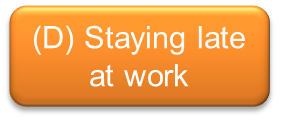
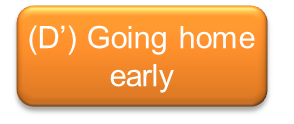
As you will see, conflict clouds illustrate the logical argument for the existence of a conflict and can be used as the seed for the rest of the TOC thinking process. To begin, we need to find two mutually exclusive events. For this example I will use (D) Staying late at work and (Not D) Going home early.
Identify the Conflict
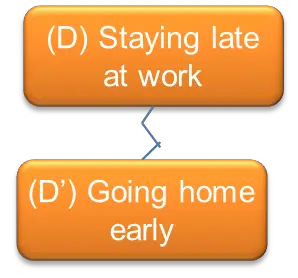
These two events cannot exist at the same time, so a conflict may arise. This conflict may exist if say I need to get some additional work finished up at the office but my wife wants me to come home. The elements are referred to as node D, denoted by D, and node Not D, denoted by D’. It is possible to stay at work and it is possible to go home early, but it is not possible to stay late at work and go home early. Formally, the D nodes are considered to be the prerequisites. We would lay the conflict out as follows.
Identify Requirements
Now let’s take a look at the requirements. The requirements are the nodes that create the need for the prerequisites. In our example the requirement for staying late at work may be to make some extra money, and the requirement for going home early may be to spend time with the family. The requirement for prerequisite D is node B, and the requirement for prerequisite D’ is node C.
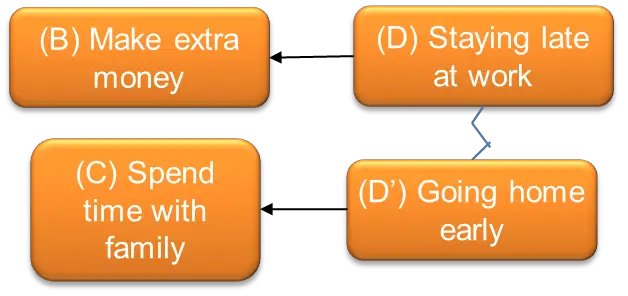
We could read the cloud as follows:
“There is pressure to stay at work late in order to make some extra money, and to make some extra money I must stay at work late. There is also pressure to go home early in order to spend time with my family, and to spend time with my family I must go home early.”
Reading the arguments aloud will help to determine the logical validity of the statements. Are D and D’ truly prerequisites to B and C? Does D’ put B into jeopardy, and does D put C into jeopardy? In other words, will (D) Staying late at work allow me to (C) spend time with my family? No. Will (D’) going home early allow me to (B) make extra money? No. It looks like we have a logically valid conflict.
The Goal
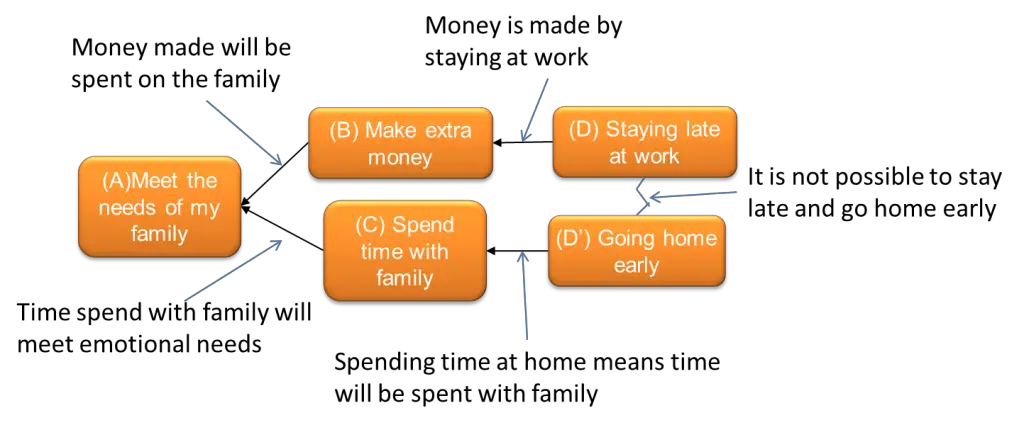
Now that we see that the connections are valid, one might ask again why the conflict exists. The conflict exists because both instances are working for the same goal. In this case, the conflict would exist inside me, and the common goal to each course of action would be meeting the needs of my family. Extra money would help meet the monetary needs of the family, while time spent with them would meet the emotional needs of the family. So, the final node is node A, which represents the objective or goal of each argument.
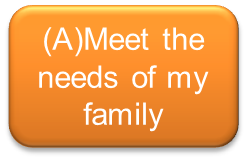
The complete cloud is illustrated below.

You can see how there is pressure from both sides of the cloud for two mutually exclusive events, yet both are needed for the final objective. The idea in a conflict cloud is to evaporate the conflict so the end goal can be achieved. Evaporating the cloud is achieved by introducing an injection that can meet the need of each side of the cloud to produce a win-win situation.
Finding an Injection
Finding an injection comes from challenging the assumptions that link each node. Each of the arrows represents a seemingly logical relationship, but each of the relationships may be subject to scrutiny. With our example, a few assumptions that have been made are:
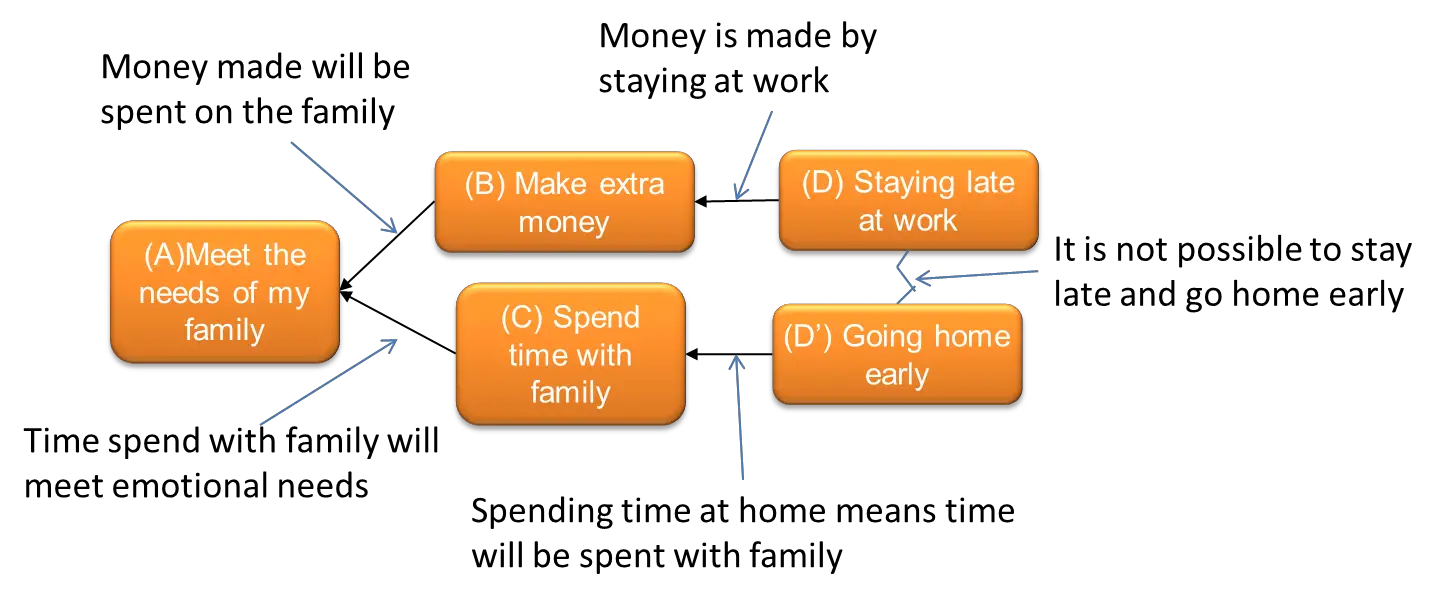
Challenging these assumptions can lead to an injection that will evaporate the cloud. A few possible solutions in this case may be to work from home, spend the money I already have on the family, or bring my family with me to work. Remember, the idea is to create a solution that will allow for the family’s needs to be met.
There may be many assumptions between each node, and in conducting a full thinking process it is not uncommon to note 5 or more assumptions at each junction in hopes of finding one to challenge. Many times simply thinking through your conflict to this extent will reveal a solution that you had not thought of before.
A practical solution in the example provided may be to go home early today (Friday) and come in early on Monday to make up the lost time. Such a solution would allow for time to be spent with family and additional time to be invested into work for the sake of financial compensation.

Cloud evaporated!
For those who want to read more, there is a good write-up on wikipedia here.
A Business Example: The Hiring Conflict
The work-late/go-home example illustrates the structure. Here is how a conflict cloud looks in a real business context.
Imagine you run a small operation and you are at capacity. You cannot take on more clients without more help. But you cannot afford to hire without more revenue. The cloud looks like this:
Objective (A): Grow the business sustainably.
Requirement B: Increase revenue.
Prerequisite D: Take on more clients.
Requirement C: Control costs.
Prerequisite D-prime: Do not hire until revenue supports it.
D and D-prime are in direct conflict. You cannot take on more clients without help, and you cannot justify help without more clients.
Now challenge the assumptions:
- Assumption behind D: “More clients requires more full-time staff.” Is that true? Maybe a part-time contractor bridges the gap without a full salary commitment.
- Assumption behind D-prime: “Hiring costs money before it earns money.” Is that always true? A commission-only referral arrangement flips that equation.
- Assumption behind B: “Revenue growth requires new clients.” Could revenue grow from existing clients through upsell, retainer conversion, or price adjustment?
Each challenged assumption is a potential injection. The conflict cloud does not tell you which injection to use. It tells you where to look.
When to Use a Conflict Cloud
Conflict clouds are most useful when a decision keeps coming back. If you have resolved something three times and the problem resurfaces, there is likely an unexamined assumption underneath it. That assumption is keeping the conflict alive.
They are also useful before making a major investment. If you are about to spend money or time on one side of a conflict, map the cloud first. Make sure you are not about to eliminate one pressure only to have the other pressure grow stronger.
The tool takes 20 minutes to apply properly. Most business conflicts that feel like personality or priority disputes are actually assumption conflicts that nobody has named yet. The cloud names them.
Pingback: The Thinking Process
Pingback: The Theory of Constraints
Pingback: Conflict Management Strategies Used In The Workplace