
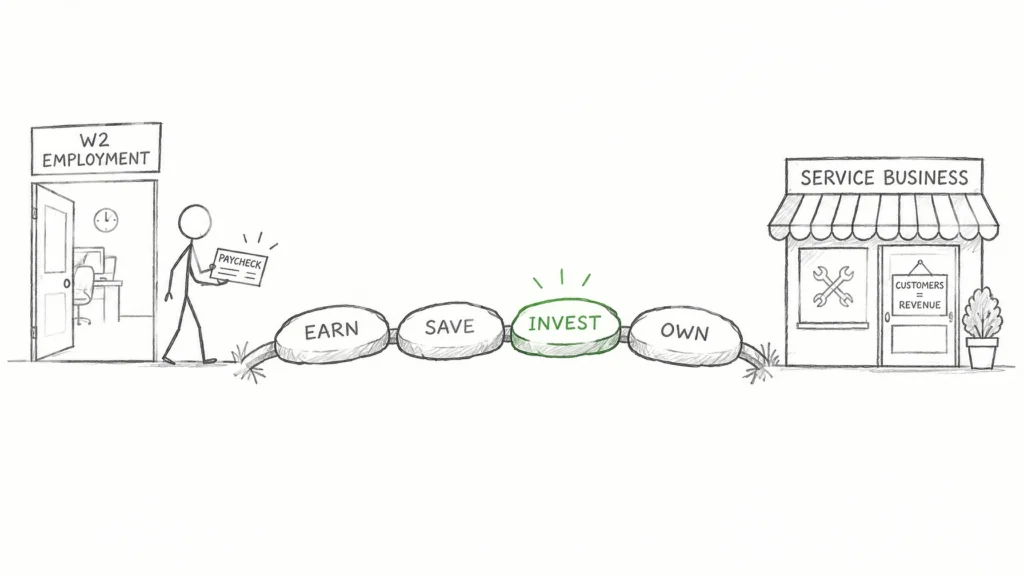
A paycheck can fund your lifestyle, or it can fund your escape.
That choice begins with a mental shift: stop viewing your W-2 income only as money for consumption. Treat it as capital that can purchase skills, systems, business capacity, and income-producing assets.
This is the purpose of the Earn to Invest stage in ShyEntrepreneur’s four-piece framework:
- Earn to Spend
- Earn to Save
- Earn to Invest
- Invest to Earn
The first stage keeps your household operating. The second creates financial margin. The third gives that margin a job. The fourth is where your assets begin producing income with less dependence on your personal hours.
The transition from employee to entrepreneur becomes far less reckless when you understand this sequence. You do not need to abandon your income source, make a dramatic announcement, or gamble your household’s stability. You need a repeatable system for turning earned income into ownership.
Earn to Invest Requires a New Relationship With Money
Many professionals earn, spend, and repeat the cycle. Their income enters one side of the financial system and exits through rent, food, transportation, subscriptions, debt payments, and lifestyle upgrades.
That pattern may be necessary at first. It becomes limiting when every raise simply creates room for more spending.
Earn to Invest asks a different question:
What portion of today’s income can improve my future earning capacity?
That portion may fund:
- Training that helps you deliver a valuable service
- Software that reduces manual work
- Equipment that supports a small operation
- A marketing experiment
- A contractor who increases delivery capacity
- A business asset with the potential to generate future cash flow
- Carefully selected financial investments
The key is intentionality. Do not deploy money because you are excited about a new idea. Deploy it because the investment has a defined purpose, a measurable outcome, and a tolerable downside.
Your Earn to Save plan creates the buffer that makes this possible. Savings gives you room to test ideas without forcing every experiment to pay your bills immediately.
Step 1: Build the Financial Runway Before You Invest
Before directing money toward a business or investment, examine the foundation beneath it.
Calculate your essential monthly expenses. Separate necessities from optional spending. Review debt obligations, insurance, taxes, and irregular costs that can disrupt your plan.
Think of cash flow as a bucket. If the bucket has holes, pouring in more water will not solve the problem. You must first identify and reduce the leaks.
Use your current income to create:
- A working emergency reserve
- A predictable monthly surplus
- A separate account for business experiments
- A clear limit for how much capital you can risk
- A personal budget that protects long-term goals
Do not confuse available credit with investable capital. Borrowed money can create urgency, and urgency weakens judgment. Your first investments should strengthen your position rather than make you dependent on immediate success.
The mental shift here is discipline over speed. You are building decision-making capacity before you build a business.
Step 2: Find the Intersection Between Skill, Demand, and Economics
A low risk entrepreneurship strategy begins with alignment.
Use the Hedgehog Concept to examine three overlapping questions:
- What work can you become unusually good at?
- What type of work can you care enough about to practice consistently?
- What economic engine can produce worthwhile profit?
The third question matters. A business can be interesting and still be financially weak. You need to understand how the offer creates revenue, how much it costs to deliver, and whether the economics improve with experience.
Start with capabilities you already possess. Potential service based business ideas include:
- Technical consulting
- Bookkeeping or financial administration
- Operations improvement
- Process documentation
- Copywriting or content production
- Website maintenance
- Data cleanup and reporting
- Specialized training
- Customer onboarding
- Compliance or administrative support
A service business often allows you to begin with limited overhead because the first asset is your knowledge and ability to solve a specific problem.
Do not choose a broad label such as “consulting.” Define a customer, a problem, and an outcome.
For example:
- Customer: small manufacturers
- Problem: inconsistent work instructions
- Outcome: a documented process that new employees can follow
Specificity makes testing possible.

Step 3: Use Lean Startup Principles to Make Small Bets
The Lean Startup method gives you a practical way to reduce uncertainty.
Begin with an MVP, or minimum viable product. In a service business, the MVP may be a simple package rather than a piece of software.
Create:
- One defined service
- One target customer
- One price or pricing method
- One delivery process
- One measurable result
Then speak with potential customers. Ask about their current process, costs, frustrations, and previous attempts to solve the problem. Listen for evidence of demand rather than collecting compliments.
A compliment is not validation. A paid pilot, signed agreement, referral, or serious buying conversation provides stronger evidence.
Track a small set of measures:
- Number of qualified conversations
- Proposals sent
- Proposals accepted
- Time required to deliver
- Direct costs
- Customer feedback
- Repeat or referral potential
Do not spend heavily on branding before you know whether the offer solves a real problem. Avoid purchasing equipment because it makes you feel like a business owner. Buy only what the next experiment requires.
[AUTHOR: insert a real example here about a small service experiment, its initial cost, what was learned, and what changed afterward.]
Step 4: Allocate Every Dollar With a Purpose
Earn to Invest does not mean sending all surplus cash toward a single venture. It means assigning capital according to a deliberate hierarchy.
Create separate categories for:
- Protection: emergency reserves and essential obligations
- Capability: education, tools, certifications, or systems
- Validation: small experiments that test demand
- Growth: proven marketing, contractors, or capacity
- Ownership: assets and investments designed to produce future income
This structure prevents a common mistake: using growth money to solve personal emergencies or using emergency money to chase an exciting opportunity.
Review each potential investment with a simple decision filter:
- What problem does this money solve?
- What result should it produce?
- How will I measure that result?
- What is the maximum acceptable loss?
- What is the next decision point?
- Can I stop without creating a larger obligation?
A purchase should earn its place in the system.
Read the companion guide on buying assets that make you money before committing capital to equipment, software, property, or a business opportunity. Ownership alone does not make something an asset. The asset must contribute to cash flow, capability, or equity in a meaningful way.
Step 5: Find the Bottleneck With the Theory of Constraints
As your service business develops, you will encounter limits. You may lack leads, sales confidence, delivery capacity, pricing power, or cash.
The Theory of Constraints gives you a disciplined way to respond:
Identify the constraint
Ask: “What single limitation is currently restricting the entire system?”
If you have no qualified leads, redesigning your delivery process will not create revenue. If you are fully booked, increasing outreach may create a delivery crisis.
Exploit the constraint
Improve the bottleneck using resources already available.
For a lead problem, clarify the offer and contact a more specific audience. For a delivery problem, create templates, standardize steps, and remove unnecessary customization.
Subordinate other activities
Stop giving equal attention to every task. A new logo, a larger software stack, and a complicated website may feel productive while the real constraint remains untouched.
Elevate the constraint
Only after improving the existing process should you add resources. Hire support, increase marketing, purchase equipment, or redesign pricing when the evidence supports that move.
Repeat the process
Once one constraint improves, another will surface. Business growth is a sequence of bottleneck decisions, not one permanent solution.

Step 6: Convert Business Surplus Into Durable Assets
A service business can create income, but your long-term objective is greater ownership.
When revenue begins exceeding operating costs, resist the urge to immediately increase personal spending. Direct a portion of the surplus toward assets that improve resilience and future cash flow.
Examples may include:
- Documented operating procedures
- A repeatable service package
- A customer list and referral system
- Specialized equipment with reliable utilization
- Intellectual property
- A trained contractor network
- Retirement or investment accounts
- Real estate or other income-producing holdings, where appropriate
Separate operating assets from speculative purchases. A tool that reduces delivery time may have a clear business case. An expensive item purchased because you hope demand will appear requires more caution.
Measure return on investment through both money and time. A purchase that increases revenue but consumes all your attention may not improve your actual position.
Step 7: Create the Path From Earn to Invest to Invest to Earn
The final goal is a durable loop:
- Earn income.
- Protect a portion through saving.
- Invest in skills, systems, and assets.
- Generate business or investment returns.
- Reinvest a portion of those returns.
- Gradually reduce dependence on personal labor.

This process may take years. Entrepreneurship is a marathon, not a sprint, and the early stages often involve sacrifice, repetition, and uncomfortable learning.
Set review points rather than relying on emotion. Every month, examine your savings rate, business revenue, delivery time, profit, and asset purchases. Every quarter, decide whether to continue, modify, pause, or stop an experiment.
Your W-2 job can provide stability while you build judgment. Your service business can provide a practical laboratory for learning sales, operations, and financial management. Your assets can eventually provide income beyond your hours.
The mental shift is simple but demanding: direct earned money toward ownership before directing every increase toward consumption. Build slowly, validate with real customers, protect your downside, and let evidence determine your next move.
That is how you move from employee to entrepreneur without treating your livelihood like a lottery ticket.